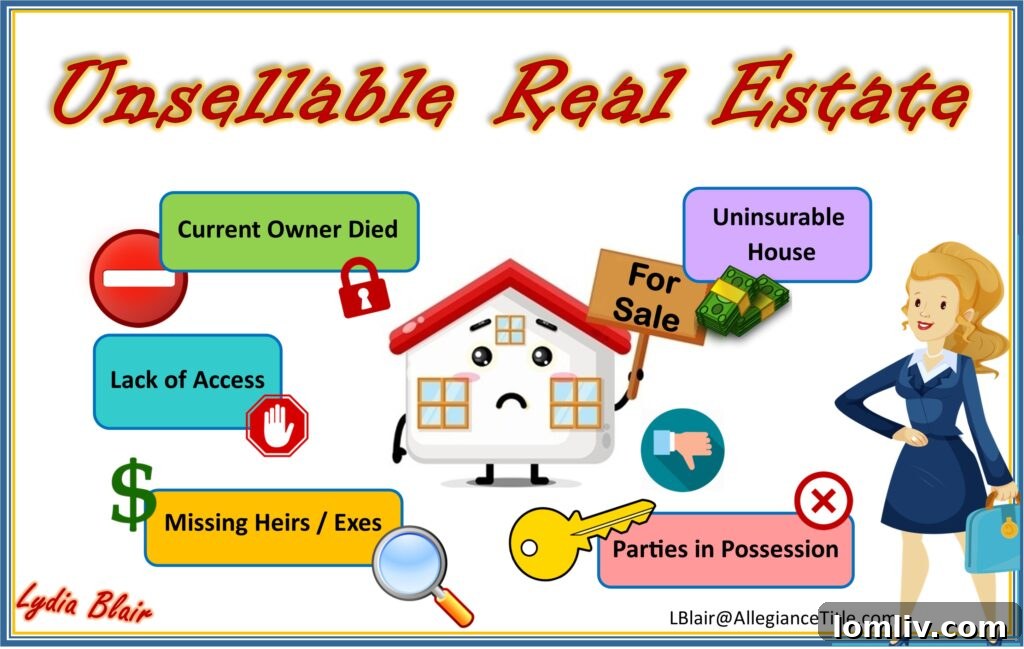
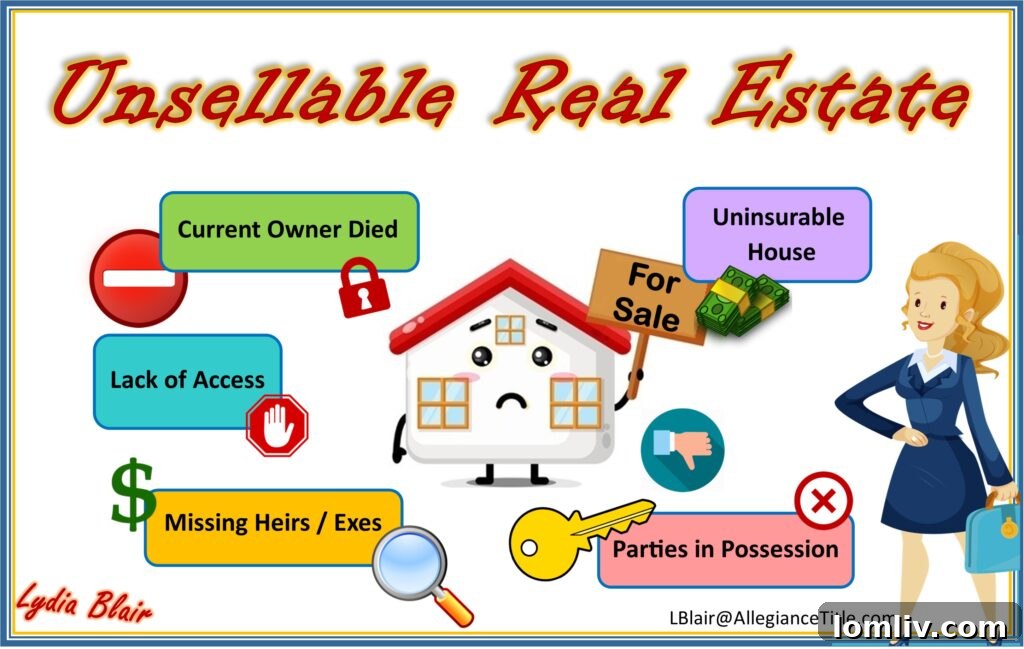
In the dynamic world of real estate, the term “unsellable” often conjures images of dilapidated houses or properties in undesirable locations. However, the truth is far more complex and legally nuanced. This article delves into the critical, often unseen issues that render a property truly unsellable – factors that have absolutely nothing to do with aesthetics or market desirability. We’re talking about fundamental legal impediments that prevent the lawful transfer of title and make securing vital title insurance an impossibility. Understanding these hurdles is crucial for anyone involved in a property transaction, whether as a buyer, seller, or real estate professional.
At its core, a legitimate real estate transaction hinges on the undisputed transfer of ownership. If an individual attempts to sell a property without holding valid legal title, the entire agreement is null and void. Imagine someone trying to sell you a landmark they don’t own; the transaction would lack any legal standing. Similarly, if a co-owner attempts to sell a shared asset without the knowledge or consent of all other legal owners, the buyer could inherit a monumental legal challenge, facing potential claims and disputes over ownership rights. These scenarios underscore the paramount importance of verifying legal ownership and ensuring all involved parties have the authority to transact.
When the Current Owner Has Died: Navigating Estate Challenges
One of the most common and complex scenarios leading to an unsellable property arises when the legal homeowner has passed away. Clearly, a deceased individual cannot sign a deed or participate in a property sale. When a homeowner dies, their interest in the property does not vanish but transitions from individual ownership to being part of their legal estate. The crucial challenge then becomes identifying who legally controls the estate and possesses the authority to sell the property. This process can be protracted and fraught with complications, particularly if there are multiple heirs or disputes among them.
If the deceased left behind a valid will, the heirs can initiate the probate process. Probate is the legal procedure through which a will is proved valid in court, and the deceased’s assets are distributed according to their wishes. While a will outlines the deceased’s intentions for their property, it does not automatically transfer ownership. The property must legally pass to the designated beneficiaries or an appointed executor through the probate court’s decree before it can be sold. The timeline for probate can vary significantly depending on the state, the complexity of the estate, and whether any challenges arise, often taking many months, if not years, to finalize.
In cases where the owner died without a will (intestate) or if the will was never formally probated, an Affidavit of Heirship might be utilized. This detailed legal document identifies all legal heirs based on the laws of intestacy for the relevant jurisdiction. It requires meticulous completion, often involving affidavits from disinterested parties who can attest to the family history, and must be thoroughly reviewed and approved by the title company. Establishing undisputed heirship can be particularly challenging when family trees are complex, records are incomplete, or distant relatives need to be identified. Until the rightful heirs are definitively established, agree on the sale, and the necessary documents are filed and recorded in county records, the property remains in a legal limbo, making it effectively unsellable.
The core issue here revolves around establishing clear, undisputed ownership and ensuring all parties with a legal claim are identified and in agreement. Until these questions are resolved, the property cannot be legally transferred, making any sale impossible and precluding the issuance of title insurance, which protects buyers and lenders from future claims against the property’s title.
The Challenge of Missing Heirs or Uncooperative Ex-Spouses
A property transaction requires the consent and signature of every individual or entity holding an ownership interest. Surprisingly, identifying and securing the cooperation of all such parties can be incredibly difficult, sometimes even impossible. Title companies are inherently risk-averse; they will typically refuse to insure a title if there’s any perceived risk that an estranged heir, an overlooked ex-spouse, or any other individual with a legitimate ownership claim could emerge post-sale to contest the transaction. Such a challenge could invalidate the sale, create costly legal battles, and leave the title company liable.
This problem is frequently encountered when a property owner passes away without a probated will to clearly delineate asset distribution. For instance, a surviving spouse might legally own half of a property, while the other half is divided among the deceased’s adult children. If one of those children has also passed away, their portion might then be further divided among their own children, creating a convoluted web of fractional ownership. Locating all these individuals, some of whom may be estranged, living abroad, or even unaware of their inheritance, presents a significant logistical and legal challenge. Private investigators, extensive record searches, and even court-ordered publication notices may be necessary, all contributing to delays and costs.
The situation becomes even more contentious with uncooperative ex-spouses. Divorce proceedings, particularly bitter ones, can leave lingering disputes over property division. Even if a divorce decree dictates the sale of a property, compelling an unwilling ex-spouse to sign the necessary documents can be an uphill battle. They might leverage their refusal as a bargaining chip for other aspects of the divorce settlement or simply out of spite. In such cases, legal action, such as a quiet title action, may be required to force the sale or clarify ownership, but these are lengthy and expensive judicial processes that few buyers or sellers are eager to undertake.
Parties in Physical Possession: Occupancy Rights
Beyond legal ownership, the physical occupancy of a property can also render it unsellable. A person occupying a property may have a legal right to possession, even if they are not the title owner. Common examples include tenants with valid lease agreements, a surviving spouse exercising homestead rights, or even family members with unrecorded agreements. A new owner cannot simply evict these individuals without adhering to specific legal processes, which can be time-consuming and costly.
Perhaps the most challenging scenario involves a surviving spouse’s homestead rights. In many jurisdictions, a surviving spouse has the legal right to continue occupying the marital home (homestead property) for the remainder of their life, regardless of who inherits the property. This right often supersedes the interests of other heirs. For a buyer, purchasing a property with a legal occupant who has no obligation to vacate or pay rent for an indefinite period is highly undesirable and typically unfinanceable. Few lenders would approve a mortgage for a property where the buyer cannot take immediate, full possession.
Even squatters, individuals occupying a property without legal right, can present a significant hurdle. Depending on local laws, squatters may acquire certain rights after a period of unchallenged occupancy, potentially requiring a formal eviction process that can be both complex and expensive to remove them. Buyers generally seek clear possession at closing, and the presence of any unauthorized occupant introduces substantial risk and uncertainty, making the property unattractive and difficult to sell.
Home Insurance Issues: An Uninsurable Property
An uninsurable home poses a significant barrier to sale, especially in the vast majority of transactions involving mortgage financing. Mortgage lenders require borrowers to maintain comprehensive property insurance to protect their investment (the loan collateral). Without adequate insurance coverage, a lender will simply refuse to fund the purchase of a home. This means that a property deemed “uninsurable” by insurance carriers is essentially unsellable to most prospective buyers.
What makes a home uninsurable? Several factors can lead to this designation. Major structural defects such as severe foundation problems, extensive roof damage, or evidence of significant fire or storm damage can make a property too risky for insurers. Beyond physical damage, homes located in high-risk zones (e.g., severe floodplains, active earthquake zones, areas prone to wildfires with insufficient mitigation) may also be difficult or impossible to insure through standard policies. Furthermore, a property with a history of numerous past claims, hazardous materials (like asbestos or lead paint that hasn’t been properly remediated), or persistent pest infestations (e.g., termites causing structural damage) can also deter insurers.
While an uninsurable property might attract cash buyers who do not require a mortgage, even these buyers face substantial risks. They would be assuming full financial responsibility for any future damage or loss without the safety net of insurance, a decision that few are willing to make without a significant discount in price reflecting the inherent risk. For most sellers, this severely limits the potential buyer pool and often leads to the property remaining on the market indefinitely until the issues are remedied and the property can be insured.
Lack of Legal Access: The Landlocked Property Dilemma
A property’s marketability and value are profoundly affected by its accessibility. A “landlocked” parcel, meaning a piece of land that has no direct legal access to a public road, presents a major obstacle to sale. This situation often arises when a larger tract of land is subdivided, and one of the resulting parcels is left without a dedicated right-of-way or easement for ingress and egress. For a property to be considered truly sellable, especially to a buyer requiring financing, clear and legal access to a public thoroughfare is paramount.
Both buyers and their lenders will scrutinize the property’s access. Lenders typically require documented and legally recognized access to protect their investment; they will not issue a loan for a property if access is uncertain or relies solely on informal agreements. Without a recorded easement or a public right-of-way, a buyer has no legal guarantee that they can continuously access their land. Relying on a neighbor’s goodwill for access is precarious and unsustainable in the eyes of legal and financial institutions.
Establishing legal access for a landlocked property can be a complex and often contentious process. It might involve negotiating with neighboring landowners to purchase an easement, which is a legal right to use another’s land for a specific purpose (like passage). If negotiations fail, a lawsuit may be necessary to obtain an easement by necessity or prescription, processes that are lengthy, costly, and have uncertain outcomes. Until such legal access is formally granted, recorded, and approved by a title company, the property remains significantly devalued and largely unsellable to the broader market.
Ultimately, these critical issues underscore the foundational importance of clear title and legal soundness in real estate transactions. A title company’s primary role is to ensure that a property’s title is free and clear of any encumbrances, disputes, or legal defects that could jeopardize ownership. Without the ability to issue title insurance – a policy that protects both the buyer and the lender from losses arising from title defects – mortgage lenders will not approve loans, and savvy buyers will avoid the purchase. When confronted with any of these challenging scenarios, proactive engagement with an experienced real estate attorney and title professionals is absolutely essential to navigate the complexities and potentially resolve the issues, transforming an unsellable property into a viable asset.
The opinions expressed are solely those of the individual author for informational purposes only and do not constitute legal advice. It is recommended to consult with qualified legal professionals for specific guidance.