Unlocking Homeownership: How Much Home Can $200,000 Really Buy?
The dream of homeownership is a universal aspiration, yet the path to achieving it often comes with a significant challenge: budget. In today’s dynamic real estate market, a $200,000 budget can evoke wildly different possibilities depending on where you choose to lay down roots. For some, it might represent a down payment on a luxurious property, while for others, it could be the entire budget for a starter home. This detailed guide explores the varying purchasing power of $200,000 across the United States, highlighting the stark contrasts and uncovering where your money truly goes further.
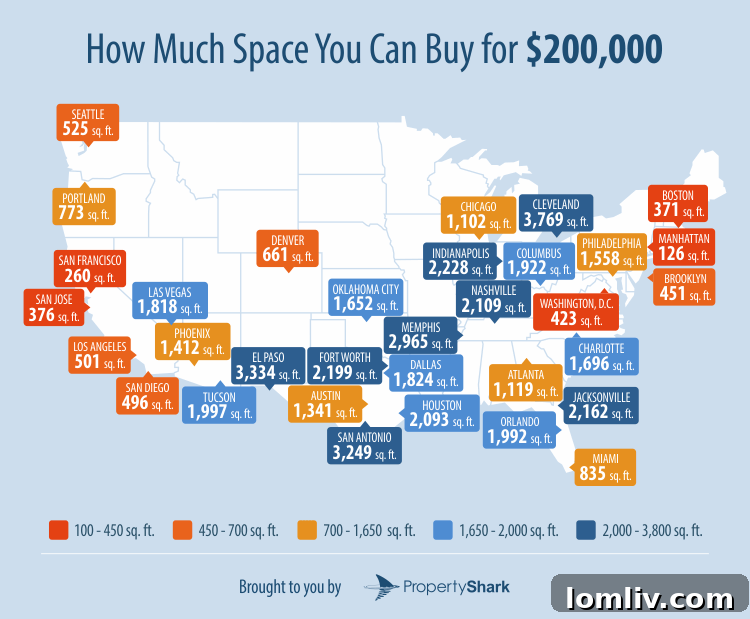
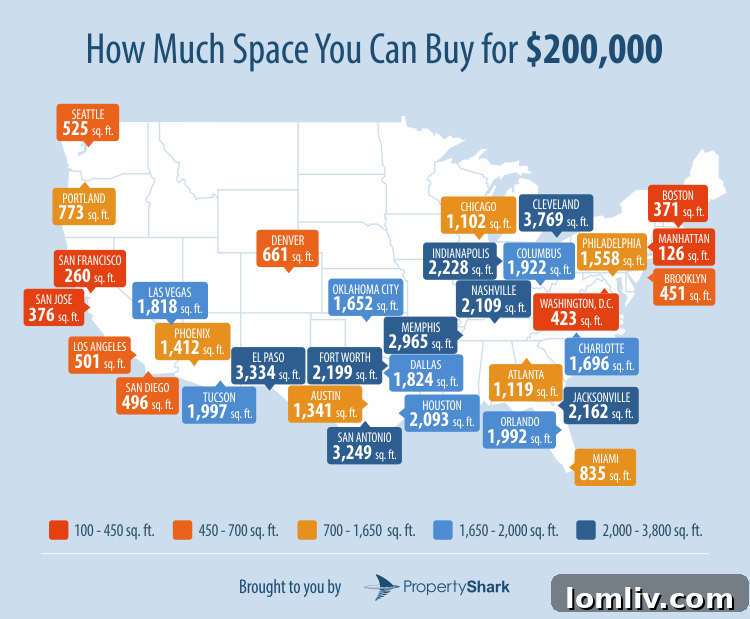
It’s no secret that $200,000 will barely get your foot in the door in some of the nation’s most expensive urban centers. Consider Manhattan, New York, a city synonymous with sky-high real estate values. A recent, eye-opening analysis by PropertyShark revealed that a $200,000 budget in this iconic borough would secure a mere 126 square feet of living space. To put that into perspective, 126 square feet is roughly half the size of an average one-car garage, offering extremely limited room for comfortable living. Such a minimal footprint often translates to a micro-apartment, a studio, or even just a fraction of a larger unit, underscoring the immense premium placed on location in prime metropolitan areas.
Robert Demeter from PropertyShark, reflecting on these findings, noted, “While the results were indeed astonishing, we didn’t think there would be such a huge discrepancy between the most expensive and least expensive cities.” This observation encapsulates the dramatic divide in real estate affordability across the country. The value of $200,000 isn’t just a matter of regional preference; it’s a reflection of intricate economic factors, population density, job market strength, and the supply-demand dynamics unique to each housing market.
The Urban Divide: Why Location Dictates Value
The vast disparity in home prices for a $200,000 budget isn’t arbitrary. High-profile cities like Manhattan are characterized by extremely limited land availability, robust economies that attract a constant influx of residents, and a concentration of high-paying jobs. These factors drive up demand exponentially, pushing property values to extraordinary levels. In such markets, a $200,000 budget might cover only the cost of parking, or a very small portion of a property, making traditional homeownership largely unattainable for many within this price range.
Buyers looking for a traditional single-family home or even a spacious condo in these highly sought-after areas often need significantly deeper pockets, typically running into the millions. This reality forces many aspiring homeowners to either compromise drastically on space or look for opportunities in more affordable regions. Understanding this geographical lottery is the first step in strategic home buying, especially when working with a specific budget like $200,000.
Finding Your Bang for the Buck: The Texas Advantage
Fortunately, the story takes a dramatically different turn if you are willing to explore further south, particularly within the vast and economically diverse state of Texas. Here, the $200,000 budget can offer substantial value, providing significantly more space and property for your investment. Texas has long been a magnet for those seeking affordability, a lower cost of living, and a thriving job market, all of which contribute to a more favorable real estate landscape for budget-conscious buyers.
Many local real estate platforms, such as our affiliate Daltxrealestate.com, regularly showcase incredible properties available for around $200,000 in the Dallas area through their “Tuesday Two Hundred” series. These examples ably demonstrate that a substantial and comfortable home is well within reach, a stark contrast to the cramped quarters offered in cities like Manhattan.
Across the state, the square footage you can acquire for $200,000 varies, yet consistently offers considerable value. Let’s break down what $200,000 can get you in some of Texas’s major metropolitan areas:
- San Antonio: Topping the list for affordability and space, San Antonio offers an impressive average of approximately 3,249 square feet for $200,000. This generous amount of space often translates into a spacious single-family home in a family-friendly neighborhood, potentially with multiple bedrooms, bathrooms, and a decent-sized yard. San Antonio’s rich history, cultural attractions, and growing economy make it an attractive option for those prioritizing space and community.
- Fort Worth: Not far behind, Fort Worth provides around 2,199 square feet for the same budget. Known for its unique blend of Western heritage and modern urban amenities, Fort Worth offers a vibrant lifestyle. A 2,199 sq ft home in Fort Worth could mean a charming suburban house, perhaps one that’s slightly older but well-maintained, or a newer build in an outlying community, providing ample room for families or those seeking more space.
- Houston: As one of the largest cities in the U.S., Houston is surprisingly affordable for its size, offering about 2,093 square feet for $200,000. Its diverse economy, from energy to healthcare, attracts a wide range of residents. This budget could secure a comfortable home in many of Houston’s expansive suburban areas, or a townhouse closer to the city center, making it an excellent choice for those who value both space and urban opportunities.
- Dallas: In the bustling heart of North Texas, Dallas comes in at around 1,824 square feet for $200,000. While slightly less than its counterparts, 1,824 sq ft is still a very respectable size, offering plenty of room for comfortable living. Buyers might find well-appointed homes in established neighborhoods on the periphery of the city or in adjacent suburbs, reflecting Dallas’s dynamic growth and metropolitan appeal.
- Austin: Bringing up the rear among the listed Texas cities, Austin offers approximately 1,341 square feet for $200,000. While this is less than other Texas cities, it still represents a significantly larger property than what one might find in ultra-expensive markets like Manhattan. Austin’s booming tech industry, vibrant cultural scene, and high demand have driven prices up, but opportunities still exist, perhaps in slightly older homes or those requiring some updates, particularly in neighborhoods a bit further from the city’s core.
Strategic Home Buying: Space vs. Location
The data unequivocally shows that a $200,000 budget necessitates a strategic decision: are you prioritizing space, or location? As PropertyShark’s Robert Demeter aptly summarizes, “Looking at the data, it’s safe to say that if you’re in the market to buy a home this year, chances are that you’ll need to come up with a lot more than just the U.S. median price to buy a spacious home in one of the country’s high-profile cities, or a lot less, if you chose a more affordable city. Either way, one thing is for sure, you’ll sacrifice either space or location to stay within this budget.”
This insight is crucial for any prospective homeowner operating with a $200,000 budget. It emphasizes the need for flexibility and a clear understanding of what trade-offs you are willing to make. For instance, a buyer might choose to live further from a city center to gain more square footage and a larger lot, accepting a longer commute. Conversely, someone prioritizing a prime location might opt for a smaller property, perhaps a condo or townhouse, to stay within budget.
Factors Influencing Your $200,000 Home Purchase
Beyond geographical location, several other factors play a significant role in determining what kind of home $200,000 can buy:
- Property Type: Single-family homes typically offer more land but might be older. Townhouses or condos can be more affordable in desirable areas but come with HOA fees and shared walls.
- Age and Condition: A $200,000 home might be an older property that requires renovations or updates, offering a chance to build equity through sweat equity. Newer homes in this range might be smaller or located further out.
- Local Economy and Job Market: Areas with robust job growth and thriving economies tend to have higher home prices due to increased demand. Conversely, regions experiencing slower growth might offer more affordable options.
- Amenities and Neighborhood Features: Proximity to good schools, parks, shopping, and public transportation can significantly impact property values, even within the same city.
- Property Taxes and Insurance: These ongoing costs can vary dramatically by location and should be factored into the overall affordability of a home.
Tips for Buyers with a $200,000 Budget
Navigating the real estate market with a $200,000 budget requires careful planning and a strategic approach. Here are some tips to maximize your purchasing power:
- Define Your Priorities: Clearly identify what is most important to you: space, location, school district, property type, or condition. Being clear on your non-negotiables will streamline your search.
- Research Extensively: Look beyond the headline numbers. Dive into specific neighborhoods, property types, and local market trends within your target cities. Online resources, local real estate blogs, and community forums can provide invaluable insights.
- Work with a Local Expert: A knowledgeable real estate agent specializing in affordable housing in your desired area can be a game-changer. They can uncover hidden gems, provide insights into market conditions, and guide you through negotiations.
- Be Flexible: Consider properties that might need minor cosmetic updates. A fresh coat of paint, new flooring, or updated fixtures can significantly enhance a home’s value and appeal without breaking the bank.
- Factor in All Costs: Remember that the purchase price is just one component. Account for closing costs, potential renovation expenses, property taxes, home insurance, and any applicable HOA fees when calculating your total budget.
- Explore Emerging Markets: While major cities are often highlighted, many smaller towns and suburban areas surrounding them offer excellent value and growing communities.
Conclusion: Your Homeownership Journey on a Budget
The journey to homeownership with a $200,000 budget is one of contrasts and careful consideration. While it may not secure a sprawling estate in a global metropolis, it absolutely can unlock the door to comfortable living and significant equity building in numerous vibrant communities across the United States. The key lies in understanding market dynamics, being realistic about trade-offs between space and location, and conducting thorough research. By embracing flexibility and leveraging expert advice, aspiring homeowners can transform their $200,000 budget into a meaningful investment and a place they can proudly call home.