

Unlock Significant Savings: The Strategic Benefits of Downsizing in Dallas-Fort Worth
Life transitions often prompt us to re-evaluate our living situations, and for many, the decision to downsize becomes a compelling option. Whether the children have flown the nest for college or started independent lives, or retirement beckons, the “empty nester” phase frequently ushers in a new perspective on homeownership. While large family homes hold cherished memories, they also carry significant financial and practical responsibilities that a smaller, more efficient residence can alleviate.
The Empty Nester’s Dilemma: Dreams vs. Dollars
Upon realizing that extra bedrooms now stand vacant, many homeowners begin to fantasize about repurposing these spaces. Imagine transforming a spare room into a state-of-the-art home theater, a dedicated professional office, an expansive sewing studio, or even a dream closet with a central island for meticulous organization. These aspirations paint a picture of luxurious extra space, tailored precisely to your evolving lifestyle.
However, the dream often collides with a stark financial reality. That property tax bill serves as an undeniable reminder that you’re continually paying for every square foot, whether it’s actively used or not. The desire to capitalize on years of accumulated home equity and free up capital for retirement, travel, or other investments becomes increasingly appealing. This leads to a critical question: Is the expense and effort of moving truly justified by the potential financial gains?
Unlocking Financial Freedom Through Strategic Downsizing
The financial incentives for downsizing extend far beyond just property taxes. A larger home typically translates into higher costs across several categories, all of which can be significantly reduced by moving to a smaller, more manageable property. Understanding these costs is crucial in assessing the true value of downsizing:
- Property Taxes: As property values rise, so do the taxes. A larger, more valuable home inevitably incurs a higher annual property tax burden, which can be a continuous drain on finances, especially for those on fixed incomes.
- Maintenance and Repairs: Big houses demand big maintenance budgets. From roof repairs and exterior painting to HVAC system upkeep and plumbing issues, the costs associated with maintaining a larger property can be substantial and unpredictable.
- Utility Bills: Heating, cooling, and lighting a spacious home consume considerably more energy. Downsizing directly translates into lower utility bills, offering ongoing monthly savings.
- Home Insurance: Insuring a larger, more valuable property often comes with higher premiums, adding another layer to the overall cost of homeownership.
By shedding these escalating expenses, homeowners can redirect funds toward retirement savings, debt reduction, or leisure activities, thereby enhancing their financial security and quality of life.
Harnessing Your Home Equity
One of the most compelling financial benefits of downsizing is the ability to unlock a significant portion of your home equity. Equity—the difference between your home’s market value and the amount you still owe on your mortgage—often represents a homeowner’s largest asset. By selling a larger, more expensive home and purchasing a smaller, less costly one, you can convert a substantial amount of this illiquid asset into usable cash. This capital can be instrumental in achieving various financial goals, such as paying off remaining debts, funding children’s or grandchildren’s education, or creating a robust retirement fund that offers peace of mind.
Dallas-Fort Worth-Arlington: A Prime Market for Downsizing Savings
According to a comprehensive study by STORAGECafé, an online platform specializing in storage unit listings, the financial benefits of downsizing vary significantly by location. Their analysis, which scrutinized the country’s 20 largest metropolitan areas, aimed to identify where homeowners stand to gain the most from a strategic downsize. The findings for the Dallas-Fort Worth-Arlington (DFW) metro area are particularly encouraging for those considering such a move.
The $190,000 Advantage in DFW
In the expansive Dallas-Fort Worth-Arlington metroplex, homeowners who transition from a four-bedroom residence to a more modest two-bedroom home can realize an impressive average overall savings of approximately $190,000. This substantial figure is derived from a meticulous calculation that considers several key financial components:
- Property Value Difference: The study notes that the average value for a four-bedroom home in DFW stands at roughly $400,000, while a two-bedroom equivalent averages around $201,000. This nearly 50% reduction in home value immediately frees up significant capital.
- Long-term Property Tax Savings: Beyond the initial sale, the report factored in the difference in property taxes over a 10-year period. A smaller, less valuable home consistently incurs lower annual property taxes, accumulating substantial savings over time.
- Reduced Closing Costs: Although both buying and selling involve closing costs, the net effect of moving from a higher-valued property to a lower-valued one, combined with subsequent lower tax assessments, contributes positively to the overall savings.
When these factors are combined, DFW earns its respectable 12th national ranking for potential downsizing savings, making it an attractive region for empty nesters and those seeking financial optimization.
Strategic Moves Within the Metroplex: Maximizing Your Savings
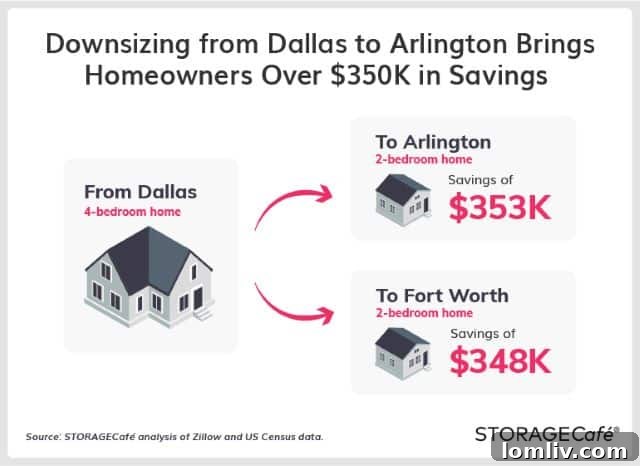
For those already residing within the Dallas-Fort Worth-Arlington market, the STORAGECafé study further identifies specific intracity moves that yield the most profitable outcomes. The data suggests that relocating strategically within the metroplex can enhance savings even further:
- Dallas-to-Arlington: Homeowners moving from Dallas to Arlington stand to gain the most, with an estimated $354,000 in savings. This significant difference can be attributed to a combination of property value disparities and potentially more favorable property tax rates or living costs in Arlington compared to central Dallas.
- Dallas-to-Fort Worth: A move from Dallas to Fort Worth also presents a compelling financial advantage, with estimated savings of $348,000. Fort Worth, while a major urban center, can offer a different market dynamic than Dallas, allowing for substantial equity release.
These specific routes highlight that understanding local market nuances is key to maximizing the financial benefits of downsizing, allowing homeowners to free up capital while remaining within the familiar and vibrant DFW region.
A National Perspective on Downsizing Benefits
While DFW offers substantial benefits, it’s insightful to consider its standing within the broader national landscape. Unsurprisingly, the top three markets identified by STORAGECafé for the highest downsizing savings were all located in California: San Francisco-Oakland-Berkeley, San Diego-Chula Vista-Carlsbad, and Los Angeles-Long Beach-Anaheim. These coastal regions are renowned for their exceptionally high property values, meaning that the difference between a large and a smaller home can be astronomical, leading to even more dramatic savings for those who downsize there.
Expert Insights: The Power of Home Equity
Reinforcing the financial wisdom of downsizing, Jon Hammond, a distinguished professor of real estate and finance at Austin Community College, emphasized the pivotal role of home equity in these decisions during an interview with STORAGECafé. “Home equity has created a buffer that can allow homeowners to pay off debt, send the kids to college, downsize their housing, and eliminate the need for a mortgage,” Hammond stated.
His insight underscores that the equity built up over years of homeownership is not just a theoretical asset but a tangible resource. Downsizing provides a practical mechanism to convert that accumulated wealth into liquid funds, offering an unparalleled opportunity to achieve financial independence, reduce financial stress, and secure a more comfortable future. For many, it’s the ultimate financial reset, enabling them to live mortgage-free and redirect their income towards retirement savings or desired lifestyle enhancements.
Beyond Financials: The Lifestyle Perks of a Smaller Home
While the financial benefits are undeniable, downsizing also brings a host of lifestyle advantages that contribute to a higher quality of life. A smaller home often means:
- Reduced Maintenance: Less square footage translates directly to less cleaning, fewer repairs, and simpler upkeep, freeing up valuable time and energy.
- Decluttered Living: The process of downsizing forces a necessary decluttering, leading to a more organized, minimalist, and serene living environment.
- More Freedom and Flexibility: With fewer financial burdens and less home-related work, downsizers often find they have more time and resources for travel, hobbies, community involvement, or spending time with loved ones.
- Potential for Better Location: A smaller home can often be more affordable in desirable, walkable neighborhoods or areas closer to amenities, healthcare, or family, improving convenience and social engagement.
Embracing a smaller footprint can lead to a simpler, more intentional way of living, allowing individuals to focus on experiences rather than possessions.
Navigating the Downsizing Journey
While the benefits are compelling, the journey of downsizing also comes with its unique set of challenges, particularly the emotional aspect of leaving a long-term home and the practicalities of decluttering decades of belongings. Resources like articles on “Supporting a parent through the decision to downsize” (such as this one: Supporting a Parent Through the Decision to Downsize) can offer valuable guidance and emotional support during this significant life transition. The key is to approach the process strategically, recognizing both the financial gains and the emotional investment involved, to ensure a smooth and beneficial transition.
Conclusion: Is Downsizing Right for You in DFW?
For empty nesters and those contemplating their next life chapter, downsizing in the Dallas-Fort Worth-Arlington metro area presents a compelling opportunity. With potential savings reaching hundreds of thousands of dollars, coupled with reduced ongoing expenses and the ability to free up substantial home equity, the financial arguments are robust. Beyond the numbers, embracing a smaller, more efficient home can lead to a more simplified, freedom-filled lifestyle.
As the DFW housing market continues to evolve, understanding the strategic advantages of downsizing allows homeowners to make informed decisions that align with both their financial goals and their evolving lifestyle aspirations. It’s not just about moving; it’s about moving forward into a more financially secure and enjoyable future.