

For generations, the dream of homeownership has stood as a cornerstone of the American ideal, representing stability, security, and a pathway to building wealth. While conventional wisdom often points to student loan debt as a formidable obstacle preventing younger generations from realizing this dream, emerging research suggests a more nuanced reality. It turns out that a college education, rather than being the primary deterrent due to associated debt, is increasingly becoming the essential gateway to property ownership.
Unpacking the Homeownership Puzzle: Education vs. Student Debt
A few years ago, data released by the Federal Reserve Bank of New York appeared to corroborate the widespread belief: student loan debt was indeed slowing down homeownership rates, particularly among younger demographics. This perspective, intuitively compelling, proposed that heavier debt burdens would naturally reduce an individual’s capacity to save for a down payment or qualify for a mortgage, thereby weakening their overall debt-to-earnings ratio. For many, this explanation seemed to perfectly capture the struggles faced by recent graduates in a competitive housing market.
However, new and more comprehensive research is now challenging this long-held assumption, fundamentally reshaping our understanding of the factors truly influencing homeownership. This groundbreaking analysis reveals that once adjusted for educational attainment, it’s not the presence of student loan debt that is the principal barrier to buying a home; rather, it’s the lack of higher education itself that proves to be the significant impediment.
The Nuance of Data: A Deeper Look at Educational Attainment
The earlier analysis by the New York Fed, while a valuable initial step, grouped individuals into just two categories: those with student loan debt and those without. This approach, however, overlooked a crucial distinction. The “without debt” group was a diverse mix, encompassing both individuals who never pursued higher education and those fortunate enough to attend college without incurring any debt – perhaps through scholarships, grants, or parental assistance. This broad categorization obscured the underlying impact of education itself.
A pivotal new research paper, authored by Susan Dynarski for the Brookings Institute (and linked below for detailed review), meticulously separated these groups. By doing so, Dynarski’s work has profoundly altered how we should interpret the relationship between homeownership, education, and financial obligations. Her findings clearly demonstrate that the primary factor holding back homeownership rates among young people is not the burden of student debt, but the absence of a college degree.
College Education: A Resilient Path to Property Ownership
The statistics are telling. Prior to the last recession, approximately 35 percent of younger, college-educated individuals who were debt-free owned homes. Post-recession, this figure saw a noticeable drop to 26 percent. While a decline, it remains significantly higher than their less-educated counterparts. For those without a college education, the pre-rerecession homeownership percentage stood at a lower 23 percent, further shrinking to a mere 17 percent after the economic downturn. What’s striking is that both groups experienced a similar proportional drop of around 26 percent in their homeownership rates, suggesting that recessionary forces affected everyone. However, the persistent gap highlights a critical insight: regardless of the broader economic climate, the lack of a college education consistently impairs a young person’s ability to achieve homeownership.
Student Debt: A Temporary Roadblock, Not a Dead End
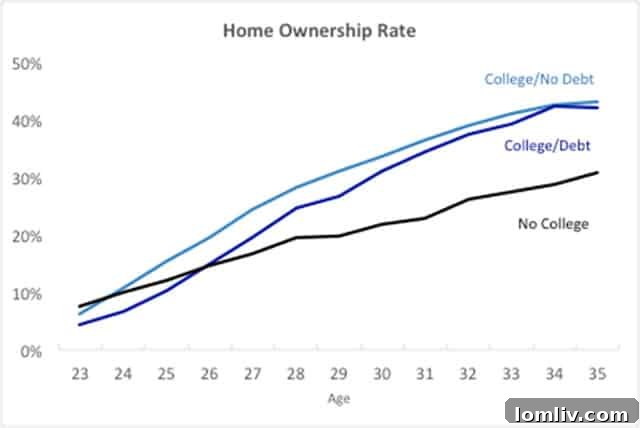
A crucial distinction emerges when comparing college-educated individuals with and without student debt. While those without debt tend to enter homeownership sooner, the research reveals that by age 35, their homeownership rates are nearly identical to those who began their adult lives with student loan obligations. This phenomenon can largely be attributed to the average repayment period for student loans, which typically spans about 10 years, thereby delaying entry into the housing market for debt-laden graduates. It’s also plausible that a portion of the debt-free college graduates benefited from significant financial support from wealthier parents, who may have also covered their college tuition, giving them an earlier advantage in accumulating savings for a home.
The narrative, however, becomes considerably more challenging for individuals who have only completed high school. Earning, on average, $25,000 to $35,000 less per year than their college-educated peers, only about 30 percent of high school graduates achieve homeownership by age 35. This already stark picture darkens further when considering that inflation-adjusted incomes for high school graduates have been on a steady decline since 1979. In stark contrast, nearly 44 percent of college-educated individuals reach homeownership by the same age, underscoring the widening gap. These figures powerfully illustrate that despite the often headline-grabbing stories of individuals burdened with six-figure student loan debts for degrees in seemingly less lucrative fields like art history, a college education, even with a manageable amount of debt, continues to be a crucial ticket to homeownership and long-term financial stability.

Beyond the Headlines: The Enduring Value of a Degree
The Shifting Sands of the Job Market: Why a Diploma is No Longer Enough
There was a time, not so long ago, when a high school diploma served as a perfectly adequate credential for securing a job that provided a decent, middle-class standard of living. These were often “hands-on” roles in manufacturing, skilled trades, or various blue-collar industries. However, the economic landscape has undergone a seismic shift. Automation, globalization, and technological advancements have relentlessly eroded the availability of these traditional jobs at an alarming rate. This transformation has left many heads of households, particularly those without a college education, with diminishing options for meaningful employment, often leading to lower wages and a direct impact on their ability to afford housing, let alone purchase a home.
It’s important to acknowledge that not everyone is naturally inclined towards or desirous of “thinking” work – careers that primarily involve conceptualization, analysis, and problem-solving. As a species, our talents and passions are diverse. While the sentiment behind “Every child is a genius” is well-meaning, it ignores the reality that not all brains are wired for abstract, highly academic pursuits. Society functions optimally when there’s a wide array of skills and roles. For this to continue, there must be meaningful work that commands meaningful pay for all citizens, regardless of their educational path.
The Economic Imperative: Bridging the Skills Gap
The gap between the cost of living and earning potential is stark. According to a 2014 Pew study, middle-class income for a household of four ranged from approximately $44,083 to $144,250. Yet, data from the Economic Policy Institute (EPI) calculated that the actual cost for a similar four-person household to live modestly in various parts of the country ranged between $49,114 and $106,493. The critical takeaway from these figures is sobering: even in the most affordable areas of the nation (at $49,114), a family earning at the lower end of the middle-income bracket ($44,083) struggles to meet basic living expenses. It’s reasonable to infer that the lowest tier of this middle-wage group is disproportionately represented by non-college educated individuals, who are subsequently at a significant disadvantage when it comes to the monumental task of purchasing a home.
Navigating the Path to Homeownership: Insights and Strategies
The evolving economic landscape underscores the paramount importance of education in achieving financial milestones like homeownership. While student loan debt can indeed delay the journey, it rarely derails it entirely for those who possess a college degree. The long-term earnings potential and career stability afforded by higher education generally compensate for the initial debt burden, enabling graduates to eventually enter the housing market. For aspiring homeowners, understanding this dynamic is crucial. Strategic financial planning, including diligent saving, responsible debt management, and a clear understanding of mortgage processes, becomes even more vital.
For individuals for whom a traditional four-year college path may not be the ideal fit, exploring alternative educational avenues like trade schools, vocational training, or specialized certifications can offer valuable skills for in-demand occupations. These paths often lead to well-paying jobs in fields such as healthcare support, technology, or skilled trades, which can provide a solid financial foundation for homeownership. However, even in these fields, continuous learning and adaptation are key to maintaining career relevance and income growth in a rapidly changing economy. The core message remains: investing in human capital, through formal education or skill development, is increasingly the most reliable strategy for economic advancement and securing the dream of owning a home.
Conclusion: Education as the Foundation of Future Prosperity
To encapsulate, the prevailing narrative that student loan debt is the primary inhibitor of homeownership needs significant revision. While it can introduce a temporary delay, the underlying research conclusively shows that educational attainment itself is the most critical determinant in increasing an individual’s likelihood of owning a home. Conversely, those without the aptitude for or access to higher education, particularly those whose career paths traditionally involved “doing” rather than “thinking” jobs, face an increasingly challenging environment. They contend with ever-diminishing job opportunities and stagnating salaries, severely impairing their ability to achieve homeownership and even to carve out a reasonably comfortable lifestyle.
This reality calls for a broader societal reflection on how we support all pathways to meaningful employment and financial security. As the economy continues to evolve, ensuring accessible education and viable career options for everyone, regardless of their academic inclinations, will be paramount for sustaining a robust middle class and upholding the dream of homeownership for future generations.
The dividing line between haves and have-nots in home ownership: Education, not student debt by Joanna England
Got a Story to Share? Do you have a fascinating HOA story, a slice of high-rise history, or a unique real estate anecdote? Realtors, are you eager to showcase a property that’s a renovator’s dream or one that shines brightly after a stunning transformation? Perhaps you’d even like to host a Candy’s Dirt Staff Meeting? We’re always looking for compelling content. Feel free to shoot Jon an email with your ideas, stories, or inquiries – even marriage proposals are accepted (they’re legal, after all)! Connect with us at [email protected].