The serene, tree-lined streets of Dallas’s prestigious Park Cities, often affectionately—or perhaps ironically—dubbed “The Bubble” for their perceived insulation from urban woes, are witnessing a disturbing shift. Heather Conover, a dedicated registered nurse and former police officer with deep roots in law enforcement, is among those feeling the unsettling tremors of change. Her family home, once a sanctuary, is now on the market, as she and her family prepare to leave an area increasingly plagued by escalating crime rates and rampant street racing that has reached a critical, untenable crescendo.
The statistics paint a grim picture of this growing crisis. In 2020 alone, the Dallas Police Department recorded an staggering 8,000 calls related to street racing and illegal takeovers across the city. North Central Dallas accounted for 360 of these incidents, Northwest reported a troubling 841, and the Northeast quadrant saw approximately 1,000 calls. While the bulk of these distress calls originated from the Southwest, Southeast, and South Central areas, the problem has demonstrably metastasized, now infiltrating historically quieter neighborhoods like Northwest Dallas, East Dallas, and Preston Hollow. Shockingly, estimates suggest that as many as 2,000 racers converge on Dallas streets on any given Sunday night, transforming public thoroughfares into dangerous, unsanctioned arenas. Despite the implementation of tougher penalties last year, the Dallas Police Department (DPD) has been largely unable to implement serious, systemic measures to curb the pervasive street racing and stunt driving that now jeopardizes virtually every community within the city limits.
While arrests are made and vehicles are impounded, these actions often feel like reactive band-aids on a bleeding wound. Police frequently arrive 30 minutes too late to a street racing call, by which time the perpetrators have long vanished into the night. Compounding the challenge, nearly half of those apprehended hail from outside Dallas, primarily from neighboring cities such as Garland, Mesquite, and Red Oak, suggesting a regional attraction to Dallas’s accessible roadways and, perhaps, its perceived lax enforcement.
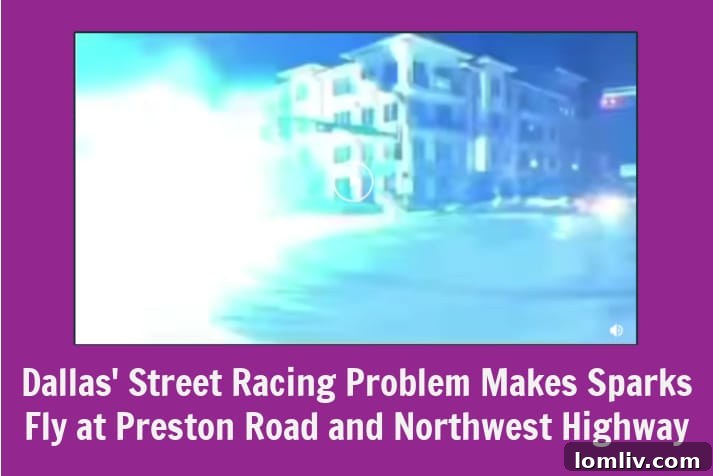
This modern scourge, which once seemed confined to industrial zones or remote stretches of highway, has now encroached upon residential areas with alarming frequency. This past weekend, the chaos struck just north of University Park, highlighting the escalating and increasingly localized threat. The incident, involving a truck slamming into a utility pole, quickly became a focal point for frustrated residents.
Truck hits pole during takeover at NW Highway and Preston on Saturday night from r/Dallas
Conover, who previously served with the Lewisville Police Department, articulates a widespread sentiment of disillusionment. “Crime has increased so much, and police are short-staffed; of course, they cannot answer the calls effectively,” she asserts. Her frustration extends to the city’s leadership: “The City of Dallas doesn’t seem to feel that security is a priority.” For too long, she argues, Dallas has grappled with a severe shortage of police manpower, a critical deficiency that can lead to catastrophic consequences. The incident with the sparking electrical pole serves as a stark reminder: what if that pole had toppled onto a passing car? What if it had ignited a devastating fire, endangering lives and property?
Understanding the Enigma of Dallas Street Racing: A Complex Challenge
Street racing, in its modern iteration, presents itself as a peculiar and complex phenomenon, defying easy categorization. It transcends traditional socio-economic boundaries, racial demographics, and age groups, drawing participants from virtually every segment of society. At a crucial December meeting of the North Dallas Chamber Public Safety Committee, Dallas PD Sgt. Christopher Barzyk, who has diligently led the DPD Street Racing Task Force for three and a half years, offered invaluable insights into this perplexing subculture. Barzyk and his dedicated team collaborate extensively with law enforcement counterparts across the nation, endeavoring to gain a deeper understanding of how these highly organized groups operate and proliferate.
Crucially, Sgt. Barzyk emphasized that this is not merely a localized Dallas problem but a pervasive, nationwide issue, manifesting from the rugged coasts of Maine to the sun-drenched landscapes of California. Dallas, in particular, holds a unique allure for these illicit racing groups due to several geographical and policy-related factors: its central location within the country, its abundance of flat terrain conducive to high-speed maneuvers, and specific restrictions on how law enforcement can pursue suspected criminals. These elements combine to create an environment that, regrettably, makes Dallas an attractive hub for illegal racing activities.
The profiles of participants are as diverse as their motivations. There isn’t a singular “type” of driver; ages can range dramatically, from impressionable 13-year-olds to seasoned individuals well over 45. Their impetus for engaging in such dangerous activities is equally varied. Some are driven by an insatiable desire to create chaos and disruption, while others chase the pure adrenaline rush and thrill of high-speed maneuvers. For many, it’s simply perceived as “fun,” a recreational outlet outside the bounds of law. A significant contributing factor, increasingly prominent in the digital age, is the pursuit of exposure and “fame” through social media platforms, where videos of their daring—and often reckless—feats are widely shared, garnering likes and notoriety. Furthermore, a darker undercurrent of gambling is often intertwined with the outcome of these races, adding a financial incentive to the already high stakes.
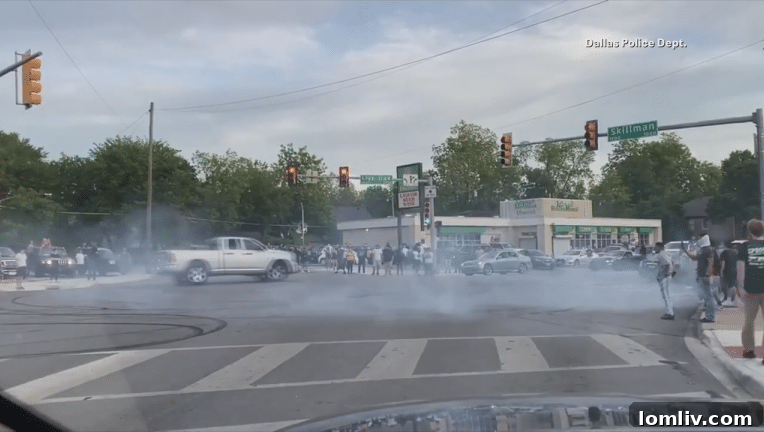
Participants typically gravitate towards warehouse districts or public roadways characterized by long, unobstructed straightaways that allow for maximum speeds. Disturbingly, there is little distinction or hesitation in targeting residential neighborhoods, bustling commercial districts, or the city’s Central Business District, demonstrating a profound disregard for public safety and order. The “takeovers,” as they are ominously known—such as the incident at Preston and Northwest Highway—are meticulously coordinated events. When a 911 call regarding street racing is placed, officers are typically dispatched within 5-7 minutes. However, these groups are highly mobile and sophisticated, employing intricate communication networks to relay information about potential intersections to “take over.” They actively monitor police calls online, immediately notifying the crowd the moment officers are dispatched to a location. On-site spotters are also strategically positioned, acting as vigilant lookouts. The result is a frustrating game of cat and mouse: “Poof,” as Sgt. Barzyk aptly describes it, “they are gone by the time police get there.” To facilitate their rapid departure and relocation, racers often use loud air horns, incessant honking, and even deploy fireworks, creating a cacophony that signals both celebration and escape.
The Elusive Search for Effective Solutions to Street Racing
Addressing the deeply entrenched problem of street racing in Dallas is anything but straightforward, with numerous proposed solutions consistently encountering insurmountable practical and logistical hurdles. The challenge lies in finding deterrents that are both effective in curbing illicit activity and compatible with the broader needs of urban infrastructure and public safety.
One common suggestion involves proactively positioning officers at intersections known to be frequent targets for takeovers. While this tactic has shown some success in deterring immediate activity—as spotters quickly identify police presence, prompting racers to disperse—its efficacy is severely limited. The inherent mobility of these groups means they simply relocate to a different intersection or neighborhood, merely shifting the problem rather than solving it. Crucially, the Dallas Police Department (DPD) simply lacks the extensive manpower and resources required to proactively station officers at every single intersection that has been, or could potentially be, targeted across the vast expanse of the city.
Other seemingly straightforward solutions, such as implementing temporary lane closures or installing speed bumps, also face significant opposition due to their potential collateral damage. While these measures might slow down racers, they would simultaneously impede the swift movement of vital emergency vehicles. Fire trucks, ambulances, and police cars must be able to navigate the city freely and rapidly to respond to critical emergency calls. Any obstruction would inevitably delay response times, potentially jeopardizing lives in urgent situations. Furthermore, forcing police vehicles to navigate through areas with speed bumps or closures would slow their response to calls, particularly concerning given that officers who violate internal speeding regulations in neighborhoods can face penalties, including loss of days off or deductions from their paychecks.
The deployment of “Stop Sticks”—those spiked devices designed to puncture vehicle tires—is another option that has been considered but deemed largely impractical in the context of street takeovers. Stop Sticks are typically utilized in high-speed car chases where law enforcement has a longer lead time and a clearer understanding of the fleeing vehicle’s trajectory. In the chaotic and unpredictable environment of a street takeover, it is incredibly difficult for officers to anticipate which direction a car might exit, making the precise and safe deployment of such devices nearly impossible. Moreover, there have been tragic instances of officer fatalities directly attributable to the close proximity required to deploy Stop Sticks in front of rapidly moving vehicles, highlighting the extreme danger involved. Exacerbating this dilemma is Dallas’s general prohibition on high-speed chases, a policy implemented due to the immense risk of injury or fatality to innocent members of the public. This practice was ceased precisely because of past fatalities, underscoring the paramount importance of public safety over apprehension in such scenarios.
Even creative, out-of-the-box solutions have fallen short. Detroit, for instance, attempted to address its street racing problem by designating a specific, controlled area for racers to congregate and operate. The intention was to provide a safe, regulated space that would divert activity from city streets. However, this designated area was reportedly used only once before racers abandoned it and reverted to their disruptive activities on public roads. The reason for its failure was telling: the designated space came with rules and regulations, a concept fundamentally unappealing to a demographic driven by the thrill of breaking rules and defying authority.
The Financial Strain and Legislative Gaps in Combating Illegal Takeovers
The persistent challenge of street racing is not only a drain on public safety but also places an immense strain on already stretched public resources, hindering proactive intervention. Sgt. Barzyk firmly believes that a significant increase in financial penalties could make a substantial dent in the proliferation of street racing. He notes that drivers involved in these activities often invest considerable sums in modifying and “souping up” their vehicles for performance—a clear indicator that impacting their wallets could serve as a powerful and effective deterrent. The financial commitment to their vehicles suggests a vulnerability to monetary disincentives that current penalties fail to exploit.
Beyond the drivers, the presence of large, often unruly crowds of spectators further complicates enforcement. The Dallas City Council recently passed an ordinance allowing for the ticketing of spectators attending these illegal gatherings, a legislative step intended to discourage participation. However, the current penalty for spectators is regrettably akin to a standard speeding ticket, which Sgt. Barzyk argues lacks the necessary “financial teeth” to be truly effective. Without more significant financial repercussions, the incentive for spectators to attend remains largely untouched, sustaining the audience and energy that fuel these events.
The existing legal framework for reckless driving also proves inadequate. It is currently classified as a Misdemeanor B, carrying a maximum fine of $200 and up to three days in jail. For many participants, such a fine is hardly a deterrent, and the prospect of a day or two in jail is often dismissed as a minor inconvenience, especially when the actual fine imposed frequently falls below the $200 maximum. Similarly, citations for loud mufflers, a common feature of these modified vehicles, are typically only $25, even after multiple infractions. This negligible fine offers no deterrent whatsoever, allowing offenders to continue operating their noisy, disruptive vehicles with impunity. Recognizing these critical gaps, Sergeant Barzyk has strongly recommended that stricter fines and more robust penalties be prioritized and integrated into the upcoming legislative agenda, advocating for changes that truly reflect the severity of the offenses.
Overcoming Evidentiary Hurdles: The Critical Need for Driver Identification
Perhaps the most significant and perplexing obstacle to successfully prosecuting street racing offenders lies in the stringent evidentiary requirements: specifically, clear video footage of the driver, not merely the vehicle, is essential for a conviction. This critical distinction underscores a major weakness in current enforcement capabilities. For example, while video footage of this past weekend’s pole-smashing truck would clearly depict the vehicle and the incident itself, it would likely not suffice for prosecution without undeniable identification of the individual behind the wheel. The absence of such clear, irrefutable evidence of the driver often leads to cases being dropped or unpursued.
Dallas possesses numerous traffic cameras at various intersections, which could theoretically provide the necessary footage. However, a significant number of these cameras are unfortunately in disrepair, rendering them useless for law enforcement purposes. Sgt. Barzyk highlighted this infrastructure deficit, stressing that prioritizing and adequately budgeting for the repair and maintenance of these crucial intersection cameras would be a transformative step. Investing in this technological capability would significantly increase the chances of capturing the clear, identifiable footage required to prosecute drivers, thereby enhancing accountability and acting as a more potent deterrent.
Recognizing the urgency and the complex, multi-faceted nature of the problem, Heather Conover has taken direct action, reaching out to the Mayor, City Council, and even the Governor, advocating for the involvement of state troopers. “You need a task force, and you need the state involved,” Conover asserts, emphasizing the need for a comprehensive, multi-agency approach that transcends local jurisdictional limitations. Her plea underscores a broader concern: “And of course, you need the officers to do this—another reason why we absolutely should not be moving resources away from DPD.” Her message is clear: addressing the escalating street racing crisis requires not just new strategies, but a renewed commitment to adequately staff and empower the Dallas Police Department, ensuring they have the necessary personnel and resources to reclaim the city’s streets and restore public safety for all residents.