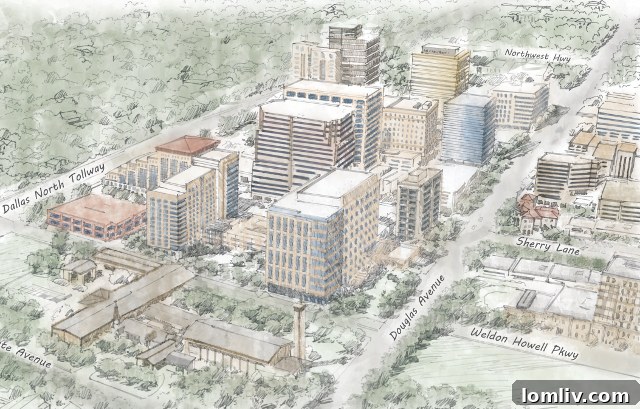
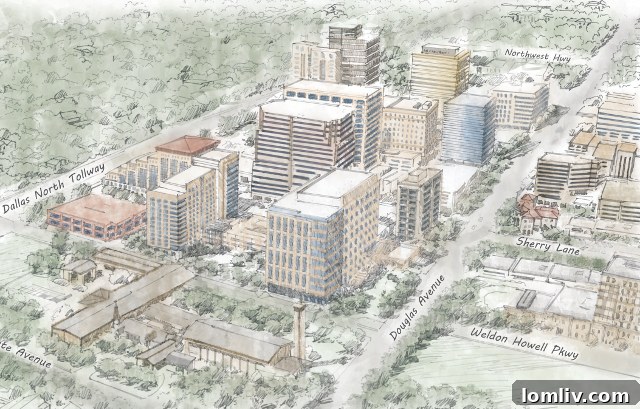
Revisiting St. Michael’s: An In-Depth Look at Preston Center’s New Development Plans
Back in 2016, St. Michael and All Angels Episcopal Church faced significant scrutiny over its proposed development plans in the heart of Preston Center. A primary point of contention was the perceived lack of transparency: while the church’s representative maintained a silent presence on the Preston Center Task Force, private negotiations were reportedly underway to introduce a substantial 250,000 square foot office building on Douglas Avenue. This clandestine approach sparked considerable local debate and led to a scathing critique regarding the church’s community engagement and development ethics. Following that highly critical assessment, it came as a considerable surprise when the church reached out, extending an invitation to review their newly revised and, ostensibly, improved plans for the site.
The updated proposal garnered immediate attention, particularly after its public announcement in the Dallas Morning News on September 6th. However, a deeper dive beyond the initial press release was necessary to uncover the granular details and underlying motivations. I swiftly scheduled a meeting with the church’s development team, and the subsequent delay in publishing this analysis falls entirely on my shoulders, a casualty of an exceptionally busy schedule. This column aims to provide that detailed insight, reflecting on the evolution of these ambitious Preston Center mixed-use plans.
My initial reading of the press release immediately piqued my critical eye, specifically noting the extraordinary repetition of “Preston Center Area Plan” – mentioned no less than eight times within a mere two-page document. Upon meeting the team, this was one of the very first observations I shared. Eight times? Their immediate response was to frame this repetition as an undeniable demonstration of their commitment to adhering to the Area Plan’s guidelines. Yet, for me, it triggered a heightened sense of suspicion, suggesting a potential effort to overcompensate or perhaps conceal aspects of the project. The team expressed genuine surprise at my reaction, assuring me there was absolutely nothing to hide. Nevertheless, the insistent repetition felt less like reassurance and more like an attempt to deflect from previous criticisms, raising questions about genuine transparency and community trust in such a high-stakes North Dallas development.
Analyzing the Evolution: From 2016 Ambitions to Current Proposals
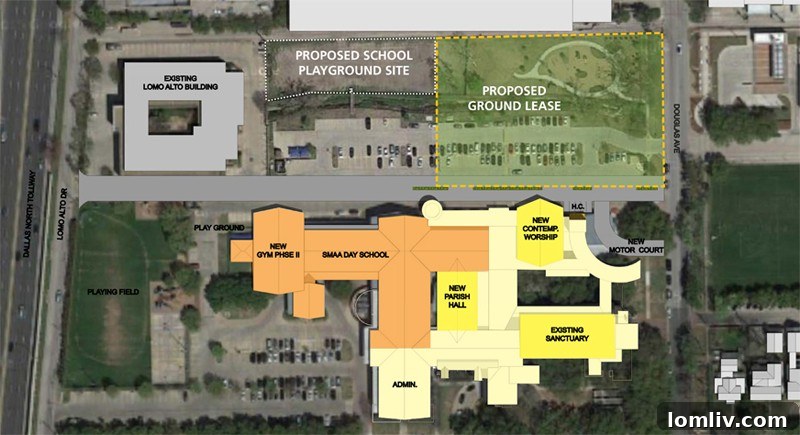
To fully grasp the current proposal, it’s essential to first revisit the 2016 plans for the St. Michael’s site, as depicted in the image above. These initial designs showcased a prominent 250,000 square foot office building slated for the eastern end of the block, directly fronting Douglas Avenue. In stark contrast to the dense development, a public playground was envisioned in the middle of the site, creating a small, green interlude. To the left, the existing two-story structure at 8100 Lomo Alto, already owned by the church, stood as a constant. The colored boxes at the bottom represented additional church-owned buildings, earmarked for potential repurposing and expansion (distinguished by orange and yellow hues). At the time, my strategic assessment suggested prioritizing density and height increases on the eastern sections, which were zoned MF-1 with a 36-foot height limit. The 8100 Lomo Alto parcel, already benefiting from greater height and density allowances under Preston Center’s Planned Development (PD) 314, seemed more suitable for a later phase of development.
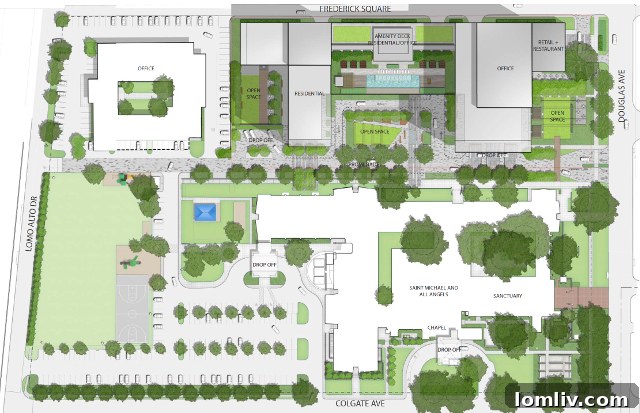
The latest plan, presented above, represents a significant departure from its predecessor. The central playground, once a proposed community amenity, has been eliminated, making way for a new apartment building. A notable change is the office building’s strategic setback from Douglas Avenue, a direct concession to the 8181 Douglas Avenue condo owners whose southern views would otherwise be severely obstructed. While this adjustment addresses a major concern, I understand that complete satisfaction among these residents remains elusive. A substantial portion of the lot will now be covered by a two-story podium, housing above-ground parking (with an additional two levels underground). The official press release states the office building at eight stories and the apartment building at twelve stories. However, these figures do not account for the parking podium, meaning the effective heights for residents and tenants will be closer to ten and fourteen stories, respectively, creating a much more imposing street presence in this key Dallas location.
Critical Analysis of Building Placement and Design
My review identified significant concerns regarding the placement of both primary structures. Firstly, from a logical and tenant-centric perspective, the residential building should ideally be positioned closest to Douglas Avenue. This strategic placement would serve two critical purposes: maximizing the distance from the incessant noise of the Dallas North Tollway, thereby improving residential quality of life, and simultaneously shortening office tenants’ access to the Lomo Alto/Tollway frontage road. However, church representatives clarified that a key element of the deal involves the church’s use of parking facilities on weekends. Consequently, the office building was intentionally located closer to their sanctuary, prioritizing convenience for churchgoers – a decision that perhaps overlooks the pedestrian experience, as is often the case in car-centric Dallas.
Secondly, both buildings are oriented along a north-south axis. This orientation is suboptimal, as it ensures neither structure will fully capitalize on the desirable, expansive views of downtown Dallas. Instead, their large glass facades will predominantly face east and west, maximizing solar gain throughout the day. This design choice inevitably leads to increased electricity bills for tenants due to higher cooling demands, and it also contributes to urban heat island effects. When questioned about this design decision, I was informed that while it might not align with best architectural practices for maximizing views and energy efficiency, it was the preferred orientation dictated by Lincoln Property, the esteemed developer leasing the land and overseeing this ambitious project. This highlights a common tension between developer preferences and optimal urban planning principles.
Nestled between the two buildings, atop the parking podium, will be the apartment’s amenity deck. A critical observation regarding this space is the likelihood of the swimming pool being considerably shaded for much of the day. Direct sunlight, a crucial element for pool enjoyment and tanning, would likely be limited to a narrow window, perhaps between 10:30 a.m. and 2 p.m. on an exceptionally clear day. This design oversight could significantly detract from the residents’ experience and the overall desirability of the amenity space, underscoring the need for more thoughtful consideration of environmental factors in urban design.
The Future of 8100 Lomo Alto and Unanswered Questions
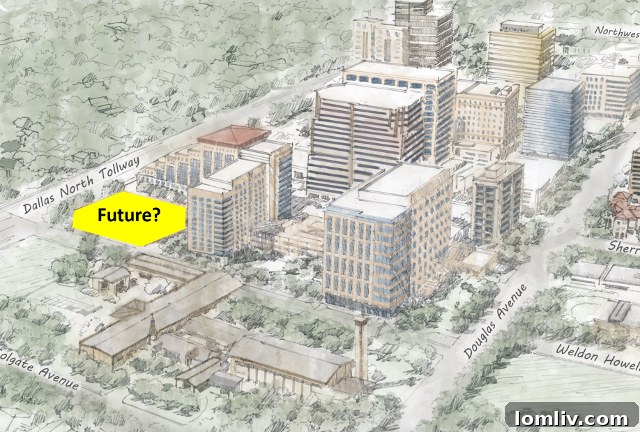
Beyond the immediate plans, the future of the 8100 Lomo Alto building, depicted with a question mark in the image above, remains a crucial element of the overall development vision for this Preston Center block. The church explains that existing long-term leases, spanning seven to eight years, currently prevent its inclusion in this initial phase of redevelopment. My immediate suggestion was to explore buying out these leases to integrate the parcel more holistically into the current plans. However, the profound silence that followed my inquiry about what *could* eventually be built there was particularly telling. This lack of a clear, articulated vision for such a pivotal parcel raises concerns about comprehensive master planning and transparency.
Under PD-314 zoning, the 8100 Lomo Alto site is permitted to accommodate a structure up to 14 stories. However, any new construction would be subject to a “residential proximity slope” requirement, meaning it would need to be stair-stepped away from the Tollway, mirroring the design of its neighbors. Critically, its potential height would be identical to the proposed apartment building situated right next door. The consequence of this is clear: resulting west-facing apartments in the new building would be entirely walled off from any views, replaced instead by the imposing facade of a future 8100 Lomo Alto tower. This creates a significant design flaw, impacting tenant satisfaction and property values.
Let’s consolidate the implications for future residents and tenants: people’s homes will face directly into office buildings to the east and north. Furthermore, the future to the west holds the prospect of a massive brick and glass wall. This immediately brings to mind the ongoing reflectivity issues seen in projects like the Nasher Sculpture Center versus Museum Tower, begging the question of whether similar sun glare and heat problems have been adequately assessed. Tenants on the narrow southern side, if south-facing balconies are even incorporated, will contend with city views perpetually engulfed in the ceaseless drone of Tollway noise. And, as previously noted, the amenity pool will likely require minimal sun protection for the majority of the day. This cumulative outlook for quality of life and residential experience is far from ideal, making it hard to envision a strong appeal for future leases under these conditions.
And another pressing point that escaped my full consideration during the meeting: the church indicated an eventual plan to bury parking on the 8100 Lomo Alto lot to preserve open space and maintain height limits. This begs a crucial economic question. If it is economically viable to fully bury 100 percent of the parking on the Lomo Alto parcel, a site with less leasable space, why, then, is the current 455,000 square foot development featuring a two-story above-ground parking podium in the first place? The economics for a project three times the scale of Lomo Alto should undoubtedly support fully subterranean parking. Imagine the significantly increased interactive green space and enhanced pedestrian experience that could be offered to the neighborhood if the entire garage were sunk beneath the ground, contributing far more positively to the urban fabric of Preston Center.
SHOW ME THE MATH: Unpacking Square Footage and Zoning
Recall that the church’s initial 2016 plans stipulated a single 250,000 square foot office tower positioned on the Douglas Avenue side of the block. Fast forward to the present, and that once-proposed playground has vanished. The church’s public relations messaging suggests that the current project is not even utilizing the entirety of the available square footage for the block – and, technically, they are correct. When aggregated, the block reportedly possesses development rights for a total of 586,127 square feet. The two planned buildings in the updated proposal account for 455,000 square feet, which, notably, is almost double their initial 2016 request (and, candidly, that playground was likely always a placeholder rather than a firm commitment).
The prevailing PR narrative frames the combined buildings as merely a “reshuffling” of density across the block, an adjustment to make the development work while remaining within the overall maximum square footage. What this message conveniently omits, however, is that while the total square footage may indeed be shifted, this “reshuffling” simultaneously enables the construction of 10- and 12-story buildings on parcels that were originally zoned for a mere three stories. This dramatic increase in height on these specific sections fundamentally alters the character and scale of that part of Preston Center.
In a truly equitable “reshuffling” scenario, one might expect that height allowances would primarily be transferred to the 8100 Lomo Alto parcel, where higher density and height are already zoned and permissible. Yet, this is not the case. The church still harbors plans to utilize the remaining 131,127 square feet (in addition to the existing 39,923 square feet within the 8100 Lomo Alto structure) on the block for future redevelopment of that parcel once its current leases expire. This demonstrates a long-term strategy to maximize density across the entire site, not just a simple redistribution.
The ultimate outcome is a block that will be packed to its gills in terms of square footage, with significant height enabled across the entire property – a reality I find acceptable given its prime location adjacent to a major artery like the Tollway. Frankly, my primary satisfaction comes from finally understanding the full scope of their long-term plans. The adage “a pinch here, a pinch there” might work in the kitchen, but it is wholly inadequate when striving to be a transparent and responsible neighbor in complex urban development. It is commendable that the church has now laid all its cards on the table. However, from this author’s perspective, the hand could have been played with greater foresight and consideration for optimal urban design and community integration from the outset.
NOT ALL BAD: Appreciating the Positive Aspects of the Plan
Despite the critical observations, it’s important to acknowledge and appreciate several commendable components within the proposed development. First and foremost, the embrace of a mixed-use model, integrating office, residential, and retail/restaurant spaces, is a positive step. This approach fosters a more vibrant, dynamic, and walkable urban environment, essential for a thriving community hub like Preston Center. The strategic pullback of the office building from Douglas Avenue is another significant improvement, as it creates valuable ground-floor retail opportunities – likely attracting a high-caliber restaurant seeking a superior location compared to the older offerings of Preston Center West. This setback also carves out much-needed green space, enhancing the pedestrian experience and softening the urban landscape. Crucially, this adjustment ensures that the residents of 8181 Douglas Avenue will largely retain their coveted views, as the office building will be positioned obliquely to their condos, mitigating previous concerns about direct obstruction.
Furthermore, the church’s beloved farmers’ market stands to benefit immensely from the new plans. It will gain more expansive and improved space, providing a better platform for community engagement and supporting local vendors. The design also incorporates a wrapped podium parking garage, which effectively blocks the unsightly parking structure of a neighboring property, contributing to a more aesthetically pleasing streetscape. I was also informed that considerable attention is being paid to incorporating green building elements throughout the project, a commitment I sincerely hope will be fully realized. Too often, when tenants bear the brunt of utility bills, the crucial aspect of energy efficiency is regrettably overlooked. Implementing features such as a small solar farm on the roof, for instance, could provide a sustainable power source for the garage, landscape, and common hallway lighting – expenses typically covered by the landlord, making this a win-win for both sustainability and operational costs. Such initiatives are vital for positioning this development as a forward-thinking and environmentally responsible addition to North Dallas.
AFFORDABLE HOUSING: The Most Promising Element of the Proposal
Of all the discussions surrounding the new development, the conversation regarding affordable housing left the most profound and positive impression. The church’s commitment extends far beyond merely offering a certain percentage of units at below-market rates. They articulated a comprehensive vision that includes providing vital support services such as food pantries, quality daycare facilities, and essential job training programs. Such integrated services are transformative; they don’t just provide shelter but offer a genuine pathway for individuals and families in need to regain their footing, achieve self-sufficiency, and contribute meaningfully to the community. I wholeheartedly applaud the church for any and all efforts they can make in this critical area, setting a potential benchmark for social responsibility in large-scale developments.
Indeed, if District 13 Council Member Jennifer Gates were to orchestrate a collaboration between the church and area businesses, the potential for a full-service ecosystem to reintegrate people into productive roles is immense. Imagine the synergistic benefits: residents of affordable units, equipped with job training, finding employment in the very restaurants and shops of both Preston Centers, and enjoying the immense benefit of being able to walk to work. This fosters a truly integrated community where work and life are seamlessly connected. I even posed the “acid-test question” to the team: “Will the church’s planned services come with religious strings attached, akin to a time-share pitch?” The answer was a most welcome and unequivocal “no.” Any services provided will be entirely free of proselytizing, unless explicitly requested by the individual seeking assistance. This commitment to non-coercive support further solidifies the integrity and positive intent behind their affordable housing initiatives, making it a true highlight of the entire development proposal.
STILL WORK TO BE DONE: Opportunities for Refinement
While acknowledging the positive strides, I remain hopeful that there will be some rethinking and refinement of the overall plan. The current building placements, particularly when considered in conjunction with the inevitable future redevelopment of 8100 Lomo Alto, strike me as highly problematic. The potential for the future 8100 Lomo Alto structure to effectively blind western-facing residents in the newly proposed apartment building – a consequence that those in the meeting room seemed not to have fully considered – is a significant design flaw. This issue is not merely detrimental to potential tenants, who will be paying premium prices for obstructed views, but it should also be a serious concern for the landlord striving to command top-dollar rents in a competitive market.
Dallas, despite its growth, already has an overabundance of locations burdened with undesirable views and suboptimal placements. There are only so many individuals willing to accept such accommodations. Prioritizing intelligent design that maximizes natural light, preserves views where possible, and mitigates noise should be paramount. A truly successful development in Preston Center will not only contribute to the urban fabric but also enhance the quality of life for its inhabitants, ensuring long-term desirability and value. The opportunity remains for the St. Michael’s development to achieve its full potential through thoughtful adjustments that address these crucial design and experiential considerations.

Remember: My expertise lies in high-rises, homeowners’ associations (HOAs), and property renovations. Beyond these core areas, I deeply appreciate the intricate balance between modern and historical architecture, always viewed through the lens of the YIMBY (Yes In My Backyard) movement, which advocates for thoughtful, responsible urban growth. My dedication to quality real estate journalism has been consistently recognized. In 2016, 2017, and 2018, the National Association of Real Estate Editors honored my writing with three Bronze awards (2016, 2017, 2018), complemented by two Silver awards (2016, 2017). Have a compelling story to share, a development project that needs scrutiny, or even a unique marriage proposal idea? Feel free to reach out via email at [email protected]. You can also look for me on Facebook and Twitter, though finding me there might prove to be a delightful challenge.