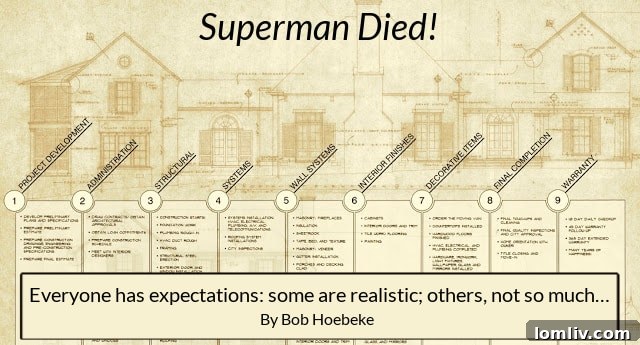
By Bob Hoebeke
President, Hoebeke Builders
The journey of building or extensively remodeling a home is often described as one of life’s most significant undertakings. It’s a venture brimming with dreams, aspirations, and the promise of creating a personal sanctuary perfectly tailored to one’s life. Yet, for many, this exciting prospect can quickly become clouded by unforeseen challenges, budget overruns, and ultimately, disappointment. The candid, almost resigned phrase, “I would if I could, but I can’t, so I won’t,” often encapsulates the harsh reality when aspirations clash with an unmanaged construction process. This article aims to transform that potential sentiment into one of triumph and satisfaction, underscoring the vital importance of setting and maintaining realistic expectations from the very first blueprint to the final walkthrough.
Every homeowner embarking on a custom build or major renovation project approaches it with a unique vision and a multitude of expectations. These expectations, while personal, must be grounded in reality and continuously aligned with the project’s parameters. The key to navigating this complex landscape successfully lies in fostering open and honest communication with your entire project team – a collaborative group typically comprising the architect, builder, interior designer, and landscape architect. By establishing transparent dialogue and clearly articulating your needs and desires from the outset, you significantly reduce the risk of disappointment, ensuring a smoother, more enjoyable, and ultimately more successful homebuilding experience.
Laying the Foundation: Cultivating Realistic Expectations for Your Custom Home
Realistic expectations are not simply wishful thinking; they are carefully constructed frameworks derived from informed discussions and mutual understanding within your project team. These discussions form the bedrock upon which all project goals and parameters are established. As highlighted in our previous discourse on creating unity for a common cause, a cohesive team works towards shared objectives. Each goal, each parameter, meticulously set and agreed upon, contributes to a robust set of realistic expectations for both you and your dedicated team. This collaborative approach ensures that everyone involved is aligned, working efficiently towards a common vision.
Consider, for instance, a common client goal: “I need to downsize my lifestyle.” This seemingly straightforward objective carries a clear, inherent expectation: the resulting design should unequivocally be smaller, more compact, and more efficient than the client’s current residence. It would be entirely unrealistic, and indeed counterproductive, for this goal to evolve into a design that somehow expands beyond the original home’s footprint. Similarly, the financial framework, or budget, alongside the projected timeline, are crucial parameters established through well-coordinated team planning. This plan is typically replete with detailed action points and milestones, clearly delineating who is responsible for what, and by when. When these agreed-upon expectations—whether concerning financial allocations, design specifications, or completion dates—are violated or deviated from without prior discussion and agreement, it invariably leads to broken expectations, causing frustration and potentially costly delays.
Unrealistic expectations often emerge from anticipating the impossible or failing to account for the inherent complexities of construction. Imagine a scenario where your project team has diligently worked to schedule the foundation pour for your expansive 5,000-square-foot custom home for May 15th. While this marks a significant milestone, expecting the entire project, loaded with bespoke features and high-end finishes, to be fully completed by Christmas of the same year would be profoundly unrealistic. Such aggressive timelines often overlook critical stages such as framing, mechanical installations, finishes, inspections, and unforeseen weather delays, leading to hurried work, compromised quality, and immense stress for all parties involved. A realistic understanding of the construction lifecycle, coupled with a flexible mindset, is paramount for maintaining project harmony and ensuring a successful outcome.
Surprise is the Enemy of Progress: Proactive Strategies for a Smooth Home Build
In the intricate world of custom home construction and remodeling, few things can derail a project faster or shatter client expectations more completely than an unexpected surprise. Whether it’s a sudden budget increase, a significant delay, or a design element that doesn’t quite match the client’s vision, surprises are invariably unwelcome guests. However, by proactively leveraging the powerful communication and planning “tools” that we’ve explored in previous articles within this series, homeowners can dramatically mitigate the incidence of these project-altering surprises. The goal isn’t just to react to problems, but to create an environment where realistic expectations flourish, fostered by continuous dialogue and strategic foresight. Here are some indispensable strategies for minimizing project surprises and empowering your team to deliver excellence:
- Revisit and Refine Your Lifestyle Inventory: At the very genesis of your project, you likely embarked on the crucial exercise of creating a detailed “Lifestyle Inventory.” This isn’t just a simple wish list; it’s a comprehensive document (preferably in writing!) that meticulously outlines your daily routines, long-term family needs, entertaining habits, storage requirements, and what truly matters most in your living environment. It differentiates between absolute needs and desirable wants. Regularly revisiting this inventory and sharing its insights with your project team is paramount. As the design evolves, discuss how each element aligns with your fundamental needs and aspirations. This iterative process ensures that the evolving plans continue to reflect your core lifestyle, preventing costly reworks or the eventual realization that a critical functional aspect has been overlooked. A well-maintained lifestyle inventory acts as your project’s North Star, guiding decisions and ensuring that the final home truly serves your way of life.
- Harness the Power of Visual Communication: In the realm of design, a picture truly is worth a thousand words, and often far more. Early in the design process, diligent work should involve collecting and categorizing a diverse range of visual references. These might include images from design magazines, compelling online portfolios, architectural photography, or even personal photos you’ve taken of spaces and details that resonate with you. Sharing these visual inspirations with your architect, interior designer, and builder provides an invaluable common language. Words alone can be subjective and open to varied interpretations, but a concrete image transcends ambiguity, allowing your team to grasp your aesthetic preferences, material inclinations, and desired ambiance with precision. Engage in healthy, collaborative discussions around these visuals; explain *why* certain elements appeal to you. This level of visual transparency helps to translate abstract ideas into tangible design concepts, ensuring that the team’s vision aligns seamlessly with yours, thereby significantly reducing design-related surprises.
- Mastering Space with the 3×5 Card Method: While it might sound unconventional in a high-tech building environment, the simple 3×5 index card can be an incredibly powerful tool for understanding and visualizing space. The work you’ve done in meticulously measuring your existing home’s rooms and committing those dimensions to these cards creates valuable “word pictures” in your mind. When your project team, comprised of seasoned professionals, discusses room dimensions – for example, a 16.5-foot by 14-foot dining room – it can be difficult for a homeowner to truly conceptualize that space in an abstract sense. However, by comparing it mentally to a familiar space, perhaps realizing that a proposed dining room is similar in size to your daughter’s existing bedroom, you gain a concrete understanding of its scale. This practical, hands-on approach empowers you to participate more effectively in design discussions, catch potential spatial misjudgments early, and minimize the risk of being surprised by room sizes or layouts that feel either too cramped or excessively vast once built.
- Embrace Value Engineering as a Strategic Partner: Budget overruns and unexpected cost increases are among the most common and distressing surprises in construction. This is where the strategic practice of “value engineering” becomes an indispensable ally. Value engineering is not about simply cutting costs; it’s a collaborative process that challenges your project team to optimize the value of every component and system in your home. It involves meticulously analyzing design elements, materials, and construction methods to identify alternative solutions that can achieve the same aesthetic intent and functional performance at a reduced cost, or offer enhanced performance at the same cost. For example, perhaps a certain exotic stone tile for a bathroom is exceeding the budget, but a high-quality porcelain alternative can achieve a very similar visual effect and durability for significantly less. By actively challenging your team to explore these options and explicitly stating your willingness to accept aesthetically similar, yet more budget-friendly alternatives, you not only save money but also keep the project’s financial plan robust and realistic. Value engineering is a proactive measure against budget surprises, ensuring that your dream home remains financially viable without compromising on the essence of your vision.
The profound satisfaction derived from a successful building project stems directly from a collective effort where everyone — the homeowner and the entire project team — works in harmony, pulling towards a shared objective. This intricate process of building or extensively remodeling your home should be viewed as a marathon, a sustained effort requiring perseverance and strategic pacing, rather than a frantic sprint. Throughout this journey, the unwavering commitment to honest, transparent, and open communication serves as the ultimate catalyst. It is the most effective way to maximize output, ensure quality, and minimize the dreaded element of surprise, ultimately leading to a home that perfectly embodies your vision and stands as a testament to effective collaboration.
NEXT TIME: We will delve into empowering your project team for maximum efficiency, exploring strategies that foster innovation, accountability, and seamless execution.
From developing a comprehensive “Lifestyle Inventory” to expertly building and meticulously monitoring your Project Team, Hoebeke Builders Consulting Services offers an unparalleled suite of tools and expertise. Our specialized services are meticulously designed to dramatically enhance your project’s overall efficiency, significantly reduce potential costs, and ensure a smooth, rewarding custom home journey. Discover more at www.hoebekebuilders.com.