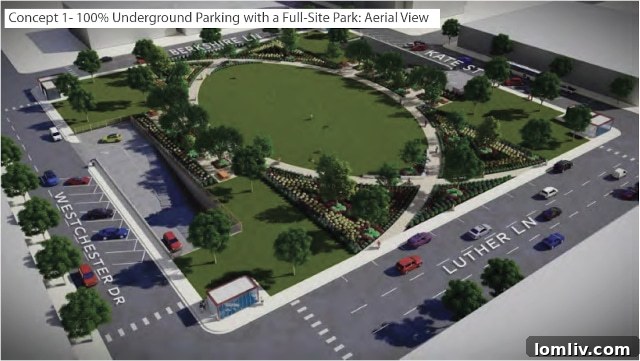
Preston Center, a commercial hub in North Dallas, finds itself in an incongruous position within the serene, upscale residential enclave of Preston Hollow. Often described as a bustling anomaly amidst quiet luxury, its current state contrasts sharply with the area’s refined character. This dissonance is particularly acute when considering the aging and underutilized Preston Center parking garage, a structure that presents both a challenge and a monumental opportunity for urban revitalization in Dallas.
The land currently occupied by this deteriorating parking garage represents the city’s most significant chance to harmoniously integrate Preston Center with its surrounding environment. For years, city planners, community leaders, and residents have envisioned a transformative project: an expanded, fully underground parking facility topped by a vibrant, accessible urban park. This vision, first formally recommended in the 2016 area plan for Preston Center, has been championed by dedicated officials like District 13 Dallas City Council member Jennifer Gates. She has diligently collaborated with local neighborhoods, the North Central Texas Council of Governments (NCTCOG), and various landowners to propel this ambitious project forward.
Despite considerable enthusiasm and extensive planning efforts, tangible progress has been repeatedly thwarted. The primary impediment stems from the persistent opposition and complex dynamics involving a group of influential landowners, collectively known as the Preston Center West Corporation (PCWC). Their consistent resistance to the proposed park concept has created an enduring stalemate, raising questions about their initial commitment to the plan. It leads many to wonder if the inclusion of the park concept in the final area plan was merely a superficial gesture, a “bone tossed” without any genuine intention of supporting its realization.
Understanding the root of this impasse requires a look back at the long-standing agreement governing the garage land. Decades ago, a legally complex and, by many accounts, disadvantageous agreement was forged between the City of Dallas, the rightful owner of the land, and the neighboring landowners represented by PCWC. This initial accord, further solidified by subsequent legal battles, granted PCWC an extraordinary level of control: a virtual veto power over any significant development on the site. Consequently, any proposal for redevelopment, whether initiated by the city or the landowners themselves, invariably leads to an unresolvable deadlock unless it secures 100 percent buy-in from all parties. In practice, this clause has ensured perpetual stalemate, preventing any meaningful evolution of the site.
In a renewed effort to break this cycle, NCTCOG, in collaboration with Walker Consultants, undertook a comprehensive study. This resulted in an exhaustive report detailing the existing, rapidly deteriorating conditions of the garage and outlining two distinct options for its redevelopment. Although the report was published in late March, its critical insights and proposed solutions only recently gained widespread attention, offering a renewed focal point for the ongoing debate.
The Conflicting Visions: A Park or a High-Rise?
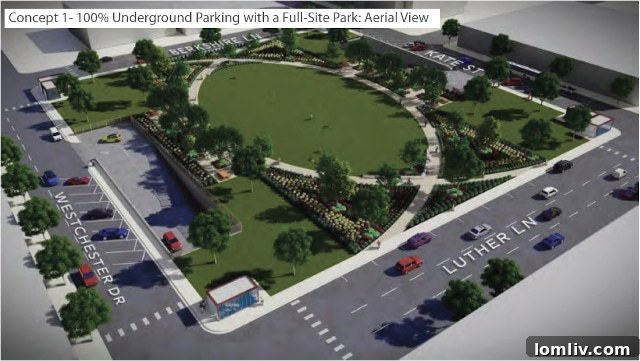
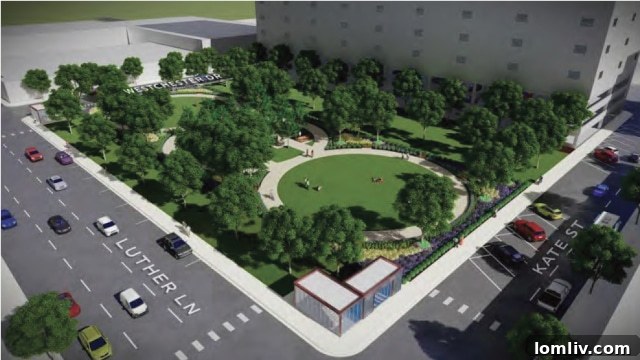
The NCTCOG and Walker Consultants report meticulously presented two primary redevelopment scenarios, each reflecting the divergent interests at play. Option One, the preferred choice for the majority of the community and city planners, advocates for a complete overhaul: a state-of-the-art, fully underground parking garage crowned by an expansive public park. This vision aligns with modern urban planning principles, emphasizing green space, pedestrian accessibility, and community amenities.
Option Two, on the other hand, represents a partial concession, reflecting some of the demands of the PCWC. This scenario proposes an apartment tower on a significant portion of the land, with a smaller, more constrained park occupying the remaining area. While presented as a compromise, this option raises concerns among those who champion the full park concept, fearing it dilutes the original vision and prioritizes private development over public benefit.
The term “sorta” in describing PCWC’s preference for Option Two is critical. It hints at an even more aggressive past stance. Recall that the last time PCWC representative Robert Dozier, who is also the presumed developer for the apartment tower, publicly articulated his vision, it was far more stark. His previous proposal aimed to cover nearly the entire 3.15-acre parcel with surface parking and a towering high-rise, leaving virtually no genuine green space beyond two small “earmuff parkettes” tucked into obscure corners. This earlier plan vividly illustrated a development philosophy that appeared to undervalue public green space, viewing it as an expendable luxury rather than an essential urban amenity.
This perspective, often perceived as prioritizing immediate financial gain over long-term community well-being, stands in stark contrast to the values many residents hold. Critics of the PCWC plan have often remarked that it seems conceived by individuals who struggle to see the intrinsic value of trees and green infrastructure unless they generate direct cash flow. Ironically, this commercial pragmatism often does not extend to their personal residences. Robert Dozier himself resides in a substantial 7,700-square-foot home on a half-acre lot in University Park, where his front yard alone boasts five mature trees, contributing to a decidedly park-like streetscape. This dichotomy underscores a fundamental difference in how public versus private spaces are valued and developed.
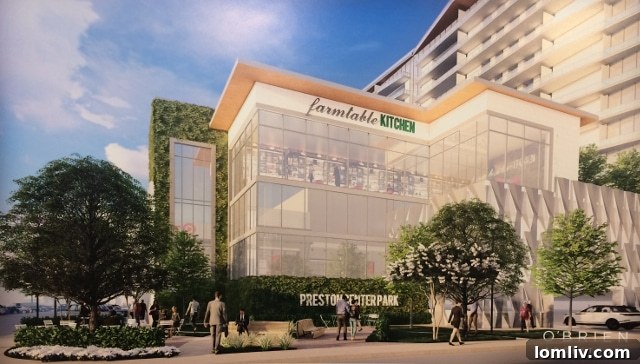
Therefore, the city’s current final plan, offering a possible compromise by ceding half the block for a residential apartment building, is met with skepticism by many. From a long-term urban planning perspective, this concession might be a significant mistake. The argument against a high-rise on this specific parcel gains further weight when considering recent developments within Preston Center. Just weeks prior, plans were unveiled for two substantial residential high-rises slated for the “Hopdoddy corner” of the garage. These twin towers are projected to introduce a significant influx of residents and visitors, adding 360 housing units and 245 hotel rooms to Preston Center, along with a modest 39 new trees. The combined impact of these existing projects on traffic, density, and local amenities is already a major consideration for the community.
The critical question then becomes: should these newly planned high-rises face yet another towering structure, like Dozier’s proposed building, or should they overlook a serene and expansive public park? The addition of a third high-rise in such close proximity would undoubtedly exacerbate density concerns, intensify traffic, and potentially obstruct views for existing and future residents. For other PCWC members, such a development presents a complex set of calculations. For instance, Leland Burk’s proposed apartment tower might face direct competition from a new high-rise on the garage site. Conversely, Rosebriar’s hotel and condos on the corner could suffer blocked views without gaining any discernible benefit from more apartments. This intricate web of competing interests among landowners within the PCWC itself creates a fragile environment for consensus. It raises a pertinent question: did Burk, who served as a Preston Center task force representative for Zone One, truly understand that the park concept, so carefully woven into the area plan, lacked the genuine support of certain influential members within the PCWC?
Time, Inconvenience, and the Shared Reality of Redevelopment
Much of the foundational information presented within the comprehensive 145-page report compiled by NCTCOG and Walker Consultants had been discussed and debated extensively in earlier stages of the Preston Center redevelopment saga. Previous community meetings and reports (accessible here, here, and here) laid the groundwork. However, the report also contained several crucial insights, particularly regarding the practicalities of construction and their implications for all stakeholders.
One of the most striking revelations in the report pertains to the construction timeline. Regardless of whether Option One (the full park with underground garage) or Option Two (the half park, half high-rise) is ultimately selected, the estimated construction period remains remarkably consistent: approximately 23 months. This is a critical detail because both options necessitate the complete closure of the entire existing parking footprint for the duration of the construction phase. Such a closure, regardless of the final design, will inevitably require the implementation of extensive alternative parking scenarios to mitigate disruption for businesses and visitors in Preston Center. Therefore, the argument that one option might be significantly less inconvenient or quicker to execute holds no weight; both the full-park and half-park scenarios demand the same timetable and impose the same level of temporary inconvenience on the community and local commerce. This shared reality undermines a common justification for preferring the less ambitious plan.
The Financial Equation: A Minimal Difference for a Maximum Impact
Beyond time and inconvenience, the financial implications constitute another major consideration in the Preston Center redevelopment debate. The NCTCOG report provides detailed cost estimates for both proposed options, offering a clear comparative analysis. The projected costs for the full-park option, which includes a comprehensive underground garage and an expansive public park above, range between $38.5 million and $41.2 million. In contrast, the estimates for the half-park option, incorporating a residential high-rise alongside a smaller park, fall between $38.1 million and $39.7 million.
A closer examination of these figures reveals a surprisingly narrow financial gap. The potential savings achieved by opting for the half-park scenario, when compared to the full-park option, are modest, ranging from approximately $400,000 to a maximum of $1.5 million. This represents a minuscule difference in the context of a multi-million-dollar urban development project. Furthermore, these cost comparisons for the half-park option do not even include the significant expenses associated with constructing Dozier’s proposed high-rise on the “un-parked” side of the parcel. When the full development costs of Option Two are considered, the initial savings become even more negligible, if not entirely negated.
Moreover, the report clearly states that the ongoing operational and maintenance costs for either scenario are projected to be virtually identical. This long-term parity in expenses further diminishes any financial argument favoring the less ambitious, half-park plan. Given that there are no significant savings in construction time, no reduction in community inconvenience during development, and virtually no substantial financial advantages—either initially or in long-term maintenance—the rationale for not pursuing the boldest and most beneficial option becomes increasingly tenuous. Why, then, is the city hesitant to embrace the fully underground option with its expansive public park, a solution that clearly aligns with community desires and modern urban best practices? The answer, as it has been for years, lies squarely with the PCWC’s enduring veto power.
It is also crucial to remember that substantial funding for the park vision already exists. Both the City of Dallas and NCTCOG have expressed strong support for the park concept and have collectively earmarked approximately $20 million for the project. This significant initial investment means that roughly half of the necessary funds are already secured, demonstrating a clear commitment from public entities towards the realization of a major green space in Preston Center. This existing “kitty” further strengthens the case for the full park, as it reduces the remaining funding gap and underscores the viability of the more ambitious vision.
The City’s Strategic Position: Why Compromise When Leverage Exists?
The persistent opposition from the Preston Center West Corporation (PCWC) to the full park concept, much to the chagrin of those who helped draft the Preston Center Plan, has been a defining feature of this protracted saga. It’s evident that the PCWC has likely never genuinely desired a full park, and they probably remain apprehensive even about the proposed half-park compromise. However, a critical strategic detail often overlooked is the allocation of responsibility for the garage’s upkeep. The City of Dallas is not on the hook for the ongoing maintenance and inevitable repairs of the crumbling garage; PCWC is. This fact imbues the city with considerable, yet often underutilized, leverage.
For the city, simply “doing nothing”—allowing the current, deteriorating parking structure to continue its decline—does not incur direct financial penalties beyond potential insurance liabilities for any structural failures. In contrast, for the PCWC, an increasingly dilapidated garage directly impacts the viability and attractiveness of their adjacent commercial properties. Tenants operating within a decaying, aesthetically unappealing, and potentially unsafe environment are less likely to thrive, and the landowners would face mounting maintenance costs and potential loss of revenue. Therefore, allowing the garage to continue its slow demise actively harms the PCWC’s business interests, while the city remains largely insulated.
Those who aspire to breathe new life into the aging Preston Center often feel cursed by the PCWC’s unwavering veto power. However, the option for the city to simply withhold approval and strategically “do nothing” can be just as potent a negotiating tool. If certain landowners within the PCWC are content for their lower-rent tenants to operate within what could ultimately become a slum-like environment due to a neglected parking facility, then perhaps the city need not rush to concede. It is not the city’s obligation to capitulate to demands that conflict with its broader urban vision and community welfare. Time, in this particular standoff, appears to be on the city’s side, as the burden of a decaying asset falls predominantly on the landowners.
However, this strategic advantage is subject to political shifts. The tenure of Council Member Jennifer Gates, a strong advocate for the park, is drawing to a close. The actions and vision of her successor in District 13 will be paramount. A new council person might, unfortunately, align with the PCWC’s more commercially focused, often aesthetic wasteland vision for development, potentially sacrificing crucial green space for increased density and private gain. This uncertainty underscores the urgency of securing a positive outcome during the current administration.
Yet, it is crucial to remind City Hall, and indeed urban planners everywhere, of a universal truth: nowhere on Earth is there a city where residents or officials are complaining about having too much green space. Parks, plazas, and natural elements are consistently identified as vital components of healthy, thriving urban environments, enhancing quality of life, promoting sustainability, and boosting property values. The desire for more green space is a global consensus.
This entire discussion, however, operates under the assumption that Robert Dozier still favors his original plan for a singular high-rise structure. As will be further explored in subsequent reports, Dozier has reportedly been tirelessly working to expand upon this initial concept, potentially crafting an even more extensive and aesthetically challenging development. Such a vision, if realized, would undoubtedly line the pockets of a select few developers and landowners, but it would do so at the direct expense of the neighborhood’s long-term liveability, the community’s desire for green space, and the city’s broader commitment to sustainable urban development. The battle for Preston Center’s future is far from over, and its outcome will significantly shape the character of North Dallas for generations to come.