Navigating Dallas’s Urban Core: A Deep Dive into Oak Lawn and Uptown Development
Dallas’s urban landscape is in constant flux, nowhere more so than in the vibrant, sought-after neighborhoods of Oak Lawn and Uptown. These areas are magnets for new multi-family developments, each project carrying the promise of revitalization and growth, yet also the challenge of integrating seamlessly into existing communities. Central to this intricate dance of progress and preservation is the Oak Lawn Committee (OLC). Having recently attended my inaugural OLC meeting, I gained invaluable insight into the meticulous process that shapes our city’s future.
The Oak Lawn Committee: Guardians of Neighborhood Integrity
For those unfamiliar with its crucial role, the OLC was established in 1982 with a clear mission: to serve as the principal neighborhood forum for guiding development, safeguarding the unique character and “vibe” of the area, and fostering overall improvement. The committee’s endorsement or rejection—its definitive “yea” or “nay”—carries considerable weight in the deliberations of the Dallas Plan Commission when considering new projects that require significant zoning changes. This makes the OLC a pivotal entity in the complex world of urban planning and real estate development in Dallas.
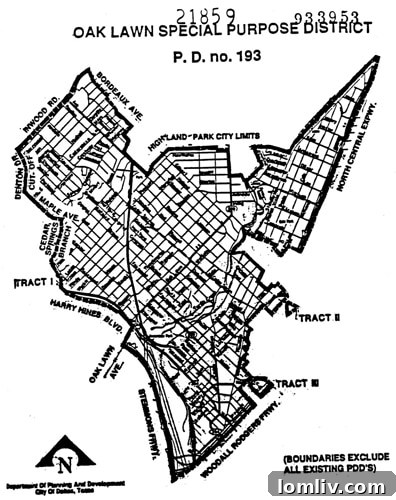
The geographic scope of the OLC’s influence is quite impressive. Its coverage area, which some might liken to a strategically drawn voting district, spans across City Council Districts 2 and 14, encompassing approximately 15 square miles of prime Dallas real estate. The primary boundaries defining this zone include Woodall Rodgers Freeway to the south, Harry Hines Boulevard to the west, Inwood Road, the affluent enclave of Highland Park, and Central Expressway to the east. Essentially, this covers the entirety of Oak Lawn, the bustling Uptown district, and the popular West Village area – all key growth corridors for Dallas real estate investments.
A Packed Agenda: Two Key Multi-Family Projects
My first OLC meeting, held on a Tuesday night, featured a compelling agenda. While two topics involved relatively minor landscaping adjustments – a strategic tree here, a decorative bush there – the bulk of the discussion revolved around two substantial proposed new multi-family projects. These presentations were not initial introductions but rather ongoing dialogues, demonstrating the iterative and consultative nature of the OLC’s process. The projects under scrutiny were located at 2728 Welborn and 3527 Dickason. Regular readers of daltxrealestate.com will already be familiar with the Dickason project, affectionately known as Turtle Creek Haus, which has been chronicled here and here, reflecting its journey through various stages of community feedback.
A Block Apart: A World of Difference in Design Philosophy
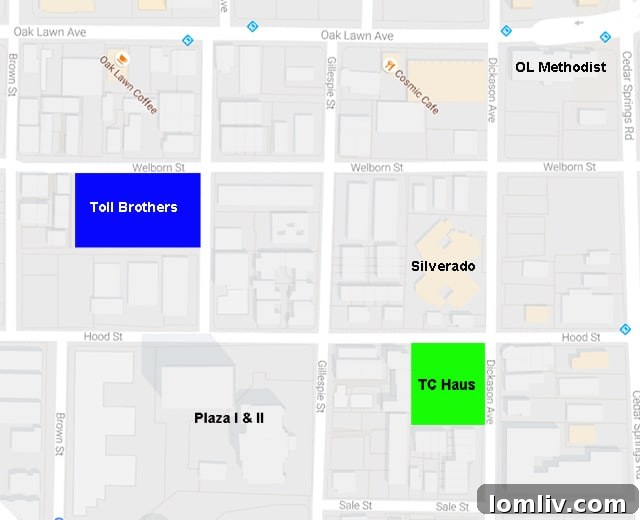
Having not previously engaged with the Welborn project, proposed by Toll Brothers, I was struck by the starkly contrasting reactions to two developments literally separated by a single city block. This divergence in approach and community reception offers a fascinating case study in modern urban development.
The Turtle Creek Haus project exemplifies a strategic approach targeting a footprint-compacted high-rise structure. Its design prioritizes leaving as much street-level openness intact as possible, maintaining a respectful distance from surrounding buildings. This philosophy aims to mitigate the feeling of overwhelming density and preserve light and air for existing structures. Ultimately, Turtle Creek Haus is envisioned as a condominium development, designed for long-term ownership, though it might operate briefly as apartments if market conditions dictate. This condo-first mindset signals a commitment to cultivating a stable, owner-occupied community.
In stark contrast, the as-yet-unnamed Toll Brothers project at 2728 Welborn presents a different vision. This development targets a more “squat,” plot-intensive structure. Instead of reaching for the sky with a compact footprint, it sprawls across a larger percentage of its land parcel. Proudly designated as an apartment complex from the outset, Toll Brothers intends to retain long-term ownership and management. This indicates a focus on the rental market, catering to a different demographic and investment strategy. Another crucial difference lies in unit size. While the smallest units at Turtle Creek Haus are projected to be a spacious 900 square feet, the average unit size within the Toll Brothers’ project will be a more modest 845 square feet. This disparity clearly illustrates the differing philosophies behind condo versus apartment developments – typically, condos offer larger living spaces geared towards owner-occupiers, while apartments optimize for rental efficiency.
Despite these significant differences, both projects share commendable attributes. A commonality worthy of applause is their commitment to steel-reinforced concrete construction. This robust method promises superior longevity, structural integrity, and reduced maintenance compared to more common and less durable stucco and wood construction methods often seen in multi-family developments. Furthermore, both ambitious projects are being expertly shepherded through the complex zoning and approval processes by Masterplan, a prominent urban planning and development consulting firm in Dallas, highlighting their pervasive influence in the city’s growth.
Turtle Creek Haus: Progress Through Collaboration
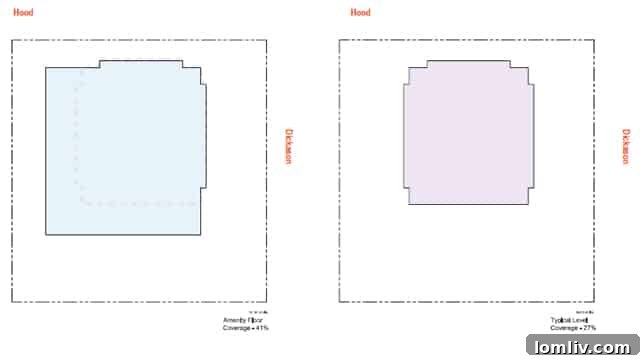
By all accounts – both from the OLC meeting discussions and insights gleaned from my informal backchannel contacts – the most recent neighborhood meeting for Turtle Creek Haus (which I unfortunately missed) marked continued positive progress. This project has consistently demonstrated a willingness to adapt and evolve based on community input. A significant breakthrough involves the garage, which is now slated to be entirely underground. This critical design change dramatically reduces the project’s overall plot coverage, thereby freeing up valuable surface space and enhancing the aesthetic appeal of the development. While this redesign has led to a minor adjustment in setbacks, as the reconfigured elevator bank encroaches slightly, the benefits of underground parking far outweigh this small “niggle.”
Crucially, the increased Floor Area Ratio (FAR) from prior meetings has been maintained. This strategy is specifically designed to encourage larger unit sizes, aligning with the condo-centric vision and appealing to residents seeking more expansive living spaces. Furthermore, the amenity deck, a common point of contention in urban developments, has been re-envisioned to target a more sedate and owner-oriented experience, rather than a potentially disruptive “Spring Break-style” party zone. All these revisions signify meaningful progress and a constructive dialogue between the developer and the community stakeholders.
In a move that surprised some observers, Teixeria Duarte has officially closed on the properties designated for Turtle Creek Haus. This decisive action underscores the developer’s confidence that, regardless of the ultimate specific zoning outcomes, they can construct a profitable structure within the existing parameters. This closing, however, shouldn’t be entirely unexpected. Teixeria Duarte had similarly closed on the Poston property back in January without any public fuss, presumably because they already foresaw the potential for a profitable project even under existing zoning regulations. Such strategic land acquisitions highlight the developers’ long-term vision and market savvy in the competitive Dallas real estate landscape.
As someone who appreciates distinctive architecture, I admit I’m still not entirely “wowed” by the current exterior renderings of Turtle Creek Haus. My hope remains for a design that transcends the utilitarian “upended shoebox with balconies” aesthetic and offers something more architecturally captivating. However, knowing that the design process is iterative and improvements are always possible, I hold out hope that the final product will deliver an inspiring visual statement for Oak Lawn.
Toll Brothers: An Alternative Approach to Development
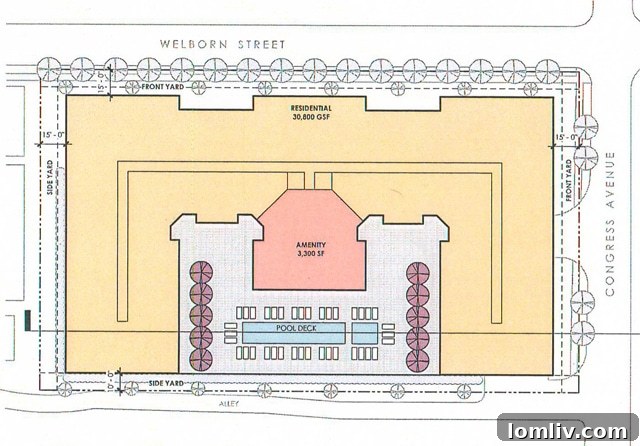
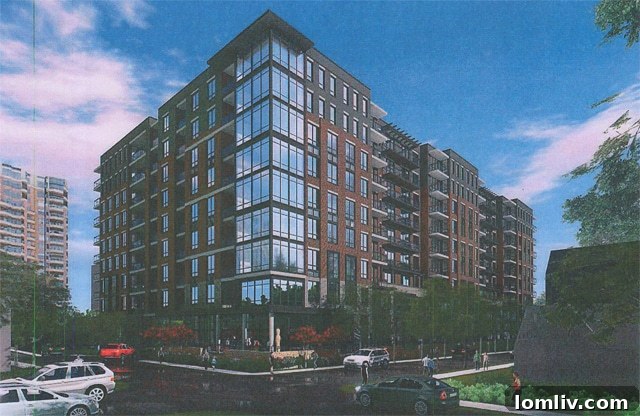
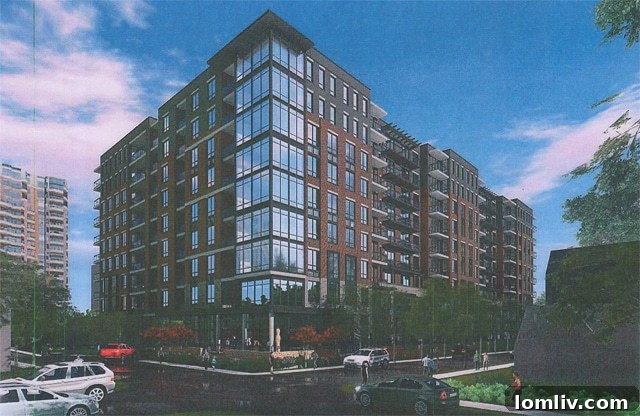
Again, the contrast is stark, emphasizing how a single block and the dynamics of neighboring properties – particularly when one is a high-rise whose views are paramount – can dramatically alter the perception and reception of a development. Here, we’re presented with renderings for a 9-story, U-shaped building that proposes to occupy a substantial 78 percent of its lot. This is a considerable departure from Turtle Creek Haus’s planned 45 percent lot coverage, signaling a much higher density at street level.
The design of the Toll Brothers building strategically positions its open “U” space to face the alley, resulting in an uninterrupted façade along its street-facing sides. To conceptualize this, one might think of the iconic Melrose Hotel, where the primary parking area effectively serves as the building’s front, while the original (concave) front entrance on Oak Lawn Avenue faces the alley and houses amenities like the pool. Like Turtle Creek Haus, parking for this project will also be thoughtfully located underground, a positive aspect for reducing visual clutter and maximizing pedestrian space.
However, a significant point of admonition from the OLC to Toll Brothers was the perceived lack of community outreach. The committee noted that Toll Brothers’ engagement efforts lagged considerably behind those of Turtle Creek Haus, which has maintained a consistent schedule of regular meetings and even launched a dedicated project website to foster transparency and dialogue. Toll Brothers’ outreach, in comparison, appeared limited to meetings in August 2015 and April 2016. This infrequent engagement is, in my view, the single biggest impediment Masterplan faces in trying to build the necessary consensus for the Toll Brothers project – a consensus that Turtle Creek Haus has demonstrably achieved through continuous and proactive community involvement.
During the meeting, Masterplan, perhaps sensing the rising tension, made a direct request for the OLC to act as a referee between the developers and the community. This proposition was met with a flat refusal from the committee, reinforcing their role as a facilitative forum for discussion and guidance, rather than an adjudicating body. This interaction highlights the OLC’s commitment to its defined role and its expectation that developers will independently manage community relations.
Evaluating the Impact: Lot Coverage and Lifestyle
Personally, my preference leans towards the Turtle Creek Haus concept, favoring its lower lot coverage and taller building profile. This design approach generally allows for more open space, better light penetration, and a less imposing street presence, contributing positively to the overall urban fabric. However, it’s important to acknowledge my inherent bias; I don’t own a north-facing condo at The Plaza, whose residents would undoubtedly experience a significant impact on their views from a new high-rise development, regardless of its design philosophy. This underscores how deeply personal and subjective these development discussions can become, touching upon property values, quality of life, and aesthetic preferences.
By the conclusion of the OLC meeting, neither project departed with a triumphant bouquet of roses or an unequivocal seal of approval. This, however, was not Masterplan’s immediate objective. Their intention was simply to provide an update to the OLC on their respective projects’ progress, gather feedback, and continue the ongoing dialogue. Both developments are anticipated to return to the OLC in the future as their plans are further refined and solidified in response to these iterative discussions.
The Future of Oak Lawn and Uptown: Growth and Guidance
As Dallas continues its impressive urban expansion, with Uptown’s vibrant energy increasingly spilling into the historic charm of Oak Lawn, more and more projects of this scale are inevitable within the high-rise-approved PD-193 zoning area. It is undeniable that developers are actively approaching a great many property owners in these highly desirable districts, seeking opportunities for new ventures. In this dynamic environment, it is incredibly reassuring and vital to witness the Oak Lawn Committee taking its responsibilities seriously. By serving as a robust and accessible forum, the OLC plays an indispensable role in helping to navigate the often-complex terrain between what is technically possible under zoning regulations and what is truly preferable for the long-term health and character of these cherished Dallas neighborhoods.
On a lighter note, I eagerly await the day Teixeria Duarte finally unwraps their “Poston property Christmas present” to the Renaissance – a project that holds significant anticipation for the area.
Author’s Corner: Insights and Engagement
Remember: My primary focus areas are high-rises, Homeowners Associations (HOAs), and renovation projects in the Dallas area. However, my interests also extend to appreciating the delicate balance between modern and historical architecture, particularly when juxtaposed against the energetic “Yes In My Backyard” (YIMBY) movement, which advocates for increased housing density and development. If you’re keen on hosting a Candysdirt.com Staff Meeting event, please consider me your go-to person! In 2016, my contributions to real estate journalism were honored with both Bronze and Silver awards from the prestigious National Association of Real Estate Editors. Do you have a compelling story to share, an innovative development idea, or perhaps even a marriage proposal to make (related to real estate, of course)? Don’t hesitate to reach out and shoot me an email at [email protected]. I look forward to hearing from you!