In the dynamic heart of Dallas, where urban ambition constantly reshapes the skyline, a new mixed-use development known as NewPark One is emerging as a focal point of discussion and debate. Positioned to redefine a crucial segment of downtown, this ambitious project, spearheaded by Hoque Global, finds itself at the intersection of innovative design, critical urban planning challenges, and passionate public scrutiny. On the very day Mill Creek presented its Trinity River project to Dallas’ Urban Design Peer Review Board, NewPark One also took center stage, sparking both general design consensus and intense controversy surrounding its proposed location and its broader implications for Dallas’s urban fabric.
The Genesis of NewPark One: A Legacy of Ambition
To fully grasp the significance and complexities of NewPark One, it’s essential to recall its origins. Back in 2018, Dallas harbored grand aspirations, making a significant bid to woo Amazon for its coveted second headquarters. Part of that enticing proposal included the promise of a custom-built, 18-acre campus nestled strategically between City Hall and the bustling I-30 corridor. While Amazon ultimately chose a different path, the vision for those 18 acres remained, setting the stage for subsequent development plans. NewPark One stands as the pioneering phase of this evolving masterplan, a testament to Dallas’s ongoing commitment to urban expansion and revitalization.
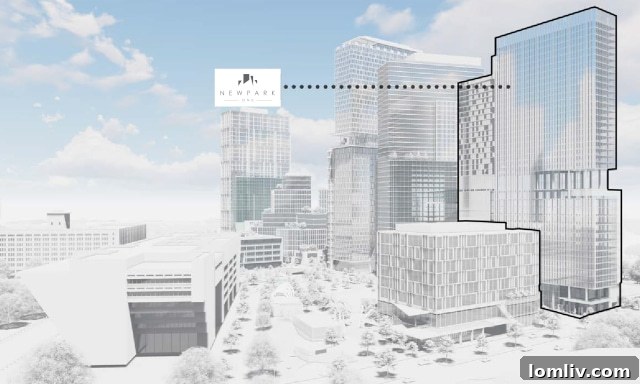
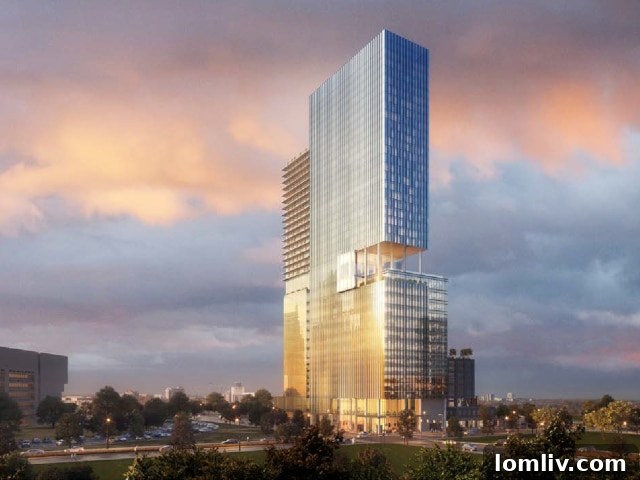
This single, towering structure is envisioned as a vibrant vertical community, seamlessly integrating office spaces, a hotel, residential units, diverse retail outlets, and an array of restaurants. Such a comprehensive mixed-use model aims to foster a lively, self-sustaining environment, echoing contemporary trends in urban living and working. However, its perceived ambition, or lack thereof, has already drawn comment. With a projected height of 488 feet, NewPark One is set to become the 20th tallest building in Dallas. While this is a respectable figure, it notably stands 24 feet shorter than the 1973-built Bryan Tower and a mere five feet taller than the Harwood Tower, completed in 1983. This relative modesty in height has led some to question the project’s true ambition in a city known for its bold architectural statements.
As illustrated in accompanying conceptual renderings, even potential future buildings within the NewPark development, though possibly slightly taller than this initial endeavor, aren’t expected to drastically alter Dallas’s iconic skyline. The formidable 921-foot Bank of America Plaza, which has proudly held the “tallest” crown for 35 years, faces no imminent competition, highlighting NewPark One’s position as a contributor to the city’s density rather than a new architectural landmark defining its uppermost reach.
Navigating Site Specifics: Challenges and Controversies
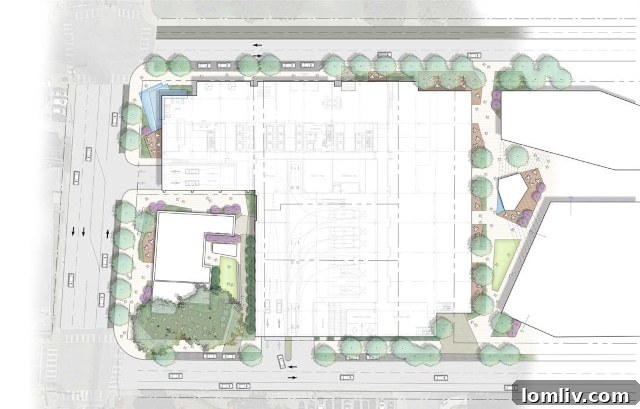
The proposed site plan for NewPark One reveals a nearly square footprint, with a distinct cutout in the lower-left section accommodating Dallas Fire and Rescue’s Station 4 – a critical existing infrastructure piece that presents significant development hurdles. The high-rise itself occupies the east-west expanse across the top, while the section adjacent to the fire station is dominated by a substantial 104-foot “tumor” – a six-story parking podium precariously balancing atop various amenity, lobby, and retail spaces. This configuration has immediately ignited concerns among urban planners and community stakeholders alike.
The Pervasive Parking Podium and the Unmovable Fire Station
The concept of large, above-ground parking podiums often draws criticism for its visual bulk and its tendency to create inactive streetscapes. In the case of NewPark One, this six-story parking structure is perceived by many as an unwelcome obstruction to urban vitality. However, an even more profound challenge arises from the presence of Dallas Fire and Rescue Station 4. The project’s developers, Hoque Global, do not own the fire station property. While there have been informal discussions about relocating the station to more modern facilities, these remain speculative. The practical reality is that the fire station stands as an immovable object within the proposed development, creating an “orphan lot” that will perpetually appear as a hold-out against progress. The developer’s proposed solution – to adorn this awkward corner with what has been described as “banal corporate plop art” – does little to alleviate concerns about urban design aesthetics and seamless integration.
Connectivity Concerns and Future Urban Infrastructure
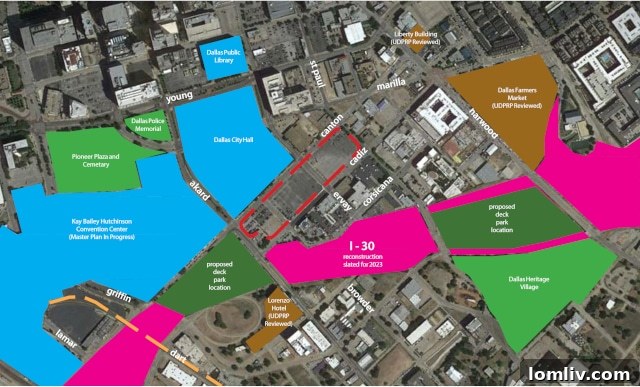
Adding to the complexity, this particular corner is strategically vital, serving as a primary link between the burgeoning NewPark district and the eagerly anticipated I-30 deck park project. As illustrated in conceptual graphics, the juxtaposition of a high-rise, an incongruous fire station, and the deck park access point raises serious questions about urban connectivity and pedestrian experience. The Peer Reviewers were quick to highlight this critical issue to the developers, emphasizing the importance of a cohesive and welcoming interface with the forthcoming park. Furthermore, they pointed out that the impending expansion of the Dallas Convention Center could significantly impact the NewPark One project, either positively or negatively, suggesting a prudent “wait and see” approach before cementing long-term design decisions.
The Browder Street Dilemma: An Artery Blocked
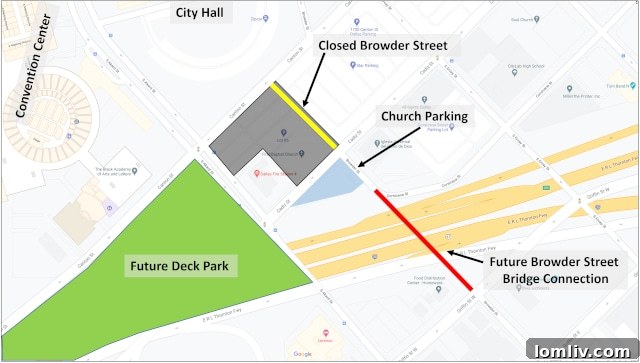
The image above starkly illustrates the challenge: the building’s façade facing the I-30 deck park will be inherently fragmented, presenting a thin, north-facing edge of the high-rise alongside the awkwardly positioned fire station. This fragmented approach stands in stark contrast to the thoughtful and unified façade orientations seen in developments fronting Klyde Warren Park, where urban design principles prioritized seamless integration and public engagement.
Beyond the deck park interface, another critical piece of Dallas’s urban infrastructure is under threat: Browder Street. This seemingly minor thoroughfare is slated for a crucial reconnection of The Cedars neighborhood to downtown once the extensive I-30 renovation is complete and the Browder bridge is restored. However, the developers of NewPark One are proposing to close Browder Street between Cadiz and Canton. The stated rationale? To allow their expansive parking podium to “overflow” and make the project’s financial model viable. This proposal has been met with significant opposition, particularly from the Peer Review Board, who vehemently argued that if Browder Street is closed, the bridge should not even be built. This raises a fundamental question about urban priorities: does the City of Dallas have the authority – and the will – to deny the closure of a vital arterial road? Surely, restoring a critical artery that connects a historic neighborhood like The Cedars to the city center holds more intrinsic value than accommodating the needs of yet another above-ground parking garage.
A Clear Path Forward: Avoiding a Century-Long Mistake
Perhaps the most compelling argument against the current NewPark One proposal is the simple fact that many of these contentious site issues – the problematic fire station and the proposed closure of Browder Street – could be entirely resolved if the developers were to relocate their project just one block east, to land they already own and have designated for Phase Two of the development. The Peer Reviewers rightly emphasized the importance of taking the necessary time to allow for these complex issues concerning the convention center, the deck park, the fire station, and Browder Street to be thoroughly worked out. As one reviewer poignantly warned, rushing forward could “cement a mistake for the next 100 years.”
This begs the question: why are the developers seemingly resistant to such a straightforward and impactful shift? Their primary argument revolves around a potential tenant interested in the office space. However, it’s difficult to fathom that a tenant genuinely interested in a prime downtown office location would be deterred by a mere one-block relocation. The long-term urban legacy of Dallas should undoubtedly take precedence over short-term developer expediency. It is imperative for city planners and decision-makers to collectively “say ‘no’ to a 100-year mistake” and ensure that NewPark One contributes positively to Dallas’s future, rather than creating intractable problems.
The Building Itself: Design, Orientation, and Missed Opportunities
Shifting focus from the contentious site to the architectural design of NewPark One, architects describe the tall building, with its distinctive “sidecar garage tumor,” as stepping down to meet The Cedars neighborhood across I-30. However, for many observers, this design choice appears to strategically position the less appealing aspects of the structure towards the south. The Cadiz Street side, for instance, arguably functions as the building’s “backside,” despite developer assurances that elements like lighted bicycle storage will enliven the street – a claim met with considerable skepticism.
Orientation and Engagement with Green Spaces
The building’s orientation is problematic for several reasons. As previously noted, it is not optimally aligned towards the forthcoming I-30 deck park, a significant new public green space. This missed opportunity for direct engagement with a critical urban amenity is a substantial design flaw. Furthermore, directly across Cadiz Street lies an 11,500-square-foot lot currently owned by the Iglesia Universal del Reino de Dios, primarily used for parking. This parcel represents a significant, yet seemingly overlooked, opportunity. It is highly plausible that Hoque Global could acquire this land, perhaps in exchange for parking within their new building. Such an acquisition would not only extend the I-30 deck park, providing a much-needed additional green space to a development footprint that currently offers precious little, but it would also provide a compelling reason to activate and enhance the southern, Cadiz-facing side of the project, especially if Browder Street is successfully restored.
Reimagining Downtown’s Southern Edge
Despite its numerous issues, one positive aspect of NewPark One is its potential to pull development interest southward, thereby addressing a long-neglected area of downtown Dallas. I.M. Pei’s iconic Dallas City Hall, which has for too long sat on the “cliff-edge” of downtown, could finally find itself nestled within a more vibrant and integrated urban landscape. However, the success of this southern expansion hinges entirely on critical design and planning. Hoque Global’s various lots form a linear progression that could, all too easily, manifest as an impenetrable wall across southern downtown, further isolating areas rather than connecting them. This raises a crucial, broader question: why isn’t the city reviewing and approving this expansive development plan in its entirety, proactively addressing such potential problems before they become entrenched realities? This holistic approach is vital for ensuring thoughtful and sustainable urban growth across Dallas.
Broader Urban Development in Dallas: A Pattern of Concern
The area surrounding NewPark One is, at present, largely a “parking lot wasteland,” a common urban blight that belies its incredible proximity to vibrant destinations such as the Dallas Farmer’s Market, Main Street, the bustling Deep Ellum entertainment district, and the steadily evolving East Quarter. This juxtaposition of potential and existing underdevelopment raises a significant concern: the trajectory of Dallas’s urban revitalization efforts.
Unfortunately, many recent developments in Dallas have fallen short of their promise. The Farmer’s Market, despite significant investment, remains a somewhat underwhelming collection of mid-rise apartments and townhouses. Similarly, highly anticipated districts like Victory Park and the Museum District, while aesthetically pleasing, often lack the genuine vibrancy and organic life that truly defines successful urban spaces. They sometimes feel as sterile and “alive as my Purell-scrubbed hands.” Deep Ellum, once celebrated for its unique character, is increasingly being overrun by generic high-rises perched atop enormous parking garages – a model strikingly similar to the one that has limited the success of Victory Park. This pattern of development raises serious questions about the long-term vision for Dallas’s urban core. One struggles to recall a recent large-scale urban masterplan in the U.S. that has achieved resounding success; even with immense financial backing, ambitious projects like Hudson Yards in New York City have faced significant criticism for their perceived lack of authentic urbanity and public engagement.
NewPark One: Perpetuating a Familiar Model
Against this backdrop of broader urban development concerns, NewPark One, in its current iteration, appears to be perpetuating a familiar and, arguably, problematic model for Dallas. The city already grapples with an abundance of above-ground parking structures, which often contribute to a car-centric environment rather than fostering walkable, pedestrian-friendly neighborhoods.
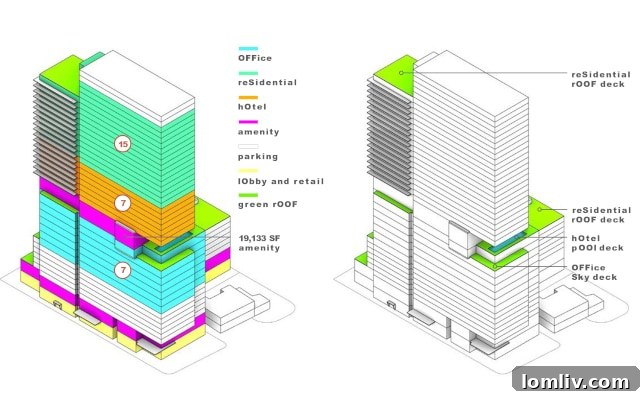
NewPark One’s design, as depicted in the lower “white” section of the above-left graphic, calls for six stories of parking spread across its entire footprint, with only three stories tucked away below ground. This extensive above-ground parking component seems to be the primary justification for the highly controversial proposal to close Browder Street. There is a profound irony in trading a vital urban thoroughfare, a place designed to move people and connect communities, for a structure whose sole purpose is to store cars. This decision would effectively block an essential artery on the very cusp of its much-anticipated reconnection, creating a significant impediment to seamless urban mobility and connectivity.
Architectural Details and Residential Appeal: A Critical Look
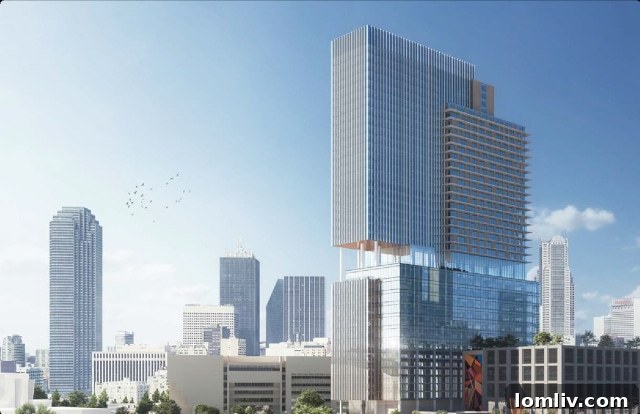
Zooming out from the immediate site challenges, a closer inspection of NewPark One’s overall architectural design, as presented in renderings, reveals further points of contention. The primary tower, standing at 488 feet, is accompanied by a distinctive 104-foot “tumor” on its southern side, a design element that has been a consistent target of critique. Beyond this, the building’s upper aesthetic remains somewhat mystifying. While it is understandable that lower office and hotel floors might not incorporate outdoor balcony spaces, especially pre-pandemic, the current global context of COVID-19 has undoubtedly shifted priorities, prompting questions about the inclusion of operable windows or enhanced ventilation strategies.
More critically, on the upper residential floors, a universal provision of balcony space appears to be absent. While the right-side “cuff” of horizontal ribs seems to house balconies, the corresponding right side of the main building inexplicably lacks outdoor space for those residential units. In a pre-COVID world, this might have been acceptable, particularly for units facing a busy thoroughfare like I-30. However, in the post-pandemic era, high-rise dwellers increasingly prioritize access to private outdoor spaces for fresh air and personal well-being. Coupled with the vertical ribbing on these upper residential floors, the design elements feel more akin to a 1950s-60s International Style office building than a contemporary residential tower, raising questions about its long-term appeal and marketability to discerning urban residents.
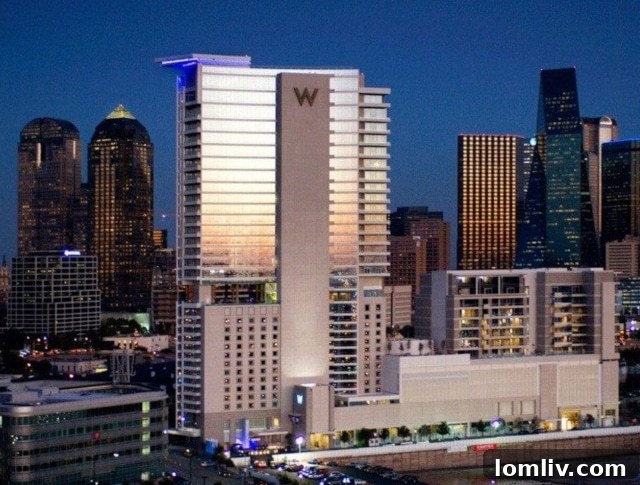
Derivative Design and the W Hotel Precedent
Furthermore, the design of NewPark One exhibits a striking similarity to existing structures within Dallas’s urban landscape, most notably the W Hotel and Residences in Victory Park. The architectural strategy of incorporating a “blank” amenity floor, designed to visually separate different uses within a mixed-use tower, has become a pervasive design trope globally. What might have been considered an exciting or innovative architectural solution two decades ago has now become simply derivative, lacking the originality and distinctiveness required to truly elevate Dallas’s architectural discourse and contribute a unique identity to its evolving skyline.
“But We Understand”: A Disappointing Conclusion from Peer Review
Despite the comprehensive and critical feedback, the ultimate stance taken by the Peer Reviewers regarding NewPark One proved profoundly disappointing to many. While they acknowledged and articulated “major issues” concerning the proposed closure of Browder Street, the building’s awkward interaction with the fire station, its integration with the forthcoming convention center expansion, its relationship to Dallas City Hall, and its interface with the I-30 deck park, their concluding sentiment offered a troubling capitulation. They stated that they “understood” if the developer was “too far along” in the planning process to halt what one reviewer had aptly termed the “cementing [of] a mistake for the next 100 years.”
This sentiment, expressed by a body tasked with upholding high standards of urban design, raises a critical question: Are we to simply accept profound urban planning mistakes because a developer has progressed too far in a flawed process? Such a concession undermines the very purpose of rigorous peer review and threatens to compromise Dallas’s long-term urban vitality for the sake of short-term expediency. The implications of allowing such a project to proceed unchecked could be far-reaching, setting a dangerous precedent for future developments and potentially locking Dallas into a century of compounded urban challenges.