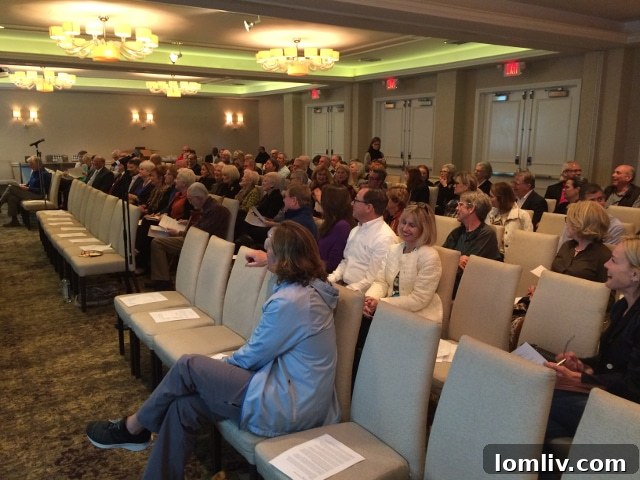
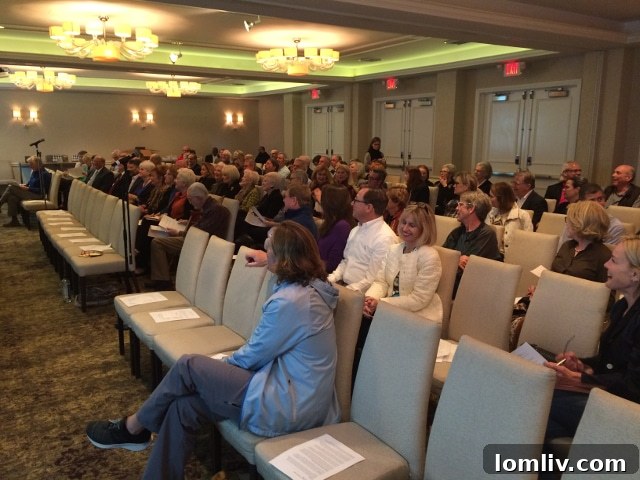
A groundswell of opposition to the controversial Reverchon Park redevelopment plan recently converged at an urgent community meeting. Hosted at the esteemed Mansion on Turtle Creek, the gathering brought together approximately 160 concerned residents to discuss the Dallas City Council’s recent decision. Last week, the council voted to greenlight a public-private partnership with Reverchon Park Sports and Entertainment LLC, a consortium spearheaded by Dallas Mavericks general manager, Donnie Nelson. The partnership’s goal: to transform the historic Reverchon Park Ball Field.
For any District 14 council representative, discovering 160 agitated constituents assembling at a prominent venue like The Mansion on Turtle Creek is undeniably a bad sign. When that same representative chooses not to attend such a crucial meeting, the situation escalates from concerning to outright problematic. This isn’t merely political optics; it’s a fundamental misjudgment of community sentiment. Residents of District 14, much like those in Preston Hollow’s Districts 11 and 13, are renowned for their significant influence and financial resources. Their collective voice, when mobilized, carries substantial weight in Dallas’s civic landscape.
Invitations were extended to key figures involved in the deal: Councilmember David Blewett, a vocal proponent of the project; Donnie Nelson, the principal applicant behind the Reverchon Park redevelopment proposal; and Calvert Collins-Bratton, President of the Parks and Recreation Board and an appointee from District 13. Despite the clear opportunity to engage with the community and address their burgeoning concerns, none of these individuals chose to attend. Their absence further fueled the perception of a lack of transparency and an unwillingness to engage in open dialogue.
The meeting itself was expertly helmed by Don Williams, former president of Trammel Crow, a titan in the real estate industry, with invaluable assistance from Bruce Bowman, a prominent partner at Godwin Bowman, one of Dallas’s largest and most respected law firms. The room was a veritable who’s who of Dallas’s affluent and influential. Presidents of the Mansion Residences and Plaza condos were present, alongside representatives from many of Dallas’s most prestigious high-rises in the Turtle Creek and Uptown neighborhoods. The sheer concentration of wealth and influence within that room was staggering, easily surpassing the value of a substantial Powerball jackpot. This formidable assembly underscored the gravity of the community’s concerns and their collective resolve.
The Power of Capital: Why Financial Influence Matters
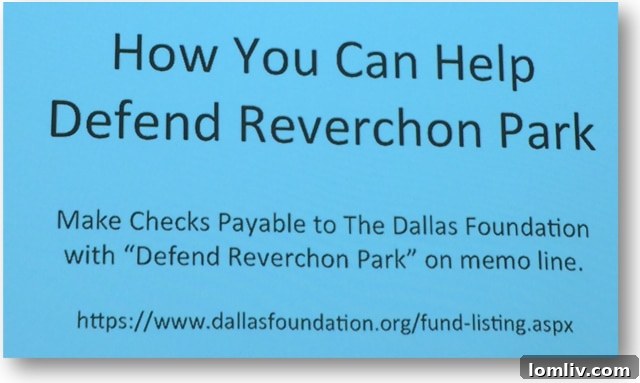
One might wonder why such emphasis is placed on the financial standing and influence of the opposition. The answer is straightforward: while both sides of this debate possess significant resources, a well-funded opposition fundamentally alters the dynamics of the discourse. It signals a capacity to meticulously scrutinize every facet of the deal. If there is even the slightest irregularity, an oversight, or a procedural misstep in the city’s approval process, this group possesses the means to uncover it. To that end, the residents present last night committed to raising a substantial sum of $100,000 specifically for this investigative effort. Demonstrating their immediate commitment and serious intent, the group successfully raised an impressive $20,000 within mere minutes during the meeting, a clear testament to their unity and dedication to the cause.
It’s crucial to contextualize this opposition. Before dismissing this powerful assembly as merely a collection of wealthy “Not In My Backyard” (NIMBY) activists resistant to any development, consider their track record. These are the same influential residents who recently engaged in extensive negotiations and ultimately lent their support to Prescott’s significant three-building project, strategically located adjacent to The Mansion. Furthermore, they were instrumental in welcoming the prestigious Mandarin Oriental hotel, situated just a few doors down. Their willingness to support large-scale, luxury developments that meet appropriate planning and community standards underscores that their opposition to the Reverchon Park deal stems from specific, well-articulated concerns about this particular project, rather than a blanket anti-development stance.
In a notable show of solidarity, District 7 Councilmember Adam Bazaldua attended the meeting. A vocal critic of the plan, he expressed his support for the residents’ concerns and attentively listened to their grievances. His comments to the group echoed his earlier statements made during the council session, primarily highlighting a significant expansion of the project’s scope. Bazaldua emphasized that what began as a modest refurbishment initiative for the existing ball field has inexplicably ballooned into a far more ambitious and impactful event venue, fundamentally altering its original intent and community purpose.
Unpacking the Concerns: Allegations of Irregularity and Lack of Transparency
The community meeting brought to light a series of serious allegations and deep-seated concerns regarding the Reverchon Park deal and the process by which it was approved. These issues point to potential irregularities in city procedures and a perceived lack of transparency.
Challenges in Accessing Public Documents
One of the most immediate and frustrating issues reported by the group was the significant difficulty in obtaining essential documents from City Hall. For citizens to understand and challenge a major public-private partnership, timely access to official records is paramount. For example, discovering the precise details of what was approved at last week’s council meeting proved to be an arduous task. The principles of open government dictate that public information should be readily accessible, especially when time is of the essence. It was also noted that Christopher Caso, the acting city attorney, appears to be adopting a cautious, “hands-off” approach to controversial rulings, a stance many attribute to his ongoing bid to secure the permanent city attorney position. This perceived hesitancy raises questions about the impartial guidance expected from the city’s legal counsel.
Allegations of a Biased Request for Proposal (RFP) Process
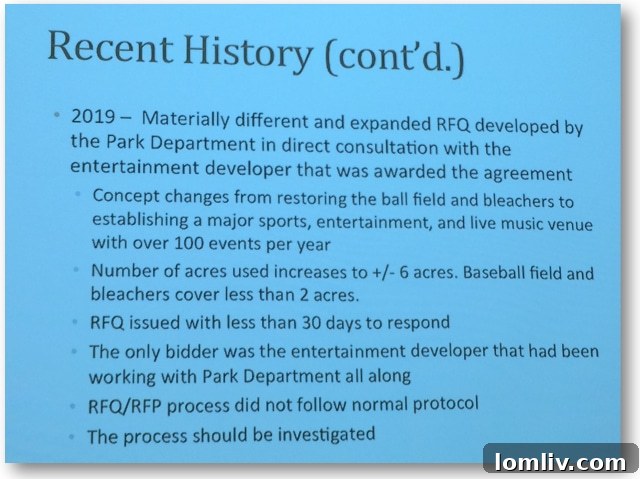
Perhaps the most damning accusation leveled by the opposition group concerns the integrity of the 2019 Request for Proposal (RFP) process. They claim that the RFP was “developed by the Parks Department in direct consultation with the entertainment developer” – the very entity that ultimately secured the bid. Compounding this, the RFP was allegedly issued with an unusually short response window, less than 30 days. Unsurprisingly, the only respondent was the group that had supposedly co-designed the deal with the Parks Department from the outset. If these allegations hold true, this entire process was less a competitive and fair RFP and more a pre-arranged, negotiated deal disguised under the veneer of standard city procurement procedures. Such a scenario undermines public trust and calls into question the fairness and legality of the partnership.
Alarming Scope Creep: From Two Acres to Six and Beyond
Another significant point of contention revolves around the substantial increase in the project’s footprint. The group highlighted that the proposed redevelopment will encompass “approximately 6 acres,” a dramatic expansion from the current ball field’s modest usage of less than two acres. This quadrupling of the project’s land use raises serious concerns about the impact on the surrounding parkland and green space. Furthermore, distressing rumors circulated that the existing recreation center, a vital community asset, might be torn down to accommodate the new project, with plans to relocate its facilities to the park’s tennis courts. Such a move would not only disrupt current recreational activities but also potentially diminish the quality and accessibility of public amenities.
The Scale of Events: A Park Transformed into a Venue
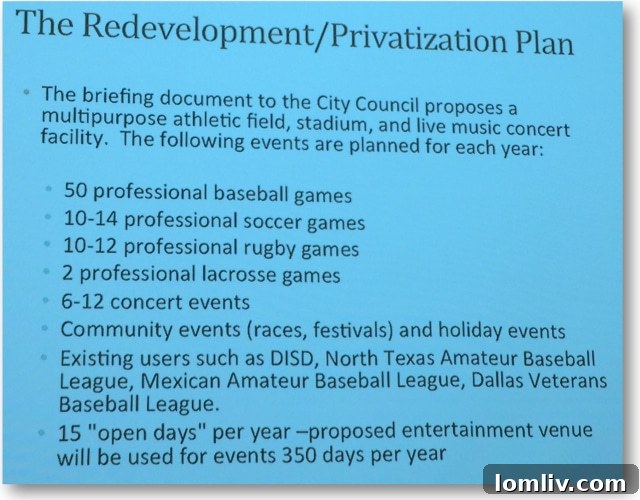
The core concern regarding the project’s shift from “refurbishment” to “event venue” was starkly illustrated by a briefing document reportedly presented to the city council. This document outlines plans for a staggering number of events each year. In total, the document claims there will be activities or events taking place in the park for approximately 350 days annually. This relentless schedule effectively transforms a community park, intended for general public use and passive recreation, into a commercial event space, raising questions about noise pollution, traffic congestion, and fundamental public access for everyday citizens.
Debunking Misinformation and Scrutinizing Stakeholders
During the meeting, claims were made by proponents of the deal that the adjacent Scottish Rite Hospital also supported the plan. Don Williams, leading the meeting, revealed that he had directly contacted the hospital, and their unequivocal response was that they maintain a neutral stance on such matters, explicitly stating they do not take sides. This direct refutation exposed a potential attempt to mislead the public about broader community support.
Beyond scrutinizing the deal itself and its principal players, the opposition group is also turning its attention to those who supported it. Specifically, the “Friends of Reverchon Park” has come under intense focus. Allegations suggest that seemingly none of the non-profit group’s reported monies were ever used for the upkeep or maintenance of the very park it is named after, based on a preliminary review of the group’s tax filings with the IRS. This raises serious questions about the organization’s mission and financial transparency. Furthermore, the group is diligently investigating financial and personnel ties between the “Friends of Reverchon Park” and a collection of entities variously identified as the Trinity Nature Conservancy, Trinity Recreation Conservancy, or Trinity Coalition, seeking to uncover any potential conflicts of interest or interconnected agendas.
Legal Loopholes: “Change of Use” Violations
When the floor was opened for comments from attendees, a critical legal point was raised. Many aspects of the proposed deal, particularly the significant expansion of its scope and its transformation into an event venue, appear to constitute a “change of use” under Texas’s park statutes. These statutory changes typically require separate, publicly noticed meetings to gain community input and approval. According to attendees, such legally mandated meetings never occurred. This omission could represent a serious procedural flaw, potentially rendering aspects of the deal legally vulnerable.
Other attendees pointed to a litany of additional inconsistencies and procedural anomalies, further solidifying the community’s belief that the approval process was flawed and lacked due diligence.
The Clock Is Ticking: Urgency and the Path Forward
The gravity of the situation and the urgency of action were palpable among the group members. They are acutely aware that time is of the essence. Critical filings, such as those related to “change of use” statutes, typically carry strict 30-day deadlines. With a week already passed since the council’s decision, the window for formal challenges is rapidly closing. However, one should never underestimate the power of concentrated financial resources and the collective will to employ them strategically. The rapid fundraising effort seen last night is a clear indication that this influential community group is prepared to expedite legal and investigative actions. Their formidable resources and determined spirit suggest that this is far from a settled matter, and the fight for Reverchon Park’s future is just beginning.
Stay tuned for further developments in this unfolding civic battle.

Remember: My focus areas include high-rises, HOAs, and property renovations. However, I also possess a keen appreciation for modern and historical architecture, often viewed through the lens of the YIMBY movement. My writing has garnered national recognition; in 2016, 2017, and 2018, the National Association of Real Estate Editors honored my work with three Bronze awards (2016, 2017, 2018) and two Silver awards (2016, 2017). Do you have a compelling story to share, or perhaps an interesting marriage proposal idea? Feel free to reach out via email at [email protected]. You’re welcome to search for me on Facebook and Twitter, though you likely won’t find me there.