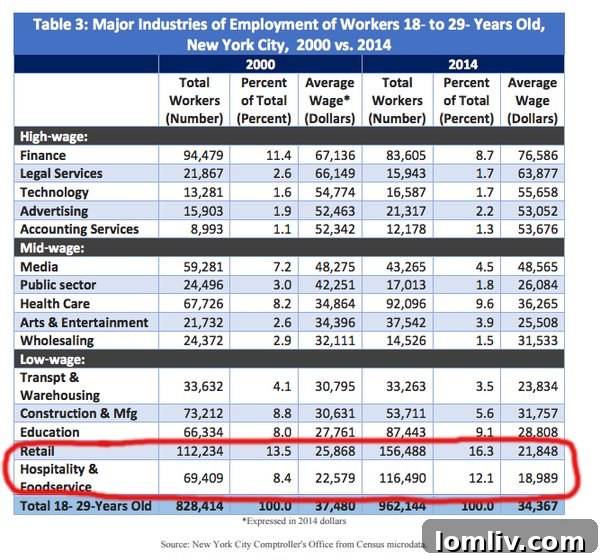
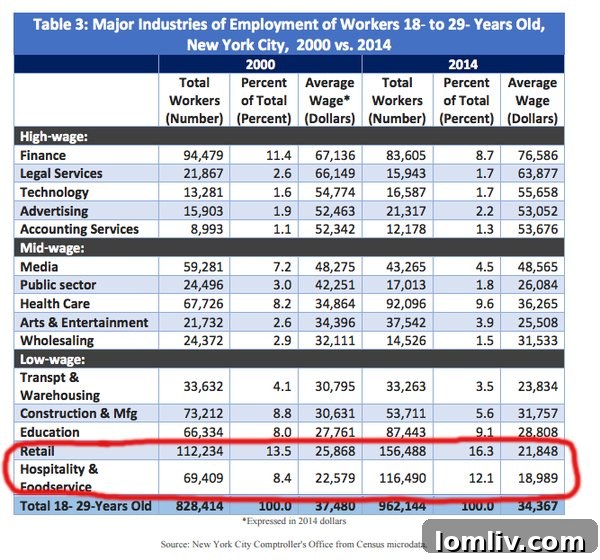
The economic landscape for millennials, particularly in major urban centers, presents a complex and often challenging picture. A compelling chart recently highlighted by Konrad Putzier, a reporter atThe Real Dealin New York City, brought this struggle into sharp focus. The data reveals a significant shift in the employment patterns and earning potential for young adults in one of the world’s most expensive cities. It underscores a generational predicament where rising living costs outpace wage growth, making traditional markers of financial stability, like homeownership, increasingly out of reach.
The Stark Reality: Millennial Wages vs. NYC Living Costs
New York City has long been a beacon of opportunity, a vibrant hub attracting ambitious individuals from across the globe. However, for its millennial residents, the dream often collides with a harsh economic reality. The chart in question illustrates that a substantial 28.4% of NYC millennials are now employed in the retail or hospitality sectors. This marks a notable increase from 21.9% in the year 2000, indicating a significant occupational shift over two decades. While these sectors are vital to the city’s economy and offer diverse employment opportunities, they often come with a critical caveat: lower wages.
The average annual wages in retail or hospitality in New York City are alarmingly less than $30,000. To put this into perspective, NYC consistently ranks among the most expensive cities globally, with exorbitant rents, high transportation costs, and a premium on nearly every service and commodity. Living comfortably on an income of under $30,000 in such an environment is not merely challenging; it’s often unsustainable without external financial support. For a generation that often grapples with significant student loan debt, these wages present a formidable barrier to building wealth and achieving financial independence. Saving for a down payment on a home, or even a modest NYC condo, becomes an almost impossible feat, pushing the aspirational dream of homeownership further into the realm of fantasy for many.
This situation raises critical questions about the long-term economic health of our major cities and the future prospects of their young inhabitants. How can a generation contribute to the vibrancy and dynamism of a city like New York when its economic foundations are so precarious? The struggle in NYC is a microcosm of a broader national trend, signaling a widening gap between the cost of living and the earning potential of a significant segment of the workforce.
The Exodus: Seeking Greener, More Affordable Pastures
Faced with the seemingly insurmountable cost of living in established mega-cities, a growing number of millennials have begun to seek alternatives. The narrative of “escaping” pricey urban centers like New York City, Los Angeles, and San Francisco has become increasingly common. Once the initial allure of city life wears off, or perhaps when parental financial supplements dry up, the pragmatic decision to relocate to more affordable locales takes precedence. Cities like Nashville, Dallas, and Austin have emerged as popular destinations, promising a better quality of life, burgeoning job markets, and, crucially, a lower cost of living.
These secondary cities, often in the Sun Belt or emerging tech hubs, offered a breath of fresh air. They presented opportunities for homeownership that were simply nonexistent in places like NYC, alongside a cultural vibrancy and community spirit that resonated with many young professionals. The prospect of earning a decent wage while also being able to afford a comfortable home, start a family, or save for retirement was a powerful draw. This migratory trend was fueled by a combination of factors, including the rise of remote work, a desire for more space, and a reevaluation of priorities post-pandemic. Millennials, often burdened by student debt and delayed life milestones, saw these cities as their best shot at achieving the financial stability and lifestyle their parents’ generation took for granted.
The influx of talent and capital into these cities spurred economic growth, leading to new job opportunities and a diversified business landscape. For a time, it seemed like a sustainable solution, offering a pathway for millennials to build wealth and integrate into communities that genuinely welcomed their contributions. However, this period of relative affordability proved to be fleeting, as the very forces that attracted new residents also set in motion a new set of challenges.
The Spreading Crisis: Affordability Evaporates in Secondary Cities
The promise of lasting affordability in cities like Dallas, Nashville, and Austin is now rapidly eroding. The increased demand, driven by the millennial migration, coupled with significant investment and development, has inevitably led to a surge in housing prices and the overall cost of living. What were once considered affordable havens are quickly becoming the next generation of expensive urban centers, albeit on a slightly different scale than NYC.
This phenomenon is complex. On one hand, the growth brings economic vitality, new businesses, and enhanced infrastructure. On the other hand, it displaces long-term residents, strains existing resources, and creates a new affordability crisis for both original inhabitants and recent arrivals. Rapid gentrification, coupled with insufficient affordable housing initiatives, means that the window of opportunity for accessible living is closing. For millennials who meticulously planned their moves based on economic projections, this shift can be particularly disheartening. They are finding themselves in a familiar predicament, where the cost of housing continues to outpace wage growth, even in markets they once considered their best hope.
This trend highlights a systemic issue within the broader economy: the inability of wages, particularly in service-oriented sectors, to keep pace with the escalating costs of housing and daily living. It suggests that the problem isn’t just confined to a few ultra-expensive cities but is a pervasive challenge that requires a more holistic approach to urban planning, economic development, and wage policies across the nation. The search for true affordability becomes a continuous, elusive chase, leaving many millennials perpetually on the cusp of financial strain.
Deciphering the Millennial Wage Puzzle: Beyond Urban Costs
While the cost of living in specific cities plays a major role, the broader factors influencing millennial wages paint an even more comprehensive picture of their economic struggle. This generation entered the workforce during challenging times, navigating the aftermath of the 2008 financial crisis, the rise of the gig economy, and significant shifts in industrial landscapes. Unlike previous generations, many millennials are burdened by unprecedented levels of student loan debt, which directly impacts their disposable income and ability to save. This debt acts as an anchor, delaying significant life milestones such as homeownership, marriage, and starting a family.
Furthermore, the nature of work itself has evolved. The gig economy, while offering flexibility, often comes with less job security, fewer benefits, and inconsistent income compared to traditional employment. Many entry-level positions across various industries have seen stagnant wage growth for years, failing to keep pace with inflation. Automation and global competition also exert downward pressure on wages in certain sectors. Even for those with higher education, the returns on investment in terms of salary increases haven’t always materialized as expected, leading to a feeling of being “underemployed” or “underpaid” relative to their qualifications and efforts.
The disparity between productivity and wage growth is another critical factor. Over the past few decades, worker productivity has consistently risen, but these gains have largely gone to corporate profits and executive compensation, rather than being passed down to the average worker in the form of higher wages. This fundamental imbalance contributes significantly to the feeling of economic stagnation experienced by many millennials, regardless of their geographical location or specific industry.
The Elusive Dream of Homeownership and Wealth Building
The combination of low wages, high living costs, and persistent debt creates a formidable barrier to homeownership, a cornerstone of wealth building for many generations. A down payment, closing costs, and ongoing mortgage payments often require a level of savings and stable income that is simply unattainable for millennials earning less than $30,000 annually, or even significantly more in expensive markets. This delay in homeownership has profound long-term consequences, as property ownership has historically been a primary driver of generational wealth transfer and financial security.
Without the ability to invest in real estate, millennials miss out on potential equity growth, leaving them reliant on other, often riskier, forms of investment or simply unable to build substantial assets. This exacerbates the generational wealth gap, as older generations benefited from more accessible housing markets and robust wage growth during their prime earning years. The psychological toll of this struggle is also significant, as the aspiration for a stable home and a secure future remains a distant dream for many, contributing to increased stress and uncertainty about their financial trajectory.
Moreover, the broader impact on the economy is noticeable. A generation unable to achieve major financial milestones can lead to reduced consumer spending, slower economic growth, and an overall sense of stagnation within the market. Addressing the challenges faced by millennials is not just about their individual well-being; it’s crucial for the sustained health and vibrancy of the national economy.
A Look Ahead: Navigating the New Economic Landscape
The economic challenges faced by millennials, from stagnant wages in high-cost cities like New York to the creeping unaffordability in once-accessible markets like Dallas, necessitate a reevaluation of our economic and urban development strategies. This generation is resilient, adaptable, and innovative, often finding creative ways to navigate complex financial landscapes. However, systemic issues require systemic solutions. Policies promoting affordable housing, initiatives for wage growth tied to productivity, and comprehensive student loan relief could alleviate some of the immense pressure.
As millennials continue to define their paths, their experiences will undoubtedly shape future economic discourse. They are redefining what success looks like, often prioritizing experiences, flexibility, and purpose over traditional markers of wealth. Yet, the fundamental desire for financial security and stability remains. Understanding their plight is not just an academic exercise; it’s essential for fostering a more equitable and sustainable future for all generations. The narrative of millennial wages and the cost of living serves as a powerful reminder that economic progress must be inclusive, ensuring that opportunity is genuinely accessible to everyone, regardless of where they choose to build their lives.