In today’s fast-paced digital economy, the ability to transfer money electronically has become an indispensable convenience for individuals and businesses alike. From paying bills and receiving salaries to making large-scale property purchases, electronic funds transfers (EFTs) facilitate billions of transactions daily. However, not all EFTs are created equal. Among the most common methods for moving money between bank accounts are wire transfers and Automated Clearing House (ACH) transfers. While they both achieve the goal of digital money movement, their underlying mechanisms, speed, costs, security features, and suitability for various transactions differ significantly. Understanding these distinctions is not just a matter of financial literacy; it’s a critical component for making informed decisions, particularly when dealing with high-stakes financial commitments like real estate transactions where the timely and secure transfer of “good funds” is paramount.
The term “Electronic Funds Transfer” serves as a broad umbrella, encompassing a wide array of financial transactions. This includes everything from the humble ATM withdrawal and point-of-sale debit card purchases to more complex systems like e-checks, direct deposits, and peer-to-peer payment apps. At the heart of this electronic ecosystem are wire transfers and ACH transfers, each playing a unique role. For consumers and businesses navigating their financial landscapes, especially in scenarios involving title companies for property closings, grasping the nuances of these transfer methods is absolutely essential to avoid costly delays, unexpected fees, or even the devastating impact of financial fraud.
Understanding Wire Transfers: Speed, Security, and Finality
Wire transfers represent one of the fastest and most direct methods of electronic money movement. Originating from telegraph technology, modern wire transfers enable the rapid transmission of funds directly from one individual’s or entity’s bank account to another. When a wire payment is initiated, the funds are typically made available to the payee almost instantly upon arrival in their bank account, allowing for immediate access and use. This real-time or near real-time settlement makes wire transfers the preferred choice for transactions where speed and reliability are critical, and time is of the essence.
The operational backbone of domestic wire transfers in the United States often relies on systems like Fedwire, operated by the Federal Reserve. For international transfers, the SWIFT (Society for Worldwide Interbank Financial Telecommunication) network is predominantly used, facilitating secure communication and instruction exchange between financial institutions globally. These sophisticated networks ensure that funds are moved with a high degree of security and traceability.
Key Characteristics and Considerations of Wire Transfers:
- Unmatched Speed: Wire transfers are known for their rapid execution. Funds are often transferred and available in the recipient’s account within hours, and sometimes even minutes, of being sent. This makes them ideal for time-sensitive payments such as earnest money deposits or final closing funds in real estate deals, where delays can have significant contractual and financial consequences.
- High Reliability and Finality: Once a wire transfer is completed, the funds are considered settled and are notoriously difficult, if not impossible, to reverse. This finality provides a high degree of certainty for the recipient that the funds are genuinely theirs and not subject to recall. While this feature is a significant advantage for recipients (e.g., a seller receiving payment for a property), it also poses a risk for the sender if the transfer instructions were incorrect or if the payment was sent to a fraudulent party.
- Higher Transaction Costs: Due to the real-time, often manual, and secure nature of processing wire transfers, financial institutions typically charge fees. These fees can range from approximately $10 to $100 per transaction, depending on whether it’s an outgoing or incoming wire, domestic or international, and the specific policies of the bank. Both the sender and, in some cases, the recipient may incur these charges, making them less suitable for small, routine transactions.
- Vulnerability to Scams: Despite their inherent security protocols, wire transfers are a frequent target for sophisticated fraudsters. Common scams include business email compromise (BEC) where criminals impersonate known parties (like real estate agents, title companies, or legal counsel) and send altered wire instructions. It is absolutely paramount to independently verify all wire instructions through a trusted, known contact method (e.g., a phone call to a previously verified number, not one provided in a suspicious email) before initiating any transfer. Wire instructions will always include the bank routing number, account number, and the full legal name of the party receiving the money; any deviation or last-minute change should raise immediate red flags.
- Preferred by Title Companies: For real estate transactions, title companies overwhelmingly prefer and often require wire transfers for the transfer of closing funds. This preference stems from the speed and finality of wires, which align with the “good funds” requirements in real estate law. “Good funds” refers to money that is immediately available and irrevocably transferred, ensuring that property ownership can be legally and securely transferred without the risk of funds being recalled or delayed. Wire transfers offer a much greater degree of security and dependability compared to methods like cashier’s checks, which, while previously common, can take longer to clear and have become increasingly susceptible to counterfeiting and fraud.
Exploring ACH Transfers: Convenience, Cost-Effectiveness, and Batch Processing
An Automated Clearing House (ACH) transfer is another common method for moving money electronically, but it operates on a different principle than a wire transfer. The ACH network, managed by Nacha (National Automated Clearing House Association), is a centralized system that processes electronic transactions in large batches rather than individually in real-time. Think of it as an electronic cousin to sending a paper check, only significantly faster and more efficient. ACH transfers have become a cornerstone of modern financial life, underpinning many automated payment systems we use daily.
If you’ve ever set up automated bill payments for utilities, received a direct payroll deposit, or sent money to a friend via popular peer-to-peer payment apps like PayPal or Venmo (which often leverage the ACH network), then you’ve utilized an ACH transfer. This method is increasingly replacing traditional paper checks due to its convenience, lower cost, and environmental benefits.
Key Characteristics and Considerations of ACH Transfers:
- Batch Processing System: Unlike the real-time nature of wires, ACH transfers are collected and processed in batches throughout the day, usually several times a day on business days. These batches are then sent to the Automated Clearing House, which routes them to the appropriate receiving banks. This batch processing is what contributes to the slower settlement time.
- Cost-Effective: One of the most attractive features of ACH transfers is their low cost. Most consumer-initiated ACH transfers (like bill payments or direct deposits) are free for the sender or recipient. Businesses typically incur a nominal fee, often just a few cents or a couple of dollars per transaction, making it a highly economical choice for high-volume or recurring payments. This cost efficiency makes ACH an appealing option for both individuals managing personal finances and businesses handling operational expenses.
- Slower Processing Time: The trade-off for the low cost is speed. While wire transfers are often completed within hours, ACH transfers typically take 1 to 3 business days to fully process and clear. In some cases, especially with newer banks or less frequent batch processing, it could take even longer. This inherent delay means ACH transfers are unsuitable for time-sensitive transactions where immediate fund availability is critical.
- Reversibility: Unlike wire transfers, ACH payments can be reversed under certain circumstances. A sender can initiate a reversal for reasons such as unauthorized transactions, errors (e.g., incorrect amount or recipient), or insufficient funds. While this feature offers a layer of protection for the sender in case of mistakes or fraud, it creates a significant risk for recipients, especially in scenarios where immediate and guaranteed funds are required. For example, a title company cannot rely on funds that could potentially be recalled days after a property closing.
- Common Use Cases: ACH transfers are best suited for frequent, recurring, or non-urgent transactions. This includes payroll, pension and social security benefits, utility bill payments, mortgage payments, subscription services, person-to-person transfers, and business-to-business payments for regular invoices. Their low cost and ease of setup make them ideal for automating financial processes.
- Not Suitable for Real Estate Closings (“Good Funds” Issue): This is a critical point for anyone involved in property transactions. The batch processing and the potential for reversal mean that ACH payments do not meet the legal definition of “good funds” required for real estate closings in many jurisdictions, including Texas. For instance, the Texas Insurance Code, Title XI, Section 2651.202, specifies that funds must be immediately available and irreversible for a closing to be considered complete and for property ownership to legally transfer. Sending closing funds via an ACH transfer is a recipe for significant delays, potential penalties, and could even jeopardize the entire sale, as the title company cannot finalize the transaction until confirmed, irreversible funds are received.
Wire vs. ACH: A Comparative Overview
To summarize, the choice between a wire transfer and an ACH transfer hinges on several key factors:
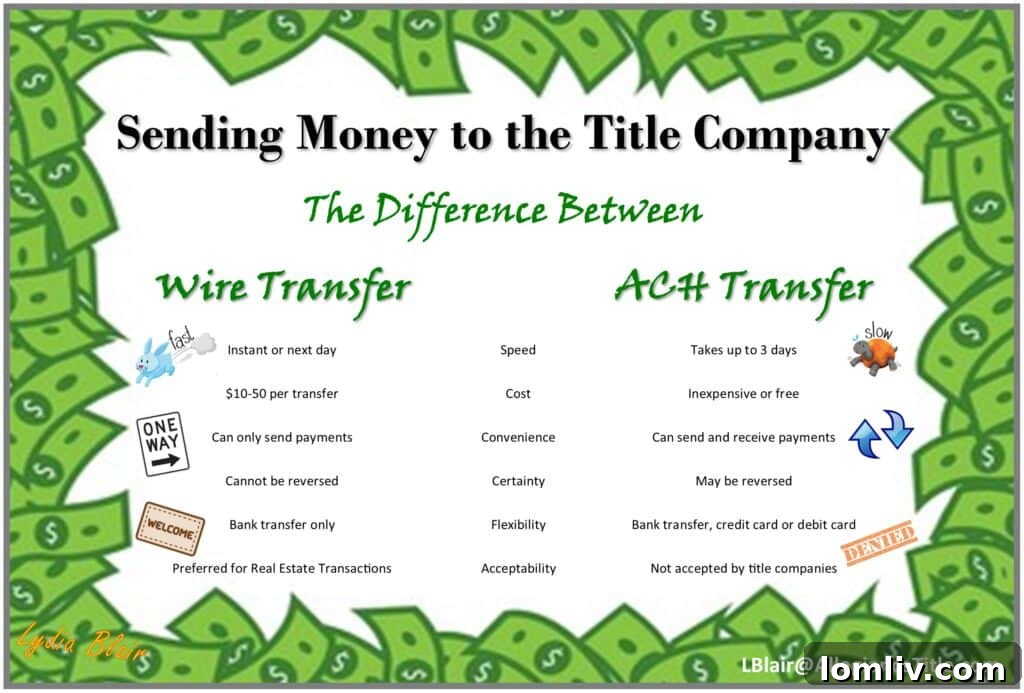
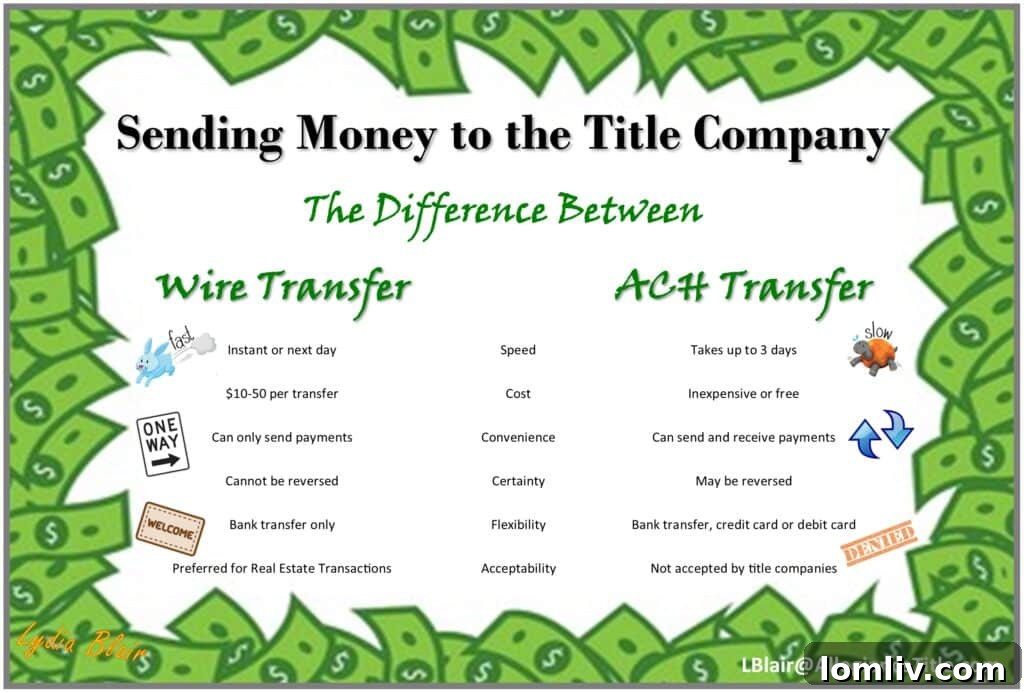
| Feature | Wire Transfer | ACH Transfer |
|---|---|---|
| Speed | Hours (often minutes) | 1-3 business days (sometimes longer) |
| Cost | Higher ($10-$100) | Lower (often free for consumers, a few dollars for businesses) |
| Finality/Reversibility | Difficult, if not impossible, to reverse (final for recipient) | Can be reversed under certain conditions (sender protection) |
| Security (Fraud Risk) | High risk of social engineering/impersonation fraud due to finality | Lower risk of immediate irreversible fraud, but still susceptible to unauthorized transactions |
| Best Use Cases | Time-sensitive, high-value transactions (e.g., real estate closings, large asset purchases, international trade) | Recurring payments (e.g., payroll, bill payments), low-value person-to-person transfers, B2B payments |
| Transaction Limits | Generally higher limits, often no fixed maximum imposed by banks | Typically lower daily/monthly limits than wires, can vary by bank and account type |
Critical Considerations for Real Estate Transactions
When you’re involved in purchasing or selling property, the method you choose to transfer funds to the title company is not merely a matter of preference; it’s a non-negotiable requirement dictated by legal and practical necessities. Title companies are tasked with ensuring a clean and legal transfer of property ownership, a process that absolutely demands the certainty of “good funds.” As discussed, ACH payments, with their inherent delays and potential for reversal, simply do not meet this standard. Using an ACH transfer for closing funds would create an unacceptable level of risk and virtually guarantee significant delays, potentially causing the entire closing to fall through.
It’s crucial to be proactive and diligent. Always confirm with your title company the exact method for transferring funds and adhere strictly to their instructions. Be wary if a bank representative suggests that wire transfers and ACH transfers are interchangeable for real estate closings; this is incorrect and could lead to serious complications. The responsibility for ensuring that “good funds” arrive at the title company on time, and via the correct method, ultimately rests with the buyer. This vigilance protects not only your investment but also ensures a smooth and successful property transfer.
Safeguarding Your Funds: Essential Security Practices
Given the increasing sophistication of financial fraud, particularly related to electronic transfers, adopting robust security practices is more important than ever:
- Verify, Verify, Verify: Before initiating any wire transfer, especially for large sums, independently verify the recipient’s bank details and account information. Do not rely solely on email instructions. Call the recipient (e.g., title company, real estate agent, lawyer) using a previously known and verified phone number, not a number found in an email that might be fraudulent. Confirm the routing number, account number, and recipient name verbally.
- Be Skeptical of Changes: Any last-minute changes to payment instructions, especially via email, should be treated with extreme suspicion. This is a hallmark of wire fraud. If you receive such a request, verify it through multiple, independent channels.
- Use Secure Communication: If sensitive banking information needs to be exchanged, use secure portals or encrypted communication methods rather than standard email.
- Enable Multi-Factor Authentication (MFA): Implement MFA for all your online banking and financial accounts. This adds an extra layer of security, requiring a second form of verification beyond just a password.
- Monitor Your Accounts: Regularly review your bank statements and transaction history for any unauthorized or suspicious activity. Report discrepancies immediately to your financial institution.
- Educate Yourself: Stay informed about common fraud schemes. Knowledge is your best defense against becoming a victim.
In conclusion, while both wire transfers and ACH transfers serve the vital function of moving money electronically, their operational differences make them suitable for distinct purposes. Wire transfers offer unparalleled speed and finality, making them indispensable for high-value, time-sensitive transactions like real estate closings, despite their higher cost and susceptibility to fraud if verification steps are ignored. ACH transfers, on the other hand, provide a cost-effective and convenient solution for recurring, lower-value, or less time-critical payments, albeit with slower processing times and the potential for reversals. By understanding these fundamental differences and adhering to stringent security protocols, individuals and businesses can confidently navigate the world of electronic funds transfers, ensuring their financial transactions are conducted efficiently, securely, and appropriately for every unique situation.