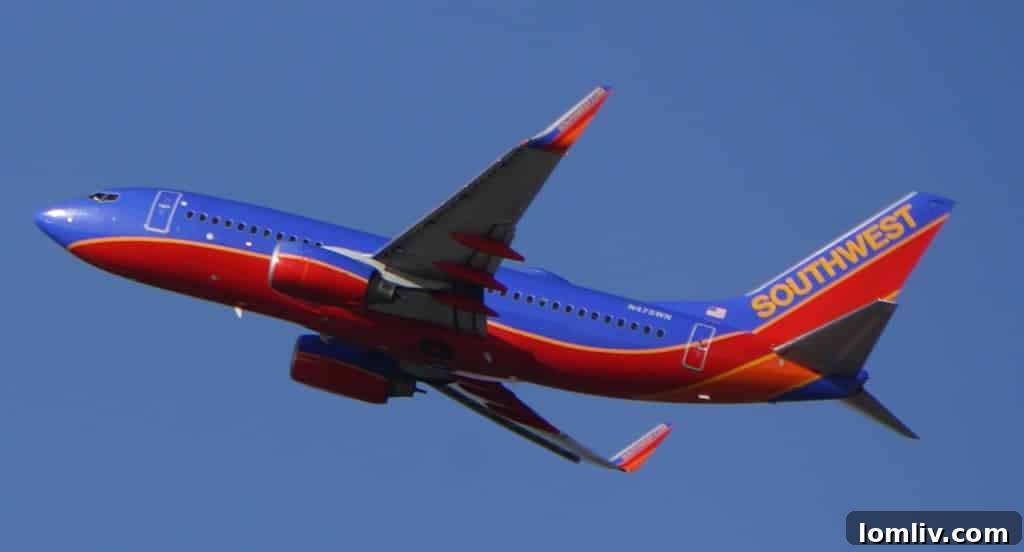
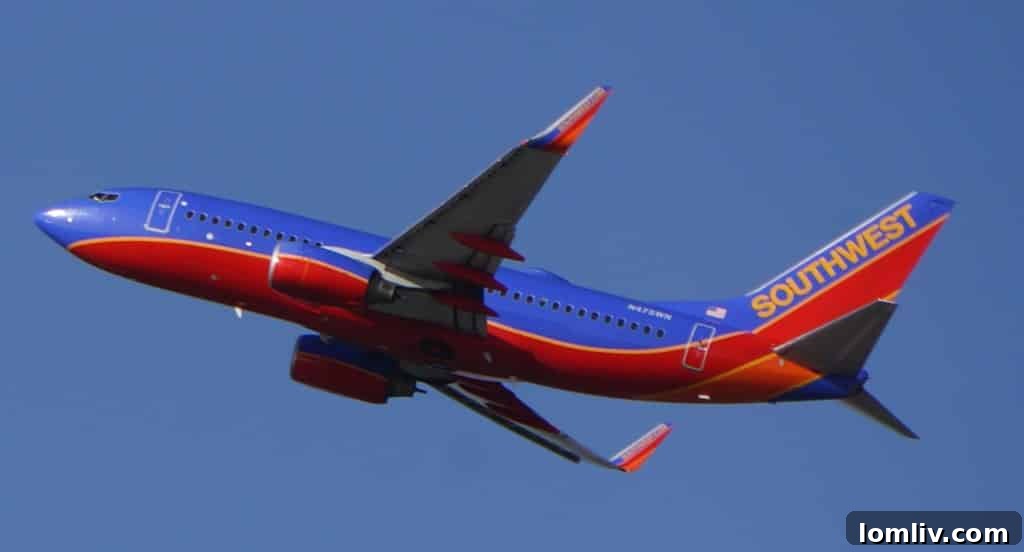
The persistent roar of aircraft engines over Dallas Love Field continues to fuel frustration among residents living in its vicinity. While anger simmers, a growing understanding suggests the true challenge isn’t with the City of Dallas, which owns the airport, but rather with the airlines themselves, many of whom are not adhering to a voluntary noise curfew designed to offer nighttime respite. This ongoing struggle highlights a complex balancing act between critical air travel operations and the quality of life for thousands of North Texas citizens.
In a concerted effort to address these deeply rooted concerns, the Love Field Citizens Action Committee (CAC) has been diligently collaborating with airport management. Their joint aim is to prepare a comprehensive briefing for the Dallas City Council, a pivotal meeting now scheduled for November 1st. This upcoming presentation is expected to outline the severity of the problem and propose tangible solutions. Ahead of this, the Dallas Love Field’s renowned Good Neighbor Program will host an important community gathering at 6 p.m. on October 17th. This meeting, held at the AviationFoxtronics Building located at 3448 W. Mockingbird Lane, provides residents another crucial opportunity to voice their experiences and learn about ongoing mitigation efforts.
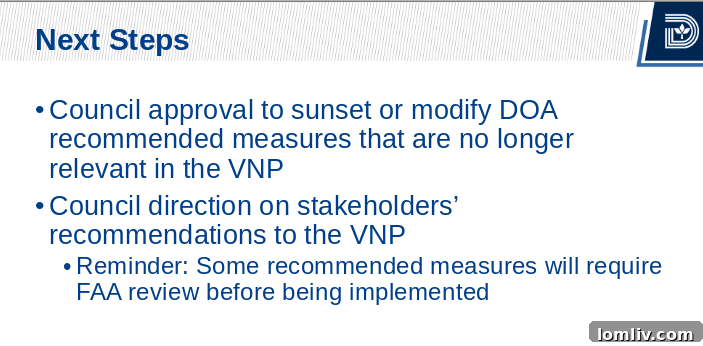
During a recent Environmental Commission meeting, Aviation Director Patrick Carreno presented a total of 14 recommendations aimed at mitigating airport noise. These proposals, largely the culmination of collaborative efforts, have received significant support from the airport staff. Notably, only one of these recommendations failed to garner the Department of Aviation’s backing, underscoring a broad consensus on the urgent need for action. Carreno’s leadership in bringing these issues to the forefront signifies a crucial step in formalizing solutions that have long been sought by affected communities.
While the Love Field Citizens Action Committee’s thoughtful and cooperative strategy offers a promising path towards achieving results, the sentiment among some long-suffering Love Field neighbors remains one of despair. Lengthy emails exchanged regularly within the community reveal a deep-seated frustration and a sense of having been continuously overlooked. Many residents have simply lost hope that the relentless aircraft noise will ever truly be abated, leading to feelings of resignation and chronic stress.
One such resident, Andy Wallace, candidly expressed this disillusionment in an email, stating, “A lot of lies were told to get us here.” Wallace specifically pointed to Southwest Airlines, suggesting they have consistently emerged victorious in various scenarios, primarily to avoid costs associated with taxiing to a more distant runway and to benefit from tax incentives related to terminal development. He elaborated on the personal toll, adding, “I’ve had to stop caring so much about this because it has caused so much stress. I’ve talked to others who feel the same but again the community is the one organization who appears to always be overlooked in all airport decisions.” This sentiment underscores the profound impact of noise pollution not just on physical environments but on the mental well-being and civic trust of the local populace.
For more details on the community’s prior efforts, residents have previously taken their noise complaints directly to the Dallas City Council, as documented in this earlier report.
Proposals for Noise Mitigation: A Detailed Look at the CAC’s Recommendations
At the Environmental Commission meeting held last week, Steve Klein, co-chair of the Love Field Citizens Action Committee, alongside members Kerri Lacher and Pat White, passionately presented their comprehensive strategy for tackling the pervasive noise issue. Klein emphasized the overarching objective of their efforts: “Our chief goal is to effect a culture change.” He elaborated on this vision, stating, “We feel that nothing changes unless there is a top-down culture change that places noise-sensitivity issues at top of mind with the operational culture at Dallas Love Field.” This proposed cultural shift aims to embed noise reduction as a core operational principle rather than a secondary consideration, ensuring that decision-making processes inherently prioritize community well-being.
Klein also highlighted the unprecedented growth at the airport, noting that enplanements are currently at an all-time high. This surge in air traffic directly correlates with increased noise, exacerbating existing problems. He acknowledged the regulatory framework governing airport operations: “We operate in a federal regulatory environment that offers us some tools to regulate operational noise at the airport locally, however many must be approved by the FAA.” This dependence on federal approval presents both opportunities and challenges for implementing local noise abatement measures.
A crucial aspect of the CAC’s approach is the practicality and cost-effectiveness of their proposals. Klein asserted that all 14 of the committee’s recommendations are realistic, with several requiring no associated cost for implementation. This pragmatic perspective aims to present solutions that are not only effective but also financially viable, increasing the likelihood of their adoption. For a comprehensive understanding, the full Oct. 11 Environmental Commission presentation and the Citizens Action Committee background document provide detailed insights into their findings and proposals.
The 14 specific recommendations put forth by the Love Field Citizens Action Committee are:
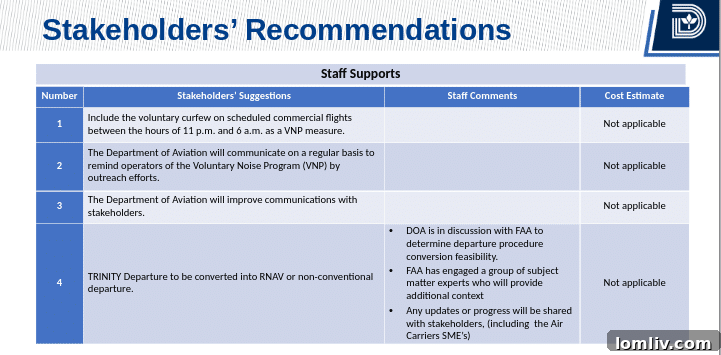
- Implement Mandatory Noise Curfew: Include a voluntary noise curfew at Love Field, precluding the scheduling of passenger airline flights between 11 p.m. and 6 a.m., into the Voluntary Noise Program (VNP) with stronger enforcement mechanisms. This aims to formally codify quiet hours, offering residents predictable periods of peace.
- Regular Operator Communication: The Department of Aviation will regularly communicate with and remind all operators about the provisions and importance of adhering to the VNP. Consistent reminders are crucial for maintaining compliance.
- Improved Stakeholder Communication: The Department of Aviation will enhance its communication channels and transparency with all stakeholders, including residents and community groups. Better communication fosters trust and ensures residents are informed.
- TRINITY Departure Conversion to RNAV: Convert the existing TRINITY departure procedure into an Area Navigation (RNAV) departure procedure by the FAA. RNAV procedures allow for more precise flight paths, potentially routing aircraft away from densely populated areas.
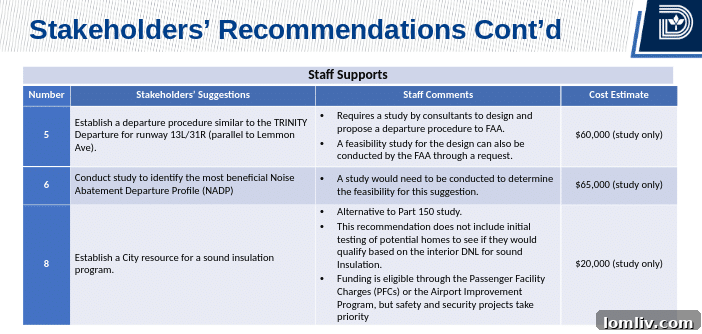
- Establish Parallel Departure Procedure: Create a departure procedure similar to the TRINITY departure specifically for Runway 13L/31R (the runway parallel to Lemmon Avenue). This would provide an alternative flight path, distributing noise more evenly.
- Study Noise Abatement Departure Profile (NADP): Conduct a comprehensive study to identify and implement the most beneficial Noise Abatement Departure Profile (NADP). NADPs dictate specific climb rates and power settings to minimize noise over communities during takeoff.
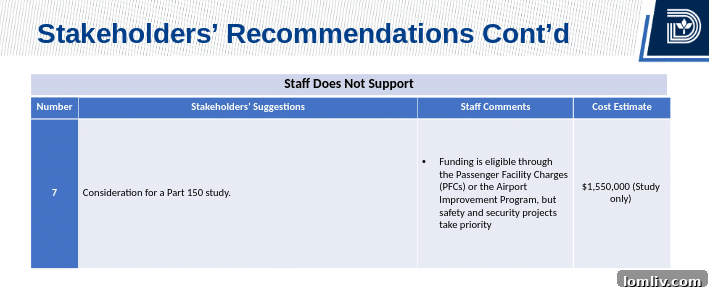
- Consideration for Part 150 Study: Evaluate the feasibility and necessity of undertaking a Part 150 study, an FAA-defined process for developing an airport noise compatibility program. This study involves extensive analysis and community input to develop formal noise mitigation strategies.
- Establish Sound Insulation Program Resource: Create a dedicated city resource for the implementation of a sound insulation program. Such a program would offer financial assistance to homeowners for noise-proofing their residences.
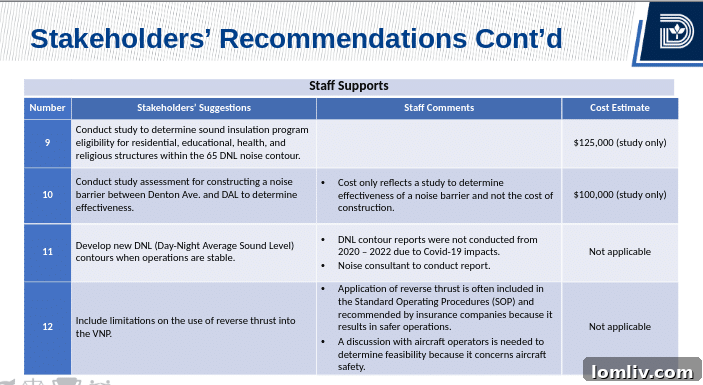
- Detailed Sound Insulation Eligibility Study: Conduct a detailed study to determine eligibility for the sound insulation program for residential, educational, health, and religious structures situated at or above the 65 Day-Night Average Sound Level (DNL) noise contour. This ensures that the most affected properties receive support.
- Noise Barrier Effectiveness Study: Conduct a study assessment for constructing a noise barrier between Denton Avenue and Dallas Love Field to determine its potential effectiveness in reducing noise pollution for nearby communities.
- Develop New DNL Contours: Develop updated Day-Night Average Sound Level (DNL) contours using current 2023 flight data. Up-to-date contours are essential for accurately identifying areas most impacted by noise and guiding mitigation efforts.
- Provisional Reverse Thrust Limitations: Implement provisional limitations on the use of reverse thrust, contingent upon weather and safety conditions. Reducing reverse thrust can significantly lessen ground noise during landing.
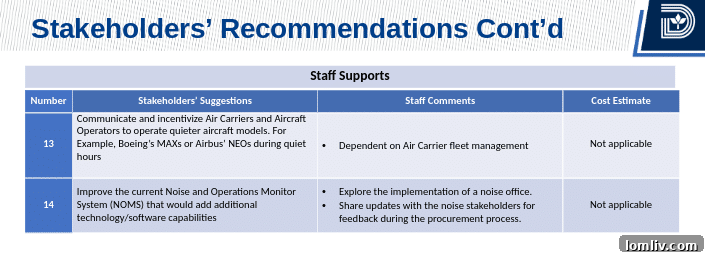
- Encourage Quieter Aircraft: Actively communicate with Air Carriers and Aircraft Operators to encourage the use of quieter aircraft models (such as Boeing’s MAX series or Airbus’ NEOs) during quiet hours. Newer aircraft are designed with advanced noise reduction technologies.
- Improve Noise and Operations Monitor System (NOMS): Enhance the current Noise and Operations Monitor System (NOMS) by integrating additional technology, software, and advanced reporting capabilities. An improved NOMS provides more accurate data for tracking noise events and identifying non-compliant flights.
Regarding these proposals, Carreno confirmed at the October 11th Environmental Commission meeting that Department of Aviation staff support all recommendations except for No. 7. He clarified that recommendations Nos. 8 and 9, which focus on establishing a city resource for a sound insulation program and conducting detailed eligibility studies, offer a more direct and effective solution for residents than the stakeholders’ proposal No. 7, which calls for a voluntary FAA-defined process for airport noise studies. While a Part 150 study is comprehensive, Carreno’s preference suggests a desire for more immediate and locally controlled noise abatement measures.
Carreno acknowledged that the implementation of many of these measures would not be instantaneous. “Some of these measures are going to take FAA review,” he stated, “Some are going to take some time before being implemented.” Despite these complexities and the need for federal approvals, he conveyed a clear commitment: “Our recommendation is to move forward with 13 of the 14 recommendations.” This indicates a strong institutional will to address the noise problem, even if the path to full implementation is gradual.
Dallas Love Field Neighbors Say Noise is Intolerable
Residents across a wide swath of neighborhoods surrounding Dallas Love Field, including Bluffview, Elm Thicket/Northpark, Briarwood, Love Field West, Bordeaux Village, and Highland Park, report that the airport noise has become an incessant intrusion, plaguing them throughout the day and night. This constant disturbance persists despite the existence of a voluntary curfew, which many feel is a token gesture offering little genuine relief.
For additional details on the city council’s authorization of upgrades at Love Field and the ongoing silence on resident noise complaints, readers can refer to this related article.
Attorney Henry Simpson articulated the severity of the situation from a legal perspective, stating, “The intolerable levels of noise generated by Southwest Airlines aircraft have now pervaded the hours after midnight and before dawn to the point where it warrants the issuance of a court injunction against the continuing nuisance.” Simpson’s strong language reflects the frustration over the lack of effective action, asserting that “Voluntary abeyance has become a sham utilized to induce those affected to believe there is some reasonable effort made to curtail aircraft noise originating at and around Love Field. There is not.” This highlights a significant trust deficit between the community and the airline industry, with residents feeling that their concerns are not being genuinely addressed.
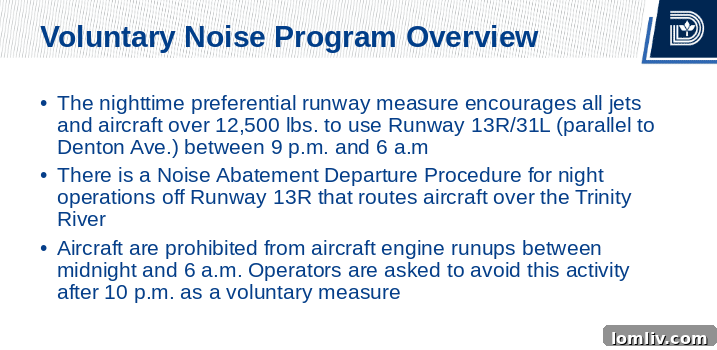
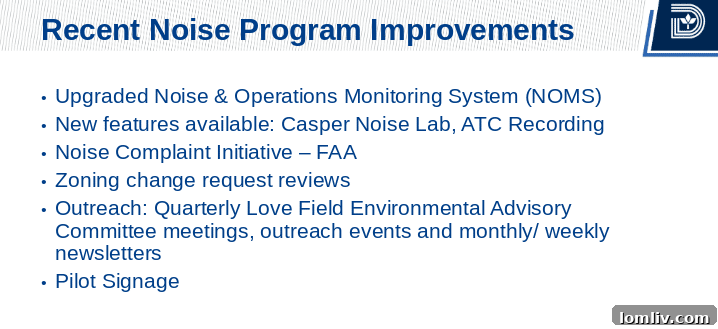
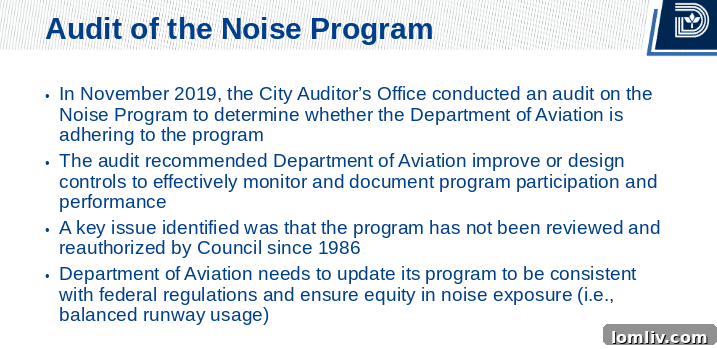
A specific grievance among residents revolves around promises made regarding runway usage. According to resident Keith Menter, the community was assured that departures would be more evenly distributed between the Lemmon Avenue and Denton Drive runways once construction on the Denton Runway was completed in June 2022. However, Menter contends that this equitable split has not materialized. He points out a significant historical shift: “For 70 years the Denton Runway was the main runway,” he explained. “Prior to 2014, there were only 50 flights a week off the Lemmon Runway. Now we have more than 200 a day.” This dramatic increase in traffic on the Lemmon Runway is particularly problematic because, as Menter notes, “The Lemmon Runway is surrounded by far more neighborhoods and residences than the Denton Runway, which primarily impacts a commercial area.” The shift has demonstrably increased the noise burden on residential communities.
In response to these concerns, Aviation Director Patrick Carreno has consistently maintained that while noise mitigation is a high priority, public safety remains the paramount concern. He explained the operational rationale behind current runway usage to daltxrealestate.com in August: “If you land on the Denton side and you have to taxi back, you’re then crossing an active runway that’s very busy. It’s not the safest.” This illustrates the complex trade-offs faced by airport management, where safety protocols can sometimes conflict with noise abatement goals. The ongoing dialogue between residents, airport authorities, and airlines underscores the critical need for innovative solutions that can simultaneously ensure operational safety, minimize environmental impact, and preserve the quality of life for Dallas residents.