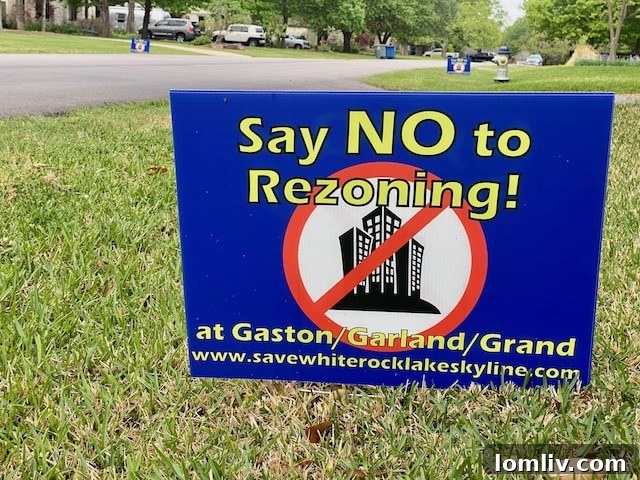
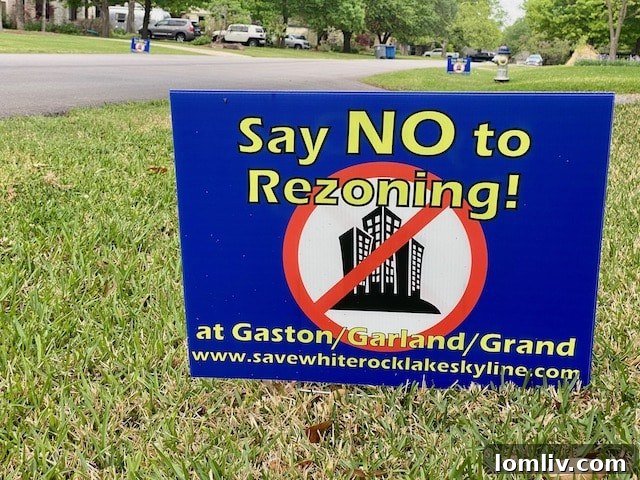
East Dallas, a vibrant and distinctive community, often communicates its most pressing concerns through an unconventional yet highly visible medium: front yard signs. These ubiquitous placards, frequently dotting the landscapes of neighborhoods nestled near the serene White Rock Lake, serve as a clear indicator of local sentiment. Messages range from the enduring charm of “Keep Little Forest Hills Funky” to pointed directives like “Dallas Arboretum Traffic Park Somewhere Else.” However, among these diverse declarations, a more urgent plea has recently emerged, capturing the community’s immediate attention: “Save The White Rock Lake Skyline,” typically accompanied by a graphic image of a high-rise building boldly crossed out. This powerful visual metaphor encapsulates a crucial ongoing debate within East Dallas—the delicate balance between urban development and the preservation of cherished local character and natural vistas.
This particular call to action directly addresses a significant proposed development that has become a catalyst for community mobilization. At the heart of this discussion lies rezoning case Z201-139, which pertains to the ambitious “Trailhead” development. This project, put forth by Mill Creek Residential through its representative Rob Baldwin of Baldwin Associates, has initiated extensive discussions regarding the future aesthetic and functional integrity of the area immediately surrounding the iconic White Rock Lake and the vital Santa Fe Trail. The City of Dallas Plan Commission convened a public hearing on this matter, offering a critical platform for community input and underscoring the democratic principles inherent in urban planning decisions. The urgency of this issue was highlighted by the short window for public comment registration, emphasizing the need for timely and engaged civic participation.
Mill Creek Residential: A Familiar Face in Dallas Development
Mill Creek Residential is a well-established entity within the Dallas development landscape, known for its consistent engagement with City Hall and its track record of securing approvals for various projects across the metroplex. The company’s recent activities include a notable success just months prior to the Trailhead discussions, when it received the Plan Commission’s approval for an apartment building situated strategically along the Trinity River in Oak Cliff. This history suggests a company adept at navigating Dallas’s intricate urban planning processes and committed to expanding its footprint within the city. However, the Trailhead project stands apart due to its highly sensitive location. Bordering a beloved natural landmark and a significant recreational trail, this development has proven to be a more contentious undertaking, facing increased scrutiny and encountering unique challenges that distinguish it from previous ventures.
The proposed site for The Trailhead development carries considerable local resonance, having formerly hosted two popular community businesses, The Lot and Local Traveler. These establishments, regrettably, were among the early economic casualties of the global pandemic, leaving a noticeable void in the community’s social fabric. Mill Creek Residential’s vision for this tract involves a mixed-use rezoning, a concept that has garnered support from certain local organizations, notably the Friends of the Santa Fe Trail. Their endorsement reflects a segment of the community that acknowledges the potential benefits of integrated development, such as increased amenities and revitalization. This divergence of opinion within the community highlights the complex interplay of interests that local governments and developers must carefully consider when balancing progress with the deeply held values and concerns of residents.
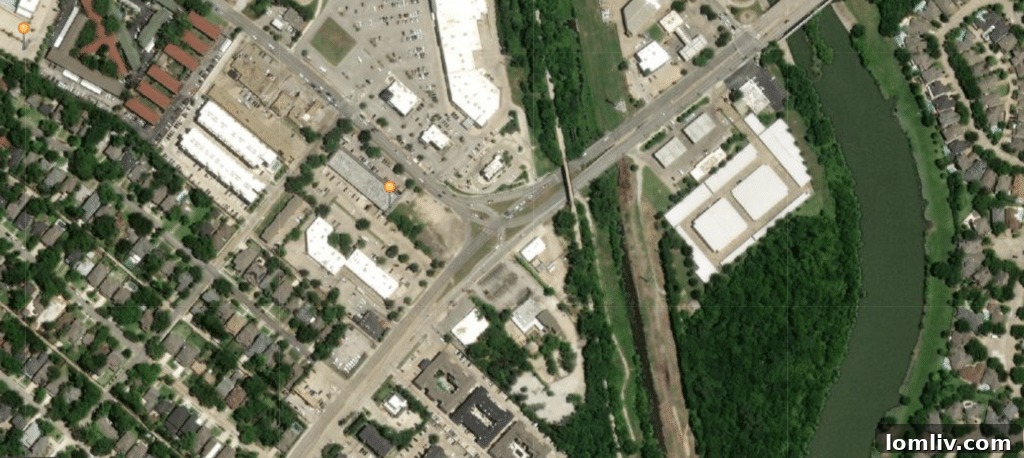
A critical layer of complexity for the proposed Trailhead development stems from its close proximity to the notoriously problematic Garland – Grand – Gaston (3G) intersection. This confluence of major thoroughfares has long been a flashpoint for traffic congestion and safety concerns among East Dallas residents, an issue so pronounced that it became a central campaign plank for a District 9 candidate just two years prior. Sarah Lamb, an accomplished commercial real estate broker at The Retail Connection and the visionary founder of Lakewood Citizens for Responsible Traffic, eloquently articulated the community’s profound anxieties in a compelling 2018 interview with NBCDFW, stating:
“We worry about the people who live and work off Gaston. Our neighborhood can’t hold all of the additional drivers. It’s just not safe.”
Sarah Lamb
Lamb’s powerful statement captures a widespread concern: that the introduction of a substantial new development, particularly one housing hundreds of additional residents, would inevitably strain an already overtaxed traffic infrastructure, further compromising neighborhood safety and liveability. Members of the “Save White Rock Lake Skyline” group, a prominent voice of opposition, have openly expressed their disappointment that traffic impact seemed to be an underestimated factor for some supporting organizations, including the Friends of the Santa Fe Trail, when they offered their endorsement of Mill Creek’s project. The development, aptly christened “The Trailhead” due to its strategic location at the entry point of the beloved Santa Fe Trail, therefore becomes a focal point for discussions that extend far beyond architectural design, touching upon the fundamental quality of life and safety within the surrounding East Dallas neighborhoods.
Deciphering the MU1 Rezoning: Height, Density, and Impact
At the very core of the ongoing controversy surrounding The Trailhead development is the proposed change in zoning classification to Mixed-Use (MU1). To fully appreciate the significant implications of this shift, it is imperative to understand the parameters and allowances embedded within the MU1 designation, as defined by the City of Dallas Department of Sustainable Development. This specific zoning type is generally engineered to foster dynamic, integrated urban environments by permitting a harmonious blend of residential, commercial, and retail functions within a single development parcel. While conceptually beneficial for urban revitalization and density, the precise details of MU1 zoning, particularly concerning lot coverage and maximum building heights, are what ignite considerable debate in this particular East Dallas context.
Under the proposed MU1 zoning, developers are granted the flexibility to achieve up to an 80 percent lot coverage. This means that a very substantial portion of the land parcel can be built upon, significantly reducing the amount of permeable open space. More critically, and directly addressing the primary concerns of the “Save The White Rock Lake Skyline” advocates, MU1 zoning permits maximum building heights ranging between 90 and a towering 120 feet. To provide a clearer perspective, such allowances could readily accommodate structures soaring seven to nine stories high, depending on whether ground-floor retail components are integrated into the design. This represents a stark and dramatic departure from the existing zoning limitations for the site, which currently cap buildings at a maximum of four stories or an overall height of 80 feet. The prospect of a significantly taller and considerably more expansive structure rising directly at the gateway to the Santa Fe Trail and in close proximity to White Rock Lake has ignited fierce community opposition, fueled by visions of a drastically altered visual landscape that could irrevocably overshadow treasured natural vistas and disrupt the current low-rise aesthetic.
The Shadow of Precedent: Comparing Developments in East Dallas
In discussions surrounding major new constructions, the concept of precedent is invariably invoked. While The Trailhead development is undoubtedly a project of considerable scale and local significance, it is not the inaugural upscale apartment complex to emerge within this dynamic section of East Dallas. A short distance away, situated on East Grand at Coronado Avenue, stands The Drake, an established luxury building already featuring seven stories and encompassing 85 units, offering its residents attractive views of the very area where The Trailhead is now proposed. The existence of The Drake might, for some, suggest a natural and perhaps inevitable progression of the neighborhood towards higher-density residential living. However, it is crucial to recognize that fundamental differences in both the sheer scale and the precise location of Mill Creek’s proposal set it apart from existing structures, making any direct comparison far more nuanced and complex than it might initially appear.
Mill Creek’s ambitious vision for The Trailhead is quantitatively and qualitatively larger than The Drake, planning a proposed seven-story building that would house an impressive 305 units. This substantial increase in residential density, combined with its direct adjacency to the beloved Santa Fe Trail and the sensitive ecosystem of White Rock Creek, introduces a unique and formidable array of challenges and community concerns. Critics passionately argue that a building of this magnitude and unit count would not only severely exacerbate existing traffic and infrastructure woes but would also directly and irreparably impact the cherished natural views currently enjoyed by nearby homeowners. Communities directly bordering White Rock Creek, particularly those situated just past the spillway, depend on these unobstructed vistas for their quality of life, their connection to nature, and the unique charm that defines their neighborhoods. The sheer size, strategic placement, and potential density of The Trailhead could cast a literal and metaphorical shadow, irrevocably altering these views and diminishing the natural beauty that is a hallmark of East Dallas.
Deed Restrictions and Environmental Responsibilities in East Dallas
Beyond the complexities of zoning regulations, Mill Creek Residential faces an additional and particularly weighty challenge: pre-existing deed restrictions on the property. These legal covenants, firmly recorded and historically established, explicitly stipulate a maximum lot coverage of merely 60 percent. This restriction is notably more stringent than the 80 percent lot coverage allowance permitted under the proposed MU1 rezoning. This significant discrepancy brings into sharp focus a fundamental conflict between historical property agreements—intended to protect specific characteristics of the land—and contemporary development ambitions. To disregard or attempt to overturn these long-standing deed restrictions could establish a deeply troubling precedent, potentially undermining the stability, predictability, and legal enforceability of land use agreements across the entire city of Dallas.
The implications of increased lot coverage extend far beyond merely aesthetic considerations. A higher percentage of impervious surfaces—areas covered by buildings, concrete, asphalt, and other non-porous materials—directly and profoundly impacts the natural water cycle. In a region like East Dallas, which has, during periods of extreme weather, unfortunately experienced localized flooding and rapid stormwater runoff, this is an extraordinarily sensitive and critical environmental issue. Without robust, meticulously planned, and carefully implemented mitigation strategies, any additional lot coverage could significantly worsen stormwater runoff, thereby increasing the already present risk of flooding in an area that frequently contends with such vulnerabilities. This poses not only a direct threat to surrounding private and public properties but also critically impacts the delicate and interconnected ecosystem of White Rock Creek and, by direct extension, White Rock Lake itself. Environmental advocates and deeply concerned residents are keenly aware that irresponsible or overly aggressive development in this ecologically sensitive area could lead to severe, long-term environmental consequences, making strict adherence to, or extremely careful negotiation of, existing deed restrictions an absolute paramount concern for the community’s future.
Community Engagement and the Future Landscape of East Dallas
The proposed Trailhead development, with its intricate tapestry of zoning transformations, significant traffic implications, potential impacts on the iconic skyline, and critical environmental considerations, culminated in a highly anticipated public hearing before the City of Dallas Plan Commission. Such public forums are indispensable democratic mechanisms, providing vital avenues through which community members can directly articulate their support or opposition, thereby offering invaluable direct input into the crucial decision-making process. The fervent discussions, diverse viewpoints, and passionate appeals shared during these proceedings vividly underscore the profound importance of active civic engagement in responsibly shaping the future of urban environments. For the residents of East Dallas, this hearing transcended the fate of a single development; it became a defining moment in determining the delicate balance between inevitable urban growth and the unwavering preservation of its distinctive, cherished character.
The outcomes of such high-profile rezoning cases invariably establish significant precedents, meticulously influencing how subsequent developments are conceptualized, proposed, and ultimately approved across East Dallas and, indeed, the broader metropolitan area. Decisions rendered today concerning critical factors like building height limits, residential density, and crucial environmental protections can have profound and lasting repercussions on property values, the unique aesthetic appeal of neighborhoods, and the overarching quality of life for current and future residents. The ongoing dialogue, and often the healthy tension, between ambitious developers like Mill Creek Residential and an actively engaged, vocal community ensures that progress is tempered with responsibility, sustainability, and genuine respect for local values. While urban development is an undeniable and continuous aspect of metropolitan evolution, the persistent and articulate advocacy by groups such as “Save The White Rock Lake Skyline” serves as a powerful reminder that thoughtful, community-centric urban planning is absolutely essential to safeguard the unique charm, natural beauty, and inherent liveability that collectively make East Dallas such an exceptionally desirable and cherished place to reside. The complex and evolving story of The Trailhead development is, in its essence, a compelling microcosm of the broader challenges and exciting opportunities confronting rapidly expanding urban areas, unequivocally highlighting the continuous and urgent need for vigilance, open dialogue, collaborative solutions, and an unwavering commitment to achieving truly sustainable and deeply beloved communities for all.