Highland Park ISD’s New School: Unpacking Design, Dollars, and Community Discord
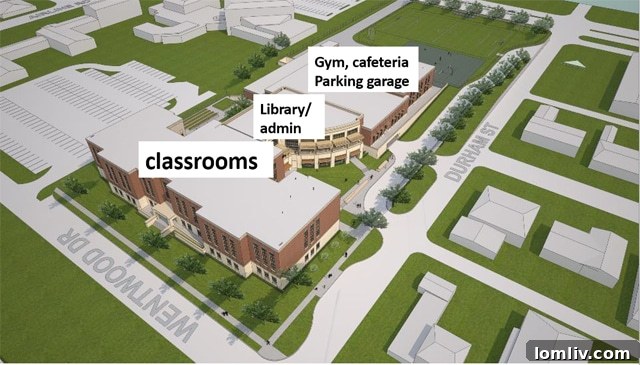
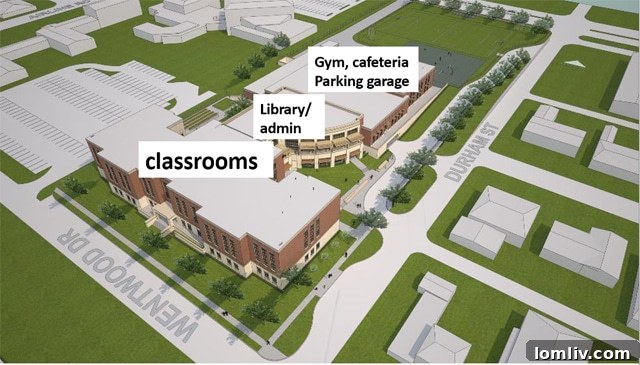
On February 25th, the Caruth Hills Homeplace Neighborhood Association convened a critical update meeting concerning the proposed new school. This significant development is slated for construction on land recently acquired by the Highland Park Independent School District (HPISD) from the Northway Christian Church, strategically located on Northwest Highway directly opposite Sparkman-Hillcrest. This new educational facility emerges from a substantial $361.4 million bond proposal, overwhelmingly approved by voters last November, which also earmarks funds for the vital rebuilding and refurbishment of other schools within the esteemed HPISD portfolio.
HPISD, a district often under public scrutiny, cultivates a distinct identity, frequently celebrating achievements that align precisely with community expectations. Delving deeper into their operational philosophy reveals a fascinating interplay of fiscal strategies and public relations, as illuminated by a series of key events:
- HPISD Board President Leslie Melson has publicly lauded the district’s comparatively lower school tax rates, highlighting annual savings of approximately $2,704 for the average homeowner when juxtaposed with many other school districts across the region. This point is often emphasized as a source of local pride.
- Despite these tax rate claims, official communications reveal a contrasting narrative. HPISD has asserted that it faces “the same drastic budget cuts as other school districts across the state,” citing preliminary figures released by the Texas Legislature. This dual messaging often raises questions among constituents regarding the district’s financial transparency and strategic positioning.
- Adding another layer of complexity, HPISD has expressed considerable frustration over its obligation to share a portion of its substantial coffers under the 1991 “Robin Hood” law. This legislation aims to redistribute wealth from property-rich districts, like those in the Park Cities, to less privileged school districts statewide. The district’s public stance on this mandatory sharing often sparks debate, with some wondering about the fundamental lessons of communal responsibility and equitable resource distribution taught within HPISD’s own elementary classrooms.
- Crucially, the November 2015 bond issue, amounting to $361.4 million, garnered the necessary public approval, paving the way for the extensive construction and renovation projects currently underway.
The strategic maneuvering by HPISD appears to present a paradox: the district touts its reduced tax rates, which, whether by design or coincidence, consequentially minimize the amount it is compelled to share with the “Robin Hood” program. Yet, simultaneously, HPISD frequently laments budget cuts and financial constraints. The district’s favored solution for undertaking significant infrastructure projects—such as demolishing three schools, renovating a fourth, and constructing a brand new fifth—involves issuing a bond. This method is particularly attractive because the proceeds and subsequent repayments of these bonds are notably exempt from the sharing requirements mandated by the “Robin Hood” law. This approach allows the district to fund large-scale improvements while seemingly sidestepping the financial redistribution system designed to benefit all Texas students.
Instead of embracing the opportunity to share their abundant resources with less fortunate school children, HPISD’s actions often suggest a concerted effort to circumvent these obligations. This posture, while perhaps fiscally advantageous for the district, underscores a broader narrative that aligns with the community’s perceived character.
Architectural Aspirations and the Drive-Thru Dominance
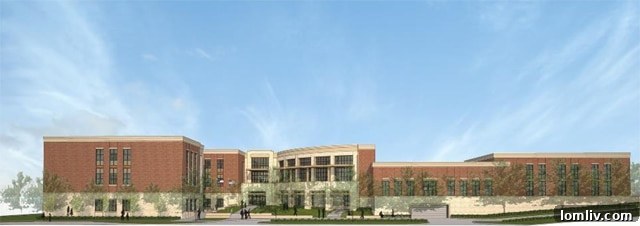
Despite the district’s considerable financial capacity, the architectural design of the new school itself has drawn considerable criticism for being remarkably uninspired. Featuring a rather bland, limestone-esque base topped with conventional brickwork, the building’s aesthetic prompted more than one resident to remark that it could easily have been constructed in Plano, Allen, or any other suburban community—a subtle but pointed translation suggesting a design lacking the distinctive affluence typically associated with the Park Cities. This perceived generic design, alongside contemporary trends like parents choosing unique, often artfully misspelled names for their children, perhaps reflects a subtle form of parental self-aggrandizement rather than genuine architectural innovation or community-specific identity.
Consider a recent observation: a children’s lemonade stand in the area. In an era where many learned the value of earning money by selling simple, hand-stirred beverages, these young entrepreneurs were peddling fresh-squeezed juice from high-end grocery stores. While the practical lessons of profit margins and financial independence were undoubtedly lost—the cost structure alone guaranteed an educational, as well as monetary, deficit—the ostentatious display allowed parents to project an image of elevated taste, even if it detracted from the core learning experience for their children.
As someone whose thoughts on school architecture largely ceased after tossing a graduation cap into the air three decades ago, I was particularly struck by the new school’s overwhelming emphasis on providing an expansive drive-thru lane along Durham Street. My previous jest about being among the last generation to walk to school seems less humorous now, given that a presenter at the meeting indicated a paltry 12-18 percent of students would arrive at school under their own power, whether walking or cycling. The vast majority, an astonishing 82-88 percent, are expected to utilize a valet service. This raises a fundamental question about the priorities embedded within the school’s design.
“School #5,” as it is currently designated, appears fundamentally designed for the omnipresent SUV brigade. This prioritization of vehicular convenience over pedestrian accessibility evokes a profound sense of melancholy. Even more disheartening was the apparent lack of concern among the parents present at the meeting regarding this pervasive car-centric approach. Perhaps it is simply the numbing reality of contemporary suburban life, where convenience consistently trumps independence.
My own childhood experience sharply contrasts with this modern paradigm. By at least third grade, and possibly even second, I habitually walked to school. Our route would gradually gather classmates, transforming the journey into an ever-expanding, lively gab session, a cherished period of fantastical childhood talk blissfully free from direct parental supervision. These few blocks of unsupervised transit instilled a vital pinch of independence and confidence. Even in high school, when a bus option became available for my mile-long commute, I often chose to walk, reserving the bus only for truly inclement Chicago weather. This enduring habit likely fostered my lifelong affinity for walking; just last weekend, I covered 18 miles at a brisk four MPH clip, a testament to the enduring value of pedestrian movement.
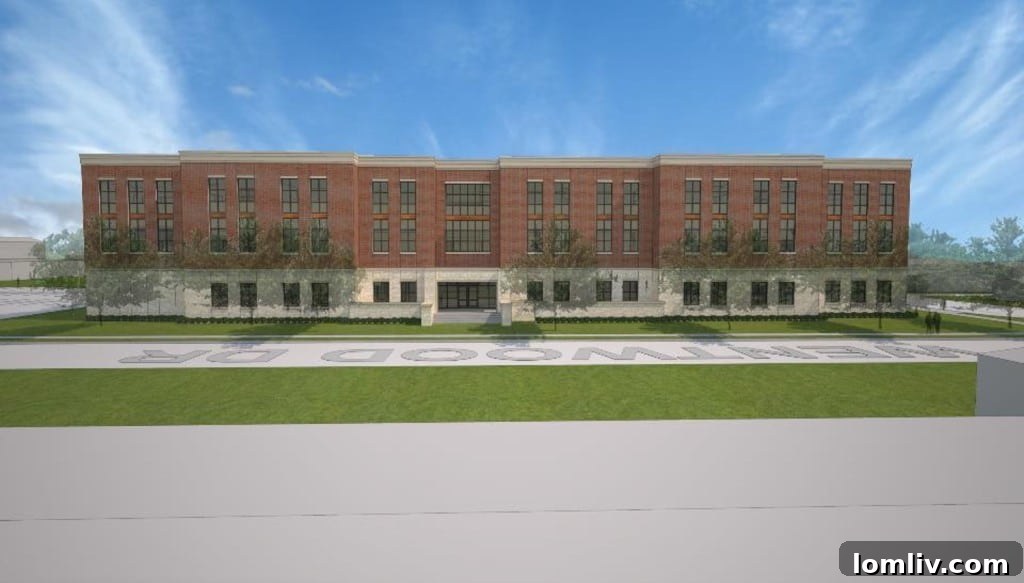
The new “School #5” is so heavily optimized for vehicle traffic that its actual front façade serves an almost purely ornamental purpose. The grand main entrance doors, typically a symbol of institutional welcome, are slated to remain locked for the majority of the time. The few children who arrive independently will be directed to enter through a side door, conveniently located near the dedicated drive-thru lane. This design choice created the distinct impression that the elaborate façade exists primarily to impress residents on Wentwood, whose homes will directly face this architectural display, rather than to serve as a functional and inviting entrance for students.
In stark contrast, when I attended school, all doors were accessible. On days when we weren’t running late, we consistently chose the front entrance, regardless of whether it was grand or modest. This simple act imbued us with a sense of importance and reinforced the idea that the school building itself held significant stature. It is with a touch of wry surprise that one observes parents in the affluent Park Cities, who meticulously cultivate an image of distinction, seemingly content with their children consistently entering through a less prominent side door.
Navigating the Impending Traffic Chaos
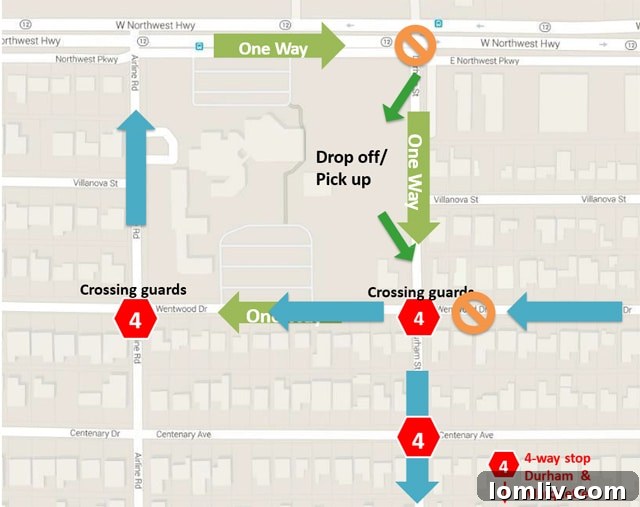
As is frequently the case with new school developments, traffic management emerged as a paramount concern at the meeting. The proposed traffic flow plan outlines a complex network of one-way roads designed to manage the influx and efflux of vehicles around the school. Parents arriving from the south will be directed towards Airline Road to initiate a substantial circular route around the entire block. Those approaching from the west will inevitably cause backups along Northwest Parkway, which serves as the frontage road for Northwest Highway. Similarly, traffic originating from the east will also converge onto Airline Road, contributing to the overall congestion. Essentially, the entire system orchestrates a large, one-way loop to funnel vehicles in and out of the immediate vicinity. With an estimated enrollment of 770 students, and considering that only 90 to 138 of these students are projected to arrive without vehicular assistance, the sheer volume of cars, even factoring in carpools, promises to be substantial and challenging.
Predictably, the localized effects of this increased traffic will ripple outwards, impacting blocks surrounding the school. Moreover, the plan is expected to significantly affect Northwest Highway itself, as there is a proposed measure to block left turns from Northwest Highway to the south during critical school pick-up and drop-off hours. This particular aspect bears a striking resemblance to the intricate traffic challenges and debates often encountered by the Preston Center Task Force, underscoring the complexity and potential for disruption that such a concentrated influx of vehicles can create in an already bustling urban corridor.
Community Voices: Questions, Concerns, and the Underlying Narrative
As is often the case in community meetings of this nature, the Question and Answer segment provided profound insights into the underlying sentiments and critical issues at play. Many questions revolved around the perennial concerns of traffic congestion, parking availability, and the frequently voiced disappointment regarding the school’s rather banal architectural design. It became apparent that a significant number of attendees had either not fully absorbed the preceding presentation or lacked a fundamental understanding of civic processes and the limitations of HPISD’s jurisdiction over both private and state-owned lands. For instance:
- Several residents advocated for the extension of the “Great Wall of University Park,” a prominent barrier separating Coffee Park from Northwest Highway. Their objective was to create a continuous, imposing fence that would deter children parking on Northwest Parkway from inadvertently running into the busy Northwest Highway. However, it was clarified that the school’s authority is limited to constructing fencing exclusively on its own property, rendering such a request beyond its scope.
- Similarly, calls were made for the installation of additional sidewalks directly across the street from the new school. This request, too, met with the explanation that those areas constitute private property, thereby falling outside the direct control and purview of HPISD.
- A demand for a new traffic signal at the intersection of Durham and Northwest Highway was vehemently rejected. This decision rests with TXDoT (Texas Department of Transportation), and the consensus was that Northwest Highway, already a high-traffic artery, could ill-afford another signal that would further impede and slow traffic flow.
- One particularly probing questioner sought intricate details about HPISD’s lease agreement with the church for a portion of its space. The inquiry was imbued with an almost palpable sense of elitism, appearing partly driven by a desire to ensure that the church would not interact with the student body. While one might typically expect such individuals to champion more religious presence in schools, an underlying suspicion surfaced regarding Northway Christian Church, possibly due to its offerings of services in Spanish—a detail that seemed to elicit an uncomfortable reaction from the questioner.
It was ultimately revealed that the leased space, comprising less than 1,000 square feet, would be hermetically sealed off from the main school facilities. Its usage would be sporadic, limited to a small group of individuals engaged in crafting toys for various children’s charity initiatives. This clarification, detailing the benign and charitable nature of the church’s presence, starkly contrasted with the initial anxieties, highlighting perhaps a missed opportunity for students to learn valuable lessons about community service and support for the underprivileged—a focus distinct from, say, opera appreciation, which might be more traditionally aligned with certain community expectations.
The Grand Finale: A Heated Conclusion to the HPISD Meeting
Just as the meeting appeared to be winding down, a sudden and dramatic turn of events unfolded. The final individual to approach the microphone was not merely a questioner but a vehement dissenter. He launched into an impassioned, unscripted tirade, articulating his profound opposition to the new school project. His core argument posited that the school was entirely unnecessary and furthermore, he accused HPISD officials of outright deception to secure the bond’s passage. His accusations escalated rapidly, culminating in a demand for their imprisonment on charges of fraud. The intensity of his outburst immediately shifted the atmosphere of the room.
Had restraints been readily available, his removal from the stage would have undoubtedly been swifter. As it was, he found himself surrounded by the representatives seated on the dais, along with several agitated audience members, who collectively worked to usher him off the stage amidst a chorus of disapproving harrumphing from the crowd. This fiery confrontation served as an explosive, albeit fitting, conclusion to a meeting that had, at various points, highlighted significant tensions and divisions within the community regarding the school’s construction and the district’s broader policies.
And so, with that memorable, if tumultuous, climax, the meeting adjourned!
Engage with Us: Share Your Story and Connect with the Community
Do you have a compelling Homeowners Association (HOA) story that deserves to be told? Perhaps a captivating piece of high-rise history from our vibrant city? Realtors, we invite you to feature a listing—whether it’s a property ripe for renovation or a stunning project completed with flying colors. How about hosting a Candy’s Dirt Staff Meeting at your unique space? Don’t hesitate to reach out to Jon via email. We even accept marriage proposals (they’re legal now)! Connect with us at [email protected].