

Unlocking Apartment Space: What Your $1,500 Rental Budget Buys in Dallas-Fort Worth and Beyond
For many aspiring renters, the magic number often revolves around a monthly budget of $1,500. This figure represents a significant investment in one’s living situation, yet the actual amount of space it affords can vary dramatically depending on your chosen location. If you’re eyeing the dynamic Dallas-Fort Worth (D-FW) metroplex, a bustling hub in Texas, you’re likely wondering: how much apartment space can you truly secure with $1,500 a month?
To shed light on this crucial question and provide a broader national perspective, a recent comprehensive analysis by RENTCafé, a nationwide apartment listing service, offers invaluable insights. This detailed study calculated rental costs by meticulously assessing the price per square foot, derived from average rents and apartment sizes across various cities, leveraging robust data from Yardi Matrix. The findings paint a vivid picture of the rental landscape, highlighting regional disparities and illustrating how different lifestyle choices can impact your living space.
Dallas-Fort Worth Rental Market: Urban vs. Suburban Space Allocation
The D-FW metroplex is a vast and diverse area, encompassing two major cities and numerous thriving suburbs, each with its own unique rental dynamics. The RENTCafé report clearly illustrates a key trend: the amount of apartment space you receive for your $1,500 budget often depends on whether you opt for the urban core or the more expansive suburban fringes.
Living Smaller in the Major Cities: Dallas and Fort Worth
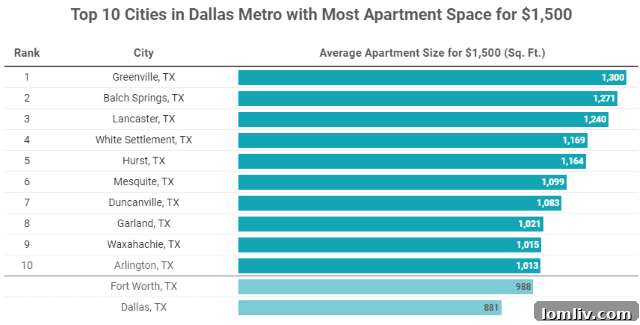
In the heart of **Dallas proper**, renters can expect to find an apartment approximately 881 square feet for $1,500. This figure, while respectable, is generally indicative of a slightly larger than average one-bedroom apartment, or perhaps a compact two-bedroom unit, in a highly competitive urban environment. Dallas, with its vibrant downtown, robust job market, and myriad cultural attractions, commands premium prices. The demand for urban living drives up the cost per square foot, meaning renters trade expansive space for unparalleled accessibility and an energetic city lifestyle. Nationally, Dallas ranks 50th in terms of the amount of space $1,500 secures, reflecting its status as a major metropolitan area with a competitive rental market.
Just a short drive away, **Fort Worth** offers a slightly more spacious alternative. For the same $1,500 monthly budget, renters in Fort Worth can enjoy around 988 square feet. This additional square footage can translate into a more comfortable one-bedroom, a spacious two-bedroom, or even a smaller three-bedroom apartment, offering a bit more room to breathe compared to its sister city. Fort Worth, known for its Western heritage blended with modern amenities, presents a compelling option for those seeking a balance between urban conveniences and a bit more personal space. This city ranks 38th nationally, positioning it more favorably than Dallas for renters prioritizing square footage within a major urban center.
Embracing Expansive Living in the D-FW Suburbs
For those willing to venture outside the immediate urban cores of Dallas and Fort Worth, the suburban landscape truly opens up possibilities for maximizing your rental budget. The RENTCafé analysis highlights several D-FW suburbs where $1,500 stretches considerably further:
- In **Greenville**, a charming city located northeast of Dallas, your $1,500 budget can unlock a generous 1,300 square feet of apartment space. This significant increase in square footage makes Greenville an attractive option for families or individuals seeking ample living areas without compromising affordability.
- **Balch Springs**, situated southeast of Dallas, provides another compelling option, offering approximately 1,271 square feet for the same $1,500. This area presents a blend of suburban tranquility and reasonable proximity to Dallas, making it a practical choice for many renters.
- Further south, **Lancaster** allows renters to secure about 1,240 square feet for $1,500. These suburbs generally benefit from lower population densities, more available land for development, and a different economic profile compared to the urban centers, all contributing to lower per-square-foot rental costs.
These suburban communities often appeal to renters who prioritize larger living spaces, potentially a backyard, and a quieter residential environment, even if it means a longer commute to employment hubs in Dallas or Fort Worth. The trade-off between commute time, access to amenities, and actual living space is a critical consideration for many D-FW residents.
The Other End of the Spectrum: Desirable D-FW Suburbs with Less Space
While some suburbs offer expanded space, other highly sought-after D-FW suburbs, often characterized by excellent school districts, upscale amenities, and booming job markets, present a different picture. For $1,500, these areas yield considerably less square footage, reflecting their high demand and desirability:
- In **Flower Mound**, a prosperous community in Denton County known for its natural beauty and top-rated schools, $1,500 will get you approximately 702 square feet. This is a clear indication of the premium associated with living in such an affluent and well-regarded area.
- **Frisco**, a rapidly growing city renowned for its sports venues, corporate campuses, and family-friendly environment, offers around 797 square feet for the same budget. Frisco’s explosive growth and high quality of life contribute to its elevated rental costs per square foot.
- **The Colony**, another booming city on the shores of Lewisville Lake, provides roughly 811 square feet for $1,500. These areas represent a choice where renters often prioritize location, community features, and specific lifestyle benefits over maximizing the physical space within their apartment.
These figures underscore the diverse nature of the D-FW rental market. Renters must weigh their priorities carefully: is more square footage the ultimate goal, or is proximity to work, specific school zones, or access to particular amenities worth a smaller living footprint?
Beyond D-FW: A Glimpse Across Texas and the Nation
The RENTCafé study extends its reach beyond the D-FW metroplex, offering a wider lens on what $1,500 can buy across Texas and other parts of the United States. This broader perspective highlights fascinating regional economic differences and housing market dynamics.
Texas Cities Offering More Space for Your Dollar
Within Texas, three cities notably rank in RENTCafé’s top 20 cities nationally for providing the most apartment space for $1,500, demonstrating areas where affordability and spaciousness converge:
- **Lubbock**, located in West Texas, stands out by offering an impressive 1,361 square feet for $1,500. This makes Lubbock one of the most budget-friendly cities in Texas for renters seeking significant space.
- **El Paso**, nestled along the U.S.-Mexico border, is another strong contender, providing approximately 1,305 square feet for the same monthly budget. Its unique geographical and economic position contributes to its relative affordability.
- On the Gulf Coast, **Corpus Christi** allows renters to secure around 1,153 square feet for $1,500. These cities, generally with lower population densities and different economic drivers compared to the major metros like D-FW, tend to offer more expansive living for less.
The Stark Reality: National Disparities in Rental Space
The national comparison provides some of the most striking insights into the vast differences in rental markets across the country. It’s truly captivating to observe what $1,500 can procure in vastly different economic and geographic landscapes:
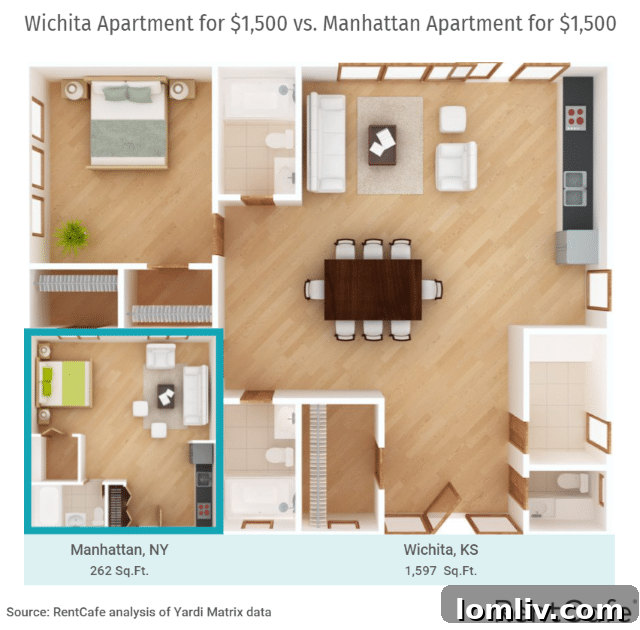
- In **Wichita, Kansas**, a city known for its affordability and robust industrial base, renters can secure an astonishing 1,597 square feet for their $1,500 budget. This generous amount of space often translates into a large multi-bedroom home or a very spacious apartment, offering unparalleled value for money.
- Conversely, in the notoriously expensive metropolis of **New York City**, specifically Manhattan, that same $1,500 budget will only get you a mere 262 square feet. To put this into perspective, 262 square feet is roughly the size of a standard one-car garage or slightly smaller than the service boxes on a tennis court—the areas where your serve must land. This incredibly limited space typically constitutes a “micro-apartment,” a compact studio designed to maximize living units in a high-density, high-demand urban environment.
The comparison is stark: for the same $1,500, you could theoretically fit six Manhattan apartments into one Wichita apartment. This extreme contrast vividly illustrates the impact of land value, population density, economic opportunity, and historical development on housing markets. It highlights the compromises urban dwellers in global cities like New York must make to live in highly desirable locations, often sacrificing space for unparalleled access to culture, career opportunities, and a fast-paced lifestyle.
Factors Influencing Apartment Space and Rent
Understanding why certain areas offer more or less space for your dollar involves delving into a complex web of economic, geographic, and social factors. Several key elements consistently influence the rental market:
- Location and Demand: Highly desirable areas, especially those with strong job markets, top-rated schools, and abundant amenities, naturally command higher rents per square foot due to intense competition among renters. Urban cores and affluent suburbs fall into this category.
- Land Availability and Development Costs: Cities with limited available land for new construction, or those with stringent zoning regulations, face higher development costs. These costs are then passed on to renters, resulting in smaller units or higher prices for existing ones.
- Economic Growth and Population Influx: Areas experiencing rapid job growth and significant population increases often see rental prices surge. Dallas-Fort Worth, being a magnet for corporate relocations and new residents, exemplifies this trend.
- Amenities and Property Age: Newer apartment complexes with luxury amenities (pools, gyms, pet parks, smart home technology) typically command higher rents, regardless of square footage. Older properties, while potentially offering more space for the same price, might lack modern conveniences.
- Property Taxes and Operating Costs: Local property taxes, maintenance expenses, and utility costs all factor into a landlord’s pricing strategy, influencing the overall rent and, by extension, the space offered.
Tips for Renters: Maximizing Your $1,500 Budget in D-FW
For those navigating the Dallas-Fort Worth rental market with a $1,500 budget, strategic planning is key to securing the best possible apartment space:
- Explore the Suburbs: As the RENTCafé report clearly shows, venturing into areas like Greenville, Balch Springs, or Lancaster can yield significantly more square footage for your money. Research commute times and local amenities to find a balance that suits your lifestyle.
- Be Flexible with Amenities: While a state-of-the-art gym or a sparkling pool might be appealing, these luxuries often come at a premium. Prioritize what you truly need versus what would be nice to have.
- Consider Different Apartment Types: A studio or a compact one-bedroom in a prime location might be a better fit than a larger, less desirable apartment further afield. Conversely, consider shared living situations or roommates to pool resources and afford more space.
- Utilize Rental Resources: Websites like RENTCafé, real estate agents specializing in rentals, and local community forums can provide invaluable information and help you uncover hidden gems.
- Monitor Market Trends: The rental market is dynamic. Keep an eye on new developments, seasonal price fluctuations, and special offers that could arise.
- Factor in Commute Costs: A cheaper apartment further out might negate savings if your commute involves significant fuel costs or public transportation fees. Calculate the total cost of living, not just the rent.
Conclusion: Informed Choices in a Dynamic Rental Market
The RENTCafé analysis serves as an enlightening guide, offering a clear snapshot of apartment costs and the corresponding space available for a $1,500 monthly budget across Dallas-Fort Worth, Texas, and the nation. It underscores a fundamental truth: location is paramount in real estate, dictating not just the price but also the physical dimensions of your living environment.
Whether you prioritize the vibrant, albeit smaller, urban living of Dallas, the slightly roomier charm of Fort Worth, or the expansive possibilities found in the surrounding suburbs, making an informed decision requires careful consideration of your lifestyle, commute, and budget. The vast disparities seen between places like Wichita and New York City further emphasize that a $1,500 budget holds vastly different purchasing power across the country.
Ultimately, understanding these trends empowers renters to navigate the complex housing market with confidence, allowing them to make choices that align best with their financial goals and personal preferences. As the rental market continues to evolve, staying informed through reputable sources like RENTCafé’s comprehensive reports will remain an invaluable tool for securing your ideal living space. 🐇