Decoding the Housing Market: Resilience, Recovery, and Future Outlook Amidst Economic Expansion
From staff reports
The echoes of the last major recession, which profoundly impacted the global economy and particularly the housing sector, are still fresh in many minds. However, what followed was an unprecedented period of sustained economic growth, setting a new record of 121 consecutive months of expansion by July 2019. This remarkable rebound begs a crucial question: how did the U.S. housing market fare during this extended era of prosperity, and what insights can we glean from its journey?
To provide a comprehensive answer, leading real estate data and analytics firm CoreLogic released a special report titled “The Role of Housing in the Longest Economic Expansion.” This in-depth analysis meticulously tracks the housing market’s trajectory from the onset of the Great Recession in 2008 through July 2019, offering invaluable perspectives on its recovery and its significant contribution to the broader economic landscape.
Understanding the CoreLogic Report: Housing’s Economic Pulse
The CoreLogic report underscores the housing market’s pivotal role as a barometer of economic health. As the report highlights, housing has consistently constituted approximately 15 percent of the Gross Domestic Product (GDP) since 2010. This substantial contribution means that the real estate sector’s performance is not merely an isolated industry trend but a fundamental driver and indicator of national economic vitality.
Central to CoreLogic’s analysis is its robust Home Price Index (HPI). This proprietary index leverages an extensive array of data points, including public records, comprehensive real estate databases, and over 40 years of repeat sales transactions. This rigorous methodology allows CoreLogic to generate highly accurate and reliable insights into home price trends, offering a clearer picture of market dynamics than many other indicators.
The Great Recession officially reached its trough in June 2009, marking the point after which GDP and industrial production began their steady climb. Since then, the economy has continued its upward trajectory, with the housing market playing an indispensable part in this prolonged expansion. Understanding the nuances of this recovery, particularly how different regions performed, offers critical lessons for future economic cycles.
Texas: A Snapshot of Resilience and Growth
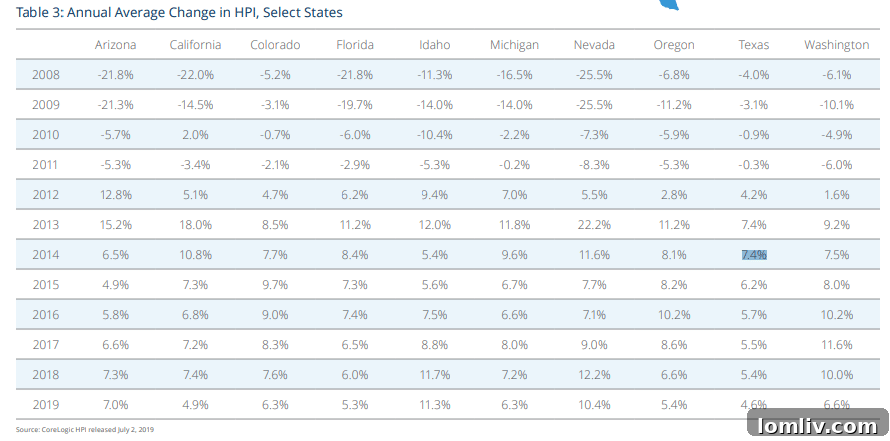
While the national housing market experienced a turbulent recovery, regional variations provide fascinating insights. Texas, often lauded for its robust economy and consistent population growth, offers a compelling case study. At the beginning of the Great Recession, Texas’s Home Price Index (HPI) reflected a negative 4 percent growth rate, indicating a challenging period for homeowners and the real estate industry.
However, the Lone Star State quickly demonstrated its resilience. Its HPI began a gradual rebound, moving out of negative territory by 2012. From a negative 0.3 percent in 2011, Texas’s HPI surged to a positive 4.2 percent in 2012, signaling a decisive shift towards recovery. This upward momentum continued, reaching its peak in 2013 and 2014, where the HPI stabilized at a strong 7.4 percent for two consecutive years.
By July 2019, as the economic expansion approached its record-breaking conclusion, Texas maintained a healthy HPI of 4.6 percent. This sustained growth underscores the state’s economic vitality, driven by factors such as strong job creation, business relocation, and an attractive quality of life, which collectively fueled demand in its housing markets even during periods of national uncertainty. Texas’s consistent performance highlights its unique economic drivers and its ability to weather downturns more effectively than some other regions.
National Housing Market Trends: A Decade of Recovery
Beyond individual state performance, the national picture reveals a broad and significant recovery in the housing market, particularly concerning homeowner equity and property values. The period following the recession saw remarkable improvements that substantially bolstered household wealth and financial stability.
The Remarkable Resurgence of Home Equity
One of the most telling indicators of the housing market’s health is the dramatic reduction in the number of homes with negative equity, often referred to as being “underwater.” At its peak in the first quarter of 2010, a staggering 25.9 percent of homes nationally had negative equity, meaning homeowners owed more on their mortgages than their properties were worth. This situation trapped many homeowners, limiting their ability to sell or refinance and contributing to widespread financial distress.
However, through steady home price appreciation, this figure dwindled dramatically. By the first quarter of 2019, the percentage of homes with negative equity had plummeted to a mere 4.1 percent, a testament to the robust recovery of property values across the country. This shift liberated millions of homeowners, restoring their financial flexibility and confidence.
Concurrently, total home equity witnessed an extraordinary surge. From a low of $6.1 trillion in the first quarter of 2009, total home equity swelled to an impressive $15.8 trillion by the end of the first quarter of 2019. This massive accumulation of wealth for homeowners provided a significant cushion against economic shocks and represented a crucial component of consumer financial health.
The average equity per borrower also experienced substantial growth during this period. CoreLogic reported that between the first quarter of 2010 and the first quarter of 2019, the average equity per borrower increased from approximately $75,000 to an impressive $171,000. In 2018 alone, homeowners saw an average gain of $13,600 in equity. Molly Boesel, a principal economist at CoreLogic, aptly summarized this trend: “Home prices have increased steadily since 2011, creating record amounts of home equity and putting homeowners in a good position to weather future downturns.” This sentiment highlights the enhanced financial resilience of American households, a stark contrast to the pre-recession fragility.
Rising Home Values and a Dynamic Rental Market
The recovery extended beyond just equity gains; both home prices and rents made significant strides from their recession-era lows. By May 2019, home prices had cumulatively risen by an impressive 50 percent since their trough, reflecting sustained buyer demand and improving economic conditions. This appreciation benefited not only existing homeowners but also contributed to overall economic stability.
The single-family rental market also experienced a robust recovery, with rents increasing by 33 percent over the same period. This trend underscored a growing demand for rental properties, perhaps from individuals who were either priced out of the homeownership market or preferred the flexibility of renting. The report noted that rental vacancies stood at 7 percent in the first quarter of 2019, while homeowner vacancies were considerably lower at 1.4 percent, indicating a tighter market for owner-occupied housing and continued demand pressures.
Navigating Future Uncertainties: Signs of Caution and Optimism
As the U.S. economy reached new heights in its expansion, conversations about its sustainability and the potential for a forthcoming recession naturally intensified. While the housing market demonstrated remarkable resilience, experts began to scrutinize various economic indicators for signs of a slowdown. CoreLogic’s report provides a balanced view, acknowledging both the positive momentum and the emerging concerns.
Ralph McLaughlin, CoreLogic’s deputy chief economist, expressed an optimistic outlook for the market’s trajectory, stating, “We expect the housing market to enter a normalcy phase over the next 24 months. With prices neither rising too fast nor too slow, and with a growing stream of young households looking to buy homes over the next two decades, the long-term view looks healthy.” This forecast suggests a shift from rapid appreciation to more sustainable growth, supported by underlying demographic trends.
Economic Indicators and Recessionary Signals
Despite the prevailing optimism, the report highlighted several economic signals that warranted caution. At the time, unemployment rates were at a 50-year low, inflation rates remained below the Federal Reserve Board’s 2 percent target, and GDP exhibited strong growth throughout 2019. These factors typically suggest a robust economy, yet a closer examination revealed potential vulnerabilities.
A significant concern emerged from the bond market: the 10-Year Treasury Yield dropped to approximately 2 percent in June 2019, a notable decline from 3.2 percent in November 2018. This “inversion” or significant flattening of the yield curve is often interpreted as a sign that the bond market anticipates a future economic slowdown or recession. Additionally, a “bumpy stock market” over the preceding 15 months further added to the apprehension, as equity market volatility often precedes broader economic contractions.
Expert sentiment also leaned towards a likely recession. According to the Wall Street Journal’s Economic Forecasting Survey, 49 percent of respondents expected a recession to occur in 2020, with another 36.6 percent anticipating one in 2021. Panelists from the NABE Outlook Survey concurred, predicting a slowdown in real GDP growth to 2.4 percent in 2019 and further to 2 percent in 2020. These expert forecasts, while not definitive, reflected a growing consensus that the record-breaking expansion might be nearing its end.
A Closer Look at the Housing Market’s Pace
Within the housing sector itself, some indicators suggested a cooling market, moving away from the rapid growth rates of earlier years. While home prices continued to grow, their pace began to moderate. In May 2019, home prices increased by 3.6 percent year-over-year, a slight deceleration from the 4.1 percent observed in January. This slowdown, while not alarming on its own, signaled a return to more sustainable, albeit less dramatic, appreciation.
Furthermore, housing starts, a key measure of future housing supply and builder confidence, underperformed expectations in May 2019, dropping 0.9 percent below the revised April estimate. This dip suggested a potential decrease in new construction activity, which could impact housing inventory and affordability dynamics in the coming months. These trends indicated that the housing market, while healthy, was recalibrating its growth trajectory in response to broader economic shifts.
Underlying Strengths and Positive Outlooks
Despite the accumulating signs of economic slowdown, the housing market retained several fundamental strengths that offered a buffer against a severe downturn. One of the most encouraging statistics was the overall mortgage delinquency rate, which hit a record low in April. This indicated that homeowners were largely able to meet their mortgage obligations, reflecting improved financial health and responsible lending practices post-recession. A low delinquency rate significantly reduces the risk of foreclosures, which were a major destabilizing factor during the last crisis.
Moreover, mortgage rates were at a two-year low, significantly improving loan affordability for aspiring homebuyers. Lower interest rates reduce the monthly cost of homeownership, making it more accessible for a wider demographic and helping to sustain demand even as prices continued to rise. This affordability boost was a critical factor in maintaining market stability and encouraging new entries into homeownership.
Looking ahead, CoreLogic’s HPI ForecastTM projected continued, albeit moderate, growth. The report anticipated a 5.6 percent acceleration in annual home price growth from June 2019 to June 2020. This forecast suggested that while the blistering pace of appreciation might be behind us, the market was expected to maintain a healthy upward trend, driven by steady demand and underlying economic strength rather than speculative fervor.
Conclusion: A Balanced Perspective on the Housing Journey
The journey of the U.S. housing market from the depths of the Great Recession to the pinnacle of the longest economic expansion has been one of remarkable resilience and recovery. CoreLogic’s detailed analysis reveals a sector that not only regained its footing but also became a significant contributor to national wealth and stability. The dramatic reduction in negative equity, the surge in total home equity, and the steady appreciation of home prices and rents underscore a market that successfully navigated a complex economic landscape.
While the latter part of this expansion period brought forth discussions and indicators suggestive of a potential economic slowdown, the housing market entered this phase from a position of strength. Low mortgage delinquency rates, favorable interest rates, and a more tempered, sustainable growth trajectory provided crucial buffers. The insights from CoreLogic underscore the importance of data-driven analysis in understanding the multifaceted dynamics of real estate and its intricate relationship with the broader economy.
As the market continues to evolve, understanding these trends remains paramount for policymakers, investors, and individual homeowners alike. The lessons learned from this unprecedented period of expansion will undoubtedly inform future strategies, ensuring a more stable and resilient housing sector for years to come.
Accessing Further Insights
For those interested in delving deeper into the comprehensive findings and detailed data presented in CoreLogic’s original report, “The Role of Housing in the Longest Economic Expansion,” further information is readily available.
To see more, head to CoreLogic’s website.