

Upon the closing of polls on Saturday, May 6, a new chapter began for Dallas’s District 10 with the definitive election of Kathy Stewart to the City Council. Demonstrating an immediate readiness to tackle pressing urban challenges, Stewart’s inaugural priority as the representative for Lake Highlands was to embark on an extensive review of the city’s complex budget and the escalating housing crisis—two critical issues demanding immediate and thorough attention from new leadership.
Stewart quickly immersed herself in the demanding pace of city governance, participating in a lengthy council meeting on June 14 alongside fellow first-term Councilman Zarin Gracey. The pair were originally slated to be officially sworn into office on Tuesday, joining Mayor Eric Johnson and a cohort of returning incumbents. However, Stewart’s official inauguration ceremony was unexpectedly delayed as she tested positive for COVID-19. Undeterred, she swiftly adapted, joining the Dallas City Council remotely for Wednesday’s crucial briefings covering the upcoming budget discussions, findings from a recent community survey, and plans for the significant 2024 bond election. This early engagement underscored her commitment and proactive approach to her new role, ensuring she remained a vital part of the council’s foundational discussions from day one.
Her initial weeks offered a firsthand look at the intricate workings and often contentious debates within the council. Stewart observed as her predecessor, the long-serving District 10 Councilman Adam McGough, unsuccessfully opposed the approval of Cypress Creek at Forest Lane, a controversial mixed-income housing development. This project, which ignited considerable local debate, provided Stewart with early insight into the complexities of urban development and community opposition. She also navigated hours of intense deliberation surrounding the regulation of short-term rentals, a topic with profound implications for Dallas neighborhoods and property owners. These early experiences served as an invaluable primer, showcasing the diverse range of issues and robust debates that define city governance.
Despite the Dallas City Council traditionally observing a recess during the month of July, residents can anticipate seeing Kathy Stewart, often equipped with her reading glasses, actively engaged at 1500 Marilla St. Rather than a period of downtime, July will serve as a dedicated phase for the new council member to meticulously pore over critical municipal documents and engage in foundational meetings with various department directors. This strategic utilization of the recess highlights her methodical approach and commitment to gaining a comprehensive understanding of the city’s operations and financial health, ensuring she is fully prepared to advocate effectively for her constituents when regular sessions resume.
Kathy Stewart’s Decisive Victory and Mandate for District 10
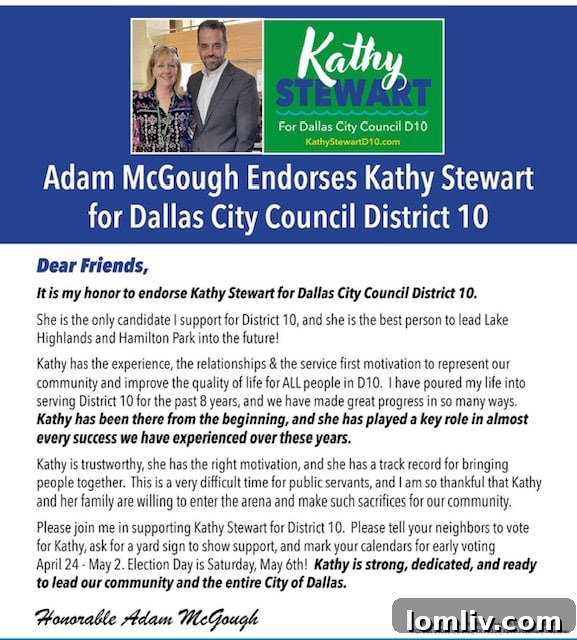
Kathy Stewart’s journey to the Dallas City Council was marked by significant support and a clear mandate from District 10 voters. Her campaign gained early and crucial momentum through the endorsement of her predecessor, Adam McGough, establishing her as a formidable frontrunner from the outset. This initial backing was further bolstered by an impressive array of major endorsements, notably from the highly influential MetroTex Association of Realtors and The Real Estate Council Political Action Committee. These endorsements from key real estate and business organizations underscored a broad-based confidence in her leadership capabilities and her understanding of the city’s economic and developmental landscape, particularly concerning housing and property issues that resonate deeply within District 10.
The results of the May 6 general election painted a clear picture of voter preference in District 10. Stewart’s challengers—Brian Hasenbauer, Chris Carter, and Sirrano Keith Baldeo—collectively garnered 1,836 votes. In stark contrast, Stewart secured a commanding 3,879 ballots, accumulating more than twice the votes of her combined opponents. This substantial margin of victory, which was quite unexpected by Stewart herself, indicated a strong community desire for her leadership and a clear affirmation of her platform.
“We get used to polls in national elections so everybody knows who’s ahead, but polls are expensive, so we didn’t know what to expect,” Stewart shared with daltxrealestate.com in an exclusive interview following her election. Her genuine surprise and profound gratitude upon seeing the election numbers highlighted the organic nature of her campaign’s success and the overwhelming support she received from the Lake Highlands community. This decisive win provides her with a strong mandate to address the critical issues facing District 10.
Despite not being able to cast her vote on the contentious short-term rental (STR) regulations, Council Member Stewart expressed her approval of the council’s decision to implement the “Keep It Simple Solution,” deeming it “a good result.” This measure decisively bans STRs within single-family neighborhoods, aiming to preserve the residential character and quality of life in these areas. Concurrently, it permits STRs by right in multi-family districts, acknowledging the different dynamics and zoning considerations of these zones. The city has slated enforcement of these new regulations to commence in December, allowing for a transition period for property owners and operators to comply with the revised ordinances.
Addressing the highly debated Cypress Creek at Forest Lane project, Stewart articulated significant concerns regarding its inherent limitations and the narrative surrounding its location. “I think when they say it’s a high-income area … I really disagreed with some of the information that was being shared with the council,” she stated emphatically. Stewart challenged the categorization of the surrounding locale as uniformly high-income, pointing to the close proximity of well-established, albeit distinct, communities. “If you look at the proximity of Hamilton Park and Northwood Estates, those are great neighborhoods but I would not label them as high-income.” Her comments underscore a critical nuance in urban planning and development: the importance of accurate socioeconomic assessments to ensure that new projects are genuinely responsive to the needs and existing conditions of a diverse district, rather than relying on broad, potentially misleading generalizations.
Navigating District 10’s Future: Projects and the Housing Imperative
Kathy Stewart, a long-term resident of Dallas since 1980 with her husband Robb, is setting a clear agenda for her two-year term, focusing on critical infrastructure and community development initiatives within District 10. Among her primary areas of focus are the advancement of a Phase Two Master Plan for the pivotal Forest Lane and Audelia Road corridor and the comprehensive Skillman Street Streetscape Plan. These projects are designed not only to enhance the aesthetic appeal of these vital thoroughfares but also to improve connectivity, safety, and economic vitality, reflecting a holistic approach to urban improvement that resonates directly with residents’ daily lives.
A significant part of Dallas’s future development hinges on the upcoming 2024 bond election, for which the Dallas City Council has empaneled a dedicated task force. This task force is meticulously reviewing potential projects that could be funded by a colossal $1 billion bond package, earmarked for essential improvements across various sectors including streets, parks, vital storm drainage infrastructure, economic development initiatives, housing, and critical municipal facilities. Stewart acknowledges the city’s ongoing journey in infrastructure improvement, stating, “We had a lot of improvement in the 2017 bond, but there’s more to go.” This perspective highlights her commitment to building upon past successes while actively pursuing new investments necessary for the city’s continued growth and residents’ well-being.
When it comes to the complex and multifaceted issue of housing, Council Member Stewart brings a wealth of perspective rooted in her deep understanding of District 10’s unique demographics and challenges. A crucial Dallas staff report from 2021 revealed that District 10 is home to an estimated 36,000 “low-income units”—a figure significantly higher than that found in many other areas of the city. Stewart emphasizes the foundational importance of this data in any meaningful discussion about housing affordability. “To me, any conversation about affordable housing starts with that piece of information,” she asserts. She passionately advocates for a nuanced understanding when discussing affordable housing specifically within District 10, urging her colleagues and the public to grasp the existing density. “When you have that affordable housing conversation with respect to District 10, I need people to understand what we have, the high density of what we have at Forest and Audelia going west to LBJ. We have a lot of low-income housing.” Her argument centers on the principle that the equitable distribution of affordable housing city-wide should acknowledge and account for existing concentrations, preventing further over-burdening of already underserved areas.
The imperative for a balanced approach to housing development becomes even more evident with several new affordable housing initiatives actively being planned or under construction along the Forest Lane-Greenville Avenue corridor. These include the previously mentioned Cypress Creek at Forest Lane, Dallas County’s significant Cottonwood Forest project situated at Forest Lane and Stults Road, and a vital permanent supportive housing facility for the homeless located on Vantage Point Drive. These projects, while addressing critical housing needs, collectively pose a challenge for a district already carrying a disproportionate share of the city’s low-income housing.
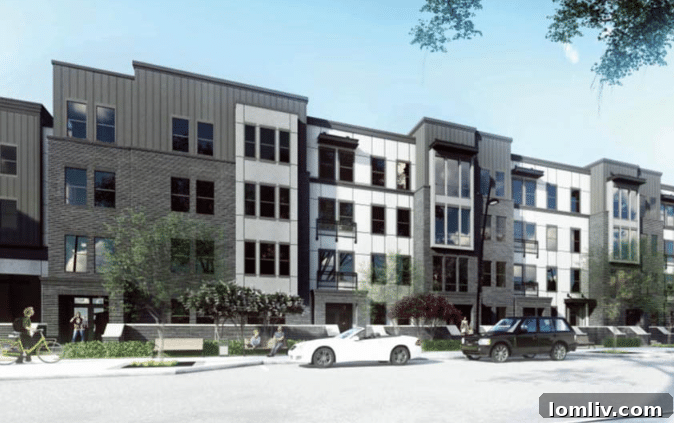
“You’ve got three projects within about a mile of each other,” Stewart highlighted, underscoring the concentrated nature of these developments. Her core advocacy for District 10 is clear: “You’re putting that into a district that already has a lot. I think I have to advocate for my district and say, ‘You’ve got to slow down a bit.’” She proposes a strategic “pause button” for new projects in District 10, allowing time to assess the impacts of current developments and plan for future growth more equitably. One potential strategy she mentioned is the introduction of a Public Improvement District (PID) along Forest Lane, which could facilitate targeted investments and improvements, further demonstrating her proactive and thoughtful approach to managing the district’s evolution. “Maybe we’ll bring in a [Public Improvement District] along Forest Lane, but let’s hit the pause button for District 10, because I feel like we have a lot,” she reiterated, emphasizing the need for strategic consideration before further expansion.
The new council member, who previously held the influential position of executive director at Uptown Dallas Inc., brings a wealth of experience in urban development and strategic planning to her current role. This background will undoubtedly prove invaluable as she dedicates July to an intensive study of the city budget and municipal processes. Understanding the vast scope and complexity of the city’s financial blueprint is no small feat. “July will be my time to prepare,” she remarked, acknowledging the immense task ahead. The sheer volume of information is daunting: “Have you seen this budget? It’s 700-and-something pages. Everyone says we’re going to be drinking from a fire hose.” This immersive preparation period is crucial for her to grasp the nuances of city finances and operations, equipping her to make informed decisions and effectively represent her constituents.
Beyond the detailed analysis of documents, Stewart is also keenly prepared to engage in extensive listening. She understands that effective leadership is deeply rooted in community engagement and responsiveness. “You’ve got to motivate your community to advocate and speak out for what they see the need is,” Stewart emphasized, highlighting the indispensable role of grassroots input in shaping public policy. She firmly believes that decisions made by the city staff and council members gain legitimacy and effectiveness when they are directly supported by community sentiment and authentic, on-the-ground information. “That’s what matters to city staff and to the council members as you go through the process. Is this just what the council member is thinking in her head or is it supported by the community and coming from grassroots information?” Her commitment to fostering active community participation underscores her vision for a transparent and responsive local government, ensuring that the voice of District 10 residents remains at the forefront of policy-making.