“That’s all your house is, it’s a place to keep your stuff while you go out and get more stuff. Sometimes, you gotta move. You gotta get a bigger house. Why? Too much stuff. You gotta move all your stuff. And maybe put some of your stuff in storage. Imagine that, there’s a whole industry based on keeping an eye on your stuff.”
George Carlin
Dallas Leads the Nation in Self-Storage Boom: A Deep Dive into the DFW Market
Legendary comedian George Carlin, with his characteristic wit, once delivered a memorable five-minute standup routine dissecting our obsession with “stuff”—our belongings and the endless cycle of acquiring and managing them. His incisive observations, made decades ago, resonate perhaps more strongly today than ever before, especially when considering the booming self-storage industry.
Carlin’s insightful commentary immediately sprang to mind upon reviewing RENTCafé’s latest Self-Storage Report. This comprehensive study, which meticulously analyzed multifamily and self-storage development trends across the nation’s 100 largest metro markets between 2011 and 2020, sought to identify the areas best equipped to offer supplementary storage solutions to a growing population of apartment renters. The findings painted a clear picture: the Dallas-Fort Worth metroplex has emerged as the undisputed leader in this burgeoning sector.
Indeed, as the metro Dallas apartment market experienced an unprecedented surge over the past decade, the ancillary business of safeguarding people’s cherished—or simply abundant—belongings has not just kept pace, but has positively exploded alongside it.
The Relentless Accumulation of “Stuff” and the Modern Dilemma
Carlin’s philosophy on “stuff” highlights a fundamental aspect of modern consumerism. Our lives are increasingly defined by what we own, and as our possessions grow, so does the need for space to house them. This phenomenon is particularly acute in rapidly growing urban centers like Dallas, where living spaces are often optimized for efficiency rather than expansive storage. The desire for a minimalist aesthetic clashes with the reality of accumulated items, from seasonal decorations and sports equipment to inherited furniture and burgeoning hobbies. This dichotomy creates a perfect storm, pushing individuals and families to seek external storage solutions.
The self-storage industry, therefore, is not merely about providing extra square footage; it’s about offering flexibility, convenience, and a solution to the spatial constraints of contemporary life. It caters to a diverse clientele: those downsizing their homes, students needing summer storage, businesses requiring inventory space, or individuals simply needing a temporary home for their possessions during life transitions like moving or renovations. In essence, it’s a testament to our collective struggle with “too much stuff” in an increasingly compact world.
RENTCafé Report Shines a Light on Storage Trends
RENTCafé, a renowned platform for apartment and self-storage searches, provided robust research to substantiate its findings on where people are increasingly choosing to store their “stuff.” Their report, which meticulously collected and analyzed data from 2011 to 2020, offers an unparalleled look into the dynamics driving this industry. The methodology involved examining both new apartment construction and self-storage facility development across the top 100 U.S. metropolitan areas, providing a comprehensive understanding of supply and demand relationships.
Dallas-Fort Worth: The Epicenter of Self-Storage Growth
The Dallas-Fort Worth (DFW) market’s performance stood out dramatically, cementing its status as the nation’s leader in self-storage expansion. The data paints a compelling picture of rapid development and a market eager to meet the growing demand for external storage. Here are the pivotal findings that underscore DFW’s supremacy:
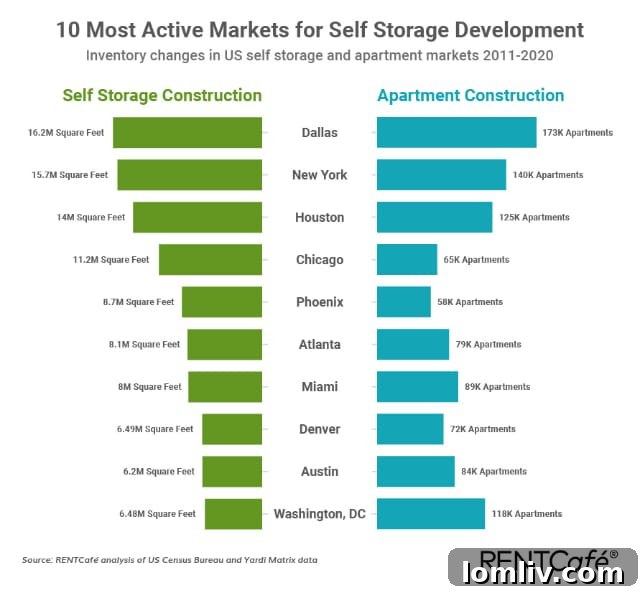
- Massive Inventory Expansion: Over the past decade, a staggering 16.2 million square feet of self-storage space, distributed across 194 new facilities, was added to DFW’s inventory. This remarkable growth significantly outpaced other major metropolitan areas, including New York, Houston, and Chicago, demonstrating an aggressive commitment to meeting storage needs. Such an influx of new facilities indicates robust investment and confidence in the region’s continued growth.
- Unparalleled Per Capita Space: DFW now offers an impressive 8.6 square feet of self-storage space per capita. This figure is nearly double that available in densely populated urban centers like New York City, Los Angeles, and Chicago. This high per capita availability suggests that DFW residents have ample options for storage, reflecting both strong demand and a proactive supply response from developers. It also highlights a cultural or economic factor unique to DFW that necessitates more personal storage space.
- Apartment Market Dynamics Driving Demand: Dallas added approximately 173,000 new rental units during the past decade. However, a critical detail emerges: these new units often feature smaller footprints and less built-in storage compared to historical trends. In fact, among the largest Texas cities, Dallas experienced the most significant reduction in average apartment unit size, which directly fuels the escalating demand for external self-storage solutions. As urban living trends emphasize efficiency and compact spaces, residents are increasingly relying on off-site storage to accommodate their belongings without cluttering their homes.
- Affordable Storage Options: Despite the booming demand and supply, DFW’s average monthly rental cost for a standard 10- by 10-foot storage unit was $94. Intriguingly, this represents a decrease of 9 percent over the past five years. This competitive pricing, even amid significant expansion, suggests a healthy and dynamic market where increased supply and competition among providers are keeping costs accessible for consumers. This affordability could also be a factor contributing to the region’s storage popularity.
The Symbiotic Relationship: Apartments and Self-Storage
The RENTCafé report clearly illustrates a powerful symbiotic relationship between the apartment market and the self-storage industry. As Dallas continues to experience rapid population growth and urbanization, the housing landscape is evolving. Many new apartment complexes are designed for efficiency and modern aesthetics, often featuring open-concept layouts and smaller closets. This design philosophy, while appealing to a younger, urban demographic, inherently creates a storage deficit within individual units.
Furthermore, lifestyle changes contribute significantly. The rise of remote work has led many to reorganize their living spaces, sometimes requiring dedicated office areas that displace other belongings. E-commerce has made acquiring goods easier than ever, contributing to the sheer volume of possessions. Life transitions—such as young professionals moving into their first apartments, couples combining households, or empty nesters downsizing from larger homes—all frequently necessitate temporary or long-term self-storage solutions. For Dallas residents, having an abundance of affordable, accessible storage options becomes not just a convenience, but often a necessity to maintain an uncluttered home environment.
A National Phenomenon: The Scale of U.S. Self-Storage
While DFW leads the charge, the expansion of the self-storage industry is a pervasive national phenomenon. Across the United States, an astounding 295 million square feet of self-storage space was added between 2011 and 2020. This represents roughly 20 percent of the nation’s entire existing inventory—a truly staggering figure that underscores the industry’s massive growth trajectory.
To put this into perspective, RENTCafé’s research reveals a truly eye-opening statistic: the U.S. now boasts more self-storage facilities than all the combined locations of major retail and fast-food giants such as Best Buy, Lowe’s, Home Depot, Walmart, McDonald’s, and Subway. This comparison vividly illustrates the sheer scale and ubiquitous presence of self-storage across the American landscape, signifying a fundamental shift in how people manage their personal property. It points to a deep-seated and widespread demand that transcends regional differences, though particular metros like Dallas exemplify its most concentrated manifestation.
Why Dallas? Factors Driving DFW’s Storage Supremacy
Understanding DFW’s leadership in the self-storage sector requires looking beyond just the numbers and examining the underlying economic and demographic forces at play:
- Explosive Population Growth: Dallas-Fort Worth is consistently ranked among the fastest-growing metropolitan areas in the U.S. A continuous influx of new residents, drawn by job opportunities and a lower cost of living compared to coastal cities, creates a constant demand for housing—and, by extension, storage.
- Robust Economic Boom: The DFW economy is incredibly diverse and dynamic, attracting major corporations and fostering a thriving job market. This economic vitality supports both apartment development and the consumer spending that contributes to the accumulation of “stuff.”
- Favorable Real Estate Trends: While apartment construction has surged, the trend towards smaller, denser urban living spaces means that new residents often find their on-site storage limited. This design choice, combined with rising property values, incentivizes the use of off-site storage.
- Strategic Geographic Location: DFW’s central location in the U.S. and its extensive transportation infrastructure make it an attractive hub for various industries, further contributing to its growth and development as a residential and commercial center.
Navigating the Self-Storage Landscape in DFW: Tips for Renters
For Dallas-Fort Worth residents considering self-storage, the abundance of options means both convenience and the need for informed decision-making. Here are some key tips to navigate the DFW self-storage market:
- Assess Your Needs Accurately: Before renting, make a list of items to store. Many facilities offer online size guides or even virtual tours to help you visualize what fits into a 5×5, 10×10, or larger unit. Renting a unit that’s too small will lead to frustration, while one that’s too large means paying for unused space.
- Consider Climate Control: For sensitive items like wooden furniture, electronics, artwork, documents, or musical instruments, a climate-controlled unit is essential to protect them from DFW’s extreme temperature fluctuations and humidity. While usually more expensive, the protection it offers can save you from costly damage.
- Evaluate Security Features: Look for facilities with robust security measures such as gated access, 24/7 surveillance cameras, individual unit alarms, and well-lit premises. Your peace of mind is worth the extra scrutiny.
- Prioritize Location and Accessibility: Choose a facility that is conveniently located to your home or office. Also, check their access hours. Some facilities offer 24/7 access, which can be a huge benefit for busy schedules, while others have more restricted hours.
- Compare Pricing and Promotions: With so much competition in DFW, many self-storage facilities offer attractive introductory rates, discounts for long-term commitments, or first-month-free promotions. Don’t hesitate to shop around and compare offers before making a decision. Read the fine print for any hidden fees or rate increases after the promotional period.
The Future of Storage in Dallas: Continued Growth or Market Saturation?
The self-storage boom in Dallas-Fort Worth has been remarkable, raising questions about its sustainability. While the factors driving growth—population influx, economic prosperity, and evolving housing trends—show no signs of abating, the sheer volume of new supply could eventually lead to market saturation. However, the consistent demand, fueled by the dynamic nature of DFW’s economy and population, suggests that the market may simply be recalibrating to a new equilibrium.
Innovations in the sector, such as smarter, tech-enabled units, enhanced security, and more flexible rental terms, could also continue to drive demand. As DFW continues its trajectory as a major economic powerhouse, the self-storage industry will likely remain a crucial, albeit ever-evolving, component of its urban landscape, helping residents and businesses manage their “stuff” in a city that’s always on the move.
For a comprehensive understanding and to delve deeper into what experts are saying about the unprecedented boom in self-storage development, you can access the full RENTCafé report by clicking here.