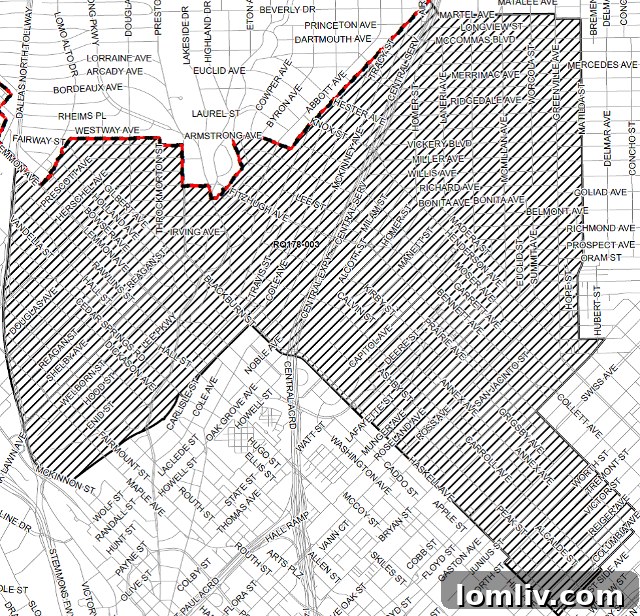
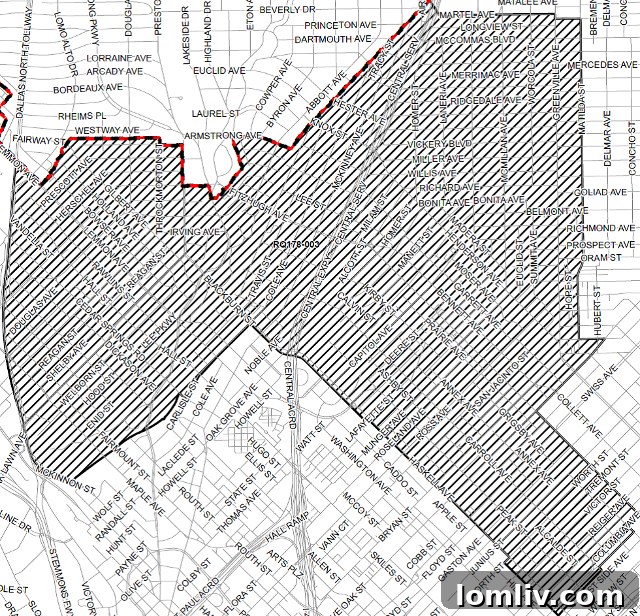
In a recent community gathering, held on a particularly stormy evening, local residents and stakeholders convened to discuss the proposed Delayed Demolition Overlay (DDO) for East Dallas-Oak Lawn. This significant new DDO district, roughly bordered by the Dallas North Tollway, the affluent enclave of Highland Park, Haskell Avenue, and Matilda Street, represents a pivotal moment in Dallas’ ongoing efforts to balance rapid urban development with the preservation of its rich architectural heritage. If approved, it would mark the city’s third such overlay, expanding the reach of historic preservation initiatives into a vibrant and rapidly evolving quadrant of Dallas.
This latest proposed DDO is ambitious in its scope, encompassing an estimated 15,000 individual parcels of land. When considered alongside the existing Downtown DDO, a substantial portion of the Oak Lawn Committee’s jurisdiction within PD-193 will fall under these protective measures. The expansion reflects a growing recognition of the historical significance present across various Dallas neighborhoods, prompting a deeper look into what these overlays truly achieve and how they impact property owners and the broader community.
What Exactly is a Delayed Demolition Overlay (DDO)?
Delayed Demolition Overlays are specific geographical zones designated by the City of Dallas where structures identified as possessing historic value are afforded a temporary reprieve before demolition. The genesis of Dallas’ DDO policy can be traced back to 2015, following a controversial incident involving the developer of the Joule Hotel, who proceeded with the demolition of historic structures without adequate warning or public discourse. This event sparked widespread outrage among preservationists and led the Dallas City Council to enact legislation creating the city’s first DDO, primarily covering downtown and parts of Uptown.
Subsequently, a second DDO was established in the culturally rich Bishop Arts District, an area known for its unique blend of art, commerce, and historic architecture, with further enlargements currently planned to safeguard more of its character. It is crucial to understand that DDOs operate distinctly from “named” historic districts, such as the storied Swiss Avenue or the historically significant 10th Street. While named historic districts impose stringent regulations on alterations and demolitions, aiming for comprehensive preservation, DDOs offer a different, more limited form of protection.
The operative word in “Delayed Demolition Overlay” is unequivocally “delayed,” not “halted.” This distinction is fundamental to understanding the efficacy and limitations of the DDO program. Should a property owner express an intent to demolish a structure that meets specific historic criteria, a predefined process is initiated. Once Dallas’ Historic Preservation Officer officially identifies the structure as meeting these criteria, a mandatory 45-day delay is imposed on any demolition activities. This period is designed to be a crucial window for intervention and discussion.
During this 45-day interval, city officials engage with the property owner to explore and discuss various alternatives to demolition. These alternatives typically include options such as relocating the structure, facilitating its sale to a party interested in preservation, or encouraging its renovation and adaptive reuse. Should the property owner be amenable to continuing this dialogue, the delay period can be extended further. However, the ultimate decision power rests squarely with the property owner. If, after these discussions, the owner remains resolute in their intent to demolish, the structure will eventually be razed. This highlights a key philosophical underpinning of property rights in Dallas and, indeed, much of the United States: the property owner retains the final say regarding the fate of their historic asset.
For a structure to qualify for this 45-day demolition delay, it must not only be over 50 years old but also be listed within one or more of the following esteemed registers or surveys:
- Located within a National Register District or individually listed on the National Register of Historic Places
- Designated as a Recorded Texas Historic Landmark
- Recognized as a State Antiquities (Archeological) Landmark
- Acknowledged as a National Historic Landmark
- Included in the 2003 Downtown Dallas / Architecturally Significant Properties Survey
- Documented within the 1994 Hardy-Heck-Moore Survey
It’s a sobering reality to consider that even if a property appears on every single one of these prestigious lists, its future remains precarious. The 45-day delay merely postpones an almost inevitable outcome if the property owner is determined to proceed with demolition. This inherent limitation often leaves preservationists feeling disheartened, underscoring the challenges of safeguarding Dallas’ architectural treasures.
The Alarming 95 Percent Failure Rate of DDOs
During the recent community meeting, Mark Doty, the chief planner within the City of Dallas’ Sustainable Development and Construction Department and Historic Preservation division, delivered a sobering assessment of the DDO program’s effectiveness. With a title so comprehensive it likely requires an extra-long business card, Doty candidly shared the program’s track record since its inception in late 2015. His data revealed a stark reality: out of approximately 40 demolition permits requested for historic structures within DDO zones, a staggering 95 percent ultimately resulted in demolition. This means only two structures, a mere 5 percent, were saved from the wrecking ball.
One of these rare successes involved a historic structure being successfully relocated, while the other was fortunately renovated. Such statistics prompt a critical examination of the DDO’s true impact. A 5 percent success rate for a program explicitly designed to protect historically significant buildings is, by any measure, profoundly disappointing. It suggests that while the intention behind DDOs is noble, their practical application falls far short of effective preservation.
For many dedicated preservationists, who often utter phrases like, “if just one more historic building could be saved,” the current DDO framework sets an incredibly low bar for success. The program, in its current form, appears to offer little more than a brief pause rather than meaningful protection. This legislative approach feels akin to a parent sending a child to their room to “think about what you’ve done” – a symbolic gesture without tangible consequence. For a property owner within a DDO, the 45-day delay often translates into little more than an additional six-week planning allowance, a period to endure city discussions, and then proceed with the original plan. It presents a minimal inconvenience rather than a genuine deterrent or incentive for preservation, reinforcing the perception that the legislation lacks real “meat on the bone” to effectively compel alternative actions.

DDOs: A Placebo Policy for Historic Preservation
The DDOs, in their current iteration, regrettably function more as a placebo policy than a robust mechanism for historic preservation. They were conceived as a knee-jerk response to public outcry, designed primarily to prevent clandestine, middle-of-the-night demolitions of historic properties. While they offer preservationists a temporary sense of relief and an opportunity to mobilize opposition, the stark reality of the 95 percent failure rate reveals their superficial effectiveness. It’s a “stay of execution” where, regrettably, the execution nearly always proceeds. The emotional satisfaction derived from “saving 2 out of 40 properties” belies the program’s systemic shortcomings.
One woman in the audience at the East Dallas–Oak Lawn DDO meeting expressed deep concern over the meager turnout, questioning the city’s commitment to educating property owners about these vital regulations. However, one might ask, why bother with extensive education if the outcome is largely predetermined? If the hypothetical owner of “Dallas’ Sistine Chapel” decides they want to demolish it, the DDO merely adds 45 days to their timeline. During this brief delay, they might face a few impassioned editorials and public protests, but ultimately, their will is likely to prevail. DDOs, therefore, serve as little more than a conciliatory pat on the head for preservation advocates and a minor, easily navigated inconvenience for property developers and owners. They fail to address the fundamental economic drivers that often push for demolition, rendering them largely toothless against the formidable power of market forces.
If Dallas were genuinely serious about identifying and protecting its irreplaceable historic assets, the ultimate decision-making power would not rest solely with the property owner. This is because, in almost every scenario, the “last say” invariably comes down to financial considerations. The allure of new development, higher density, and maximizing land value frequently outweighs the sentimental or cultural value of an older structure. In the relentless march of urban progress, money, time and again, emerges as the decisive factor, overshadowing preservation efforts and leading to the regrettable loss of tangible history.
Achieving Real Protection for Historic Buildings
To truly understand what “real protection” for historic buildings entails, one only needs to look across the Atlantic to the United Kingdom. In 1882, England enacted its groundbreaking first legislation aimed at safeguarding historic structures. This initial list, though modest, included 50 prehistoric monuments – a clear statement of national intent to preserve heritage. After the devastation of World War II, a comprehensive resurvey was undertaken, a monumental effort that spanned 25 years and expanded the list of protected properties to an astonishing 125,000. Today, the UK boasts over 400,000 “listed” properties, meticulously categorized into Grade I (buildings of exceptional interest), Grade II* (particularly important buildings of more than special interest), and Grade II (buildings of special interest).
A crucial distinction in the British model is that the government proactively creates the legislation and categorizes these structures. Historic listing is, by and large, not something a property owner applies for; it’s a designation bestowed by the state based on a rigorous assessment of historical and architectural significance. Consequently, as the owner of a “listed” building in the UK, you are legally required to obtain government consent for virtually any proposed changes, augmentations, or, crucially, demolitions. This system places the collective heritage value of a building above individual property rights when it comes to fundamental alterations or destruction, embodying a deeply ingrained cultural commitment to preserving the past.
In stark contrast, here in the USA, and particularly in cities like Dallas, our approach to historic preservation is fundamentally different – almost the inverse. Rather than proactively protecting buildings through stringent governmental oversight and mandatory consent, our policies, such as the DDOs, primarily offer a temporary pause, effectively giving us time to “kiss them goodbye.” This disparity highlights a broader philosophical divergence between prioritizing individual property rights, often interpreted as the right to do as one pleases with one’s land, versus a more communal responsibility to safeguard shared cultural and historical assets for future generations. While the UK model might seem overly restrictive to some, its proven track record in comprehensive historic preservation offers a powerful vision for what “real protection” truly looks like, challenging Dallas to consider more robust and enduring solutions beyond mere demolition delays.

Remember: My focus areas include high-rises, homeowners’ associations (HOAs), and innovative renovation projects. I also maintain a keen interest in the harmonious balance between modern and historical architecture, especially in the context of the YIMBY (Yes In My Backyard) movement’s impact on urban development. If your organization is interested in hosting a Candysdirt.com Staff Meeting event, I would be delighted to participate and share insights. My writing has been recognized by the National Association of Real Estate Editors, earning two Bronze awards in 2016 and 2017, alongside two Silver awards in 2016 and 2017, for insightful contributions to real estate journalism. Do you have an intriguing story to share, a perspective to offer, or even a marriage proposal to make? Feel free to reach out via email: [email protected].