[Editor’s note: Jon Anderson is a columnist for Daltxrealestate.com. His opinions are his own.]
Dallas’ Zoning Divide: Unpacking the Unequal Burden on Multi-Family Residents
In Dallas, a critical and often overlooked phenomenon is reshaping our urban landscape: the growing disregard for established zoning classifications, particularly within multi-family residential areas. The rhetoric and decisions emanating from many city plan commissioners and city council members send a clear and concerning message to multi-family residents: discrete zoning designations hold little weight, personal investments made based on existing zoning are inconsequential, and ultimately, your concerns as a resident may not be prioritized. This trend signals a fundamental shift in how Dallas approaches urban development, creating an uneven playing field that disproportionately impacts those living in denser housing.
One striking example that brought this issue into sharp focus was the Lincoln Katy Trail project. When this development came before the City Plan Commission (CPC), it faced significant neighborhood opposition, specifically regarding a proposed change from an MF-2 designation to MF-3. For those unfamiliar with the nuances of urban zoning, this administrative reclassification is far from trivial. It allows for a drastic increase in buildable height, leaping from a modest 36 feet to a towering 90 feet. CPC chairwoman Gloria Tarpley’s dismissive response to widespread community outcry – “we do this all the time” – underscored the city’s casual approach to such profound changes. This process isn’t just about constructing taller buildings; it’s a form of real estate alchemy, where a stroke of administrative re-zoning dramatically inflates land values for sellers, often at the expense of existing community character and residents’ peace of mind.
The Lincoln project’s journey continued to the city council in January, where Mayor Rawlings, rather than addressing neighborhood concerns about density and quality of life, swiftly swept aside opposition. His focus shifted to securing less-affordable housing units already in existence, ironically framing this as a “win” for affordable housing in North Dallas. This pattern reveals a city leadership seemingly unconcerned with the lived experiences of multi-family residents. There’s a prevailing sentiment that any change, no matter how disruptive, is acceptable, and residents should simply adapt. This perspective suggests that constant anxiety over immense increases in density is an inherent part of multi-family living, a stark contrast to the near-bulletproof zoning protections enjoyed by single-family neighborhoods.
The Faustian Bargain: Multi-Family as Dallas’ Growth Buffer
Dallas appears to have entered a Faustian bargain, using its multi-family areas as a convenient “carpet” under which to sweep the city’s increasing population. This strategy primarily serves to preserve single-family homes, which are seldom converted to multi-family developments. The primary exception, of course, is determined by a sliding scale of resident income. Generally, the poorer and more strategically located an area, the higher the likelihood that its single-family homes will be gentrified and replaced by denser housing options. Middle-class and affluent single-family neighborhoods, however, largely remain untouched, enjoying a “golden” immunity from such conversions.
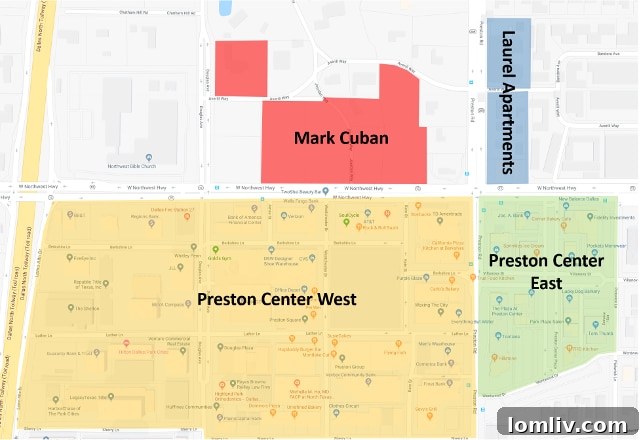
Consider the illustrative case of Mark Cuban’s 10 acres on Northwest Highway, directly across from Preston Center. This sizable parcel is currently zoned for single-family residences. The affluent residents of the surrounding single-family neighborhood, despite being less wealthy than Cuban, have vehemently insisted on maintaining this single-family designation. Yet, these lots are uniquely situated: they are the sole single-family properties along a 4.4-mile stretch of Northwest Highway between the Tollway and Merriman Park, directly facing the commercially zoned Preston Center. The intersection with Preston Road further highlights this anomaly, with two corners hosting major shopping and commercial developments, and another featuring newly constructed mid-rise apartments. These apartments themselves are a testament to the city’s densification trend, having been upzoned from low- to mid-density multi-family. The stark difference in treatment between Cuban’s Northwest Highway lots and the burgeoning carpet of townhomes replacing single-family homes in areas like Belmont Park and Old East Dallas speaks volumes. The answer lies largely in the size of the opposition’s checkbooks, which directly correlates to political influence. This same dynamic can be observed in the earlier “townhouse-ing” of a then more economically struggling Oak Lawn area.
It’s important to note that Mark Cuban has not publicly announced any plans for his Northwest Highway properties. However, it’s a reasonable conjecture that he isn’t planning to replace existing single-family mansions with different single-family mansions; if so, such a development likely would have occurred already. This ongoing situation underscores the selective enforcement of zoning principles across Dallas, revealing a system that often bends to the will of significant financial and political power, creating clear winners and losers in the urban development game.
Addressing Affordable Housing: A Disproportionate Burden
When the critical issue of affordable housing enters the equation, it is once again multi-family living that disproportionately bears the brunt of Dallas’ escalating unaffordability crisis, in ways that single-family areas do not. As concerns over housing affordability intensify, the pressure on the city to implement solutions grows, particularly the challenge of distributing these solutions northward across the city. This directional thinking is, fundamentally, the correct approach to achieving a more equitable distribution of housing options. However, the method of implementation raises serious questions about fairness and equity.
For multi-family areas, “fixing” the affordability problem almost invariably translates into more upzoning, moving from low-density structures to mid-rise developments. What is notably absent from this trend is a widespread conversion from mid- to high-rise structures. This is primarily due to the significantly higher per-square-foot construction costs associated with true high-rises compared to, for example, an eight-story hybrid concrete and wood structure. Consequently, new high-rise developments in Dallas remain largely the preserve of the wealthy. It has been over two decades since the last “middle-class” high-rise was constructed in the city, highlighting a severe gap in housing options that are both dense and genuinely accessible to a broader economic spectrum.
The Unfair Distribution of Density and Its Consequences
These contributing factors, coupled with Dallas City Hall’s persistent willingness to supersize multi-family developments as a means to protect single-family areas, clearly explain why Dallas continues to aggressively pursue the redevelopment of any low-density, low-rise apartment or condo building in a desirable location. From a cynical perspective, it’s fair to question whether this unequal burden placed on multi-family areas is, in part, influenced by the fact that plan commissioners and council members themselves overwhelmingly reside in single-family homes. For many of these decision-makers, urban neighborhoods are often perceived as distant destinations for cultural outings – akin to a New York City theater weekend – rather than the vibrant, daily living environments of their constituents.
When this inherent bias is combined with the existing geographical distribution of Dallas’ zoning, it becomes evident that certain areas of the city have become perpetual magnets for increasingly larger multi-family developments. Neighborhoods such as Oak Lawn, Uptown, Knox, West Village, Bishop Arts, Trinity Groves, and Deep Ellum – essentially any area possessing a unique character, history, or perceived “interest” – are consistently targeted for intensified development. During the January council meeting where the Lincoln Katy Trail project was discussed, Oak Lawn’s District 14 Council Member Philip Kingston vocally criticized this trend. He argued that Oak Lawn, specifically, is unevenly expected to absorb the city’s density requirements and contribute disproportionately to affordable housing solutions, effectively picking up the slack for largely single-family districts that face minimal development pressure.
From my personal vantage point, I would go so far as to propose a radical solution: for every block in a multi-family area that the city upzones, an equivalent block of single-family homes should be randomly upzoned elsewhere in the city. While I wholeheartedly agree with the principle of increasing density to accommodate urban growth, I also recognize that, eventually, the scope of allowed multi-family development must expand beyond its current constrained zones. True fairness dictates that single-family homeowners should also share the palpable fear and uncertainty that the distinctive character of their neighborhoods could vanish with a single city council vote, a reality currently almost exclusive to multi-family residents.
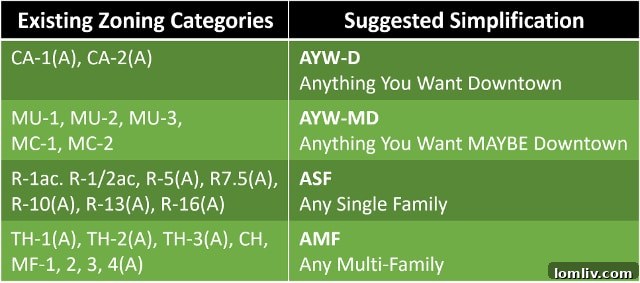
Rethinking Dallas’ Residential Zoning Classifications for Modern Reality
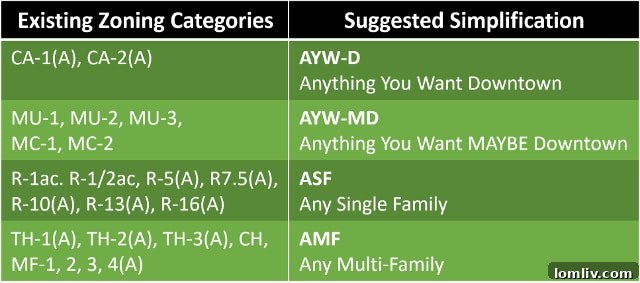
With these observations in mind, and to reflect the current, often challenging, reality faced by condo, townhouse, and apartment dwellers, I propose a simplified and more honest residential zoning code for Dallas. This new framework aims to strip away the misleading complexities of current designations and clearly communicate the city’s true development priorities:
- The “AYW” (Anything You Want) Categories: These designations, encompassing existing Central Area (CA) and Mixed Use (MU/MC) zones, would grant virtually carte blanche for development. In these locations, structures could be built as tall and as dense as physically and structurally possible. Within CA designations, this would mean 100 percent lot coverage, no specified legal height limits, zero setbacks, and permission for “all but the heaviest industrial uses.” Essentially, these zones would become the urban planning equivalent of rubbing a magic bottle and a genie granting every development wish. MU/MC designations would be similarly permissive to CA, provided they include at least one residential unit and one retail/restaurant unit. Like CA, MU would allow for 100 percent lot coverage with no maximum total square footage for a building, with overall building height being “district dependent.” As stated, “Anything You Want” – the primary distinction would simply be whether a parcel is situated downtown or not. These categories acknowledge and formalize the city’s current permissive approach to high-density development in these areas.
- Simplified Single-Family (SF) Category: Because single-family areas are notoriously difficult to convert to other uses unless they are economically disadvantaged, the city should consolidate all existing, disparate single-family zoning buckets into a single, unified category. This designation would apply to any structure intended for one family, unconnected to another residential unit, situated on a single lot, and three stories or less in height. This simplifies the rules for traditional single-family homes. However, it would come with an explicit caveat: if a single-family area is not well-maintained or primarily inhabited by at least middle-class residents, there would be a heightened and acknowledged risk of it being converted to an “AMF” (All Multi-Family) zoning designation. This transparency highlights the economic vulnerability of certain single-family neighborhoods.
- The “AMF” (All Multi-Family) Category: This new designation would collapse all the currently misleading and overly granular multi-family categories. These existing categories offer a false sense of security, implying that a neighborhood’s character will largely remain stable. In truth, each of the old categories served more as a series of stair steps, where a property zoned for lower density could readily petition for a zoning change to the next highest category, and so on, leading to continuous upward pressure on density. The AMF category would honestly represent the reality that multi-family neighborhoods in Dallas are treated as inherently flexible, constantly in flux, and destined to become larger and denser with each passing day.
My proposed new designations are not merely theoretical; they are an honest and candid representation of the true reality of city zoning in Dallas today. This framework communicates, loudly and clearly, the actual state of affairs. By being honest from the outset, prospective buyers and renters in multi-family areas will fully understand the score before their moving van has to contend with a cement mixer for parking space. This starkly contrasts with single-family neighborhoods, which continue to remain largely insulated from the city’s pressing density and affordable housing challenges, much like delicate summertime fireflies safely contained within a jar.
NOTE: I am already aware that this column is being referenced to support development opposition in Preston Hollow’s PD-15. This is an incorrect application of my argument. Dating back at least to 1945, PD-15 was explicitly intended to be a high-density area. This historical intent is reflected in the area’s underlying MF-3 high-rise zoning. The original owner of that area actually envisioned double the density that currently exists, with super-sized buildings. If anything, my column suggests that figures like Mark Cuban should be actively encouraged to develop multi-family or mixed-use projects north of Preston Center on land currently zoned for single-family residences, to help distribute density more equitably across the city.

Remember: High-rises, HOAs, and renovation are my primary focus. However, I also deeply appreciate modern and historical architecture, always striving to balance these elements against the dynamic principles of the YIMBY movement. My writing has been recognized by the National Association of Real Estate Editors, earning three Bronze awards in 2016, 2017, and 2018, as well as two Silver awards in 2016 and 2017. Do you have a compelling story to share, or perhaps a unique marriage proposal? Feel free to reach out via email at [email protected]. You’re also welcome to look for me on Facebook and Twitter, though I must warn you, finding me there might be a delightful challenge!