Dallas, a city experiencing rapid growth and increasing demand for residential spaces, faces a persistent challenge in ensuring adequate affordable housing options for its diverse population. In response to this pressing need, the Dallas City Council recently convened to scrutinize the efficacy and operational hurdles of its key development programs designed to foster mixed-income housing across the metropolitan area. The objective of these crucial discussions, which unfolded last month, was to explore potential amendments that could render these initiatives more appealing and accessible to developers, ultimately streamlining the creation of much-needed affordable homes.
At the heart of Dallas’s affordable housing strategy are programs established to incentivize construction and assist homebuyers. However, these initiatives are not without their complexities, primarily due to stringent guidelines imposed by the U.S. Department of Housing and Urban Development (HUD), which restricts the utilization of federal funds. One council member articulated a common concern, observing that while Dallas seemingly offers substantial incentives to both developers and prospective homeowners, these benefits appear concentrated on a limited number of projects. This concentration, they noted, often leads to the rapid absorption of federal funds, raising questions about the programs’ broader impact and equitable distribution.
The intricate details of these programs were brought into sharper focus during a pivotal Housing and Homeless Solutions Committee meeting on November 14. Assistant Housing Director Darwin Wade presented a comprehensive review of two cornerstone initiatives: the Single Family Home Ownership Development Program and the Land Transfer Program. His presentation highlighted not only their intended benefits but also the significant operational challenges that frequently impede their success and limit their reach within the community.
The challenges facing Dallas’s affordable housing landscape are multifaceted and profound. According to James Armstrong, President and CEO of Builders of Hope, the removal of existing city subsidies for developers and homebuyers would send a clear, unequivocal message: low-income residents are not a priority in Dallas. Such a move, Armstrong emphasized, would exacerbate the housing crisis for those already struggling to find suitable and affordable homes within the city limits. His assertion underscores the critical role that these subsidies play in enabling homeownership for a significant segment of the population.
Annually, Dallas receives approximately $16 million from HUD, a vital injection of capital that is meticulously distributed across various housing programs. This federal allocation is primarily channeled through two main avenues: roughly $10 million is administered via the Community Development Block Grant (CDBG) program, while the remaining $6 million comes through the HOME Investment Partnership Program. Each of these funding streams comes with its own set of detailed regulations and restrictions, which can sometimes complicate their application and limit their flexibility in addressing diverse housing needs.
An illustrative example of these restrictive HUD guidelines involves CDBG funds. Crucially, CDBG money cannot be utilized for new construction projects. Instead, its use is strictly confined to activities such as land acquisition and infrastructure development. This specific restriction means that while CDBG funds are invaluable for preparing sites and improving existing infrastructure, they cannot directly contribute to the building of new homes, thereby necessitating other funding sources for vertical construction and potentially slowing down overall development timelines.
Looking ahead, officials from the Dallas Department of Housing and Neighborhood Revitalization are expected to present a resolution to the City Council in March. This resolution aims to propose strategic modifications and improvements to the programs outlined in the Dallas Housing Policy 2033, signaling a concerted effort to adapt and refine the city’s approach to affordable housing in the face of ongoing challenges.
Developer Programs and Incentives: Fueling Dallas’s Affordable Housing Growth
Dallas initiated a proactive approach to affordable housing development in 2020 with the introduction of its “Notice of Funding Availability” (NOFA). As Assistant Housing Director Darwin Wade elaborated, this mechanism was designed to provide the development community with crucial gap financing. This financial support, typically structured as a repayable loan, is instrumental in assisting developers with the acquisition, development, and rehabilitation of affordable, mixed-income rental and for-sale housing units. The NOFA process is a critical tool in bridging financial gaps that often make affordable housing projects difficult to fund through conventional means.
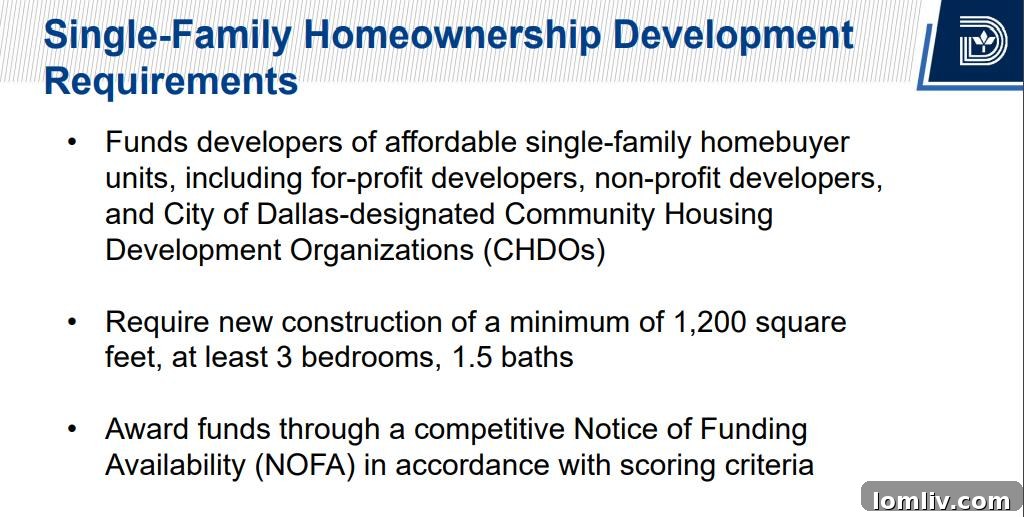
The Single Family Home Ownership Development Program
A cornerstone of Dallas’s strategy is the Single Family Home Ownership Development Program. This initiative provides essential funding to a broad spectrum of developers, including for-profit entities, non-profit organizations, and certified community housing development organizations (CHDOs). The program’s core mission is to stimulate the construction of single-family homes that are genuinely affordable, thereby expanding homeownership opportunities for low-to-moderate-income families who might otherwise be priced out of the market. By partnering with various types of developers, Dallas aims to leverage diverse expertise and resources to meet its housing goals.
The Land Transfer Program: Unlocking City-Owned Assets
Complementing the Single Family Home Ownership Development Program is the innovative Land Transfer Program. This initiative strategically leverages city-owned assets – specifically vacant surplus and tax-foreclosed land – to incentivize the creation of high-quality, sustainable housing. By making these parcels available, Dallas aims to reduce a significant barrier to entry for developers: the cost of land acquisition.
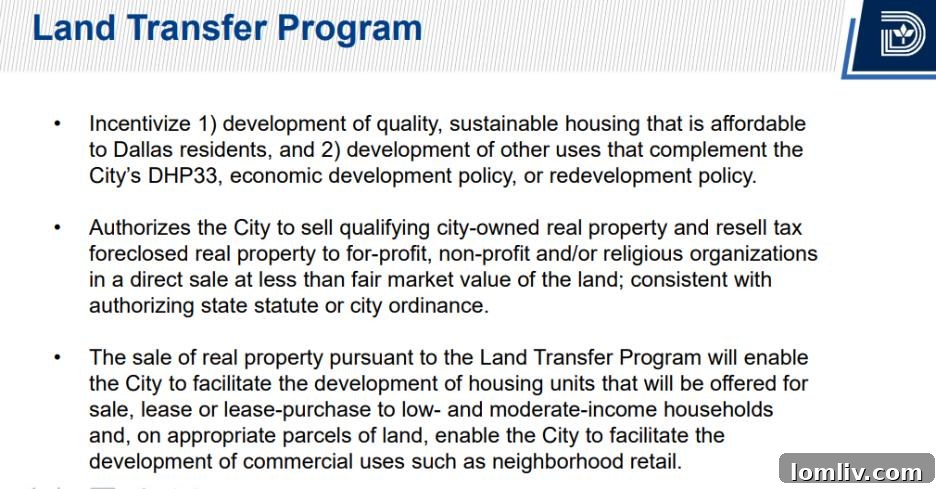
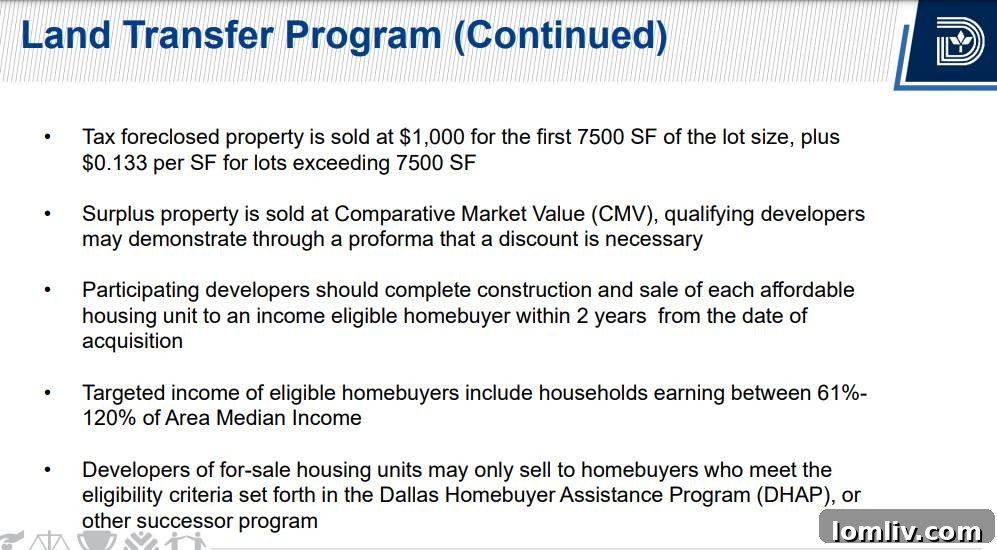
As Darwin Wade explained, the land within this program can be sold to for-profit developers, non-profit organizations, and even religious institutions at below fair market value. This substantial discount directly translates into reduced development costs, making it more feasible to construct housing units specifically designed for low-to-moderate-income (LMI) households. Beyond residential development, the program also supports other beneficial uses, such as commercial spaces, fostering holistic community development and economic revitalization in targeted areas.
Developer Challenges: Navigating Economic Headwinds and Policy Conflicts
Despite the city’s earnest efforts, operational challenges frequently arise, creating significant hurdles for developers attempting to build affordable housing. Wade elucidated these difficulties using a pertinent example: imagine a scenario where the city awards a developer an $880,000 subsidy, provided as a repayable loan, to construct 20 homes. This equates to a substantial $44,000 subsidy per home, intended to lower the overall cost and make the units more accessible. However, the current economic climate often undermines the effectiveness of such subsidies.
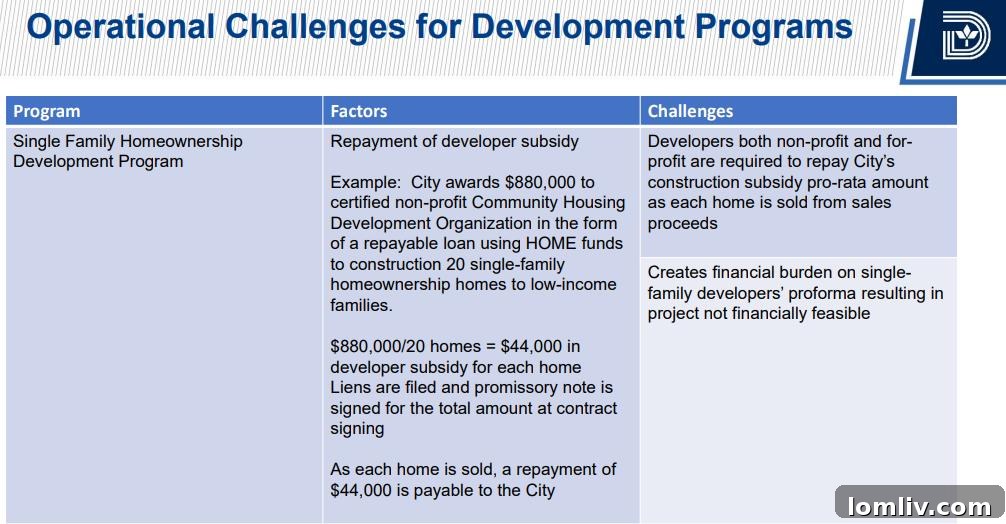
Developers have consistently voiced concerns about the prevailing market conditions, which have created undue hardships on their financial viability and project performance. Over the past three years, key economic indicators have significantly impacted the housing sector: surging construction costs, escalating interest rates, persistent inflation, and rising lot development expenses have collectively squeezed profit margins. These factors make it financially infeasible for developers to construct single-family homes that can be sold at prices affordable to families earning 60 to 80 percent of the area median income (AMI). Wade underscored this point, explaining that when these formidable challenges are compounded by the requirement to repay the city a portion of the loan each time a home is sold, it renders the financial feasibility of such projects “increasingly difficult, if not practically impossible, to make the deal pencil.” This phrase, “make the deal pencil,” refers to the ability to structure a project’s finances in a way that allows for a reasonable profit after all costs and obligations are met.
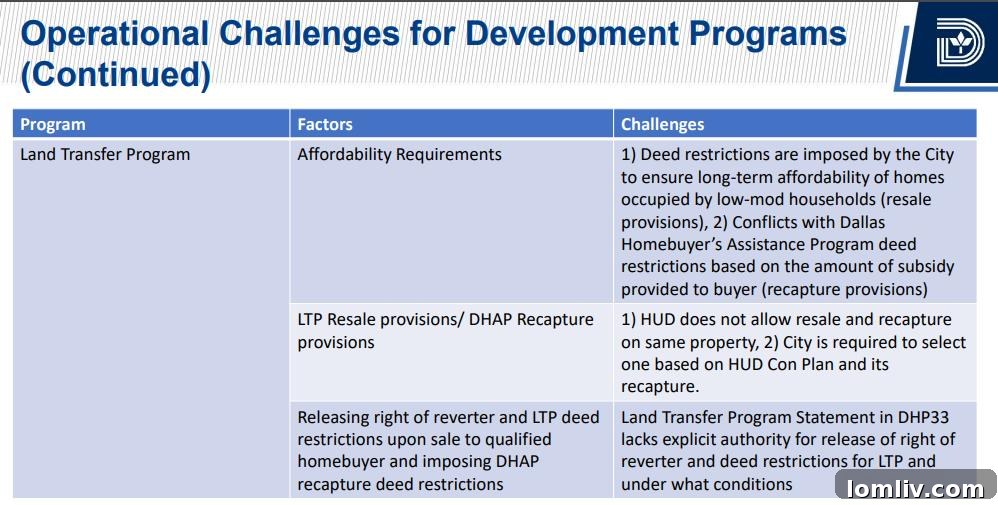
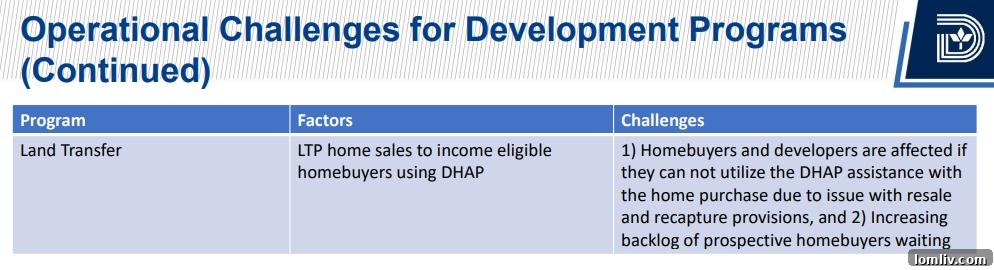
Further complicating the landscape is a significant conflict between the resale provisions of the Land Transfer Program and the deed restrictions associated with the Dallas Homebuyer Assistance Program (DHAP). This conflict arises primarily due to the amount of direct subsidy provided to the homebuyer through DHAP. According to HUD regulations, as Wade clarified, the department “does not allow both resale and recapture on the same property.” This means that a property cannot simultaneously be subject to resale restrictions (which dictate who can buy the home next and at what price to maintain affordability) and recapture provisions (which require the initial subsidy to be repaid upon resale). This regulatory inconsistency presents a major operational and legal issue for Dallas, placing both developers and homebuyers in a state of uncertainty.
To address this critical policy inconsistency and provide much-needed clarity, one potential solution, pending City Council approval in March, involves authorizing city staff to release the developer’s deed restriction in specific cases. Wade highlighted the urgency of this amendment, stating, “We need something in our policy, and right now it’s silent on that issue.” Such a policy adjustment, he argued, would not only resolve the current regulatory impasse but also offer substantial relief to the developer community and the many homebuyers who are presently caught in “limbo” due to these conflicting requirements.
Council Feedback on U.S. Housing and Urban Development Restrictions: A Debate on Strategy
The discussions at the City Council meeting revealed diverse perspectives on how best to navigate the complexities of federal funding and local housing needs. Councilman Chad West, for instance, put forth a suggestion that perhaps HUD funds could be channeled through the least restrictive and fastest federal program available, rather than being fragmented across numerous options. His rationale was rooted in efficiency: “Whatever is going to make it the most fluid to build the most affordable housing for us to get on the market, I fully support,” he stated. West’s perspective emphasized the urgency of increasing housing supply and reducing bureaucratic delays, suggesting that a more consolidated and less prescriptive funding approach might yield quicker and more impactful results for the city’s affordable housing goals.
In contrast, Councilwoman Cara Mendelsohn expressed significant reservations, raising fundamental questions about the extent of the financial commitment the city was making in the name of affordable housing. She sought to understand precisely “how much the city is giving away.” Mendelsohn pointed to specific data from 2023, noting that the DHAP program provided funding for a total of 33 homebuyers, with 15 of these benefiting through the Land Transfer Program. While acknowledging that 15 percent of federal funds are mandated for Certified Community Housing Development Organizations (CHDOs), which limits radical changes to that specific allocation, she pressed Wade for clarification on the broader financial implications of the current strategies. Her line of questioning suggested a concern that the substantial funds might be disproportionately benefiting a small number of recipients, rather than achieving broader impact across the community. When Wade reiterated developers’ claims about the increased burden of repaying $44,000 per home, Mendelsohn remained skeptical, stating, “I’m not looking to hear from the developer about their woes.” She sought a clearer understanding of the mechanics: “What I’m trying to understand is … are you saying we would give the developer the $1,000 lot, we would then do the DHAP for $50,000 or $60,000, and then we would forgo being reimbursed?” Her interrogation aimed to uncover the true cost to the city when combining various subsidies.
Wade clarified that his intention was to provide a realistic scenario to solicit feedback rather than to present a definitive proposal for a forgivable loan. He explained that developers still purchase the land through the Land Transfer Program, and the $44,000 in his example represents a repayable loan. He did, however, open the door to a potential change, noting that if the council desired, this could be structured as a forgivable loan – an option that could be incorporated into an update to the Single Family Development Program. Mendelsohn further clarified her understanding, articulating her concern that three distinct pots of funding were being layered for a single home. She voiced her apprehension that such a strategy could be perceived as “essentially buying people homes and giving them away.” From her perspective, this approach focused intensely on a few individuals rather than maximizing the reach of the city’s resources to develop more housing units for a larger population. She affirmed her strong support for using federal pass-through dollars for their intended purpose, but stressed the importance of helping “as many people as possible.” She underlined the significant amounts involved—”$44,000 here, $50,000 there”—and expressed “a lot of reservations about making the changes that you’re proposing here,” implying that such deep subsidies for individual homeowners might not be the most fiscally responsible or equitable path for the city.
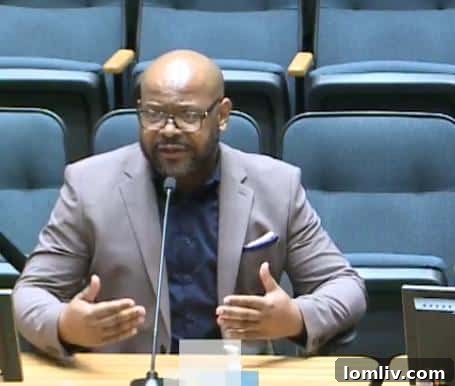
Standing in staunch defense of the programs, James Armstrong, representing Builders of Hope, countered Mendelsohn’s concerns by emphasizing the profound social impact of these initiatives. He argued that the program is not about “woes” but about creating vital opportunities for homeownership for individuals who are otherwise priced out of an increasingly expensive market. Armstrong clarified that the $50,000 typically allocated through DHAP does not go to the developer but directly benefits the homebuyer, thereby “increas[ing] the affordability for someone who may work at a local hospital or as an administrative assistant.” He stressed that the homes constructed are not “shoddy” but are quality residences that necessitate subsidy to be accessible to the city’s essential workforce. Armstrong powerfully concluded that if Dallas were to disallow the $44,000 subsidy from being part of the home’s affordability structure, the city would effectively be signaling that homeownership for residents earning 60 to 80 percent of the AMI is “not welcome in the city of Dallas.” His argument highlighted the critical role of subsidies in bridging the gap between market realities and the financial capabilities of working families, asserting that these programs are not just about financial transactions but about fostering inclusive communities where essential workers can afford to live and thrive.
Charting the Future for Dallas’s Affordable Housing: Balancing Vision with Viability
The dialogue within the Dallas City Council exemplifies the complex interplay of federal mandates, market forces, and local aspirations that defines the affordable housing landscape in major urban centers. The upcoming resolution in March represents a pivotal moment, as the city grapples with how to best adapt its policies to overcome current operational bottlenecks and ensure the sustained viability of its affordable housing initiatives. Whether the council opts for releasing deed restrictions, exploring forgivable loans, or refining existing funding allocations, these decisions will profoundly impact the capacity of Dallas to provide accessible homeownership opportunities.
Ultimately, the challenge before Dallas is to strike a delicate balance: fostering robust developer engagement through attractive incentives while maintaining fiscal prudence and ensuring that public funds generate the broadest possible impact. The insights shared by housing officials, developers, and council members underscore that sustainable affordable housing solutions require not only financial investment but also agile policy frameworks that can adapt to dynamic economic conditions. By carefully considering all perspectives and pursuing innovative strategies, Dallas can move closer to its vision of being a city where diverse income levels can find a stable and affordable place to call home, strengthening the economic and social fabric of the community for generations to come.