

The real estate landscape in North Texas is a dynamic tapestry of growth, challenges, and opportunities, consistently capturing national attention. From soaring populations to evolving housing dynamics, understanding these trends is crucial for residents, investors, and policymakers alike. This comprehensive report dives deep into recent studies and analyses, exploring key facets of the Dallas-Fort Worth real estate market and its broader implications for Texas. We’ll uncover Dallas’s remarkable economic expansion, examine the complexities of housing voucher acceptance in Fort Worth, analyze the trends shaping single-family rental markets, and commend Texas’s leading efforts in ensuring transparency within the real estate profession. Get ready for an insightful journey into the heart of one of America’s most vibrant real estate environments.
Dallas’s Economic Surge: A Top American Boomtown
Dallas continues to solidify its reputation as an economic powerhouse, securing a prominent spot on the list of America’s most significant “boomtowns.” According to a meticulous analysis by the personal finance experts at MagnifyMoney, which scrutinized 100 of the nation’s largest metropolitan areas between 2011 and 2016, Dallas emerged as a leader in growth and development. This comprehensive study evaluated cities based on three critical categories: population and housing growth, the strength of the workforce and earnings, and the vitality of business expansion.
Each category was assigned a potential score of 100, with an average of these three scores determining a city’s final ranking. The methodology considered various indicators of a thriving economy, including the median earnings for workers, the overall number of businesses, the employee count per pay period, unemployment rates, and the availability of housing units. These metrics paint a vivid picture of metropolitan areas experiencing rapid and sustained economic acceleration.
Dallas proudly earned an impressive overall ranking of 7th among the top boomtowns. Its individual scores highlighted robust performance across the board: a population and housing score of 61.4 underscored its magnetic appeal for new residents and development; a workforce and earnings score of 48.7 demonstrated a healthy job market and rising incomes; and a business growth score of 64.4 showcased a fertile environment for new enterprises. While Dallas’s growth is undeniable, its Texan counterparts also made significant waves. Austin, the state capital, claimed the top spot nationally with exceptional scores of 100 for population and housing, 70.3 for workforce and earnings, and 93 for business growth. San Antonio also ranked high at 9th, and Houston secured the 11th position, reinforcing Texas’s dominance in fostering dynamic urban centers. The consistent high rankings of these major Texas cities underscore the state’s robust economic policies, favorable business climate, and attractive lifestyle, making them magnets for both individuals seeking new opportunities and companies looking to expand. This sustained growth trajectory positions Dallas and its sister cities as key drivers of the national economy, with continued expansion anticipated across various sectors.
Challenges in Fort Worth: Navigating Housing Voucher Denials
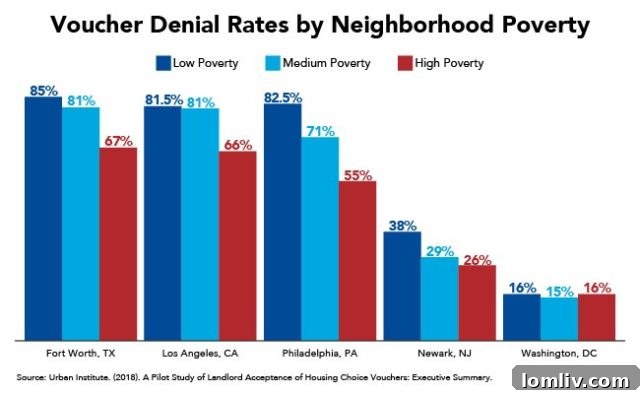
While some parts of North Texas celebrate economic booms, other areas grapple with significant challenges in housing accessibility. A sobering report from the Urban Institute’s Pilot Study of Landlord Acceptance of Housing Choice Vouchers revealed that Fort Worth has one of the highest housing voucher denial rates among the major metropolitan areas studied. This critical study shed light on the difficulties faced by low-income individuals and families attempting to secure housing using Housing Choice Vouchers (HCVs), also known as Section 8 vouchers.
The Urban Institute’s research encompassed five diverse metropolitan areas: Fort Worth, Los Angeles, Newark (New Jersey), Philadelphia, and Washington, D.C. The findings were stark, indicating a direct correlation between high denial rates and areas where local ordinances do not explicitly prohibit discrimination based on a potential tenant’s source of income. This lack of legal protection leaves voucher holders vulnerable to landlords who may be unwilling to accept federal assistance as a form of rent payment.
Conducted over a 16-month period, the study involved an extensive screening process. Researchers analyzed 341,000 online rental advertisements, meticulously filtering them to identify approximately 8,700 listings that would be financially accessible to housing voucher recipients. This rigorous selection ensured that the subsequent inquiries focused exclusively on properties that were theoretically within the voucher program’s affordability guidelines.
The telephone inquiry phase of the study yielded compelling and concerning results regarding landlord acceptance. “In telephone inquiries to the landlords about voucher acceptance in housing that would be affordable to voucher holders, the outright denial rate of vouchers was 78% in Fort Worth, 76% in Los Angeles, 67% in Philadelphia, 31% in Newark, and 15% in DC,” the researchers reported. These figures highlight a stark disparity, with Fort Worth and Los Angeles exhibiting significantly higher rates of outright refusal compared to cities like Newark and Washington, D.C., which often have stronger source-of-income protection laws.
Furthermore, the study delved into neighborhood-level dynamics within Fort Worth, uncovering another layer of complexity. Denial rates in low-poverty neighborhoods were even higher than in high-poverty neighborhoods, with an alarming 85 percent denial rate in more affluent areas compared to 67 percent in high-poverty areas. This suggests that voucher holders face increased hurdles when attempting to access housing in areas that might offer better schools, amenities, and job opportunities, reinforcing patterns of segregation and limiting upward mobility.
To ensure the robustness of their findings, the researchers employed a “paired tester” methodology for a subset of landlords who initially indicated acceptance of vouchers. “Two testers would call the same landlord. These testers were similar in all aspects, including race, except that one identified as a voucher-holder and one did not.” This method is crucial for identifying subtle forms of discrimination that might not be evident in outright denials, providing deeper insights into the real-world experiences of housing voucher recipients. The findings from this study underscore an urgent need for policy interventions in areas like Fort Worth to ensure equitable housing access for all residents, regardless of their income source.
Dallas Single-Family Rentals: A Steady Rise Amidst National Trends
The single-family rental market in Dallas presents a more tempered picture compared to its booming economic headlines. While still experiencing growth, Dallas finds itself firmly in the lower-middle tier when it comes to the pace of year-over-year rent increases for single-family homes. This insight comes from CoreLogic’s comprehensive first-half review of its Single-Family Rent Index (SFRI), a crucial barometer for this often-overlooked segment of the housing market.
Molly Boesel, Chief Economist at CoreLogic, emphasized the significance of this sector: “Single-family rentals make up one-half of all residential rentals but are an overlooked segment of the housing market.” The SFRI provides vital data that helps illuminate trends beyond traditional multi-family apartments, offering a clearer view of diverse rental options. Nationally, the Single-Family Rent Index has shown a consistent upward trajectory, increasing by 4.1 percent since January 2018. The average year-over-year increase across the country has hovered around a steady 2.8 percent, reflecting a robust demand for detached rental properties.
Specifically, within the Dallas-Plano-Irving metropolitan area, single-family rents saw an increase of approximately 1.8 percent since January 2018. Looking at the year-over-year data, rents in this key North Texas region rose at a rate of 2.2 percent. While these figures indicate growth, they suggest a more moderate pace compared to some of the nation’s most heated rental markets. This stability could be attributed to a combination of factors, including new construction mitigating some demand pressures or a more balanced supply-demand dynamic in certain price points.
However, CoreLogic’s projections point towards continued upward pressure on single-family rents, driven by the same fundamental forces that inflate home prices: limited availability and strong demand. “High demand and low supply of lower-priced single-family rental properties continue to push up rents for this segment of the rental market,” Boesel explained. This trend highlights a critical challenge for affordability, especially for families seeking more space or privacy than traditional apartment living can offer, but who are not yet ready or able to purchase a home.
The economist further predicted that “With these market forces expected to stay in place in the near term, rents on lower-priced rental properties should continue to outpace those of higher-end rental properties.” This suggests a widening gap in affordability, where entry-level single-family rentals become increasingly competitive and expensive, putting pressure on household budgets and potentially impacting migration patterns within the region. Understanding these nuanced rental market dynamics is essential for both residents planning their living situations and investors assessing opportunities in the robust Dallas-Fort Worth real estate environment.
Texas Leads the Nation in Real Estate Professional Transparency
In a landscape where consumer trust is paramount, Texas has distinguished itself as a national leader in fostering transparency within the real estate profession. The state’s robust system for allowing consumers to review complaints against Realtors and understand the outcomes of disciplinary actions has garnered significant praise, particularly from influential real estate publications like the New York-based The Real Deal.
The article highlighted a stark contrast between Texas’s exemplary approach and the cumbersome systems found in other major markets. Reporter Kevin Sun, who conducted the analysis, noted, “New York State has a remarkably unwieldy system for recording disciplinary actions against real estate brokers, with low usability and confusing organization. But how much better are other states doing? The answer, it turns out, is a lot.” This comparison underscores the critical importance of accessible and transparent information for consumers making significant financial decisions.
Sun’s investigative review focused on six major real estate markets across the country, evaluating their public disclosure systems based on functionality and ease of use for the average consumer. The goal was to identify which states truly empower buyers and sellers by providing clear, concise, and readily available information about the professionals they work with.
The Texas Real Estate Commission’s (TREC) website emerged as the unequivocal frontrunner, earning the highest accolades for its exceptional design and functionality. TREC’s online platform was not only recognized as the best on the list but also set a benchmark for other states to aspire to.
“Texas was only state examined which provided a flexible search engine for consumers, allowing users to construct custom queries using various criteria,” Sun wrote. This flexibility is a game-changer for consumers, enabling them to conduct targeted searches for specific information rather than sifting through disorganized data. The TREC database contains records of approximately 1,000 disciplinary actions taken against brokers and sales agents since 2007, in addition to actions against home inspectors and instructors. Crucially, TREC’s disciplinary action search allows users to filter results by city, date range, or violation type, and even search for individual brokers and specific cases. This granular level of detail provides an invaluable resource for due diligence.
Sun further elaborated on the accessibility of information: “For many cases, the relevant documents may also be viewed directly in the search results, though others require freedom of information requests.” This direct access significantly streamlines the process for consumers to obtain detailed insights into any professional misconduct, enhancing accountability and consumer protection. In stark contrast to Texas’s leading efforts, New York was ultimately ranked last in the study, highlighting the significant disparities in transparency practices across state lines. Texas’s commitment to making critical information readily available to the public not only builds trust but also serves as a vital safeguard in the complex world of real estate transactions.
These insights into the Dallas-Fort Worth real estate market paint a picture of a region in constant evolution. From economic booms and rental market adjustments to the critical issue of housing affordability and the exemplary standards of professional transparency, North Texas remains a fascinating and significant player in the national real estate conversation. Understanding these trends is key to navigating its dynamic landscape effectively.