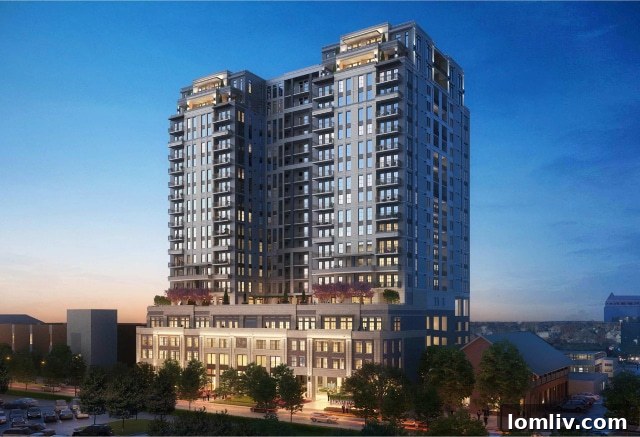
In the vibrant and rapidly evolving landscape of Dallas, particularly within the esteemed Oak Lawn neighborhood, real estate development projects are constantly under scrutiny. These initiatives, while promising growth and modernization, inherently demand meticulous adherence to zoning regulations, urban planning guidelines, and transparent communication with community stakeholders. Our recent investigation into a prominent development by Crescent Communities near Oak Lawn and Irving Avenues has unearthed a series of significant discrepancies that raise serious questions about process, compliance, and accountability.
Initially, my coverage of an Oak Lawn Committee meeting highlighted concerns regarding a specific project. From the outset, the proposed building appeared to vastly exceed the permissible square footage for its stated 0.936-acre parcel. This visual assessment suggested a density nearly double what would typically be allowed, immediately flagging the project for deeper examination by concerned citizens and local observers.
As the day progressed, additional critical information began to surface, painting a more complex picture. During the Oak Lawn Committee meeting, representatives from Crescent Communities asserted that their actual lot size was 1.83 acres, a dimension that, if accurate and legally established, would indeed place their development within the allowable buildable envelope. This claim, however, stood in stark contrast to publicly available records and initial observations, necessitating a closer look at the factual basis of their assertion.
Further clarity arrived late yesterday following a direct communication with Kris Sweckard, the director of Sustainable Development and Construction for the City of Dallas. His response unveiled a pivotal piece of information: on January 17, 2019, the 0.9336-acre Novel parcel (which was formerly owned by Southwest Bell) and a directly adjacent parcel, still under the ownership of Southwest Bell (SBC), had been approved for replatting into a single, unified lot by the Plan Commission. The official replat filing unequivocally stated, “The number of lots permitted by this plat is one.” This revelation, on the surface, seemed to support Crescent Communities’ claim of a larger 1.83-acre parcel.
However, the existence of an approved replat is merely one step in a multi-faceted legal and administrative process. The true validity and practical application of such a change hinge on its formal recordation and the alignment of ownership. This is where the discrepancies begin to unravel, transforming what appeared to be a straightforward planning approval into a web of inconsistencies.
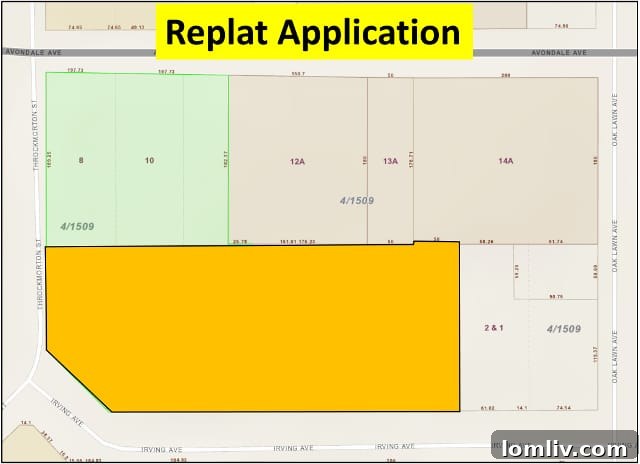
Indeed, records confirm that the City Plan Commission (CPC) granted approval for Crescent’s Novel parcel to be replatted in conjunction with the neighboring SBC parcel, thereby creating the 1.83-acre site that Crescent Communities presented to the Oak Lawn Committee. This approval, from a planning perspective, intended to consolidate the two distinct parcels into a single, larger property. But a critical oversight or perhaps a strategic omission renders this replatting effectively moot for the purposes of development compliance.
The fundamental issue lies in the fact that this replatting has never been officially recorded with the Dallas Central Appraisal District (DCAD). The DCAD records continue to reflect two separate owners for these parcels. Moreover, and perhaps most significantly, Crescent Communities explicitly informed the Oak Lawn Committee that they have no intention of purchasing the SBC site. This creates an irreconcilable conflict: how can two properties be legally replatted into one, with the intention of accumulating density rights for a larger development, while simultaneously maintaining entirely separate ownership? Unless Crescent and SBC are entering into a formal development partnership or co-ownership agreement – for which there is currently no evidence – the premise of building on a unified 1.83-acre lot becomes legally unsound.
The implications of this unrecorded replat extend beyond just density calculations. If the replatting was intended for more than merely aggregating Floor Area Ratio (FAR), other crucial zoning parameters might also be in violation. One such critical aspect is lot coverage. According to the specific provisions of the Oak Lawn Plan, the maximum lot coverage allowed is 60 percent. A visual inspection of the Novel project’s footprint suggests that it likely exceeds this threshold even without factoring in the SBC/AT&T parcel. If the project is already over the 60% limit on its original, smaller parcel, then the entire development’s compliance with foundational urban planning principles in the Oak Lawn area is compromised. Lot coverage limits are put in place to ensure adequate open space, manage stormwater runoff, and maintain the aesthetic character of a neighborhood. Bypassing these regulations can have detrimental effects on local infrastructure and the quality of life for residents.
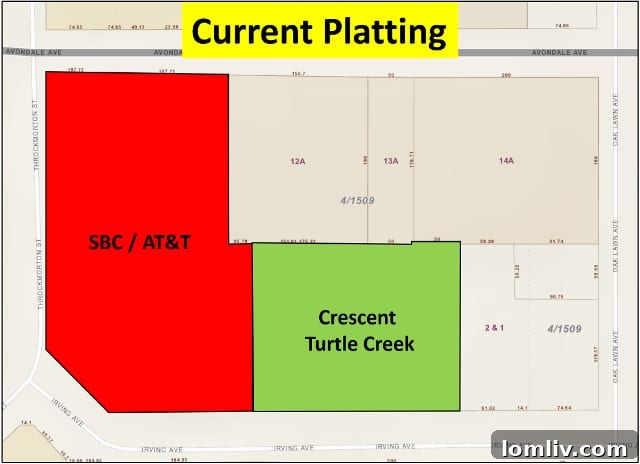
The complexity is further compounded by the nature of the SBC site itself. This parcel is not merely a small, isolated lot adjacent to Crescent’s property. It is a more substantial piece of land, connected to additional parcels at the rear, effectively forming an “end cap” of the entire block. For the proposed development arrangement to gain any semblance of legal footing, one of the following scenarios would seemingly need to materialize, each presenting its own set of legal, financial, and logistical challenges:
- Unified Ownership: Crescent Communities would have to proceed with the outright purchase of the SBC/AT&T parcel. This would establish singular, unified ownership, thereby legitimately merging the parcels and allowing for shared development rights and a consolidated plat. This is the most straightforward, albeit potentially costly, resolution.
- Partial Replat and Joint Ownership: The SBC/AT&T parcel could be further replatted to legally separate its lower half, which would then be formally joined with the Crescent parcel as per their original replatting application. This would, however, necessitate either singular ownership of the newly combined larger parcel or a legally binding partnership ownership agreement between SBC/AT&T and Crescent Communities, clearly defining responsibilities, rights, and liabilities.
- Reversal of Ownership: In an unlikely but theoretically possible scenario, SBC/AT&T could opt to repurchase the Crescent parcel. This would effectively reverse the current development trajectory and bring the land back under a single owner, albeit not the developer in question.
Crucially, it must be reiterated that during the Tuesday night meeting, the Oak Lawn Committee was explicitly informed that Crescent Communities had no plans to acquire the SBC/AT&T site. Yet, the committee members were presented with visual aids that seemed to contradict this statement.
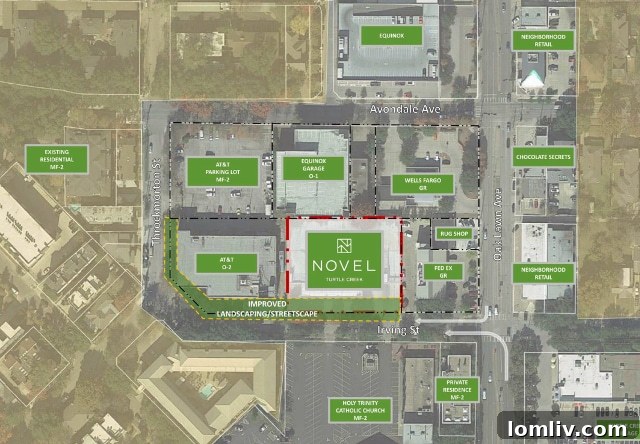
As depicted in the graphic presented to the Oak Lawn Committee, the visual representation was highly misleading. It appeared to show the “top/bottom” SBC/AT&T lots as having been already separated, which is factually incorrect as they remain a single, undivided property under separate ownership. Furthermore, the graphic illustrated an extended landscape area that visually wrapped around Crescent’s Novel frontage and seamlessly connected with the southern portion of the SBC/AT&T parcel. This deceptive visual presentation effectively tricked viewers into perceiving the parcels as physically connected and integrated, when in reality, they are not. Such visual manipulation in public presentations erodes trust and undermines the integrity of the planning process, making it difficult for community members to assess projects accurately based on factual data.
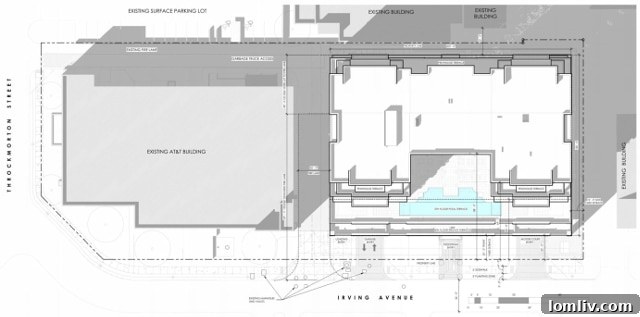
What The Plat Actually Stated: Discrepancies in Public Access
Another area of significant concern revolves around public access and easements. The Oak Lawn Committee was informed by Crescent Communities that a 26-foot gap between their parcels would serve as a utility and emergency services right-of-way. They proposed that this lane would be gated and primarily utilized as a dog park. This description, however, directly clashes with a fundamental condition outlined in their replatting approval. The replatting document explicitly states, “The utility and fire lane easements shall be open to the public, fire and police units, garbage and rubbish collection agencies, and all public and private utilities for each particular use.” The emphasis here is unequivocally on public access.
This raises a critical question: How can an easement legally designated as “open to the public” simultaneously function as a gated dog park, which by its very nature implies restricted access? Public easements are vital arteries for community services, ensuring unhindered passage for emergency vehicles, utility maintenance, and general public use. Gating such an area, even with the intention of creating a community amenity like a dog park, directly contravenes the terms of the replat and poses potential legal and safety risks. Limiting access to a fire lane, for instance, could have severe consequences in an emergency situation. This contradiction highlights a blatant disregard for the stipulated conditions of the replat and suggests a selective interpretation of legal requirements to suit development plans.
Beyond access, city staff reports from the replatting process also raised crucial environmental and infrastructure questions. Specifically, concerns were noted regarding the “Capacity of existing wastewater system is questionable. Submit proposed wastewater discharge (gpm) of development for further assessment.” Given the apparent lack of final, conclusive documents addressing many of these issues, it remains unclear whether this vital assessment of the wastewater system’s capacity was ever properly conducted or followed up on. The sustainable functioning of urban infrastructure, particularly wastewater management, is paramount for public health and environmental protection. Ignoring or failing to adequately assess these concerns before proceeding with a large-scale development is a grave oversight. Readers can review the original replat filing here for a detailed understanding of the conditions and concerns raised.
The Enigma of Building Permits: A Breakdown in Oversight?
Perhaps the most perplexing question arising from this complex situation is how this project managed to secure building permits in the first place. The process of issuing building permits in any municipality is typically rigorous, designed to ensure that all aspects of a proposed development align with local zoning ordinances, building codes, and legal property descriptions. In this instance, it appears that fundamental checks were either neglected or circumvented.
It seems unequivocally clear that no one involved in the permitting process adequately verified that the approved replatting of the two parcels into one had been formally recorded with DCAD. This critical step confirms legal ownership and the official property boundaries upon which development plans are based. Furthermore, it is equally evident that the specific terms and conditions stipulated within the replat application itself were not thoroughly reviewed or enforced. Had these checks been performed diligently, the inconsistencies regarding separate ownership, lot coverage, and public easements would have been immediately apparent, potentially halting the permitting process.
This raises serious concerns about the integrity of the city’s development oversight mechanisms. When building permits are issued based on incomplete or inaccurate information, it undermines the entire framework of urban planning, jeopardizes public trust, and can lead to costly rectifications, legal battles, and significant delays. Such a lapse in due diligence suggests a systemic breakdown that demands immediate attention. Therefore, a crucial question must be posed: Is it not time to issue a stop-work order on this project until all these profound discrepancies are thoroughly investigated, clarified, and legally resolved? Proceeding with construction under such a cloud of uncertainty poses risks to the developer, the city, and the Oak Lawn community alike.
A Note on Accuracy: Correcting the Record
In the pursuit of factual reporting and journalistic integrity, it is vital to correct any misstatements or misunderstandings. Yesterday’s piece included a quote attributed to Lauren Ferguson, suggesting she had been in detailed discussions with the head of the Oak Lawn Committee regarding the project. This assertion has since been clarified.
This morning, I received an emphatic call from Hilda Rodriguez, the President of the Oak Lawn Committee, who vehemently denied that any such detailed conversations had taken place. President Rodriguez clarified that Lauren Ferguson had indeed alerted her to an upcoming “by-right” project that Crescent Communities intended to present to the OLC in the future. However, Rodriguez firmly stated that no specific details about the project were discussed during that preliminary notification. This correction underscores the importance of precise communication and accurate representation of interactions between developers and community leadership, especially in projects attracting significant public interest and scrutiny.