
The Return of the Company Town: A Modern Paradox in Silicon Valley and Beyond

In a striking echo of the past, powerful Silicon Valley corporations like Facebook and Google are actively reimagining and resurrecting the concept of the “company town.” For decades, this innovative hub has been singularly focused on generating immense wealth through technological advancement. The meteoric rise of tech millionaires has, however, created a severe and increasingly insurmountable housing crisis, pushing real estate prices far beyond the reach of those not benefiting from lucrative stock options and highly anticipated IPOs. On the surface, constructing dedicated housing for employees within this environment might appear to be a benevolent solution, aiming to increase housing capacity and benefit all. Yet, a closer examination reveals a potentially far darker and more complex outcome, echoing the problematic history of its predecessors.
A Look Back: The Checkered History of Traditional Company Towns
The company town, a fascinating and often controversial chapter in industrial history, emerged in the mid-19th century. Pioneered by industrialists operating various businesses in remote or undeveloped locations, these towns served a critical purpose: providing essential housing and basic social infrastructure for workers where none existed. This model was particularly prevalent in industries such as mining, lumber, and isolated manufacturing operations, where access to labor required immediate, on-site solutions. Over time, the scope of industries adopting this model expanded, even including seemingly benign sectors like chocolate production, with famous examples being Hershey in the US and Cadbury in the UK.
However, the reputation of most traditional company towns became tarnished, and for good reason. Industrialists frequently leveraged their ownership not merely to supply housing but to exert an oppressive degree of control over their workforce. For instance, it was common practice for company towns to simultaneously terminate employment and evict workers who dared to organize labor unions in an effort to improve abysmal working conditions. Furthermore, town owners were often perceived as “double-dippers.” They owned all the local shops, which routinely sold overpriced merchandise to a captive audience of isolated workers who had no other purchasing alternatives. This monopolistic practice often trapped workers in cycles of debt, effectively tying them to the company both financially and geographically.
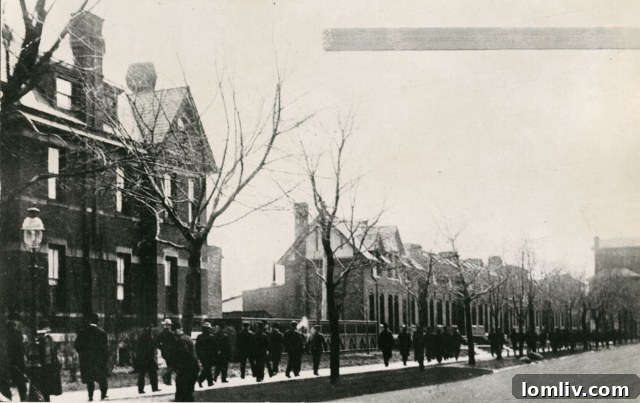
Perhaps the most infamous American example is that of railroad car manufacturer George Pullman and his eponymous town. In 1883, a severe economic depression led to a sharp decline in orders for Pullman cars. In response, Pullman drastically cut his workers’ wages, yet he maintained the same high prices in company stores and kept rents for company housing unchanged. This tactic squeezed workers from every conceivable angle, leading to widespread desperation. The simmering resentment boiled over in the historic 1894 Pullman Strike, a pivotal event in American labor history. The strike ultimately led to the Illinois Supreme Court declaring Pullman’s absolute control over his town “un-American” and forcing him to divest ownership. Today, the once-independent Pullman is a historic neighborhood within Chicago, a testament to the eventual triumph of labor rights and public interest over unchecked corporate power.
Following the significant backlash against Pullman’s model, the concept of company towns underwent a re-evaluation. Many were refashioned to consciously avoid the overt “paternalism” and suffocating control that characterized earlier iterations. This shift occurred because the fundamental rationale for company towns – providing housing for workers in areas with few or no other viable options, while also offering a standard of living that might otherwise be unattainable – remained valid in certain contexts. However, the golden age of company towns waned with the onset of the Great Depression. The final blow, or “coup de grâce,” was delivered by President Franklin D. Roosevelt’s New Deal legislation, particularly its guarantee of a minimum wage, which empowered workers and reduced their dependence on company-controlled economies. At their peak, company towns housed an estimated three percent of the entire U.S. population. Nearly a century after the Great Depression and the advent of a mandated minimum wage, a critical question resurfaces: Are we once again facing circumstances that necessitate the return of the company town? And, more importantly, have we truly learned the profound lessons from their troubled past?
The New Corporate Enclave: Silicon Valley’s Modern “Company Town”
Many observers of the Silicon Valley phenomenon have highlighted that tech corporations possess staggering amounts of capital, often exceeding the budgets of many municipalities. These funds could ostensibly be used for public services and infrastructure, functions traditionally handled by local governments. What often goes unsaid, however, is a significant reason for this imbalance: rampant corporate tax avoidance. A quick search for “Google tax avoidance” on their own search engine yields over four million results, while “Facebook tax avoidance” nets nearly seven million. Indeed, almost all household names in the tech industry generate hundreds of thousands, if not millions, of hits for tax avoidance strategies. This raises a crucial question: are these companies using funds derived from avoided taxes to acquire vast tracts of land for corporate expansion, cleverly disguised by the self-described “good deed” of providing rental housing for their employees?
Silicon Valley, with its astute understanding of human psychology and behavior, operates on a “casino philosophy” when it comes to employee retention. The primary goal is to keep workers “at the tables” – meaning at work – for as long as humanly possible. Modern corporate campuses are veritable self-contained ecosystems, offering an astonishing array of amenities: concierge services, state-of-the-art onsite medical care, unlimited free gourmet food, and even dedicated nap stations. All these perks combine to create an environment designed to minimize reasons for employees to leave the premises. Surrounding these elaborate campuses with dedicated housing eliminates the daily commute, freeing up that time to be conveniently reallocated back into work hours. As the Eagles famously sang about the Hotel California, the sentiment perfectly captures the experience: “You can check-out any time you like, but you can never leave.” This modern iteration subtly blurs the lines between work and life, fostering a culture of constant availability and deep corporate integration.
The original company towns faced widespread condemnation for their disproportionate control over workers who simply couldn’t afford to live anywhere else. While six-figure salaries are often merely a starting point at tech companies, and stock options are jokingly said to be dispensed from a roll, the reality is that affordable housing in Silicon Valley is often harder to secure than a high-paying tech job itself. When an individual’s home and job become inextricably intertwined within such a hyper-competitive and expensive housing market, professional mobility is severely stifled. This dynamic creates a modern form of dependence, reminiscent of the plight of union organizers in the original company towns, who were trapped by their living situations and limited options.
For cash-starved municipalities, the rise of these new corporate enclaves presents other formidable dangers. A privately owned or heavily influenced “company town” inevitably grows more politically powerful as the corporation’s land ownership and operational reach expand. How long will it be before Facebook’s Menlo Park home, for example, implicitly or explicitly adopts the motto: “What’s good for Facebook is good for Menlo Park”? This unchecked corporate influence can subtly, or overtly, shape local policy, zoning decisions, and resource allocation, potentially prioritizing corporate interests over broader community needs.
Of course, more benevolent approaches to corporate housing are theoretically possible. Corporations could, for instance, purchase and lease lands near their campuses to genuinely unconnected Real Estate Investment Trusts (REITs). These REITs would then be responsible for building, managing, and maintaining apartment buildings, operating truly independently from direct corporate influence. While the corporations would still wield the political power associated with land ownership, they would not exert direct control over the daily lives of the residents. An even better alternative might involve corporations buying land and constructing homes for sale, with resale prices tied in perpetuity to overall inflation rather than the volatile, dynamic fluctuations of the tech-driven housing market. This would offer employees genuine homeownership and a degree of financial independence.
The seemingly obvious solution of simply increasing wages to keep pace with skyrocketing housing costs is, paradoxically, perhaps the worst option in the long run. Such a move would only exacerbate the already prevalent income inequality between tech and non-tech workers, further pricing lower-income individuals and essential service workers out of the market entirely. Another critical dimension of inequality is starkly visible in the rapid gentrification that inevitably follows the establishment of these new corporate hubs. Even in predominantly affluent, “lily-white” Silicon Valley, there exist vital pockets of minority neighborhoods whose (often underpaid) residents provide the essential services that keep white-collar tech workers protected, educated, physically fit, and well-caffeinated. It is these very areas, often rich in history and community, that become prime targets for aggressive redevelopment, leading to displacement and cultural erosion.

Beyond Silicon Valley: Why This Matters to Dallas and Other Cities
The conversation about corporate influence and the housing crisis isn’t confined to the Bay Area. Since the Great Recession, Dallas real estate has soared out of reach for many, with affordability continuing to worsen at an alarming rate. As the Dallas city government appears either unable or unwilling to spur meaningful development of affordable homes or initiate any substantial revival of Southern Dallas, a crucial question arises: do we look to flush corporate employers to bridge this ever-widening gap?
North Texas, like countless other regions across the country, vigorously submitted multiple bids to attract Amazon’s HQ2 project. The promise was alluring: 50,000 well-paying jobs for the area, in addition to an untold “comet-trail” of relocating businesses eager to be in close proximity to Amazon’s new colossal presence. If Dallas were to “win” such a prize, what would be the true cost? How beholden would the city become to Amazon’s, and its various corporate “courtesans’,” whims and dictates?
A stark cautionary tale unfolded in Seattle. In May 2018, the Seattle City Council unanimously approved a $275-per-employee tax on corporations with annual revenues exceeding $20 million. The revenues generated from this tax were specifically earmarked for critical homeless programs, directly addressing a growing crisis that had paralleled the tech boom. However, barely a month later, following a ferocious and exceptionally well-funded campaign spearheaded by powerful corporate interests, the city council dramatically reversed its decision, voting to repeal the tax by a significant 7-2 margin. According to a detailed article in The Atlantic, Amazon played an outsized and decisive role in the drama to repeal the tax. But Amazon was not alone; the city’s major newspaper published seven editorials vehemently opposing the tax, and even the influential Seattle Chamber of Commerce actively funded anti-city council advertisements. What began as a reasonable tax on the wealthiest corporations, aimed at addressing a pressing social issue, quickly morphed into a contentious referendum to replace the city council with individuals perceived as more “business-friendly.” This incident provides a chilling example of corporations exerting immense power to shape governance.
This dynamic – business controlling government – is a pervasive threat. In all the extensive reporting surrounding Amazon’s HQ2 selection process, one critical voice was conspicuously absent: what specific demands or expectations did municipalities place upon Amazon? Instead, what was consistently reported was how cities were tripping over themselves, eagerly offering an enormous, immensely powerful, and already highly profitable business billions in freebies, tax breaks, and generous incentives. These “gifts” would inevitably come from the coffers of resident taxes, placing immense pressure on city governments to “do more with less,” further straining public services and infrastructure.
Whoever ultimately “wins” a corporate project of such magnitude, whether it’s Amazon’s HQ2 or a similar corporate relocation, risks becoming a de facto company town. This comes with all the attendant political power imbalances, threats to local autonomy, and potential for unchecked corporate influence. Of course, the local politicians who champion these lavish giveaways will likely be long gone before the negative consequences truly materialize and “the do hits the fan.” Does this sound unsettlingly familiar to certain looming pension problems or long-term financial liabilities? It’s a cyclical problem, perhaps best summarized by the Eagles once more:
We are all just prisoners here, of our own device
And in the master’s chambers
They gathered for the feast
They stab it with their steely knives
But they just can’t kill the beast

Remember: High-rises, HOAs, and renovation are my beat. But I also deeply appreciate modern and historical architecture, often viewed through the lens of the YIMBY movement. My writing has been recognized by the National Association of Real Estate Editors, earning two Bronze awards in 2016 and 2017, alongside two Silver awards in 2016 and 2017. Do you have a compelling story to share, or perhaps a marriage proposal to make? Feel free to shoot me an email at [email protected]. While I encourage you to look for me on Facebook and Twitter, you likely won’t find me – but you’re always welcome to try!