

North Texas continues to be a vibrant epicenter of growth and opportunity, drawing significant attention from residents, businesses, and investors alike. In our latest deep dive into the region’s real estate landscape, we uncover compelling data highlighting Fort Worth’s remarkable ascent as one of the fastest-growing cities in the nation. We also examine the dynamic house-flipping market across North Texas, assessing which cities offer the most promise for investors. Additionally, we provide an update on the DFW rental market, noting how local rent increases compare to national trends. This comprehensive roundup offers crucial insights into the evolving real estate narrative of this thriving Texas region.
Fort Worth: A Powerhouse of Urban Growth in the U.S.
Fort Worth has firmly established itself as a beacon of urban expansion, ranking as the country’s third-fastest growing city. This significant finding comes from a meticulous analysis of U.S. Census data conducted by CityLab, a reputable source for urban research and policy insights. The study sheds light on the post-recession recovery and growth trajectories of major American cities, with Fort Worth emerging as a standout performer.
Unpacking CityLab’s Comprehensive Analysis
Richard Florida, a distinguished co-founder and editor-at-large of CityLab, spearheaded a dedicated team of researchers to delve into the economic performance of America’s 50 largest core or principal cities. Their primary objective was to identify which urban centers had successfully rebounded and were experiencing robust growth in both population and employment, and conversely, which areas continued to face economic hurdles. The research meticulously examined U.S. Census data spanning from 2012 to 2017, providing a five-year snapshot of urban evolution.
As Florida articulated, “To get at this, I worked with a team of researchers to analyze the economic performance of American’s 50 largest core or principal cities over the five-year period of 2012 to 2017.” Economist Todd Gabe was instrumental in crunching the numbers, utilizing the U.S. Census’s American Community Survey. This robust dataset allowed the team to chart each city’s performance across a multitude of critical factors. These indicators included not only straightforward metrics like population growth and employment growth but also more nuanced measures such as the growth in college graduates and the creative class. Furthermore, the analysis delved into social and economic indicators like economic inequality and housing affordability, which Florida frequently refers to as elements of the ‘new urban crisis.’ These comprehensive metrics offer a holistic view of urban health and sustainability, moving beyond mere economic output to consider quality of life and social equity.
To provide a broader context, the research team also drew comparisons between the 50 largest cities and America’s 53 large metropolitan areas. Two metros were excluded due to boundary changes that could skew results, leaving a comparison group of 51. Florida emphasized the illustrative nature of these comparisons, noting that “eight of the 50 largest cities do not belong to any of the 53 large metros, and also that not all of these metros have cities that number among the 50 largest.” This methodological transparency ensures that the findings are interpreted with the appropriate understanding of their scope.
North Texas Cities Shine in Growth Metrics
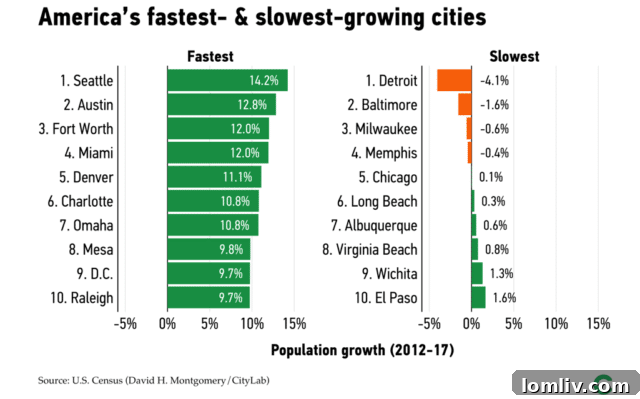
The visual representation above, depicting the 10 fastest and slowest-growing cities by population, clearly underscores Fort Worth’s impressive trajectory. With a remarkable population growth rate of 12 percent, Fort Worth secured its position as the third-fastest growing city in the nation. This significant expansion points to a city that is successfully attracting new residents and fostering a dynamic environment.
When extending the comparison to large metropolitan areas, the Dallas-Fort Worth metroplex showcased its collective strength. Dallas, for instance, ranked seventh among metros with a substantial 11.3 percent growth. This dual performance by two of North Texas’s largest cities highlights the regional magnetic pull and robust economic foundations that continue to fuel demographic shifts and urban development. The sustained influx of new residents underscores the appeal of North Texas, driven by factors such as job opportunities, relatively affordable living, and a burgeoning cultural scene.
Beyond population, the CityLab team also scrutinized changes in the employed population from 2012 to 2017, revealing stark contrasts in job growth across American cities. Their findings indicated that the fastest-growing cities were expanding their employed populations at a rate ten times faster than their slower-growing counterparts. In this crucial metric, Fort Worth once again demonstrated its economic vitality, ranking as the third-fastest growing city with an impressive 21.5 percent increase in its employed population. This surge signifies strong job creation and a healthy labor market that supports its expanding populace.
However, the picture wasn’t uniformly positive across all North Texas cities. Arlington, a prominent city within the DFW metroplex, appeared on the other end of the spectrum. It registered the fifth-slowest employed population growth, at a modest 4.2 percent. This disparity within the same region suggests varying economic drivers, industry concentrations, and perhaps differing stages of development or market saturation among neighboring cities. Understanding these nuances is crucial for policymakers and residents alike, as it informs decisions about infrastructure, public services, and future economic development strategies. Fort Worth’s consistent high ranking in both population and employment growth underscores its role as a leading engine of prosperity and urban transformation in the United States.
Source: CityLab
Navigating the North Texas House Flipping Market
For real estate investors eyeing opportunities in the dynamic house-flipping sector, understanding local market conditions is paramount. WalletHub, a leading personal finance website, undertook a comprehensive study to identify the most and least favorable cities for house-flipping investors across the United States. This analysis provides valuable context for how North Texas cities stack up in this competitive landscape.
WalletHub’s Deep Dive into Flipping Potential
WalletHub’s methodology involved comparing more than 170 U.S. cities, evaluating them against a robust set of 29 key indicators. This multi-faceted approach aims to provide a holistic view of the flipping market, moving beyond simplistic metrics to assess the true potential for profitability and success. As the company explained, “Our data set ranges from median purchase price to average full home remodeling costs to housing-market health index.”
These indicators encompass three crucial dimensions: market potential, renovation and remodeling costs, and quality of life. Market potential factors might include local housing inventory, investor activity, foreclosure rates, and the average gross flipping profit. Renovation and remodeling costs typically examine labor expenses, material costs, and the availability of contractors. The “housing-market health index” likely consolidates metrics such as job growth, population growth (tying back to the previous section!), and overall economic stability, which directly influence buyer demand and property appreciation. For investors, this detailed analysis helps to mitigate risks and identify locations where a profitable return on investment is more likely, considering both acquisition and exit strategies.
North Texas Cities: A Mixed Bag for Flippers
So, where exactly does North Texas stand in this national house-flipping ranking? The region finds itself squarely in the middle of the pack. While not topping the charts as the absolute most investor-friendly market, it also avoids the bottom, suggesting a balanced environment with both opportunities and challenges. This mid-range performance indicates that success in North Texas flipping requires strategic planning, local market expertise, and a keen eye for undervalued properties.
Several North Texas cities made their appearance on WalletHub’s list, each with its unique ranking. Plano led the local contingent, securing the 65th spot nationally. Its strong economic base, excellent schools, and high quality of life often contribute to stable housing demand. Close behind was Fort Worth at 66th, benefiting from its rapid growth and ongoing urban development, which can create significant appreciation opportunities. Grand Prairie ranked 79th, followed by Arlington at 83rd, both offering diverse housing stock and proximity to major employment hubs. Further down the list, Garland placed 109th, Irving at 125th, and Dallas, surprisingly, ranked 133rd.
Dallas’s lower ranking might seem counterintuitive given its reputation as a major economic powerhouse. However, it could be attributed to factors such as higher median purchase prices, increased competition among investors, or perhaps specific challenges related to renovation costs or market saturation in certain segments. For flippers in Dallas, this suggests a need for even more precise market targeting, focusing on specific neighborhoods with high potential for value addition and discerning buyer demand. The varied rankings across North Texas highlight that while the region as a whole is active, the optimal strategies for house flipping can differ significantly from one city to another, emphasizing the importance of localized due diligence.
Source: WalletHub
DFW Rental Market: A Steady, Measured Ascent
The rental market in Dallas-Fort Worth, a critical component of the region’s overall real estate health, continues to exhibit growth, albeit at a more tempered pace compared to the national average. Insights from RENTcafe’s latest report reveal intriguing dynamics for both renters and landlords in one of the nation’s most attractive metropolitan areas.
National Rental Trends and Local Distinctions
Across the nation, the average rent experienced a steady increase, rising by 3.4 percent year-over-year. This pushed the national average rent to $1,469 in July 2019, up from July 2018. This consistent upward trend reflects a robust demand for rental properties nationwide, influenced by demographic shifts, evolving homeownership trends, and economic stability.
However, RENTcafe’s data also suggested a potential moderation in this growth. July’s month-over-month increase was a modest 0.2 percent, marking the slowest increase observed since February. This subtle slowdown could be attributed to a variety of factors, including seasonal fluctuations, a slight increase in new rental inventory, or perhaps the market reaching certain affordability ceilings in some areas. Understanding this national context is key to appreciating the specific performance of the DFW market.
A City-by-City Look at DFW Rent Prices
Within the bustling DFW metroplex, individual cities present distinct rental market profiles. In Dallas, the average rent in July stood at $1,232. This represented a $48 increase compared to the previous year, with a slight month-over-month rise of 0.1 percent. This steady, yet moderate, increase indicates a healthy market that continues to grow without experiencing the rapid spikes seen in some other major U.S. cities, offering a degree of predictability for both renters and investors.
Fort Worth, mirroring its population and employment growth, also saw an increase in rental prices. The average rent in Fort Worth for July was recorded at $1,119. This figure reflects a notable $46 increase since last year, maintaining a month-over-month growth of 0.1 percent. Fort Worth’s consistent rent appreciation underscores its growing desirability and the increasing demand for housing options as more people flock to the city for its job opportunities and quality of life. The slightly lower average rent compared to Dallas also suggests it remains a more accessible option for many, contributing to its sustained growth.
Interestingly, Arlington’s rental market showed a slightly different trend. Its average July rent was $1,024, but it experienced a slight month-over-month decrease of 0.2 percent. This marginal dip could be influenced by a range of local market dynamics, such as an increase in new apartment completions, temporary shifts in demand, or a greater supply of available units. While a minor decrease, it highlights that rental market trends can vary significantly even within close geographical proximity, requiring a granular understanding of each city’s unique conditions. Overall, the DFW rental market, while growing, appears to be doing so at a more sustainable pace than the national average, offering a stable environment for residents and a predictable landscape for real estate investors.
Source: RENTcafe
The latest real estate insights from North Texas paint a clear picture of a dynamic and rapidly evolving region. Fort Worth’s exceptional growth in both population and employment positions it as a national leader in urban development, signaling continued demand for housing and services. The house-flipping market, while competitive, offers distinct opportunities across various DFW cities, urging investors to conduct thorough localized analyses. Furthermore, the DFW rental market, characterized by steady but measured increases, reflects the region’s strong underlying economic fundamentals and attractiveness to a diverse demographic. As North Texas continues its impressive trajectory, these trends will remain crucial indicators for anyone interested in the future of one of America’s most vibrant real estate landscapes.