

On Wednesday, the City Council is poised to green-light Pegasus-Ablon’s contentious proposal to erect a towering 20-plus-story high-rise within a neighborhood explicitly zoned for a maximum height of 36 feet. The outcome, unfortunately, appears predetermined.
The votes, metaphorically speaking, have already been tallied. The upcoming City Council hearing seems little more than a theatrical production, designed to offer a semblance of debate and allow opposing voices to believe they hold a chance of swaying the decision. In reality, such influence is rarely, if ever, achieved. One could almost expect a Playbill and a Flora Street address to accompany these municipal proceedings, underscoring their performative nature.
As previously discussed in November, this project presents virtually no redeeming qualities. The local neighborhood stands to gain nothing of value, while the city’s purported benefit amounts to a mere 23 affordable housing units. This approval will strike another significant blow to the Oak Lawn Committee, following closely on the heels of the Lincoln Katy Trail project, which was controversially approved last month by an unconcerned council despite near-universal opposition from all parties not driven by profit.
The Looming Approval: A Radical Departure from Established Zoning
The existing zoning regulations, meticulously established in 1997 by Caven Enterprises, the original seller of the land, were designed to limit development to a modest 36 feet across most of the lots. These protections were further fortified by a residential proximity slope and specific setback requirements. While minor portions of the property allowed for heights up to 120 feet, the total building density was capped at 250,000 square feet. Crucially, these regulations also prohibited driveways on Dickason, a measure intended to protect the residential character of the street.
The original 1997 case file unequivocally demonstrates that Caven Enterprises’ primary motivation was to deliberately restrict intense development and safeguard the integrity of the two-story neighborhood situated directly across the street. These protections were instituted without any time limits or financial thresholds that would negate their purpose. It is impossible to argue today that these foundational protections are no longer necessary; indeed, the very existence of this current proposal underscores their enduring merit and foresight.
The current predicament stems from a pivotal change in 1999, just two years after Caven Enterprises enacted these crucial protections. Corporate ownership transitioned to an employee-owned model. This shift created a direct monetary incentive for every employee-owner to consider selling the property—a scenario akin to a multitude of foxes, nearing retirement, having free reign over the henhouse.
The development plan now slated for approval on Wednesday represents a stark and dramatic escalation. It proposes a building mass and density that is triple the current allowable limit. Furthermore, based on the City Plan Commission’s (CPC) recommendation, the proposed height is nearly six times what the current zoning permits in the majority of the area. This radical vision includes elevating the urban setback from 36 feet to an astonishing 75 feet, primarily to accommodate an enormous, above-ground parking garage—a structure of a scale rarely, if ever, seen in Oak Lawn. Compounding these issues, the plan introduces new entrances and exits on Dickason Street, with one directly opposite a school, raising significant safety and traffic concerns for local residents and children.
Deconstructing the Detriment: Why This Project Harms Oak Lawn
Beyond the direct assault on the Oak Lawn Committee’s integrity and influence, this project, in my assessment, profoundly disserves the entire neighborhood. Its approval will inevitably act as a dangerous precedent, a catalyst for upzoning the surrounding area. Already, multiple neighboring properties have been listed for sale—a familiar pattern observed after the Lincoln Katy Trail project received its green light. Introducing a massive high-rise where it fundamentally does not belong inevitably invites more such incongruous developments, eroding the established character of Oak Lawn piece by piece.
Critically, the proposed design falls far short of contemporary urban planning best practices. Many comparable projects within the Oak Lawn area judiciously incorporate underground parking solutions. This Pegasus-Ablon proposal, however, reportedly offers only a single story of underground parking, and exclusively beneath the specific portions of the lot undergoing development. In stark contrast, Streetlights’ future apartment building at Lemmon and Oak Lawn managed to creatively integrate more extensive underground parking, thereby preserving the beloved Eatzi’s establishment, maintaining profitability, and achieving a design 35 feet shorter than this proposal. That project also prioritized community amenities, featuring generous 25-foot sidewalks on Oak Lawn Avenue, burying unsightly power lines, and thoughtfully wrapping its above-ground garage portion with active uses like restaurants and apartments, even providing additional parking for Eatzi’s patrons. Pegasus-Ablon, regrettably, offers none of these thoughtful, community-centric design elements.
Furthermore, the city’s handling of this proposal reveals a troubling lack of strategic foresight. When the Ablon-Caven project first came before the City Plan Commission, the developers ostensibly “reduced” the proposed height from 260 feet to 210 feet. This maneuver was presented as a concession, implying a smaller project. However, reducing height is merely one component of truly scaling down a development. To genuinely shrink a project, it is imperative to also decrease the Floor Area Ratio (FAR) and the overall lot coverage—and, in this specific instance, the colossal parking lot podium. Neither of these crucial adjustments was made. This height reduction was nothing more than another piece of strategic theater, ultimately making the project even more profitable for the developer, as constructing a fatter, less tall building is inherently cheaper than building a slender, towering structure.
This episode is part of a much larger, disturbing pattern: a city that perpetually laments the struggles of its downtown core while simultaneously approving gargantuan zoning increases in inappropriate residential areas. Perhaps if city leaders exercised greater discretion in curbing such unsuitable projects, it would compel developers to direct their investments and construction efforts toward areas where the city genuinely desires growth and revitalization.
Why does the city permit such detrimental outcomes? The answer, regrettably, appears to lie in the realm of “bully politics.” This current iteration of City Hall seems to conspicuously lack the necessary resolve and backbone to evaluate cases purely on their merit, frequently capitulating to powerful, unyielding developers who relentlessly push their agendas forward.
Perhaps it is time to revisit discussions surrounding projects like the Trinity Tollway, if only to spark a broader conversation about urban planning priorities and the willingness to stand firm against unsustainable development pressures.
The Deceptive Narrative: Exposing the Developer’s Ruse
The primary tactic employed by the developers since the inception of this project has been a calculated campaign of fear-mongering and strategic misinformation. They have meticulously crafted a narrative designed to convince all stakeholders that this high-rise proposal represents the only viable option, short of demolishing many of the city’s cherished gay bars. This assertion, I firmly believe, is utterly baseless. Any project capable of generating the substantial financial returns Caven Enterprises seeks would inherently necessitate a zoning change. A by-right project, adhering strictly to current regulations, would likely yield less than a third of the desired revenue, rendering the “only option” claim disingenuous.
Even more objectionable are reports from council members detailing what some describe as a concerted campaign by alleged Caven employees. These individuals have reportedly engaged in fervent pleas to council members, begging them to “preserve their jobs.” It is ironic, however, that if any establishments were to be torn down, it would be by the very employee-owners of Caven Enterprises—the presumed architects of this manipulative campaign.
Compounding this unethical pressure, developers have broadly hinted that a vote against this project is inherently “anti-gay.” As a gay man myself, I find this “crying wolf” or “dog whistle” tactic absolutely abhorrent and deeply offensive. This is unequivocally a bad project, full stop. Voting against a poorly conceived development is not an act of anti-anything, save for being anti-bad projects.
No responsible adult would capitulate to a child holding their breath to get what they want. Similarly, no entity driven by profit can credibly claim, “We’ll take a third of the money if you don’t give us 100 percent… just 85 percent?… nope, we’re taking 30 percent, you had your chance.” Such statements are patently ludicrous. Yet, a majority of the Plan Commissioners regrettably fell for this charade, and I have little doubt that many City Council members will follow suit.
Following the Plan Commission vote, several “yes” voters privately expressed significant reservations about the project, yet admitted they succumbed to the developer’s deceptive narrative. As AT&T famously articulated, “You get what you pay for,” and Plan Commissioners, it must be remembered, serve in a voluntary capacity, potentially making them more susceptible to well-funded lobbying efforts.
Similarly, a column published in March, partly lamenting the struggles of bars under COVID-19 restrictions, failed to mention a crucial detail: Caven had been actively trying to sell the land long before the pandemic began. Nor was there any acknowledgment of the significant funds Caven received from the government’s Paycheck Protection Program (PPP), further undermining the narrative of financial desperation.
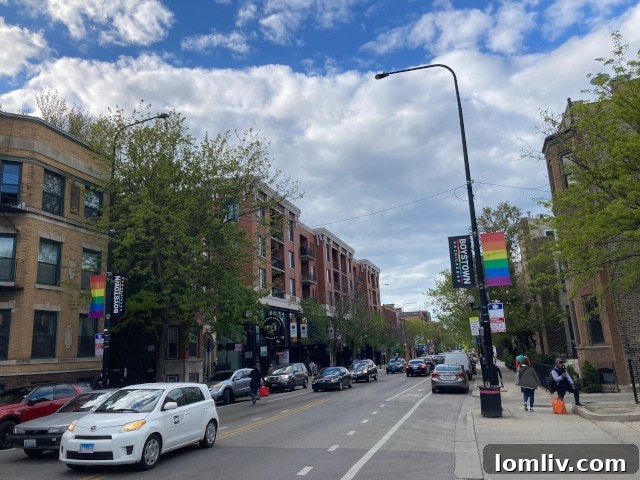
A Global Reality-Check: Lessons from Chicago’s Vibrant Boystown
To put this high-rise obsession into perspective, I recently visited Chicago and deliberately walked through its thriving Gayborhood. How many high-rises did I observe? Precisely zero. The vibrant blocks of Broadway and Halstead predominantly feature buildings that max out at a harmonious three stories. Only a couple of four- and five-story properties exist, notably on former city-owned lots. While Chicago certainly boasts its share of high-rises, they are appropriately situated in designated urban centers, not injected into established, low-rise community enclaves.
The Chicago Gayborhood is not faltering or “dying” without a towering high-rise looming behind popular establishments like Sidetrack or Roscoe’s. In fact, it exhibits remarkable vitality, with hardly any retail vacancy—a striking contrast to the consumerism-driven expanse of Michigan Avenue. This serves as powerful evidence that vibrant, successful urban communities, especially those with unique cultural identities, do not require or benefit from inappropriate high-rise developments to thrive.
The Fading Voice: Is the Oak Lawn Committee on Life Support?
The Oak Lawn Committee, long a stalwart advocate for responsible development in its community, appears to be on a ventilator, its influence severely diminished, partly by circumstances and partly by design. The committee’s own City Council representatives, David Blewett and Adam Medrano, have consistently supported projects that are staunchly opposed by this longest-serving neighborhood zoning group in the city. This pattern of disregard effectively sidelines the committee’s vital influence and erodes its credibility.
Councilman Blewett has recently made a show at two Turtle Creek Neighborhood Association meetings, ostensibly lamenting that while he “values the committee’s work,” he “needs it to do its job vetting projects.” This rhetoric rings hollow, however, as both he and Plan Commissioner Wayne Garcia have repeatedly voted in favor of projects that the Oak Lawn Committee explicitly denied support for—and for very sound reasons, rooted in their dedicated work of vetting proposals.
Both the Lincoln Katy Trail and the Ablon-Caven projects essentially bypassed or overruled the Oak Lawn Committee’s diligent efforts. The Lincoln project, after years of community angst and the OLC denying its support, was ultimately approved by the city because a less thoughtful Plan Commission and City Council chose not to uphold the decade-old prohibition on upzoning that specific area.
The Ablon-Caven project, situated in Councilman Medrano’s District 2, demonstrated an even more brazen disregard for community input. After a mere 10-minute presentation to a visibly shocked OLC in November, the developers completely ignored the assembled sub-committee. In February, they flatly stated they would commit to none of the committee’s recommendations and would proceed directly to the Plan Commission—confident in their foreknowledge that they already possessed the necessary votes to pass. And pass it did, with alarming ease.
A Noteworthy Effort: It is important to acknowledge that Medrano’s own District 2 appointee, Joanna Hampton, did attempt to halt the project when it was before the City Plan Commission. However, lacking the necessary majority support, she ultimately had no choice but to allow it to pass, highlighting the systemic challenges faced by dissenting voices.
Finally, just this past Monday, I received an early notification from the city indicating that 2915 Vine Avenue is now applying directly to the city for a Planned Development Subdistrict within the Oak Lawn Planned Development District (PD-193). Their declared goal is to “redevelop/modernize the site with a new building” and to significantly alter parking requirements to one space per 1,000 square feet of office space. Crucially, there are, as yet, no plans to present these substantial plans to the Oak Lawn Committee for their review or input.
What binds all three of these controversial projects—Lincoln Katy Trail, Ablon-Caven, and now 2915 Vine Avenue? They are all represented by Suzan Kedron of Jackson Walker. I reached out to Ms. Kedron via text, inquiring if she ever intends to advise her clients to present their plans to the Oak Lawn Committee again. As of press time, no response has been received.
So far, the Oak Lawn Committee has not had the opportunity to vet a single new case in 2021. While this can partly be attributed to COVID-19-related development stalls, more than one OLC member has openly wondered, in light of the Lincoln and Ablon-Caven decisions (and now the 2915 Vine application), whether the group will ever truly see another zoning change request pass through its review process with genuine consideration.
With the current composition of the Plan Commission and the City Council, the question must be asked: why would any developer genuinely bother engaging with community oversight when a direct route to approval seems so readily available?