Costco Arrives in Dallas: A New Era for Wholesale Shopping and Community Development
Dallas is buzzing with excitement as a new chapter in wholesale retail is set to unfold. The Dallas City Council recently cast a pivotal vote, approving a substantial $3 million in economic incentives to usher the renowned bulk retailer, Costco, within the city limits. This decision marks a significant milestone for residents seeking a better, more sustainable wholesale option. The arrival of Costco promises not only increased shopping convenience but also a substantial boost to the local economy through job creation and renewed urban development.
For many Dallas residents, especially those who’ve long traveled beyond city boundaries for their bulk shopping needs, this news signals a welcome change. The strategic move to attract such a major retailer underlines the city’s commitment to fostering economic growth and enhancing the quality of life for its citizens. This article delves into the details of the agreement, its funding mechanisms, the expected economic and social impact, and the broader implications for community development across Dallas.
Understanding the Economic Incentives: Funding Dallas’s Growth
The allocation of $3 million in economic incentives for Costco has naturally raised questions about its source and purpose. As explained by Candy, a prominent voice in local real estate, this funding emanates from a specialized public-private partnership fund, uniquely generated through user fees collected via Dallas water bills. This mechanism offers an intriguing insight into how the city strategically finances its economic development initiatives.
It’s a pool of funds earmarked for Economic Development. The funds are actually generated from fees users of Dallas Water pay. The water department is a revenue generating operation for the city — the city charges the utility a fee in lieu of taxes. This money goes into the public/private partnership fund and can be used for whatever the City Council decides, in this case economic development.
This fund acts as a crucial reservoir for projects deemed beneficial to Dallas’s economic landscape. Instead of relying solely on general tax revenue, which can be subject to various budgetary pressures, the city utilizes a system where the water department, operating as a revenue-generating utility, contributes a ‘fee in lieu of taxes’ to this specific development fund. This innovative approach allows the Dallas City Council greater flexibility in deploying capital for initiatives that promise significant returns in terms of job creation, increased tax bases, and overall urban improvement. The decision to invest in Costco reflects a calculated move to leverage these funds for a project with widespread community benefits and substantial long-term economic impact.
A Long-Awaited Arrival: Impact on North Dallas
The news of Costco’s impending arrival has been met with particular enthusiasm by those who had previously hoped for a similar development in North Dallas. Many residents remember the anticipation surrounding the possibility of Costco relocating to the former Steakley Chevrolet lot on Northwest Highway and Abrams, a decaying eyesore that has long sought revitalization. Though those plans ultimately did not materialize, the current confirmation of a new location brings renewed optimism and a sense of resolution.
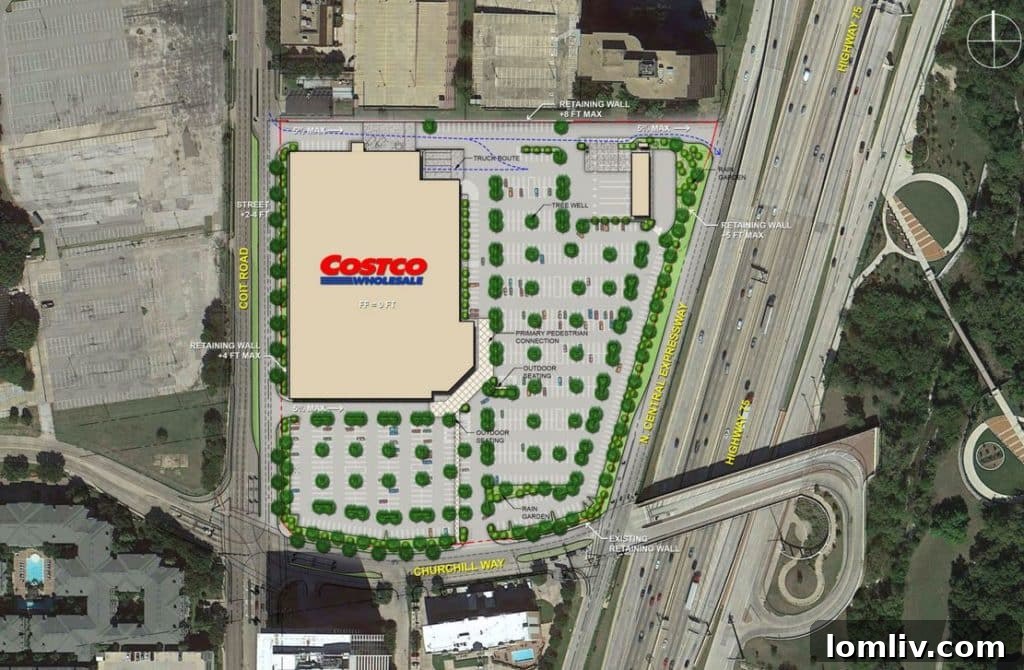
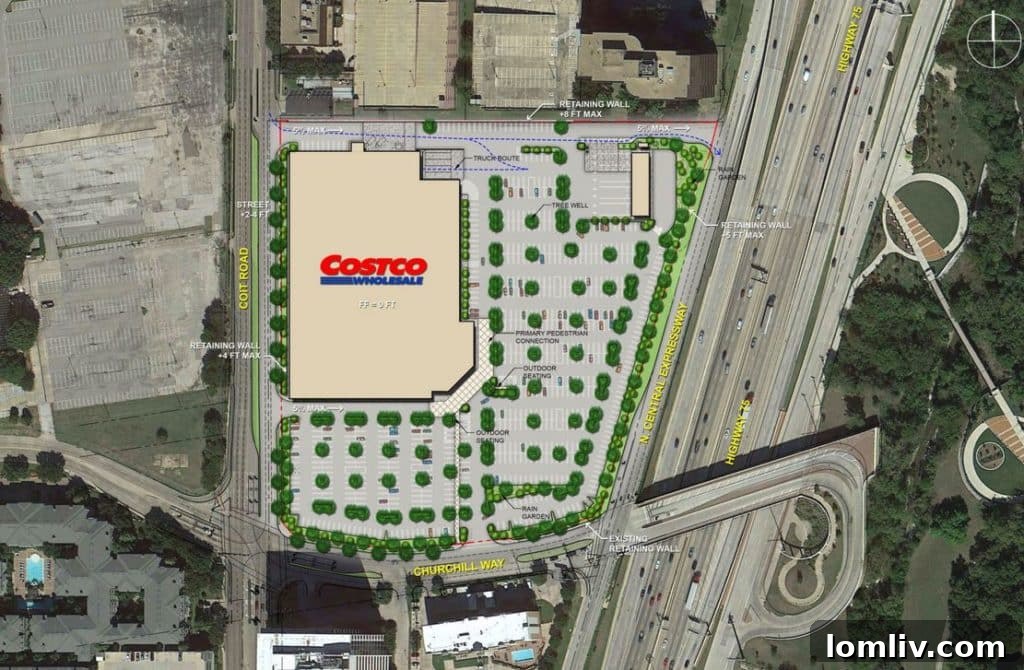
The chosen site for the new Costco store, nestled at Coit and Churchill Way, is strategically positioned to serve a vast demographic. According to Costco’s internal projections, members residing south of LBJ are expected to contribute a significant $40 million in spending at this new location annually. This forecast highlights the immense market potential and the pent-up demand for a major wholesale retailer in this area. Beyond existing Costco members, the arrival of the new store is poised to entice a considerable number of shoppers currently loyal to competitors like Sam’s Club. Costco’s reputation for quality products, competitive pricing, and excellent customer service is a powerful draw, and many believe a significant ‘jump ship’ phenomenon is imminent. Indeed, even those who aren’t currently wholesale club members, like myself, are already planning to shop at the new store once construction is complete, underscoring the broad appeal and anticipated success of this venture.
The development at Coit and Churchill Way is not just about a new retail store; it represents a significant step in local urban renewal. The transformation of a key commercial area into a vibrant shopping destination will enhance property values, drive auxiliary business growth, and improve the overall aesthetic and utility of the neighborhood. This project is a testament to how targeted economic incentives can catalyze broader community benefits, making Dallas a more attractive place to live and shop.
A Major Investment: Construction, Jobs, and Employee Welfare
The commitment to bringing Costco to Dallas involves a substantial financial outlay that underscores the scale of this economic development. The acquisition of the former TxDOT property alone will cost an estimated $16.5 million. Following this, Costco has pledged to spare no expense in constructing its state-of-the-art facility, with building costs projected to exceed $30 million. This significant investment is a clear indicator of Costco’s long-term confidence in the Dallas market and its dedication to providing a top-tier shopping experience.
Beyond the impressive financial figures, one of the most impactful aspects of this development is its promise of robust job creation. Once operational, the new Costco store is expected to employ 225 individuals, providing a significant boost to the local job market. What truly sets this apart, however, is Costco’s renowned commitment to employee welfare. Starting wages for these positions are anticipated to be around $13 per hour, accompanied by comprehensive full benefits packages. This standard is considerably higher than the typical entry-level wages often seen in the retail sector, reflecting Costco’s long-standing philosophy of valuing its workforce.
Costco has built a reputation as an exemplary employer, known for offering competitive pay, generous benefits, and opportunities for career growth. This approach not only attracts high-quality talent but also fosters a stable and motivated workforce. By setting such a high bar for wages and benefits, Costco’s arrival could potentially exert positive pressure on other businesses in the Dallas area, encouraging them to reassess their own compensation structures. This ripple effect could lead to an overall improvement in the economic well-being of hourly workers across the city, contributing to a more equitable and prosperous local economy. It’s an investment not just in a building, but in the people who will make it thrive.
Addressing Food Deserts: A Call for Equitable Development
While the excitement surrounding Costco’s arrival in North Dallas is palpable, the City Council’s vote was not without its contentious moments, particularly concerning issues of equity across the city. Amidst the discussions at 1500 Marilla, Council Member Mark Clayton commendably seized the opportunity to advocate for Southern Dallas, attempting to turn what some perceived as a geographically focused development into a broader win for the entire city. As reported by Robert Wilonsky, Clayton introduced a significant amendment aimed at tackling a critical issue: food deserts.
Before the item was even discussed, council member Mark Clayton tacked on an amendment that instructed the Office of Economic Development to come back to council within 90 days with a concrete plan for adding a grocery store within a food desert — a part of the city lacking easy access to fresh fruits, vegetables and healthy food. Clayton said that if the city was going to kick in money for a superstore up north, the very least it could do was promise something to those living south of the Trinity River as well.
Clayton said his amendment was “a sincere attempt to provocatively turn around parts of the city in desperate need.”
A food desert is defined as an urban area where residents have limited access to affordable, nutritious food, often leading to reliance on fast food and convenience stores. These areas, predominantly found in Southern Dallas, contribute to significant health disparities and economic challenges for their inhabitants. Clayton’s amendment was a direct challenge to the perceived imbalance in economic development, arguing that if the city could invest millions in a superstore for an already well-served area, it had a moral imperative to address the severe lack of access to healthy food in other, more disadvantaged parts of the city.
Bravo to Council Member Clayton for his sincere effort to bridge this divide. While some critics dismissed his amendment as mere “lip service,” its underlying principle of equitable development is profoundly important. It sparked a crucial conversation about how Dallas prioritizes its investments and ensures that all communities, regardless of their geographical location or socioeconomic status, benefit from the city’s growth. This initiative could pave the way for concrete plans to attract grocery stores, develop farmers’ markets, or support community-based food programs in areas historically neglected by major retailers.
Looking ahead, Clayton’s proposal raises a pertinent question for future urban planning and economic strategy: could the city make the next significant economic development dispersal contingent upon relocating to southern Dallas? Such a policy could serve as a powerful incentive for businesses to invest in underserved communities, fostering balanced growth across the entire metropolitan area. It’s an idea that challenges conventional development models and pushes for a more inclusive vision for Dallas, ensuring that prosperity is shared by all its residents.
The Broader Benefits of Wholesale Clubs and Costco’s Appeal
The excitement surrounding Costco’s arrival extends beyond just its immediate economic impact; it also speaks to the broader appeal and benefits that wholesale clubs offer consumers. For many households and small businesses, wholesale clubs provide an invaluable opportunity for bulk savings on groceries, household essentials, and even specialized items. The ability to purchase larger quantities at lower unit prices can significantly reduce monthly expenditures, making quality goods more accessible. Moreover, these clubs often feature unique product offerings, from gourmet foods to electronics and seasonal merchandise, providing a diverse shopping experience that traditional supermarkets cannot match.
Costco, in particular, has cultivated a strong reputation that differentiates it from competitors like Sam’s Club. Its Kirkland Signature brand is widely lauded for its quality and value, often rivalling or even surpassing national brands. Members appreciate Costco’s commitment to ethical sourcing, its generous return policy, and the overall premium shopping environment. Furthermore, many Costco locations offer competitive pricing on gasoline, providing an additional incentive for members to consolidate their shopping trips. These factors combine to create a compelling value proposition that has historically drawn a loyal customer base. The entry of Costco into Dallas is therefore not just about another store; it’s about introducing a retail model known for its distinct advantages, which will undoubtedly resonate with a large segment of the population and potentially redefine local shopping habits.
A Forward-Looking Dallas: Balancing Growth and Inclusivity
The arrival of Costco in Dallas marks a significant moment for the city, symbolizing a vibrant future of economic growth and enhanced retail options. The $3 million in economic incentives is a testament to Dallas’s proactive approach to attracting major businesses that promise substantial returns in job creation, increased spending, and urban revitalization. The new store at Coit and Churchill Way is poised to become a thriving hub for North Dallas, offering unparalleled convenience and a high-quality wholesale shopping experience.
However, this development also serves as a powerful reminder of the ongoing challenges related to equitable growth within the city. Council Member Mark Clayton’s impassioned plea for Southern Dallas underscores the critical need to address disparities such as food deserts and ensure that economic prosperity is not confined to specific areas. His amendment, regardless of its immediate outcome, has set a vital precedent, sparking necessary conversations about how Dallas can foster inclusive development and support all its communities.
As Dallas continues to evolve, the Costco saga encapsulates a dual narrative: one of successful economic expansion and another of a city striving for greater social equity. The ultimate success will lie not only in the bustling activity of the new superstore but also in the city’s commitment to extending similar opportunities and essential services to every neighborhood. With strategic planning and a sustained focus on community well-being, Dallas can forge a future where economic dynamism and social responsibility go hand in hand, benefiting every resident south of the Trinity River and beyond.