The City of Dallas welcomes a new era of development and construction with the appointment of Andrew Espinoza as its chief building official. Espinoza steps into a crucial role, acknowledging the significant challenges within the city’s permitting system and expressing a firm commitment to resolving them. After nearly two years of operating without a dedicated director for Development Services and facing a backlog of thousands of building permits, Espinoza’s selection in May and his official start on June 1 signal a hopeful turning point for Dallas’s burgeoning real estate and construction sectors.
The permitting crisis in Dallas has been a growing concern, steadily unraveling since 2020. Espinoza attributes this “perfect storm” to a confluence of factors. “You had COVID, folks working from home, and a department pushing out software prematurely,” he explained. The urgency imposed by the pandemic, aimed at ensuring the safety of employees and stakeholders, led to an expedited rollout of new software. However, this haste proved detrimental. “Our stakeholders, employees, and other working groups were not comfortable with the product and didn’t know how to use it,” Espinoza noted, highlighting a critical flaw in implementation and user adoption.
Even today, the department grapples with frequent information technology issues, often occurring three or four times a week. While the IT department has diligently collaborated with the software vendor, Espinoza confirms that system functionality remains the most significant hurdle. This costly operational blunder has not only frustrated the building community but also drawn intense public scrutiny, becoming a key point of contention in broader city governance discussions, including calls for the termination of City Manager T.C. Broadnax, whose performance review was slated for a special council meeting on June 23.

Rebuilding Trust: A New Vision for Dallas Development Services
Andrew Espinoza, 50, brings a wealth of experience to his new role. His journey with the City of Dallas began three years prior in code compliance, following a distinguished 17-year tenure leading San Antonio’s Development Services Department. Equipped with an MBA from Texas A&M-San Antonio, Espinoza is prepared to tackle the foundational issues plaguing Dallas. His immediate priority is to clearly define the department’s purpose, a critical step he believes is essential for effective operation and team cohesion.
“One of the challenges that Development Services has been going through is we don’t know why we exist,” Espinoza candidly stated. He observed a lack of a clear organizational chart and, perhaps more tellingly, the absence of a known mission statement during his interview process. This organizational ambiguity, he argues, has directly impacted the department’s ability to communicate its value and objectives internally and externally. “Where we’re falling short is being able to communicate to our team why we exist and what our purpose is. We need to figure out who we are and where we’re going,” he emphasized, underscoring the importance of a clear vision to guide the department’s future endeavors.
Espinoza’s leadership philosophy is rooted in transparency and community service. He views his role not merely as an administrative position but as a calling to serve the community and empower his team. “My purpose is to serve the community and to serve the team,” he affirmed. “My calling is to add value to others and to influence with good, effective leadership. Your calling has a spiritual touch to it. As public servants, we can affect many more lives if we’ve identified our calling and our purpose than if we come to collect a check.” This holistic approach to public service highlights his dedication to making a tangible, positive impact.
The Dallas Development Services department, despite its critical function, operates with approximately 290 authorized positions but faces a significant 20 percent vacancy rate. Espinoza, as the new department head, commands an annual salary of approximately $190,000, as per official city records. He understands that the efficiency of the permitting process is not monolithic; it varies significantly based on the type of permit being sought. This complexity further necessitates clear communication and streamlined procedures.
“We’ve done a poor job of communicating,” Espinoza admitted, directly addressing one of the most persistent criticisms. He outlined a clear path forward: “We need to do better in communicating how quickly we can get you on track and get your permit and what we need from you. We need to rebuild confidence with our customers. We need to hold ourselves accountable and set performance goals.” This commitment to accountability, clear performance metrics, and enhanced communication forms the bedrock of his strategy to restore public trust and operational efficiency within Dallas Development Services.
Industry Optimism and Community Demand for Change
The appointment of Andrew Espinoza has been met with cautious but significant optimism from the Dallas building community. Phil Crone, executive officer for the Dallas Builders Association, has been a vocal critic of the permitting delays, which have plagued builders and contractors since the onset of the COVID-19 pandemic in Texas in 2020. Despite the lifting of restrictions and the return to pre-COVID operational capacities, the situation has shown little improvement over the past two years. Crone, however, has publicly endorsed Espinoza’s hiring, expressing hope for a positive transformation.
“The permitting situation still hasn’t gotten better more than two years since it became a crisis,” Crone shared with Daltxrealestate.com earlier in the month. He emphasized that any positive strides made so far have largely been due to the persistent efforts of the affected industry and council members who pushed for solutions like third-party plan reviewers and, crucially, the filling of the chief building official position after an 18-month vacancy. “I am optimistic that the newly-hired building official can bring a new culture to the department,” Crone added, reflecting the collective desire for decisive action and a more responsive system.
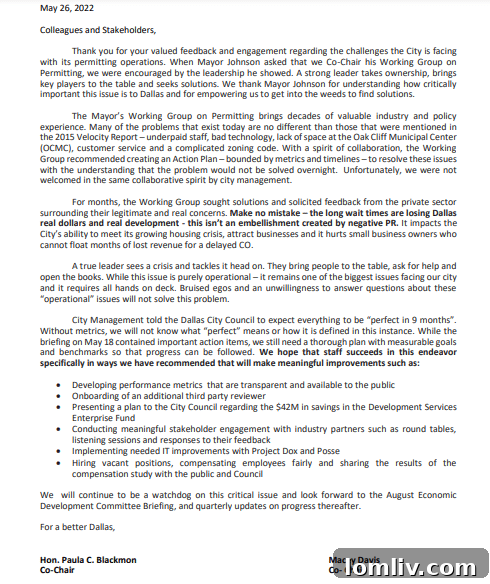
Further underscoring the urgency of the situation, Councilwoman Paula Blackmon and government consultant Macey Davis co-chair the Mayor’s Working Group on Permitting, a dedicated initiative to provide comprehensive guidance on this critical issue. In a pointed letter to stakeholders, Davis and Blackmon articulated the severe economic consequences of the ongoing delays. “Make no mistake – the long wait times are losing Dallas real dollars and real development – this isn’t an embellishment created by negative PR. It impacts the city’s ability to meet its growing housing crisis, and attract businesses and it hurts small business owners who cannot float months of lost revenue for a delayed CO,” their letter stated, highlighting the tangible financial and developmental setbacks Dallas is experiencing.
The letter also issued a powerful call for leadership and accountability: “A true leader sees a crisis and tackles it head-on. They bring people to the table, ask for help and open the books. While this issue is purely operational – it remains one of the biggest issues facing our city and it requires all hands on deck. Bruised egos and an unwillingness to answer questions about these ‘operational’ issues will not solve this problem.” This direct message reflects the widespread frustration and the demand for transparent, proactive solutions from city leadership.
The Mayor’s Working Group on Permitting has put forth a series of vital recommendations designed to overhaul the system:
- Developing Performance Metrics: Establish clear, transparent performance metrics that are publicly accessible, allowing stakeholders and citizens to track progress and hold the department accountable.
- Onboarding Additional Third-Party Reviewers: Increase the capacity for permit review by bringing in more qualified third-party reviewers, thereby reducing bottlenecks and accelerating the approval process.
- Presenting a Plan for Development Services Enterprise Fund: Develop and present a comprehensive plan to the City Council regarding the utilization of the $42 million in savings within the Development Services Enterprise Fund, ensuring these resources are strategically allocated to improve departmental efficiency.
- Conducting Meaningful Stakeholder Engagement: Implement regular, impactful engagement initiatives with industry partners, including roundtables, listening sessions, and structured mechanisms for responding to feedback, fostering a collaborative environment.
- Implementing Needed IT Improvements: Prioritize and execute critical IT enhancements for Project Dox and Posse, addressing the persistent software issues that have significantly hampered operations and user experience.
- Hiring Vacant Positions and Fair Compensation: Actively recruit and fill vacant positions within the department, ensuring employees are compensated fairly, and transparently sharing the results of compensation studies with the public and City Council to attract and retain top talent.
Making Tangible Progress: Espinoza’s First Steps
Despite being less than a month into his new role, Andrew Espinoza is pragmatic about the journey ahead, acknowledging that solving the department’s deeply entrenched problems will require sustained effort. He notes that permitting is beginning to move a little faster, a subtle but significant sign of initial improvement. More importantly, he is vigorously implementing fundamental changes, focusing on establishing clear performance goals and robust accountability measures.
“We’ve been really drilling down on what our performance goals should be for all permits, then we can begin to track and measure those,” Espinoza explained. This methodical approach to setting quantifiable targets is a critical step towards creating a data-driven, transparent department. He plans to share these performance metrics at stakeholder meetings and on the department’s website by July, demonstrating his commitment to public accountability. “At community meetings, I want to bring a report card to the public,” he stated, emphasizing his dedication to open communication and demonstrating tangible progress. Espinoza also believes in empowering his team: “As a leader, you’re always trying to leverage your team. We have some great staff members. In general, I can tell that the staff is really trying to do a good job but there are certain roadblocks that we need to eliminate or minimize.” This highlights his focus on removing obstacles for his dedicated employees, allowing them to perform at their best.

The stakes for Dallas Development Services are exceptionally high, given the city’s dynamic growth and ambitious upcoming projects. Among these is a monumental $1.5 billion renovation planned for the Kay Bailey Hutchison Convention Center Dallas, a project set to redefine the city’s downtown landscape and connectivity to South Dallas. The efficient processing of permits for such large-scale developments is crucial for maintaining Dallas’s economic momentum and ensuring its continued reputation as a hub for business and innovation.
“Dallas is very diverse, vibrant, and fast-paced,” Espinoza observed, contrasting it with his previous experience in San Antonio. “There’s more volume [than in San Antonio]. The expectations from the community are very high and they should be.” He outlined a clear path for engagement and improvement: “We want to connect the community with city staff. We want to identify the problems that are really hurting our operations. We want to implement policies, procedures, and good business practices. My role every single day is to try to influence others, work on relationships, take time to talk to folks, communicate and sell the vision of where we want to be and where we want to go.” This proactive and communicative approach is designed to foster a collaborative environment where problems are identified and solved collectively, ultimately serving the community more effectively.
Espinoza expressed immense enthusiasm for his new leadership role, confident in his ability to steer the department away from its past turmoil and towards an era defined by positivity and transparency. “I’m extremely excited,” he declared. “I’m really enjoying myself. Our department is in the spotlight and receiving a lot of criticism. I feel pressure to perform and deliver, but I don’t feel stressed because I love what I do. Where I am right now is right where I belong. In the very near future, you’re going to see progressive improvement. We’re going to make this the best department in the country. Hold us to that.” His unwavering confidence and clear vision offer a promising outlook for the future of building and development in the City of Dallas.