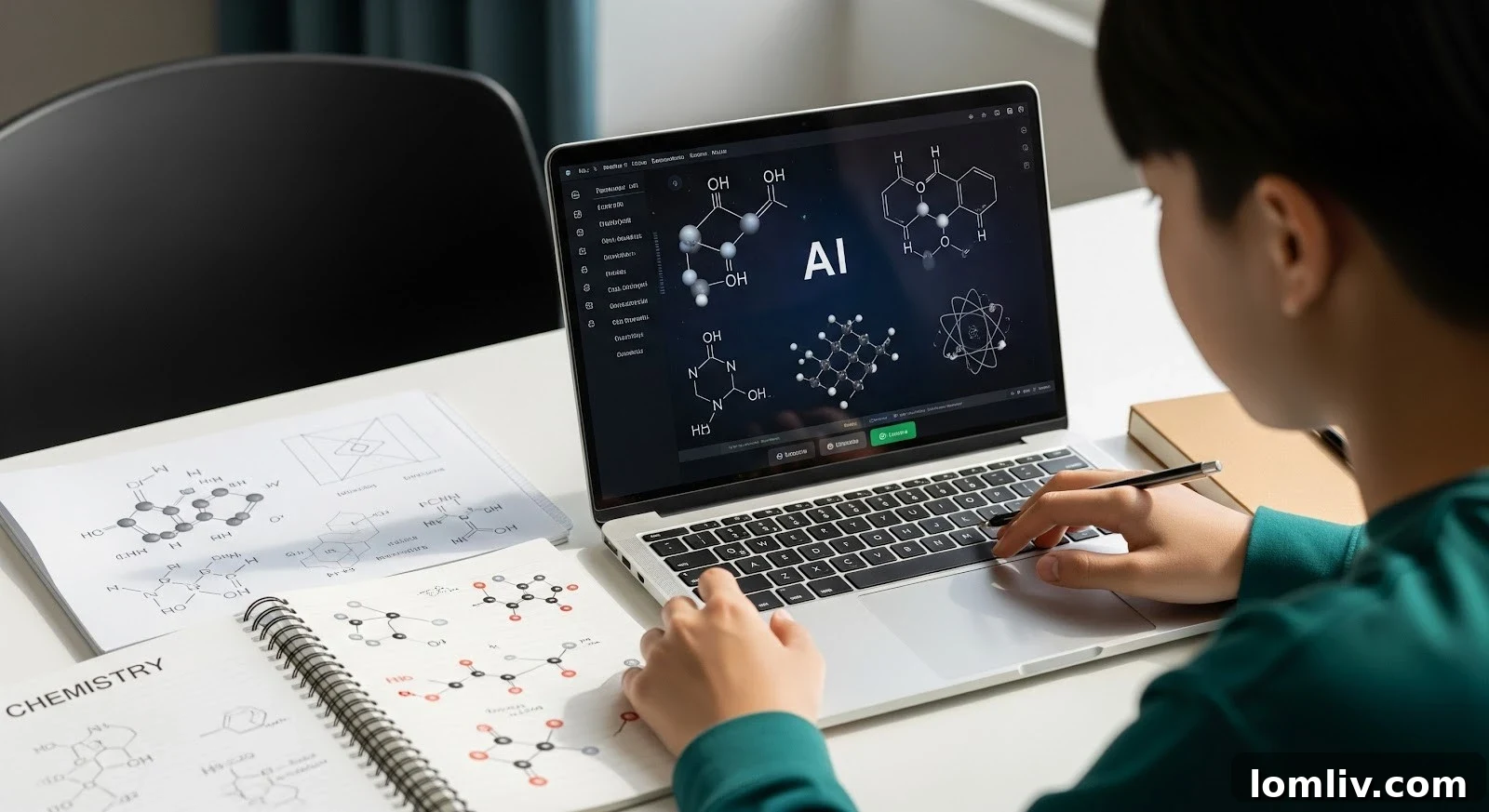
In an age where artificial intelligence is increasingly woven into the fabric of our daily lives, its capabilities are constantly being tested and redefined. We readily ask chatbots to craft creative prose or summarize complex news articles. However, when the demands shift from linguistic artistry to the rigorous precision of scientific inquiry – delving into chemical formulas, intricate equations, and multi-step reaction mechanisms – a natural skepticism emerges. This is where the world of chemistry intersects with AI, posing a fundamental question: can artificial intelligence truly solve chemistry problems with the accuracy and depth required by real science?
To preemptively address this query, it’s crucial to acknowledge that the answer is far from a simple yes or no. The efficacy of an AI chemistry solver profoundly hinges on what one means by “solve” and the desired level of depth and accuracy. While some AI tools have shown surprising proficiency in specific chemistry domains, others, despite their polished interfaces, often falter when confronted with the nuanced complexities inherent in genuine chemical problem-solving. For students and educators navigating the rapidly evolving landscape of AI for chemistry, understanding these distinctions is paramount. Exploring a curated list of the best AI chemistry solvers can provide a valuable starting point for discerning which tools genuinely contribute to scientific understanding.
Decoding the Complexity: Not All Chemistry Problems Are Created Equal
The universe of chemistry problems is incredibly diverse, ranging from straightforward calculations to highly abstract theoretical challenges. This inherent variability is precisely why generalized AI tools often perform inconsistently. Consider the vast chasm between a foundational high school chemistry worksheet, which might ask for a simple molar mass calculation or basic stoichiometry, and a graduate-level inquiry into electron orbital theory, quantum mechanics, or a multi-step asymmetric synthesis. An AI chemistry solver that excels at the former might utterly collapse when faced with the latter.
Chemistry is not merely a quantitative discipline; it is profoundly visual, conceptual, and layered. It demands more than just deriving the correct numerical answer. It requires a profound understanding of how that number integrates into a larger molecular structure, a dynamic reaction pathway, or an underlying principle. While an AI tool might, at times, furnish the correct result, it often struggles to articulate the reasoning, the mechanistic flow, or the foundational principles that lead to that answer. This absence of explanatory depth becomes a significant impediment if the primary goal is genuine learning and conceptual mastery, rather than simply fulfilling an assignment requirement.
Where AI Chemistry Solvers Truly Shine
Despite their limitations, there are distinct areas within chemistry where AI tools demonstrably hold their own, proving to be efficient and accurate assistants. Tasks involving basic quantitative calculations are a prime example. Concepts like molarity, mole-to-mass conversions, dilution problems, or determining limiting reagents are often sufficiently straightforward for most AI chemistry solvers. These tools are adept at processing numerical inputs, following predefined logical steps, and consistently delivering correct answers based on established formulas. Their computational speed and accuracy in these domains can be a significant time-saver for students and researchers alike.
Equation balancing, a fundamental skill in chemistry, is another task where AI tools tend to excel. This process is inherently pattern-based, requiring the identification and adjustment of coefficients to satisfy the law of conservation of mass. Machine learning models, particularly those trained on extensive datasets of chemical reactions, are exquisitely designed to recognize and apply such patterns. Provided the input reaction is clearly presented and the question is well-structured, users can reliably expect a balanced equation, often accompanied by the coefficients in a usable format.
Furthermore, AI proves to be an excellent resource for “flashcard-style” questions. When it comes to recalling definitions, explaining periodic trends, outlining properties of elements, or tackling any memorization-heavy topic, AI tools can rapidly generate accurate and articulate responses. In many respects, this function represents one of their most effective applications: serving as intelligent study companions or rapid information retrieval systems, rather than attempting to be comprehensive problem-solvers for complex conceptual challenges.
The Gaps and Enduring Limitations of AI in Chemistry
The true limitations of AI chemistry solvers become starkly apparent when problems demand multi-step logical reasoning, intricate conceptual understanding, or spatial visualization. Here, AI often struggles to connect the dots between various problem components, missing the overarching coherence required for a complete solution. This inadequacy is particularly pronounced in organic chemistry, a field characterized by its reliance on reaction mechanisms. Understanding a reaction mechanism involves more than just identifying reactants and products; it necessitates visualizing electron flow, bond breaking and formation, stereochemical considerations, and the dynamic interaction of molecules in three-dimensional space. If you’ve ever meticulously drawn curved arrows to depict electron movement on paper, you understand the profound difference between a computational output and genuine mechanistic comprehension.
Beyond mechanistic challenges, many AI tools also falter when confronted with ambiguous, poorly phrased, or context-dependent questions. Human students possess an intuitive ability to infer a teacher’s intent or extrapolate meaning from incomplete information. AI, however, lacks this innate contextual understanding and struggles to “read between the lines” unless explicitly trained on highly diverse and nuanced datasets that encompass such interpretive abilities. Even with advanced training, the rate of misinterpretation remains higher than what would be acceptable in critical scientific applications.
Understanding How AI Chemistry Tools Are Trained: The Data Dilemma
Many of the inconsistencies observed in AI chemistry solvers stem directly from their training methodologies and the quality of their underlying datasets. AI models trained primarily on structured textbooks, well-defined problem sets, and digitized databases of known reactions tend to perform admirably with predictable, common questions that mirror their training data. However, if the training material lacks diversity, omits nuanced explanations of complex reasoning, or fails to cover less common reaction pathways, the AI tool will predictably struggle when presented with problems that lie outside its “comfort zone.”
This is not an inherent flaw of AI itself, but rather a reflection of how these systems operate. They are essentially sophisticated pattern recognizers that reproduce and extrapolate from the data they have “seen.” Consequently, an AI chemistry solver exposed to a broad, meticulously curated, and exceptionally well-structured dataset – encompassing various sub-disciplines, reaction types, experimental conditions, and explanatory texts – will inherently be more reliable and versatile. The challenge, however, lies in the immense effort and resources required to assemble such comprehensive and clean datasets for chemistry. Many readily available, free online options are often built with speed and accessibility as primary objectives, sometimes at the expense of the depth and breadth of their training data, leading to superficial capabilities rather than profound problem-solving acumen.
When to Leverage AI (and When to Exercise Caution) in Chemistry Education
Strategic deployment of AI in chemistry education is key to maximizing its benefits while mitigating its potential drawbacks. If a student is grappling with a basic concept and requires a quick refresher, or if they wish to double-check a calculation for accuracy, AI can be an incredibly efficient resource. It can provide rapid feedback, walk through a simple example, or confirm a numerical answer, thereby saving valuable time and reinforcing foundational knowledge. However, the utility of AI diminishes significantly when the goal shifts from mere calculation or recall to deep conceptual understanding. If the objective is to comprehend why a particular reaction favors one pathway over another, or to grasp the underlying principles governing molecular interactions, an AI chemistry solver will likely fall short of providing the necessary insightful explanations.
An AI does not “understand” chemistry in the way a seasoned educator or a skilled peer tutor does. It doesn’t possess the pedagogical instinct to pause, ask probing follow-up questions, or guide a student through their erroneous assumptions. It simply generates an answer. While this directness can be useful in specific contexts, it carries the inherent risk that students who predominantly rely on AI as their primary study tool might bypass critical thinking steps, inductive reasoning, and the challenging but essential process of independent problem-solving – skills that are absolutely vital for success in science and beyond.
The Most Potent Use Case: Collaboration Between Human and AI
The most promising avenue for AI in chemistry education lies in fostering a collaborative model. When students integrate AI tools with traditional learning methodologies – such as engaging with textbooks, attending lectures, participating in laboratory experiments, and engaging in peer discussions – the overall learning outcomes tend to improve substantially. The AI can efficiently handle the repetitive computational aspects, offer instantaneous feedback on simple tasks, or help catch minor errors in calculations. However, the deeper, more profound learning, the development of intuition, and the ability to synthesize complex ideas still originate from the human engagement with the material, guided by experienced educators.
Many forward-thinking chemistry teachers are beginning to embrace this hybrid model. They might assign AI-assisted problems but mandate that students provide detailed, human-generated explanations of their answers and reasoning. This approach cleverly leverages the AI’s efficiency for foundational tasks while ensuring students do not circumvent the crucial cognitive processes required for true mastery. It encourages exploration and rapid iteration without allowing students to bypass the essential intellectual struggle that underpins scientific learning.
A Crucial Note on Reliability, Transparency, and Trust
A significant concern surrounding the use of AI chemistry tools, particularly in academic and research settings, is the lack of transparency regarding their operational mechanisms. Not all AI tools explicitly disclose how they arrive at their answers, what datasets they were trained on, or the specific algorithms employed. This “black box” nature presents a substantial problem, as reliance on any scientific tool necessitates a clear understanding of its provenance and decision-making process. Tools that articulate their logic, provide step-by-step derivations, or cite their sources inherently deserve greater trust than systems that merely present a final answer or a probability score without any accompanying explanation.
Transparency is not merely a desirable feature; it is an ethical imperative in scientific inquiry. When AI tools clearly explain their reasoning, students and researchers can learn from potential mistakes, understand the model’s limitations, and critically evaluate the validity of the output. Conversely, when tools operate as opaque systems, users are left to guess, potentially accepting incorrect or biased information without a basis for critique. This lack of accountability is not only frustrating but introduces significant risks, particularly when accurate chemical understanding can have real-world implications.
So, Can AI Truly Revolutionize Chemistry Problem-Solving?
The concise answer to whether AI can truly “solve” chemistry problems is a nuanced one: yes, it can assist significantly, but perhaps not in the revolutionary, fully autonomous way some might envision. AI can undoubtedly help in solving specific types of chemistry problems, expedite practice, and reinforce fundamental concepts. However, it cannot, at least in its current iteration, fully replicate or replace the profound human understanding, intuition, and critical reasoning essential for mastering complex chemical principles.
For the foreseeable future, AI should be viewed as an invaluable addition to the scientific toolkit. It is akin to a sophisticated calculator, a powerful data analysis program, or an advanced search engine – a highly useful instrument, but not the professor, the mentor, or the independent researcher. Its true utility manifests when it is thoughtfully paired with human judgment, contextual awareness, and the time-honored, often challenging, process of intellectual struggle that defines genuine learning. The most impactful scientific breakthroughs and the deepest personal understanding will continue to emerge from individuals who possess the ability to ask incisive questions and critically evaluate the answers, regardless of their source. AI may provide an answer, but it remains unequivocally up to the human mind to discern whether that answer is truly meaningful, accurate, and conceptually sound.