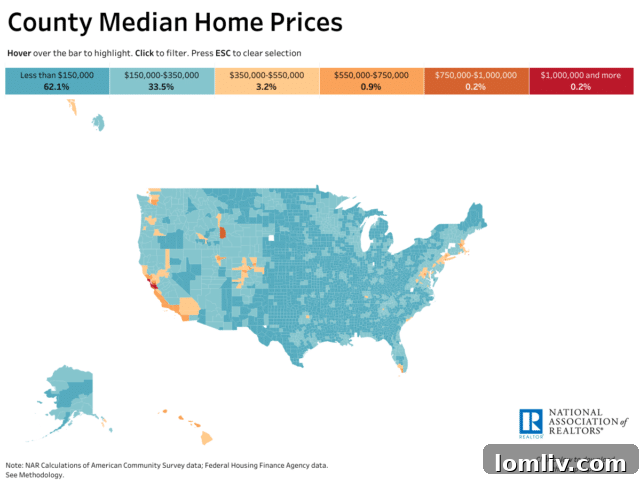
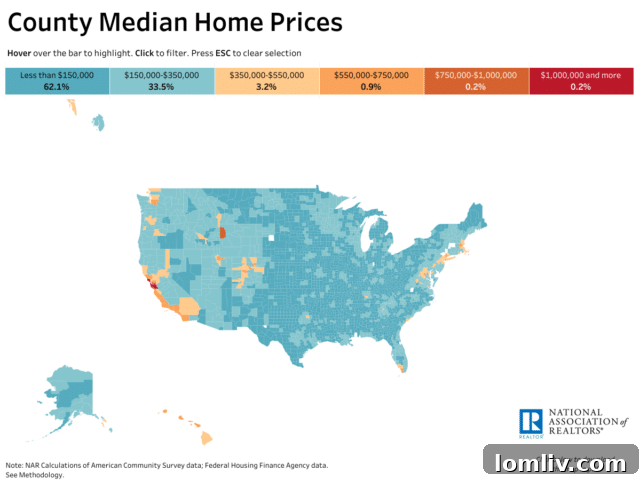
The dynamic real estate landscape of North Texas continues to capture attention, reflecting broader national trends while showcasing unique regional characteristics. A comprehensive report from the National Association of Realtors (NAR), leveraging intricate data visualizations, has cast a spotlight on median home values across the United States for the third quarter of 2018. This pivotal analysis offers invaluable insights into the housing markets of 3,119 counties nationwide, providing a detailed snapshot of property values and the varying degrees of affordability.
While the national median home value stood at an estimated $235,000 during Q3 2018, the NAR report revealed significant disparities, with an overwhelming 87 percent of U.S. counties registering median home values below this national benchmark. This wide range underscores the diverse economic conditions, demand-supply dynamics, and lifestyle preferences that shape local housing markets from coast to coast. For instance, the report highlighted regions like California, particularly San Francisco County, which commanded the highest median home price at an astonishing $1,272,170, illustrating the extreme end of the housing spectrum.
Focusing on the burgeoning North Texas region, the NAR data unveiled a compelling narrative, marked by both soaring property values and relatively more accessible options. Dallas County, a major economic hub, recorded a median home value of $191,696, notably lower than the national average. However, this figure tells only part of the story for the wider metropolitan area. Two adjacent North Texas counties, Collin and Denton, emerged as leaders in the local market, boasting median home prices significantly exceeding both Dallas County’s figures and the national median. Collin County topped the local list with an impressive median home price of $354,363, closely followed by Denton County at $307,370. Tarrant County, another significant player in the region, registered a median value of $203,964.
Unpacking North Texas’s Diverse Housing Landscape: Factors Behind the Figures
The striking variations in median home values across North Texas counties are not coincidental but rather a reflection of a complex interplay of economic, demographic, and geographical factors. Understanding these underlying drivers is crucial for both prospective homebuyers and current homeowners navigating this vibrant market.
The Rise of Collin and Denton Counties: A Magnet for Growth
The elevated median home prices in Collin and Denton counties can be attributed to several powerful forces. Both counties have experienced explosive population growth over the past decade, fueled by robust job creation, particularly in the technology, finance, and corporate sectors. Major companies have relocated or expanded their operations in cities like Plano, Frisco, and McKinney within Collin County, and Lewisville, Flower Mound, and Denton in Denton County, attracting a steady influx of high-income professionals. This surge in demand, coupled with limited housing inventory in highly sought-after areas, naturally drives up property values.
Furthermore, these counties are renowned for their highly-rated public school districts, attractive master-planned communities, and abundant amenities, including parks, recreational facilities, and upscale retail and dining options. These quality-of-life factors make them particularly appealing to families and individuals seeking a suburban lifestyle with urban conveniences. New construction, while active, often struggles to keep pace with demand, especially for single-family homes in desirable school zones, further contributing to competitive bidding and escalating prices.
Dallas and Tarrant Counties: Urban Cores and Varied Offerings
In contrast, Dallas and Tarrant counties, while still experiencing growth, present a different market dynamic. Dallas County, encompassing the sprawling Dallas metropolitan area, offers a more diverse range of housing options, from historic neighborhoods and urban high-rises to more established suburban communities. Its median home value, while lower than Collin and Denton, reflects a mix of older, more affordable homes alongside luxury properties. The county’s vastness and varied economic pockets contribute to this broader median. For many, Dallas County represents a more accessible entry point into homeownership within the broader DFW metroplex.
Tarrant County, anchored by Fort Worth, boasts a similarly diverse housing market. It has also seen significant economic development and population growth, particularly in areas surrounding Fort Worth and Arlington. Its slightly higher median home value compared to Dallas County might reflect the ongoing revitalization efforts in certain areas and a consistent demand for housing driven by its own distinct job market and cultural attractions. Both Dallas and Tarrant counties continue to evolve, with ongoing urban development and suburban expansion shaping their respective real estate trajectories.
Methodology Behind the Data: A Foundation of Reliability
The accuracy and depth of the NAR report stem from its meticulous methodology, which integrates two highly respected data sources: the American Community Survey (ACS) and the Federal Housing Finance Agency’s (FHFA) House Price Index (HPI) growth. The ACS, conducted by the U.S. Census Bureau, provides vital demographic, social, economic, and housing information across communities. Its comprehensive nature allows for detailed insights into housing characteristics and values at a local level. The FHFA House Price Index, on the other hand, measures average price changes in repeat sales or refinancing of the same properties, offering a robust indicator of home price appreciation or depreciation over time.
By skillfully applying FHFA’s HPI growth rates to the base median home values identified by the ACS, the NAR was able to calculate estimated median home prices for thousands of counties, providing a granular and reliable assessment of property values. This robust analytical framework ensures that the report offers a credible and actionable understanding of the national and local housing markets.
Beyond the Price Tag: Understanding Mortgage Payments and Affordability
While median home prices offer a crucial benchmark, they represent only one facet of the affordability equation. The true cost of homeownership is often best understood through the lens of monthly mortgage payments. Recognizing this, the NAR report extended its analysis to include average mortgage payments by county, providing a more holistic view of financial accessibility.
This calculation was based on the median home price for each county and three separate, representative mortgage rates prevalent during Q3 2018. By varying the interest rates, the report effectively illustrated how fluctuations in lending conditions directly impact a homeowner’s monthly financial burden. For prospective buyers, especially in high-value areas like Collin and Denton counties, even a slight increase in interest rates can translate into significantly higher monthly payments, potentially impacting purchasing power and overall affordability. This segment of the report serves as a critical reminder that market prices must always be considered in conjunction with prevailing interest rates and individual financial capacity.
Implications for North Texas Residents and the Economy
The findings of this NAR report carry significant implications for various stakeholders within the North Texas region. For potential homebuyers, understanding these median values is paramount for setting realistic budgets and identifying target areas that align with their financial goals. Those eyeing Collin and Denton counties might need to prepare for higher down payments and larger monthly mortgage obligations, reflecting the premium placed on these desirable locations. Conversely, the relatively lower median values in Dallas and Tarrant counties could signal more accessible opportunities for first-time buyers or those seeking to maximize their investment within a more diverse housing stock.
Current homeowners in Collin and Denton counties likely benefit from increased property equity, although this also comes with the potential for higher property taxes. For the broader North Texas economy, strong housing markets contribute to local government revenues, stimulate the construction industry, and support ancillary services like real estate agents, mortgage lenders, and home improvement businesses. However, rapidly escalating prices also pose challenges, including potential affordability crises for lower and middle-income residents, workforce housing shortages, and increased traffic congestion as populations expand.
Looking Ahead: Sustaining Growth and Affordability
As North Texas continues its trajectory of economic and population growth, the conversation around housing affordability and sustainable development will remain critical. The insights from reports like the NAR’s Q3 2018 analysis provide a foundational understanding of where the market stood and offer valuable context for future planning. While market conditions and interest rates continually evolve, the underlying drivers of demand in North Texas—strong job markets, quality of life, and strategic location—are likely to persist. Monitoring these trends and adapting to the dynamic real estate environment will be key for ensuring continued prosperity and accessibility for all residents.
For those interested in delving deeper into the granular data and exploring other counties across the nation, the National Association of Realtors has made its comprehensive data visualizations publicly available. These interactive tools offer an unparalleled opportunity to visualize median home prices and mortgage payment scenarios across diverse regions, empowering individuals with detailed market intelligence. You can access the NAR data visualizations here and here to explore the detailed findings.