The North Texas Housing Market: A New Reality for Homebuyers
The landscape of the North Texas housing market has undergone a dramatic transformation, redefining what it means to find an affordable new home. Where once the dream of owning a property under $200,000 was readily attainable, it has now become an increasingly rare possibility. A comprehensive report from Metrostudy, analyzing first-quarter 2016 data, paints a clear picture of this seismic shift, revealing a “new normal” characterized by a significant surge in homes priced above $200,000. This trend signals growing challenges for first-time buyers and those seeking entry-level properties in one of the nation’s most dynamic metropolitan areas.
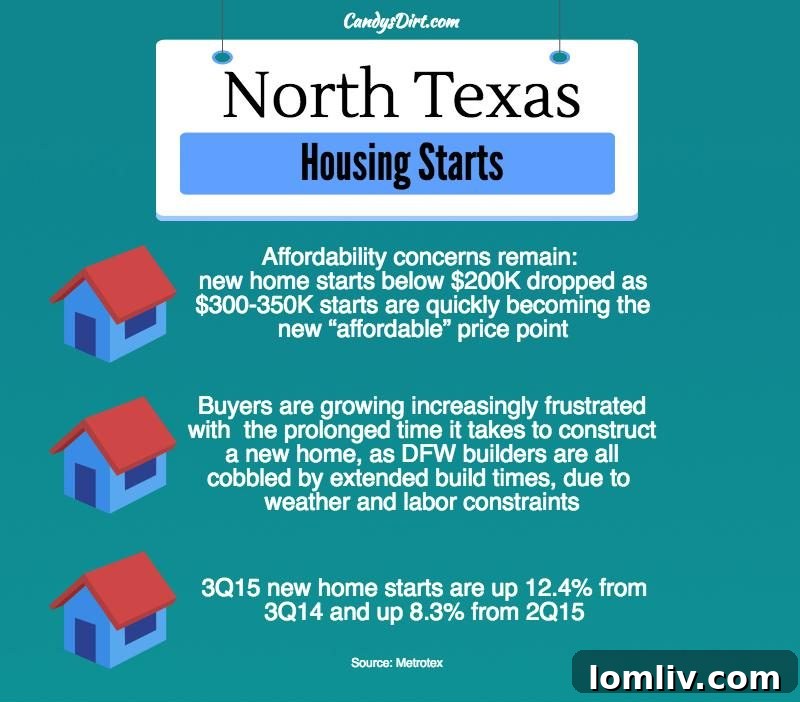
The data from Metrostudy’s report is stark and illuminating. Paige Shipp, Regional Director of Metrostudy’s Dallas office, highlighted the disparities in market growth across different price brackets. “When comparing the increase in starts and closings year-over-year, starts between $250,000 and $299,999 are nearly three times the closings increase,” Shipp noted. This indicates that while more homes are being initiated in this mid-range segment, the pace of sales is not keeping up, potentially leading to a backlog. The trend becomes even more pronounced in higher tiers: “Starts between $300,000 and $349,999 jumped 81.2 percent, which is almost twice the increase in closings.” Conversely, the more affordable segments have seen a significant decline: “starts below $200,000 have dropped 14.6 percent and closings plummeted 31 percent.” These figures underscore the rapid pivot away from the construction of lower-priced homes, making them exceptionally scarce for prospective buyers.
The Driving Forces Behind Escalating Home Prices in DFW
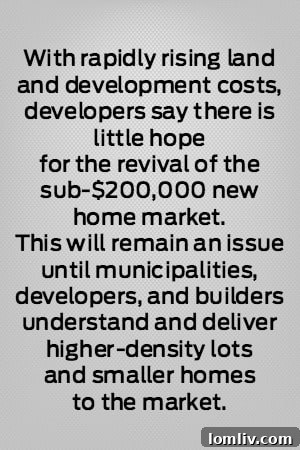
The disappearance of the sub-$200,000 new home market in North Texas is not an arbitrary shift but a direct consequence of several interconnected economic pressures. Developers consistently point to the rapidly rising costs of land and development as primary culprits. These foundational expenses dramatically increase the minimum price point at which a builder can profitably offer a new home. Until cities, developers, and builders can collaboratively implement strategies focused on higher-density lots and smaller home footprints, the hope for a resurgence of the entry-level market remains dim, as explained by industry experts like Shipp.
This sentiment is not new or isolated. For some time, other leading experts in the real estate field have echoed these concerns. As we previously reported in November of last year, Dr. James Gaines, chief economist with the Real Estate Center at Texas A&M University, provided a prescient warning. “For years in Texas, we have had the most affordable housing for a major metro area,” Gaines stated, lamenting the erosion of this advantage. He added, “Affordability and workforce housing are going to be a major issue — we are not building enough houses in the $150,000 to $200,000 bracket.” This underlines a critical challenge: the region’s economic growth is creating jobs, but the housing market struggles to provide homes at prices accessible to the very workforce driving that growth.
Land Scarcity and Development Costs: The Core Challenge
The cost of land in rapidly growing regions like North Texas has become an overwhelming factor in new home pricing. As urban areas expand and available land parcels shrink, developers face fierce competition, driving prices upward. This increased cost is then passed on to home builders, who, in turn, must factor it into the final sale price of the home. Furthermore, development costs—including infrastructure, utilities, permitting, and regulatory fees—have also seen substantial increases. These foundational expenses disproportionately impact the feasibility of constructing lower-priced homes, as the lot cost alone can consume a significant portion of what would have once been the entire home’s budget. Builders find it increasingly difficult to acquire lots priced under $40,000, a threshold that makes a sub-$200,000 home nearly impossible to deliver profitably today.
Understanding Demand and Inventory in DFW’s Evolving Market
While the entry-level market recedes, demand for mid-to-high range homes remains robust. Metrostudy’s report highlights that the greatest demand and strongest sales during the first quarter of 2016 were concentrated in the $250,000 to $400,000 price range, accounting for a significant 44.4 percent of the quarter’s total housing starts. This segment caters to move-up buyers and those with higher incomes, reflecting the economic prosperity of many North Texas residents. Perhaps more surprisingly, a substantial 31.6 percent of all new housing starts occurred above the $400,000 mark. As North Texas continues to attract affluent individuals and as land values appreciate, builders are increasingly focusing their efforts on these higher-priced segments, tailoring their offerings to meet the demand of buyers willing and able to invest more.
However, the picture is not without its complexities, particularly concerning housing inventory. Despite strong first-quarter closings, the total and finished vacant inventory levels continue to climb. In the first quarter of 2015, North Texas maintained a 6.7 months of supply (MOS) of housing. This figure has since grown to eight MOS. While part of this increase can be attributed to factors like extended build cycles influenced by weather in prior seasons, the persistent rise in completed yet empty homes is a point of concern. This could signal an uptick in cancellations by buyers, or, more plausibly, a scenario where speculative inventory—homes built without a pre-identified buyer—is not closing as quickly upon completion, leading to a build-up of available, unsold properties.
The Challenge of Equilibrium and Labor Shortages
The concept of market equilibrium, typically defined as an eight-month supply of homes, is a crucial metric for gauging market health. Metrostudy’s analysis reveals that inventory below $300,000, while growing slightly in Q1 2016, still remains below this eight-month equilibrium. This scarcity in the lower-to-mid price points exacerbates the affordability crisis. Conversely, price points above $300,000 hover above equilibrium, indicating a potentially softer market in these higher tiers. This imbalance is unlikely to notably decrease until labor shortages, a significant bottleneck in the construction industry, ease up. The pricier a home, the more custom elements it often entails, and the longer it generally takes to build. This translates to a greater volume of “under construction” inventory in higher price points, as projects simply take longer to complete. The tight labor market further extends these home building cycle times, intensifying the wait for buyers and impacting the overall supply flow.
Currently, the Dallas-Fort Worth (DFW) metroplex has approximately 21,150 lots under active construction, signaling ongoing development and growth. Historically, North Ft. Worth has been known as a more affordable market, and it currently leads the region with 2,530 lots under construction, representing a substantial 14.8-month supply. Following closely is Frisco, a rapidly expanding suburban city, with 2,055 lots under construction, equivalent to a 10.9-month supply. These areas are key indicators of future housing availability, though the price points of these new homes will continue to be influenced by the aforementioned cost pressures.
Forging a Path Forward: Collaborative Solutions for Attainable Housing
The long-term health and accessibility of the North Texas housing market hinge on a concerted effort from all stakeholders. Paige Shipp’s observations from the first three months of the year confirm that while prices for builders and developers remained stable, an anticipated increase in concrete costs for April posed a new challenge. If builders are unable to pass these escalating material costs onto buyers, their profit margins will inevitably be affected, potentially slowing future construction. Despite these hurdles, the demand for homes across Dallas-Fort Worth remains consistently strong, driven by robust job growth and population influx.
The imperative, therefore, is clear: builders, developers, and municipalities must collaborate effectively to deliver attainably priced homes. The prevailing factors of land prices, development costs, various fees, and general home building costs are largely uncontrollable in a booming market. The most viable strategies to provide new homes below the critical $300,000 threshold involve fundamental changes in construction and planning. This primarily means increasing home density—building more homes on smaller plots—and strategically decreasing home square footage. Such approaches require forward-thinking zoning policies from cities, innovative design from developers, and efficient construction methods from builders. Only through such integrated efforts can North Texas hope to address its growing affordability crisis and ensure that homeownership remains an achievable dream for a broader segment of its thriving population, fostering sustainable growth for years to come.