Unlocking Preston Center: Navigating Zoning, Deed Restrictions, and Redevelopment Hurdles
Urban redevelopment in established, desirable neighborhoods often faces a complex web of challenges, from intricate regulatory frameworks to deeply rooted community sentiments. Preston Center, a vibrant district in Dallas known for its unique blend of residential and commercial spaces, exemplifies such a landscape. At the core of its redevelopment struggles, particularly within the area colloquially referred to as the “Pink Wall,” lie several potent “poison pills” that significantly impede progress and reshape planning efforts. This article will delve into these critical impediments, examining how both municipal zoning regulations and historical civil covenants conspire to create formidable barriers to modern development initiatives.
Recent insights from the Preston Center Task Force, articulated by the Pink Wall representative, have brought these multifaceted development hurdles into sharp focus. The discussions have centered on understanding the unique interplay of zoning laws and long-standing deed restrictions that define the area’s current state and dictate its future potential. These are not merely bureaucratic hurdles but deeply embedded constraints that demand meticulous analysis and strategic navigation from developers, urban planners, and residents alike.
The Dual Framework: Zoning Ordinances and Civil Covenants
Land use and urban development are primarily shaped by two distinct yet interconnected mechanisms: city or municipal zoning ordinances, and civil covenants or deed restrictions. While zoning provides a broad regulatory framework set by local government, deed restrictions offer a more granular level of control, often initiated by original developers or property owners. In the context of the Pink Wall, understanding both is crucial to comprehending the current limitations and forecasting future development potential.
Decoding MF-1(A) Zoning in the Pink Wall Area
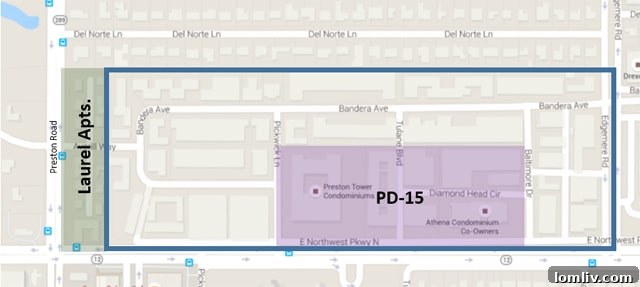
According to the Preston Center Task Force, a significant portion of the Pink Wall area—excluding the Preston Tower and Athena PD 15 zone, and the newly established Planned Development (PD) for the Laurel project—is designated as MF-1(A) zoning. This classification typically permits multi-family residential structures, generally allowing for building heights up to three stories. The “(A)” designation appended to MF-1 usually implies additional setback requirements, designed to ensure adequate spacing between buildings and property lines, promoting light, air, and privacy.
However, a closer examination of Dallas’s Article IV on Zoning reveals a critical nuance. The setback requirements associated with MF-1(A) zoning are explicitly mandated for “nonresidential districts.” Given that the Pink Wall is undeniably a residential district, this interpretation raises pertinent questions. Does this clause effectively negate the setback requirements for new residential developments within MF-1(A) zones in the Pink Wall? This ambiguity in the zoning text presents a potential point of contention or, conversely, an unexpected avenue for developers seeking greater flexibility. Such discrepancies underscore the need for precise legal interpretation and clarification from city authorities to ensure consistent application of planning regulations.
The Enduring Legacy of Deed Restrictions: A Development Stalemate
Beyond municipal zoning, the Pink Wall area is further constrained by a complex web of deed restrictions, a tangible legacy from its development in the 1950s when it was part of the nascent town of Preston Hollow. These restrictions were deliberately placed by the original builders, covering extensive tracts of land from Northwest Highway to the alley situated between Bandera and Del Norte, and from one lot inside Preston Road to Edgemere. Despite encompassing several distinct parcels, these restrictions are remarkably uniform in their scope and impact across the designated area.
The core of these deed restrictions severely limits new construction by essentially capping building height, mandating specific setbacks, and restricting the number of units per parcel to existing levels. In essence, they were designed to preserve the original character and density of the neighborhood, effectively creating a “dead end for redevelopment” without direct, proactive intervention. This means that any significant modernization, densification, or substantial alteration efforts would be impossible under the existing framework of these covenants.
These crucial deed restrictions, originally enacted in 1956, were designed with an initial enforceability period of 20 years. Critically, they also included an automatic renewal clause, extending their validity by 10 years at each subsequent interval. The most recent automatic renewal occurred on January 1, 2016, ensuring their continued legal force for the foreseeable future. This built-in perpetuity mechanism means that the restrictions remain a powerful determinant of the area’s development potential for years to come. It is noteworthy that the Transwestern Laurel project, a significant new development in the vicinity, is strategically located outside this restrictive zone, underscoring the profound impact these covenants have on development feasibility within the affected areas and guiding where new projects can realistically emerge.
Navigating and Overcoming Deed Restrictions: Pathways to Change
While formidable, these deed restrictions are not entirely immutable, though their dissolution requires a specific and often challenging process. A simple majority of 51 percent of the landowners within a given tract holds the power to vote and extinguish any or all of the existing restrictions. This democratic mechanism provides a theoretical pathway for change, albeit one that necessitates significant consensus, coordination, and often, extensive negotiation among property owners.
The legal implications of these restrictions are particularly complex for developers. Should a developer proceed with construction on a lot in compliance with city zoning but without formally removing the deed restrictions, the city itself would likely not intervene, as zoning compliance is its primary mandate. However, this action would expose the developer to potential legal challenges from the remaining landowners, as even a single dissenting landowner could initiate a lawsuit for violating the established covenants. This risk introduces a substantial layer of legal uncertainty and financial peril for any project not fully cleared of these historical encumbrances, highlighting the importance of due diligence.
Consequently, an ambitious developer eyeing the Pink Wall for redevelopment faces a clear, albeit potentially costly, strategy: acquire 51 percent of the voting rights within a target tract. Such an acquisition would grant them the necessary leverage to vote for the extinguishment of the restrictions, thereby unlocking the parcel’s full development potential. This approach, while legally sound, underscores the high capital investment and strategic planning required to successfully navigate the unique regulatory landscape of Preston Center’s Pink Wall, transforming static parcels into viable development opportunities.
Critiquing the Preston Center Task Force: Gaps in Research and Planning
The recent Task Force meetings, including one focused on the Pink Wall (Zone 4) and an earlier session for Zone 1 (Preston Center), have unfortunately been characterized by a notable lack of thoroughness and a concerning level of unpreparedness. The very impetus for these expensive consultations, reportedly costing a staggering $350,000, was the consultants’ inability to provide accurate unit counts for existing buildings—a basic data point one might assume the Dallas Central Appraisal District (DCAD) or a paid professional study would readily possess. Furthermore, critical details regarding existing deed restrictions and Planned Developments (PDs) were only brought to light at the preceding meeting, suggesting a superficial initial investigation. While acknowledging that records can span over six decades, such fundamental oversights raise serious questions about the return on investment for such a substantial sum, leaving many to expect a more comprehensive and diligently researched output.
Flawed Growth Projections and Overlooked Solutions in Urban Planning
Adding to the list of concerns, the Task Force’s projections for growth within the Pink Wall area appear significantly flawed. These calculations conspicuously fail to account for nearly 300 units from already approved projects, some of which are currently under construction. In a relatively compact urban area like the Pink Wall, such a substantial number of additional units would undeniably skew any development calculations, rendering them inaccurate and potentially misleading for future planning. This omission undermines the credibility of their growth models and creates an incomplete picture of the area’s ongoing transformation, necessitating a re-evaluation of their foundational data.
Moreover, discussions regarding the feasibility of new development under current zoning conditions often cite prohibitive land costs and structural limitations as insurmountable barriers. Yet, a crucial and increasingly common solution—underground parking—is frequently dismissed or undervalued. Despite its proven efficacy in maximizing land use and mitigating density concerns, the idea was met with a mumbled, almost dismissive acknowledgment, as if it were a novel and unproven concept. This casual dismissal is particularly striking given that the Transwestern Laurel project, located just around the corner, is actively implementing underground parking, showcasing its viability and demonstrating a clear path forward for innovative development in constrained urban spaces. This reluctance to embrace modern planning solutions further highlights a disconnect between the Task Force’s analysis and practical, contemporary urban development strategies.
The De Riguer Attitude: Fear-Mongering, Prejudice, and Misinformation
Beyond the technical shortcomings, the Task Force meetings were permeated by an undercurrent of skepticism, fear-mongering, and biased rhetoric that actively undermined objective discussion. This ‘de rigueur ‘tude often overshadowed genuine efforts to address Preston Center’s development challenges in a constructive manner.
The Specter of Rentals: Unpacking a Common Bias in Development Debates
A recurring theme, often presented with an almost palpable disdain, was the resurrection of the “ick” factor associated with rental properties in the area. Some attendees openly questioned whether the Pink Wall, perceived as an “owner-occupied” enclave, could somehow implement a ban on rentals—a notion that is, in fact, more than “kinda illegal.” This sentiment reveals a profound misunderstanding of property rights and housing market dynamics, alongside a thinly veiled prejudice against renters. The irony of this stance becomes even more apparent when considering the composition of the Task Force’s representatives for Zone 4: Steve Dawson, who owns a rental building within the Pink Wall, and Patti Niles, who is herself a renter in the area. This glaring conflict of interest, where one representative profits from rentals while simultaneously expressing concerns about new rental competition, and another represents the very demographic being disparaged, exposes a clear case of “pot meeting kettle.” Dawson, notably, did not volunteer to convert his own building to condominiums, suggesting that the problem isn’t rentals per se, but rather *new* rentals that might introduce competition or alter perceived neighborhood demographics.
Furthermore, the argument against rentals collapses under the weight of existing facts. Preston Tower, a prominent building in the area, has a significant percentage of its 382 units occupied by renters, with other condominium buildings also hosting rental units. This demonstrates that the area already boasts a diverse housing landscape including a substantial presence of rentals. Historically, this point is further amplified: every single condo building behind the Pink Wall was originally constructed as a rental building before being converted to condos. Therefore, the narrative of the Pink Wall as an exclusively owner-occupied haven, suddenly threatened by the prospect of rentals, is demonstrably false and serves primarily as a rhetorical tool for fear-mongering rather than a factual concern about neighborhood character.
While legitimate concerns about the quality of construction and long-term maintenance of new developments are valid—concerns about “slapped-up buildings that begin to crumble before the paint is dry”—these were not the primary concerns articulated. Instead, the focus was squarely on the tenant status of future residents, revealing an underlying bias rather than a genuine interest in structural integrity or neighborhood longevity, which would be more pertinent to responsible urban planning.
The Bogeyman of Low-Income Housing and Misrepresented Affordability
The most egregious instance of fear-mongering erupted when the topic of low-income housing, specifically “SECTION 8,” was introduced by Dawson. The term was uttered with the gravitas of a medium channeling a ghost at a séance, designed to evoke immediate alarm and visceral reactions among the audience. This discussion arose in the context of the city’s broader initiative to address housing affordability across the entire urban landscape. As part of this comprehensive effort, various organizations were invited to propose potential solutions and ideas—nothing concrete, merely preliminary pitches and theoretical discussions, akin to a Girl Scout selling cookies with no obligation to buy. It was an exploratory dialogue, not a binding proposal.
During a presentation by the Texas Real Estate Commissioners’ (TREC), the Pink Wall was identified as one of MANY, MANY possible locations for such initiatives. This identification was likely based on its current low density-to-zoning ratios, without necessarily implying a thorough on-the-ground assessment or specific recommendation. Yet, Dawson deliberately “ZOOMED in” on this specific slide during the meeting, presenting it in a manner that caused palpable horror throughout the room. The reaction was almost theatrical, reminiscent of a bygone era where individuals might “get the vapors” at a shocking revelation, highlighting the power of selective information presentation.
This tactic was a transparent attempt to rally opposition within an already largely homogeneous group, triggering anxieties about the prospect of “low-to-mid-income neighbors” and their implicitly multi-racial makeup. However, had the presentation slides not been rushed through, the audience would have clearly seen that the “low-income” bracket being discussed encompassed individuals earning 80 to 140 percent of the average salary. This demographic typically includes essential workers like teachers, firefighters, nurses, and other middle-class professionals who are crucial to the functioning of any city, not the sensationalized “local addict looking to score a bump” as implied by the fear-mongering rhetoric.
Fortunately, cooler heads eventually prevailed, and these exaggerated fears were quickly debunked by more rational voices in the room. Nevertheless, the incident served as a potent reminder of how easily misinformation can spread, especially in an election year. Once a lie is introduced, regardless of its factual basis, it can quickly morph into perceived gospel for some, profoundly influencing public opinion and policy discussions and hindering objective decision-making.
The Unspoken Truth: Preston Center’s Existing Mixed-Income Fabric
The irony of the low-income housing scare is that the Pink Wall, often perceived as a less affluent segment of Preston Hollow, is already a mixed-income neighborhood. It is home to a significant population of retirees who subsist on pensions and Social Security, with incomes that are often a mere fraction of those enjoyed by residents in the wealthier parts of Preston Hollow and the Park Cities. Indeed, their incomes can also be significantly lower than those of the very residents that new, denser development might attract—professionals and families seeking more affordable entry points into a desirable area. This “unspoken truth” underscores the hypocrisy of using income as a barrier to development, as the neighborhood itself already embodies the very diversity it professes to fear, making the opposition appear disingenuous.
Conclusion: Charting a Principled Path for Preston Center’s Future
The complexities surrounding the redevelopment of Preston Center, particularly the Pink Wall area, are a microcosm of the broader challenges facing urban growth in established communities across the nation. The intricate interplay of historical deed restrictions, ambiguous zoning interpretations, and politically charged community dialogues creates a formidable barrier to responsible progress. The insights gleaned from recent Task Force meetings reveal a troubling pattern of inadequate research, flawed projections, and the pervasive influence of biased opinions driven by glaring conflicts of interest.
It remains profoundly disheartening to witness a Task Force, ostensibly operating under a banner of impartiality for the public good, utilize members with blatant conflicts of interest and allow them to publicly express biased, rabble-rousing opinions. Such practices erode public trust and undermine the very objective analysis and collaborative spirit required for effective, equitable urban planning. True progress in Preston Center demands a fundamental shift: away from fear-driven narratives and incomplete data, and towards a transparent, evidence-based approach that prioritizes the long-term, equitable development of the entire community, considering the needs of all its current and future residents.
Moving forward, stakeholders must insist on rigorous research, clear and consistent interpretation of legal frameworks, and an inclusive dialogue that respects diverse perspectives while challenging unfounded prejudices. Only through such a committed and ethical approach can Preston Center truly navigate its inherent “poison pills” and unlock its full potential, transforming these significant challenges into opportunities for responsible, sustainable, and inclusive growth that benefits everyone.
Engage with the Conversation: Share Your Story!
Do you have a personal story about navigating HOA restrictions, a piece of high-rise history to share, or unique insights into urban planning challenges in your community? Realtors, perhaps you have a listing that powerfully showcases the potential of renovation or a success story of a beautifully transformed property that overcame similar hurdles? We invite you to share your perspectives and contribute to this vital conversation about development, community, and the future of our urban spaces. Your experiences help illuminate the intricate realities of real estate and community development, providing valuable context and understanding for all. Feel free to reach out and share your thoughts with us.