
Disrupting the Real Estate Game: Alex Doubet and the Flat-Fee Revolution
In the dynamic world of real estate, innovation is constant. This article delves into the journey of Alex Doubet and his company, Door, which is spearheading a significant shift in how homes are bought and sold, challenging traditional commission structures and agent marketing strategies.

Challenging the Status Quo: A New Perspective on Real Estate Marketing
From the outset, Alex Doubet, the Harvard-educated chief executive officer of the real estate company Door, has expressed a refreshing, no-nonsense perspective on real estate marketing. His critiques of conventional agent advertising resonate deeply with many who question the efficacy of traditional approaches.
“When you see all the nicely printed collateral from the brokers around town, the pictures and the big-hair poses, that’s all nice, but it doesn’t do anything to sell your house,” Doubet famously told the Dallas Morning News. “It’s somewhat akin to saying, ‘I’m going to sell your house by running an ad during the Super Bowl.’ You want to get in front of people who are actually going to buy your house, not just spray and pray everywhere.”
Doubet’s “spray and pray” analogy powerfully encapsulates the perceived inefficiencies of lavish, self-promotional agent advertisements. For years, critics have argued that the best strategy for agents is to highlight the property itself, rather than focusing on their personal brand through expensive, glossy ads. While these advertisements can boost an agent’s ego – perhaps involving professional makeup artists and even a limousine ride to a photoshoot – their actual contribution to selling a home remains a contentious point. The high cost of such campaigns often falls back on the client through hefty commissions, raising questions about whether this expenditure genuinely translates into a faster or more profitable sale for the homeowner.
The Wave of Disruption: From Redfin to Open Door
Alex Doubet is not alone in his quest to disrupt the long-established real estate industry. Silicon Valley, in particular, is a hotbed of companies striving to build “a better mousetrap.” We’ve previously covered entities like Open Door, a heavily funded company that directly purchases homes, making significant inroads into markets like Dallas-Fort Worth through extensive media campaigns. The success of these iBuyer models, which promise quick, hassle-free sales, warrants continuous monitoring and analysis.
Redfin’s Journey: From Agent Elimination to Hybrid Model
The concept of a reduced-commission or even no-commission brokerage is far from novel. Redfin, a widely recognized name today, began with a similar revolutionary spirit. Its original founder, David Eraker, a Seattle-based tech enthusiast who left medical school, was driven by personal frustration. He found the online search for a condo cumbersome and was particularly vexed by the fixed nature of broker commissions, which seemed immune to market dynamics or agent competition. In 2002, collaborating with a Yale-educated electrical engineer, Eraker launched a pioneering website that digitally mapped homes for sale in Seattle, a significant leap forward in online real estate search.
Redfin’s initial vision was radical: to either eliminate or drastically minimize the role of the traditional real estate agent, drawing inspiration from the Expedia model in the travel industry. However, the Redfin we know today has evolved considerably from this early philosophy, acknowledging the enduring importance of human interaction in real estate transactions.
Zillow’s Vision: The Auction Dream and Agent Reality
The founders of Expedia.com, Rich Barton and Lloyd Frink, also sought to disrupt real estate with Zillow. Initially, they explored the audacious idea of online home auctions to overhaul the existing system. Yet, Barton soon recognized a fundamental difference between travel agents and real estate agents.
“It was obvious to us, regardless of how relatively frustrated consumers were with the whole process, how important the agent relationship was to customers. No robots were going to eliminate the agent,” Barton reflected.
Despite this realization, the allure of shrinking massive agent commissions remains a powerful motivator for many business minds. The potential for financial gain is substantial; for context, Zillow’s market capitalization reached approximately $540 million when it went public in July 2011.
While some might draw parallels between Door and services like Uber, the comparison falls short when considering the stakes involved. Purchasing a home, often the most significant financial investment of a lifetime, differs profoundly from arranging a taxi ride. The complexity, emotional weight, and financial commitment of a real estate transaction necessitate a distinct approach.
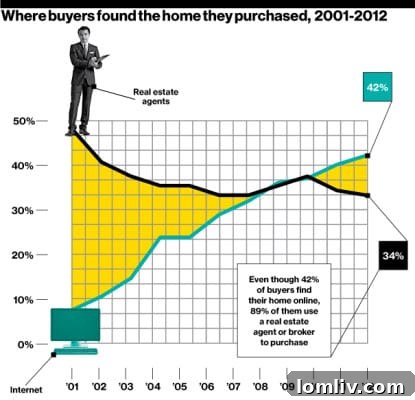
Despite these waves of disruption, real estate agents have proven remarkably resilient. Statistics from institutions like Champions School of Real Estate, which continues to expand its campuses, underscore the ongoing demand for professional guidance in property transactions.
Door’s Flat-Fee Model: A Direct Challenge to Commissions
A recent profile by veteran journalist Cheryl Hall highlighted the innovative structure of Doubet’s company. Door LLC, launched six months prior, operates as a full-service brokerage, but with a crucial difference: it charges a flat fee of $5,000 for either side of a home sale, a stark contrast to the typical 6 percent commission charged by traditional Realtors.
Doubet’s inspiration for this model was personal. His mother sold her University Park duplex for $857,000 through conventional channels, incurring a combined commission of $51,400 for the two Realtors involved. Remarkably, she received no acknowledgment beyond the transaction itself, sparking Doubet’s conviction that there had to be a more value-driven approach.
Flat-commission sales are not entirely new to the market, but they currently represent a small fraction, roughly 3%, of the overall real estate landscape. While the national average commission hovers around 5.26%, according to Hall’s findings, significant regional variations exist. For instance, in high-value markets like California, where million-dollar-plus homes are common, commissions tend to be higher.
Beyond the Flat Fee: Unpacking the Agent’s Value Proposition
The question then arises: what does a traditional agent *actually* do for their commission? A good agent invests considerable time and effort into preparing a home for sale. This includes meticulous detail cleaning, decluttering, professional staging, and crucially, hiring a professional photographer to produce magazine-quality images. These steps are vital for creating a compelling listing that stands out in a crowded market. Furthermore, agents bear the costs of various marketing efforts, from direct mail campaigns (which some still swear by, despite the digital age) to online advertisements, and hosting elaborate open houses designed to attract both prospective buyers and other agents who can spread the word. In highly competitive markets, agents go to great lengths – sometimes even orchestrating events with local celebrities or showcasing luxury vehicles – to generate buzz and excitement around a property.
This raises a critical question for flat-fee models like Door: how do they account for and cover these extensive marketing expenses? When comparing traditional and flat-fee services, it’s essential to ensure an “apples-to-apples” comparison, evaluating what services are included and what costs are truly absorbed by the flat fee.
Evolving Marketing Strategies: Print vs. Digital
The landscape of real estate marketing is continually shifting. While some agents still advocate for direct mail, arguing its effectiveness, others, especially those more digitally inclined, find its impact diminishing in an era where most bills are paid online and unsolicited mail often heads straight to the recycling bin. Similarly, traditional print ads face skepticism regarding their reach and return on investment.
However, one area consistently proves its worth: social media. The power of digital platforms to target specific demographics, engage with potential buyers, and generate widespread interest is undeniable, making it an indispensable tool for modern real estate marketing.
The Enduring Role of the Realtor: More Than Just Listings
Jim Fite, president and CEO of Century 21 Judge Fite Co., a respected voice in the industry, firmly believes that his agents earn their commissions. He argues that real estate is not a commodity, and each property is unique, demanding specialized skills. Fite emphasizes that a knowledgeable and experienced Realtor can save or earn clients many thousands of dollars, a point often echoed by traditional brokerages.
However, this argument is increasingly being challenged by a new generation of buyers, as exemplified by Brandon and Kate Marks, Door’s first millennial clients. Their dissatisfaction stemmed from a “lazy agent” who seemed more interested in closing any deal than in finding true value for them. This sentiment underscores a critical vulnerability for traditional agents: the perception of inconsistent service quality.
Doubet’s proposition to the Marks, offering “the exact same experience at $5,000” and significant savings, highlights Door’s competitive edge. In their case, the reduced buyer’s commission even played a role in negotiating down the seller’s asking price, demonstrating a tangible benefit of the flat-fee model.
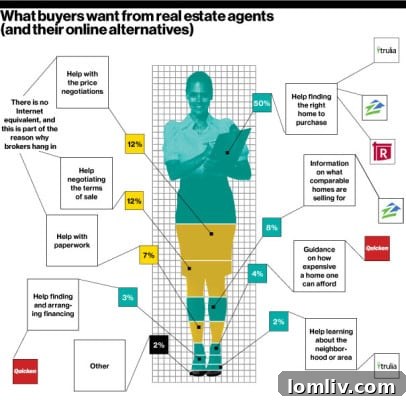
While some argue that agents are merely there to find listings – information readily available on platforms like Realtor.com – their true value often lies in other areas: their vast connections, access to off-market listings (especially crucial in inventory-starved markets), deep knowledge of neighborhoods, ability to identify homes with strong appreciation potential, and perhaps most importantly, their calm and collected negotiation skills during a highly emotional process. Savvy buyers, particularly those in finance, are capable of navigating many aspects of a transaction themselves but often choose an agent due to time constraints and the desire for professional expertise.
The Agent’s Earning Potential and the Future Landscape
The debate over commissions often leads to discussions about agent compensation. Spencer Rascoff, Zillow’s CEO, once stated at a technology conference that while many startups attempt to reduce agent commissions, most would likely fail because “consumers don’t really care about commissions.” He clarified that while consumers might express concern in theory, when it comes to the infrequent, highly emotional, and expensive process of selling a home, they ultimately “turn to a professional.”
However, Door’s model challenges this premise directly. Alex Doubet himself takes a flat salary of $60,000, and his agents earn $50,000 annually. This figure, according to Doubet, aligns with the U.S. Bureau of Labor Statistics’ going rate for an established residential agent, although other sources like the NAR suggest a median closer to $40,990, with many earning significantly less.
The financial sustainability of Door’s model, paying competitive salaries while charging only $5,000 per transaction, raises questions about operational overhead. Without traditional office spaces, desk fees, or extensive print advertising, Door aims to minimize costs, betting on efficiency and volume to make its model viable.
Despite the critical questions and inherent challenges, the energy and vision behind Alex Doubet and Door are undeniable. His approach signals a coming change in the real estate industry, a disruption that may very well originate from unexpected places like Dallas. The future of real estate may see fewer “Uber” comparisons and more focus on value-driven services, potentially shaping Alex Doubet into a future leader akin to Spencer Rascoff, another Harvard graduate who transformed a market.