By Lydia Blair
Special Contributor
Navigating the Unseen: Protecting Your Property from Hidden Hazards in Real Estate
Purchasing a home or any piece of real estate is often one of the most significant financial and emotional investments an individual or family will ever make. It represents more than just a transaction; it embodies dreams, security, and a future. Yet, beneath the excitement of acquiring a new property, there lurk potential perils that even the most diligent property buyer might never anticipate. These are known as “hidden hazards” in the realm of real estate and title services – insidious issues that can silently undermine your property ownership and lead to unforeseen complications, costly legal battles, or even the devastating loss of your entire investment.
Unlike a physical hazard you might stub your toe on, a hidden hazard in property ownership refers to an unseen problem with the legal title to the property. It’s an issue so elusive that it typically escapes detection during a standard, thorough search of public records. This article delves deep into the nature of these hidden dangers, explores common and critical examples, and highlights the indispensable role of title insurance in safeguarding your property rights and financial peace of mind against these unexpected threats.
The Foundation of Ownership: Understanding Your Property Title
Before exploring the unseen, it’s crucial to understand what a property title signifies. A property title is essentially a bundle of legal rights to a specific piece of real estate. It’s the documented proof of ownership, outlining who has the right to possess, use, and transfer the property. When you purchase real estate, you’re not merely acquiring the physical structure or land; you are fundamentally acquiring the title to that property. This title must be “clear,” meaning it should be free from any liens, claims, or encumbrances that could challenge your ownership rights. A clear title is the bedrock upon which secure and undisputed property ownership is built, offering the holder absolute legal dominion over their asset.
Beyond the Surface: The Standard Title Search Explained
The initial and critical line of defense against potential property title issues is a comprehensive title search. Conducted by experienced title companies and professionals, this process involves an exhaustive examination of all public records related to the property in question. Title professionals meticulously review a vast array of documents, including deeds, maps, plats, mortgages, tax records, court records, liens, abstracts of judgment, probate actions, divorce decrees, and other relevant legal and historical documents. The primary objective is to uncover any “discoverable” issues that could affect the property’s title and inform the prospective buyer.
Discoverable issues are those problems that are identifiable through diligent research of publicly accessible records. These commonly include, but are not limited to:
- Outstanding Mortgage Loans: Any existing unpaid loans secured by the property that would need to be satisfied.
- Property Tax Liens: Unpaid property taxes that can accumulate and lead to severe penalties or even foreclosure.
- Court Judgments: Legal rulings against the seller, such as unpaid debts or civil penalties, that could become a lien on the property.
- Utility Easements: Legally recorded rights for utility companies (e.g., water, electricity, gas) to access specific portions of the property for maintenance or installation.
- Recorded Covenants, Conditions, and Restrictions (CC&Rs): Rules and regulations governing the use and development of the property, often found in homeowners’ association (HOA) communities.
- Boundary Disputes: Issues arising from incorrect property line descriptions or existing encroachments that have been legally recorded and might impact the property’s usable area.
- Mechanic’s Liens: Claims filed by contractors, laborers, or suppliers who were not paid for work performed on the property.
Most title companies are highly proficient at identifying these transparent issues, ensuring that buyers are fully aware of any existing encumbrances or obligations before finalizing a property purchase. While a robust title search significantly mitigates a wide range of risks, it cannot, by its very nature, reveal everything. This limitation is precisely where hidden hazards emerge as a formidable threat.
The Elusive Threats: What Constitutes a Hidden Hazard?
A hidden hazard stands in stark contrast to discoverable issues because it represents a defect in the chain of title that is not apparent from public records and cannot be found through even the most painstaking and diligent title search. These issues often arise from events that occurred in the distant past, sometimes many years prior to the current transaction, and only come to light much later through an unexpected claim or revelation. These unforeseen difficulties can be an unpleasant, deeply disruptive, and profoundly costly shock for any property owner, capable of jeopardizing their entire investment and their right to ownership.
The insidious nature of hidden hazards lies in their invisibility until a critical event forces them into the open. Such events can include a long-lost relative appearing with a claim, an old and previously undiscovered will being unearthed, or a historical fraudulent transaction being exposed. When these issues surface, they can throw into question the rightful ownership of the property, creating immense stress, significant financial burden, and legal complexities for the current owner. Without adequate protection, these hidden defects can transform a dream home into a legal nightmare.
Common Examples of Critical Hidden Hazards
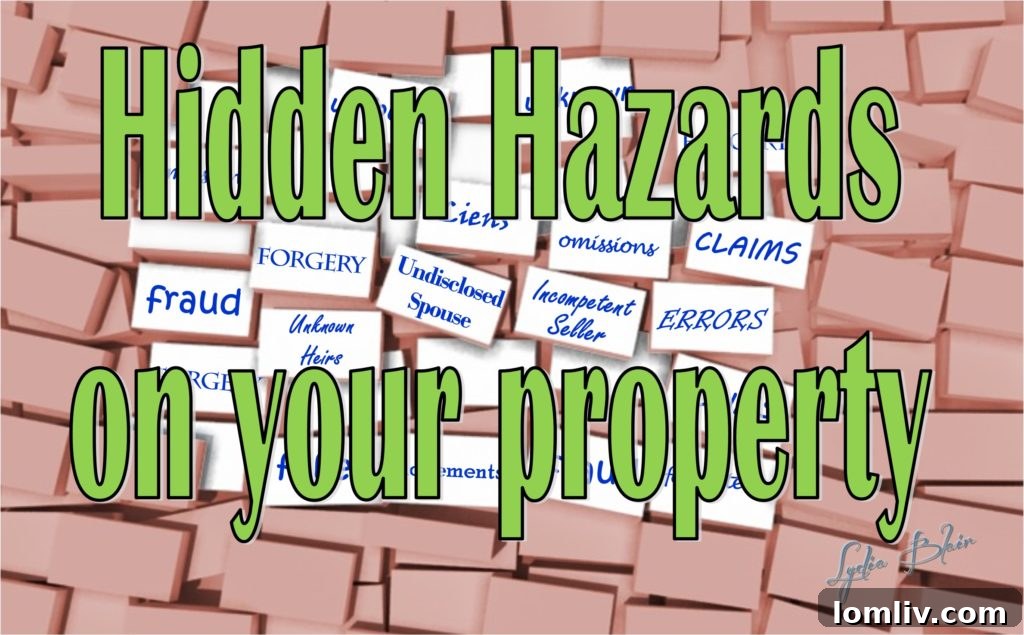
To better grasp the gravity and variety of these unseen threats, let’s explore some of the most common and impactful hidden hazards that can silently plague property titles and imperil property ownership:
1. Forgery and Fraudulent Deeds
One of the most unsettling hidden hazards involves acts of forgery or outright fraud in previous property transfers. Imagine purchasing a property, only for a legitimate former owner to appear years later, claiming their signature was forged on a deed in the chain of title. Identity theft is a rampant and growing issue in the real estate sector, with sophisticated fraudsters often impersonating legitimate property owners to illegally transfer property and abscond with the proceeds. Such a fraudulent transaction, even if it occurred several sales back in the property’s history, can render all subsequent transfers invalid. If the true owner was unlawfully dispossessed, they maintain a rightful claim to the property, potentially voiding your ownership despite your good-faith purchase. This type of claim can surface many years after a transaction, long after anyone involved would expect new complications, making it a particularly dangerous hidden risk.
2. Errors in Public Records or Defective Deeds
Despite significant advancements in electronic record-keeping, human error remains an unfortunate reality. Clerical mistakes, misspellings of names or addresses, incorrect legal descriptions, or errors in filing documents can occur at any stage of a property’s history. A seemingly minor typo in a legal description could mean your deed describes a different parcel of land entirely, or perhaps only a smaller portion of the property you thought you purchased. An error could also occur if a previous deed was improperly executed, for instance, lacking necessary witnesses, proper notarization, or containing an incomplete legal description, rendering the transfer technically invalid. These subtle defects might go unnoticed for decades until a new survey, sale, development project, or boundary dispute brings the precise boundaries or documentation into question, leading to a defective deed that jeopardizes your legal claim and potential property rights.
3. Undisclosed Heirs or Spouses
This category encompasses complex situations where not all legal claimants to a property were identified, acknowledged, or involved in a past transaction. For example, a seller might have been unknowingly (or knowingly) married at the time of sale, and their spouse’s consent or signature was legally required for the transfer in their jurisdiction. If this undisclosed spouse later appears to claim their dower, homestead, or community property rights, your ownership could be severely impacted, forcing you to buy out their share or face partition. Similarly, an unknown heir – perhaps a child from a previous marriage, a relative thought to be deceased, or someone named in an undiscovered will – could emerge with a legitimate claim to all or part of the property, challenging the validity of a prior probate or estate distribution. These claims often arise from complex family histories and can be incredibly difficult and costly to resolve without proper protection.
4. Mental Incompetence or Incapacity of a Previous Seller
For any property transaction to be legally binding, all parties must be of sound mind and legal capacity to enter into a contract. If a previous seller in the chain of title was mentally incompetent or legally incapacitated at the time they transferred the property, that transaction could be deemed voidable. This could apply to an elderly individual suffering from advanced dementia, someone under severe duress, an individual with a debilitating mental illness, or even a minor who illegally signed a deed. Years later, a legally appointed guardian, a family member, or a legal representative might challenge the validity of that past transfer, asserting that the seller lacked the capacity to convey the property, thus creating a cloud on your title and jeopardizing your current ownership.
5. Unrecorded Easements or Encroachments
While many easements are discoverable through a diligent title search, some can remain hidden. An unrecorded easement might be an old, informal agreement for access across a property that was never formally documented or registered with public authorities. Similarly, an encroachment – where a structure, fence, or improvement from an adjacent property illegally crosses onto yours – might exist but not be apparent from visual inspection or recorded documents. These issues could surface unexpectedly during a new property survey, when you attempt to build on a certain part of your land, or when a neighboring property owner decides to enforce an old, unrecorded right. A previously granted access right to a neighbor that was never formally recorded, for example, could significantly restrict your property use and surprise you when it is enforced.
6. False Impersonation of the True Owner
Similar to outright forgery, this hazard involves someone completely misrepresenting themselves as the actual property owner. This can occur when fraudsters obtain sophisticated false identification or exploit vulnerabilities to assume the identity of a legitimate owner. They might then proceed to sell the property, collect the funds, and disappear, leaving the actual owner and the subsequent buyer in a profound legal quagmire. The initial sale by the imposter is fundamentally invalid, meaning all subsequent transfers based on that fraudulent sale are also invalid, putting your ownership at severe and immediate risk.
7. Duress or Coercion in Prior Transfers
A deed or property transfer made under duress or coercion is not legally valid. If a previous owner was forced, threatened, or pressured against their will to sell the property, that transaction could be contested and potentially overturned in court. While proving duress can be incredibly challenging, if successful, it could invalidate all subsequent transfers down the chain of title, including your current ownership. Such claims are extremely difficult to uncover through standard title searches because the public records would simply show a standard, apparently legitimate transaction, not the underlying, illegal circumstances that led to it.
The Shield You Need: Why Title Insurance is Indispensable
Given the array of complex, often unforeseeable, and potentially catastrophic hidden hazards, property owners need robust and specialized protection. This is precisely where title insurance becomes not just an option, but an absolutely vital necessity for anyone investing in real estate. Unlike other forms of insurance that protect against future events (like fire, theft, or natural disasters), title insurance offers unique protection against financial loss and legal expenses arising from defects in the property’s title that occurred in the *past* – before you even owned the property.
Title insurance is a unique form of coverage that offers a critical layer of security for perhaps your most valuable asset. It acts as an enduring bulwark against the unexpected, safeguarding your investment from claims that can emerge from the shadows of history and challenging your right to own. Without it, you could face immense financial distress, legal battles, and emotional turmoil if a hidden hazard materializes, potentially losing your home and your life savings.
How Title Insurance Protects Your Investment and Peace of Mind
When you secure a title insurance policy, you’re not just buying a piece of paper; you’re investing in invaluable peace of mind and powerful legal and financial protection against the unforeseen:
- Comprehensive Title Search: While title insurance specifically covers hidden hazards, the title company’s initial, rigorous title search remains paramount. This process aims to identify and resolve any discoverable issues *before* closing, minimizing risks from the outset and ensuring a clear title at the time of purchase.
- Legal Defense: Should a claim arise challenging your ownership due to a covered hidden hazard, your title insurance policy assures you of a robust legal defense. The title insurer will pay for the legal fees, court costs, and related expenses associated with defending your title in court, saving you potentially tens of thousands of dollars in legal bills.
- Financial Compensation: If the claim against your ownership is ultimately determined to be valid and you suffer a loss as a direct result (e.g., loss of a portion of your property, or the entire property), the title insurer will provide financial compensation up to the amount of your policy. This ensures that your financial investment in the property is protected, even if your ownership rights are partially or fully diminished.
- Invaluable Peace of Mind: Perhaps the most significant benefit, knowing that you are protected against the myriad of potential, unseen issues provides invaluable peace of mind. It allows you to fully enjoy your property without the constant worry that a hidden historical defect could threaten your home and your future.
Types of Title Insurance Policies
It’s also important for homebuyers to understand that there are generally two distinct types of title insurance policies:
- Lender’s Title Policy: This policy is mandatory in almost all real estate transactions involving a mortgage. It specifically protects the lender’s investment in the property, ensuring that their loan is secure against title defects. It does *not* protect the homebuyer’s equity or investment.
- Owner’s Title Policy: This policy directly protects the homebuyer (the owner) from claims against their ownership. While often optional, it is unequivocally recommended as it safeguards the buyer’s equity, investment, and right to possess the property. A lender’s policy, crucial as it is for the bank, provides no coverage whatsoever for the owner.
The Cost vs. The Risk: A Prudent Investment
Unlike most other insurance policies that require ongoing monthly or annual premiums, title insurance is typically a one-time premium paid at closing. This single payment provides continuous coverage for as long as you or your heirs own the property, offering lifelong protection. Considering the potentially catastrophic financial losses that can result from an unaddressed hidden title defect – including extensive legal fees, court costs, and the possible loss of the entire property – the initial cost of title insurance is a remarkably prudent and comparatively small investment. It is a modest price to pay for security against problems that can cost exponentially more to resolve, both financially and emotionally.
Don’t Let Hidden Hazards Derail Your Dream
The journey to property ownership is an exciting and fulfilling one, filled with aspirations and significant commitments. However, it’s a journey fraught with potential legal pitfalls, many of which remain entirely invisible until it’s far too late. A hidden hazard on your property can do far more damage than a mere stubbed toe; it can severely impact your financial stability, emotional well-being, and overall quality of life, taking a considerably longer time and far greater resources to recover from. Title insurance stands as your essential safeguard, ensuring that your property ownership remains secure and your investment protected from the unexpected complexities and historical ambiguities of real estate.
By understanding the critical distinctions between discoverable and hidden title issues and by proactively securing comprehensive title insurance, you equip yourself with the necessary defense to navigate the intricate world of real estate with confidence and peace of mind. Don’t let an unseen problem from the past undermine your future and your most cherished asset.
The opinions expressed are of the individual author for informational purposes only and not for the purpose of providing legal advice. Contact an attorney to obtain advice for any particular issue or problem.