

The Battle for District 14: Unraveling the Dallas City Council Runoff and Real Estate Influence
The Dallas City Council District 14 runoff election presents a critical juncture, not just for the constituents of this vibrant district but for the broader landscape of Dallas urban development. As incumbent Philip Kingston faces off against challenger David Blewett, a central question looms large: who stands to gain the most if Kingston is unseated? This high-stakes political contest appears deeply intertwined with significant real estate interests, particularly the controversial Lincoln Property Katy Trail project, which has become a symbol of the ongoing tension between development ambitions and community preservation.
The Shadow of the Katy Trail Project: A Precursor to Political Tensions
The saga of the Lincoln Property Katy Trail project offers a compelling backdrop to the current political drama. This ambitious development, which sought approval from the Dallas City Council, faced resounding defeat not once, but twice – first at the City Plan Commission and then again in January before the full City Council. This initial rejection was, for many, a clear sign that the perceived arrogance displayed by the developer throughout the planning and approval process had not yielded its desired outcome. Indeed, it served as a powerful reminder that community opposition, when unified and vocal, can successfully challenge even the most well-funded development proposals.
Whispers circulating after the project’s failure suggested that the contract between Lincoln Property and the owners of the Turtle Creek Terrace condos, a crucial component for the Katy Trail development, had expired and remained unrenewed. Yet, curiously, it was also reported that the contract hadn’t been formally canceled, leaving the property in a state of suspended animation, actively seeking to sell but awaiting a favorable political climate. This strategic ambiguity underscored a persistent belief that the developers were merely biding their time, anticipating a shift that might revive their plans. Just as a previous District 13 election became a referendum on development issues, it is increasingly clear that the District 14 runoff is similarly animated by the dazzling, often contentious, world of Dallas real estate and urban planning.
Campaign Contributions and Developer Allegiances: A Closer Look at the Blewett Campaign
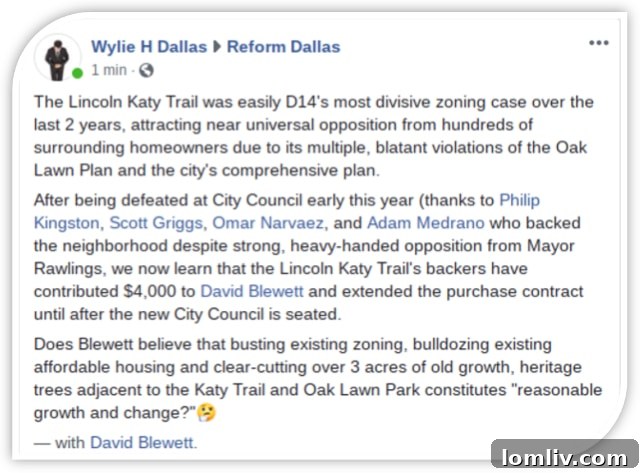
Further fueling speculation about developer influence is a post by the enigmatic Wylie H. Dallas. This commentary brought to light significant campaign contributions to David Blewett’s campaign: four contributions totaling $4,000, each for $1,000, from two Lincoln executives and their respective spouses. Simultaneously, Wylie H. Dallas reported that Lincoln Property had taken the strategic step of extending their contract with Turtle Creek Terrace. This extension, crucially, is said to remain active until the outcome of the District 14 election is decided and a new city council is officially seated.
Wylie’s analysis suggests that Blewett, a relatively unknown figure in the race prior to the runoff, might possess an unstated connection to the Katy Trail project, a link not yet overtly proven. However, the timing of these contributions, made on the heels of Kingston’s staunch opposition to the development, undeniably adds weight to the theory that these donations represent an “anyone but Kingston” strategy. It’s a calculated move designed to clear the path for projects that have faced significant hurdles under the current council member. Adding further fuel to this speculative fire are consistent reports indicating that Blewett allegedly neglected to meet with several vital neighborhood groups, including the Stonewall Democrats and Uptown Dallas, despite multiple invitations extended during the intense election run-up. This perceived lack of engagement with key community stakeholders has raised eyebrows and deepened concerns among residents about his potential allegiances and priorities should he be elected.
Key Players and Financial Backing in the Dallas Runoff

An excerpt from Blewett’s donor list further solidifies the links to Lincoln Property. This list conspicuously includes Tim Byrne and Mack Pogue, along with their spouses. Mack Pogue holds the esteemed position of Chairman at Lincoln Property, a development giant with extensive influence across Texas and beyond. Tim Byrne serves as the President and CEO of Lincoln Property’s Residential Division, overseeing a vast portfolio of residential projects. Their combined financial contributions, while seemingly a modest $4,000 in the context of a large-scale political campaign, represent a strategic investment for Lincoln. For a development firm, this sum is often considered “chump change” for the mere possibility of securing a more favorable political environment – essentially, another “spin of the wheel” to advance a stalled project like Katy Trail. The fundamental question, therefore, transcends the donations themselves: has David Blewett met with Lincoln Property representatives and, critically, decided to align himself with their development agenda, potentially against the strong and unified opposition of the neighborhood, the City Plan Commission, and the revered Oak Lawn Committee? The true measure of his intentions will likely only become clear if he succeeds in ousting Kingston and Lincoln Property subsequently attempts to resurrect the Lincoln Katy Trail project.
The Crucial Question: David Blewett’s Stance on Development and Community Advocacy
Beyond the immediate future of the Katy Trail project, the District 14 runoff election presents a broader, more profound question for the entire district. Will David Blewett, if elected, choose to uphold the 35-year tradition of respecting and backing the considered decisions and recommendations of the Oak Lawn Committee? Or will his tenure mark a departure, potentially compromising the longstanding effectiveness and influence of this crucial community advocacy group? The Oak Lawn Committee has historically served as a vital guardian of neighborhood character and a powerful voice in shaping responsible development within its purview. Its decisions carry immense weight, often reflecting years of careful planning, community input, and dedicated volunteer work. To undermine their role would send a chilling message to other neighborhood associations striving to preserve their unique identities against relentless development pressures.
Upholding a 35-Year Legacy: The Oak Lawn Committee’s Critical Role
The Oak Lawn Committee’s resilience has been tested before. In 2018, the organization weathered a significantly divisive leadership struggle, emerging from it with its mission and advocacy efforts intact. This history underscores its vital importance to the community and its ability to withstand internal challenges. The question now is whether the Oak Lawn Committee, having recently navigated such internal strife, is prepared for another potential crisis – one that could arise from a city council member less inclined to respect its established role in guiding prudent development. The stakes for community-led urban planning and the balance of power between residents and developers in District 14 have rarely been higher. A shift in the political landscape could dramatically alter how future development projects are evaluated, approved, and integrated into the existing fabric of the neighborhoods, potentially setting a precedent for other districts across Dallas.
Philip Kingston’s Record: Principled Opposition Versus Personal Style
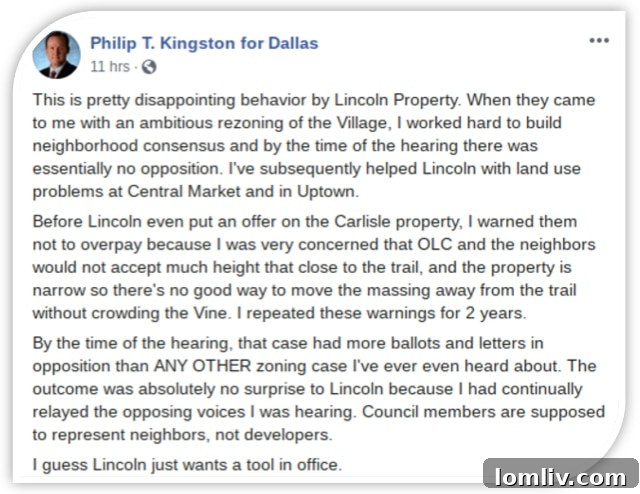
In response to the escalating discourse, Council Member Philip Kingston has publicly provided more comprehensive details regarding his consistent opposition to the Lincoln Katy Trail project. He has pointed to a history of warnings he issued to Lincoln Property, dating back two years, underscoring the long-standing nature of the community’s concerns. Students of Dallas’s urban history will recall that oversized redevelopment projects on this very plot of land have faced a similar fate in the past, famously dying under previous administrations. Notably, during Angela Hunt’s tenure as a council member – rather than in her current role as a developer representative – these projects met with a fierce outpouring of near-universal opposition from residents. This historical context reinforces Kingston’s argument that his stance on the Katy Trail project is rooted in a consistent pattern of community advocacy and responsible urban planning, not a personal vendetta.
To further demonstrate that his opposition to the Katy Trail development is not an isolated act of animosity, Kingston has also highlighted his record of being largely helpful to Lincoln Property on other, unrelated cases. This nuanced approach suggests that his decisions are based on the merits of each individual project and its potential impact on the community, rather than a blanket hostility towards any specific developer. While it is widely acknowledged that Kingston possesses a complex and at times “problematic personality,” which has admittedly led to a trail of self-inflicted wounds in his political career, his detractors and supporters alike often agree on one crucial point: when it comes to fundamental issues like combating homelessness, championing affordable housing initiatives, and advocating for reasonable and context-sensitive area development, his policy positions are generally “spot on.” His unwavering commitment to these core principles has earned him a reputation as a fierce advocate for the less privileged and a staunch defender of sustainable urban growth, often placing him at odds with powerful development interests. The District 14 election, therefore, is not merely about personalities; it is a profound choice about the direction of development, community voice, and the values that will shape Dallas’s future.
The Stakes for District 14: A Crossroads of Development and Representation
The upcoming District 14 runoff election transcends a typical political contest; it represents a critical crossroads for Dallas. Voters are faced with a stark choice: whether to continue with a council member known for his unyielding, albeit sometimes controversial, advocacy for community interests and responsible development, or to embrace a change that could potentially usher in a more development-friendly political climate. The ramifications of this decision will extend far beyond the boundaries of District 14, influencing the delicate balance between urban growth, neighborhood preservation, and the power of community voice across the entire city of Dallas. On Saturday, the residents of District 14 will cast their votes, and their decision will undoubtedly shape the future trajectory of real estate development, political accountability, and community empowerment in one of Dallas’s most dynamic districts.

Remember: My focus consistently revolves around high-rises, homeowners associations (HOAs), and the intricate world of property renovations. However, my passion also extends to appreciating modern and historical architecture, always balancing these aesthetic and historical values against the dynamic forces of the YIMBY (Yes In My Backyard) movement. My dedication to insightful real estate journalism has been recognized by the National Association of Real Estate Editors, who honored my writing with three Bronze awards in 2016 (2016), 2017 (2017), and 2018 (2018), alongside two Silver awards in 2016 (2016) and 2017 (2017). If you have a compelling story to share, an important tip about Dallas real estate, or even a unique marriage proposal, please don’t hesitate to reach out via email at [email protected]. You’re also welcome to look for me on Facebook and Twitter, although a successful search might prove elusive.