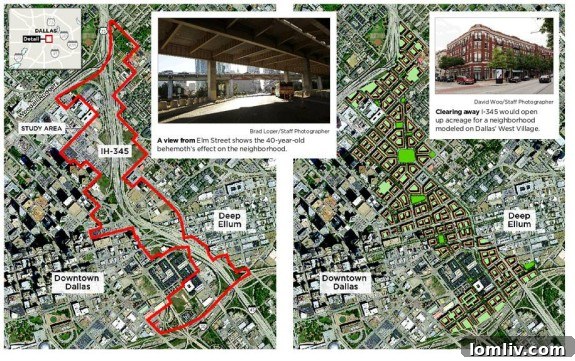
Reimagining Dallas: The Contentious Debate Over I-345 Freeway Removal
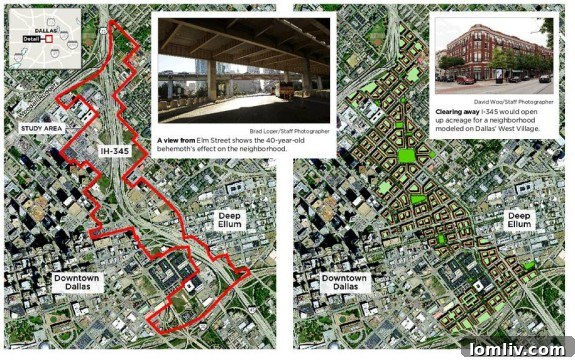
Beyond the concrete: envisioning a vibrant new future for Dallas where I-345 once stood.
A Bold Vision for Urban Transformation: Connecting Deep Ellum and Downtown Dallas
For several years, a significant and often passionate conversation has been unfolding in Dallas, Texas. At its heart lies a bold proposal: the removal of a specific 1.7-mile section of Interstate 345 (I-345), an elevated highway that currently acts as a formidable barrier between the city’s historic Deep Ellum district and its bustling downtown core. This discussion transcends mere infrastructure; it’s about fundamentally rethinking urban space and connectivity, moving towards a more integrated and people-centric city design. The primary proponents of this transformative idea are urban planner and blogger Patrick Kennedy, alongside Brandon Hancock. They advocate for tearing down this aging concrete structure, not merely to dispose of it, but to reclaim the valuable land it occupies.
Their vision is compelling: to eliminate a palpable physical and psychological barrier that has long fragmented two vital parts of Dallas. By removing I-345, they envision opening up acres of prime urban real estate for development, paving the way for a brand-new, cohesive neighborhood. This ambitious plan promises not only to foster greater synergy and seamless pedestrian flow between Deep Ellum and downtown Dallas but also to inject new life into the city’s economic landscape. Such a redevelopment could lead to the creation of thousands of new homes, businesses, and cultural spaces, generating entirely new property and sales tax revenues, thus significantly enhancing the overall quality of urban living and Dallas’s economic vitality.
While the concept of demolishing a major urban artery without direct replacement might initially strike some as radical or even counterintuitive, historical precedents from other major cities around the globe demonstrate that such initiatives can yield remarkably positive, long-term outcomes. When elevated highways have been removed elsewhere, urban dynamics have often shifted profoundly. Residents and commuters adapt, frequently driving less, opting for alternative routes, or embracing public transportation as part of a more integrated mobility network. The long-term benefits frequently include reduced traffic congestion in core areas, improved air quality due to fewer emissions, and the invaluable reclamation of prime land for public spaces, green infrastructure, and economic development.
The Legacy of Mid-Century Urban Planning: Highways Over Humanity?
The very existence of I-345, much like countless other urban expressways across America, is a direct product of a specific era in urban planning that dominated the mid-20th century. This period saw cities gripped by an intense fascination with the automobile, often prioritizing rapid vehicular movement and large-scale infrastructure over established communities, local economies, and pedestrian-centric design. This philosophy is famously encapsulated in the extensive biography of New York City urban planner Robert Moses, whose monumental projects, particularly his vast network of parkways and expressways, fundamentally transformed the landscape of New York and its environs.
Moses, often dubbed the “master builder,” famously prioritized vehicular traffic and monumental construction over public transportation and the preservation of existing neighborhoods. Critics of Moses frequently contended that his deep passion for automobiles eclipsed any concern for people, leading to the destruction of scores of vibrant communities and historical districts to make way for the 13 expressways he built across New York City. His influence spread nationally, shaping how many American cities approached their growth.
This auto-centric philosophy was by no means unique to New York. Across the United States, cities like Boston, San Francisco, Seattle, and Chicago enthusiastically embraced massive highway construction projects and inner-city housing developments throughout the 1940s, 1950s, and 1960s. America’s collective infatuation with the car during this period was as profound and ubiquitous as our modern reliance on smartphones. In Chicago, for instance, expressways dramatically cut into the urban fabric, often stopping abruptly at natural barriers like Lake Michigan, forcing a complete overhaul of pre-existing urban patterns. Dallas, following this pervasive national trend, constructed the specific section of I-345 in question around 1971, designed to connect critical parts of the burgeoning metropolitan area and facilitate commuter travel.
I-345: A Barrier to Progress or an Essential Link for Dallas?
Upon closer examination, and particularly from the perspective of modern urban planning, the idea of removing I-345 gains considerable traction. The 1.7-mile stretch of highway, despite its relatively short length, often feels considerably longer and is notoriously confusing for drivers navigating its ramps and intersections. More significantly, however, it acts as a pronounced physical and psychological barrier, fundamentally severing downtown Dallas from the distinct cultural vibrancy of Deep Ellum. This concrete divide has long hindered organic growth, natural pedestrian flow, and seamless connectivity between two areas that could otherwise thrive as a unified, walkable urban experience. Patrick Kennedy and his supporters articulate powerful arguments for why this separation is detrimental, pointing to the lost opportunities for shared economic activity, cultural exchange, and critical community cohesion.
Furthermore, the continuous drone of highway noise is a significant quality-of-life issue for nearby residents and businesses, impacting property values and the overall desirability of the adjacent areas. While some affluent areas, like parts of Preston Hollow near the Dallas North Tollway, demonstrate that high-value real estate can exist within earshot of major thoroughfares, the underlying desire for quieter, more pedestrian-friendly, and green environments is a rapidly growing trend in modern urban living. The removal of I-345 would not only eliminate a perpetual source of noise and visual pollution but also open up immense possibilities for creating expansive green spaces, public plazas, and safer routes for cyclists and pedestrians. This would transform a currently industrial and sterile corridor into a more humane, livable, and engaging urban space, fostering a sense of place that is currently stifled by the elevated freeway.
TxDOT’s Decision: Rehabilitation Over Removal and Its Implications
Despite the compelling arguments and growing public discussion surrounding the potential removal of I-345, the Texas Department of Transportation (TxDOT) ultimately decided against the demolition plan. According to reports from early 2014, TxDOT concluded that the most feasible and cost-effective path forward was to rehabilitate the existing I-345 structure. This decision set an initial target completion date of 2020 for the rehabilitation work, though the project is now projected to take a lengthy 20 to 25 years to complete, with an estimated cost of $100 million for the rehabilitation alone.
This outcome has been met with significant disappointment and mixed reactions, particularly from those who advocate for removal and a more visionary approach to Dallas’s urban future. The prospect of decades of construction, mirroring the notorious traffic challenges and prolonged disruption faced during the massive LBJ Freeway expansion, raises considerable concerns about chronic congestion and inconvenience for downtown Dallas commuters, residents, and businesses alike. While TxDOT did consider alternative options, the financial implications and logistical complexities weighed heavily on their final decision. Rebuilding I-345 either at grade level or as a tunnel, similar to Boston’s ambitious “Big Dig” project (though Dallas lacks the complex water channels and sub-surface challenges of Boston), was estimated to cost a staggering $100 billion. Such a colossal figure made a direct replacement financially untenable from TxDOT’s perspective.
A primary and understandable concern for TxDOT was the immediate question of traffic displacement: “Where do those 170,000 to 200,000 cars per day go?” This question highlights the immense operational challenge of relocating such a high volume of daily commuters and freight traffic without creating unmanageable congestion on alternative surface streets or existing highway networks. While proponents of removal argue that traffic patterns adapt over time, and public transit usage naturally increases when viable alternatives are present, TxDOT’s mandate often prioritizes maintaining existing traffic flow and minimizing immediate, perceived disruption to the state’s vast transportation network, leading to a more conservative approach.
The Multifaceted Benefits of Freeway Teardowns: Economic, Social, and Environmental
The debate over I-345 is not merely about concrete and cars; it embodies a much larger discussion about modern urban priorities and long-term sustainability. Cities that have successfully undertaken freeway removal projects often report a cascade of profound positive effects that extend far beyond simply moving traffic. Economically, removing a physical barrier like I-345 can unlock immense development potential and significantly increase urban land values. The newly available land becomes prime territory for high-density, mixed-use developments – incorporating residential, commercial, retail, and hospitality spaces – leading to increased property values, job creation, and a significant boost in tax revenues for the city. The creation of a unified, walkable district naturally attracts new investment, businesses, and tourism, further stimulating local economies and establishing Dallas as a magnet for urban growth and innovation.
Socially, the benefits of such urban transformation are equally profound. Reconnecting communities that were historically separated or marginalized by imposing highway infrastructure fosters stronger social ties, improves accessibility for all residents, and can help rectify past injustices where freeways were often built through minority or low-income neighborhoods, creating lasting divides. Enhanced walkability and bikeability promote healthier, more active lifestyles, reduce reliance on private vehicles, and create a more equitable urban environment where everyone can enjoy public spaces. Imagine a Dallas where residents and visitors can seamlessly stroll from a vibrant performance in Deep Ellum to a world-class dinner downtown, without encountering a daunting concrete jungle – fostering a sense of community and shared urban experience.
Environmentally, the advantages are clear and align with global trends in green urbanism. Replacing a sprawling highway with green spaces, tree-lined boulevards, and compact, mixed-use development reduces urban heat island effects, dramatically improves air quality by decreasing vehicular emissions, and offers innovative opportunities for sustainable stormwater management solutions. While the initial challenge of diverting traffic and managing construction impacts is real, the long-term environmental gains from a more sustainable, less car-dependent urban form are substantial, positioning Dallas as a leader in environmentally conscious city planning and contributing to the global fight against climate change.
Cultural Nuance and the Path Forward: A Call for Vision

Amidst the serious policy discussions, financial analyses, and urban planning debates, the passion of the advocates often surfaces in memorable and unexpected ways. Patrick Kennedy, for instance, once famously referenced a classic line from the iconic film Animal House to underscore his point, asking, “Was it over when the Germans bombed Pearl Harbor?” – a deliberately anachronistic and humorous quote from the movie. While this playful jab, where he was humorously “chided” for attributing the Pearl Harbor bombing to Germans instead of the Japanese, might seem tangential to the core issues, it powerfully highlights the fervent belief that bold ideas, even those initially dismissed as impossible or absurd, can ultimately prevail through persistent advocacy and vision. For those unfamiliar with this particular cultural touchstone, a viewing of the irreverent comedy Animal House would certainly provide context to this brand of impassioned urban planning rhetoric.
“We’re told a tear-down of IH 345 and re-construction of the vibrant, multi-cultural area it destroyed into a complete neighborhood of homes, restaurants, theaters and businesses once there is too expensive. TxDOT’s solution is $100 million to last 20 years. There is no benefit but preventing a collapsing viaduct catastrophe. The tear-down as proposed by A New Dallas would have a similar cost — not a burial — and extraordinary economic, social, and environmental benefit.”
Kennedy’s statement above powerfully encapsulates the core of the debate: is TxDOT’s $100 million rehabilitation merely a deferment of an inevitable structural issue, offering no broader urban benefit beyond preventing a collapse? Or is the vision for a revitalized, reunited Dallas, despite its initial perceived cost and logistical challenges, the truly economically, socially, and environmentally beneficial path forward? Proponents of removal strongly believe that the long-term gains far outweigh the short-term disruptions, arguing that the cost of rebuilding at-grade or removing the freeway would be comparable to the rehabilitation cost, but with vastly superior returns on investment and quality of life improvements for the city and its residents.
Conclusion: Dallas at a Crossroads – Shaping Its Future Identity
The I-345 debate represents a critical juncture for Dallas, prompting profound questions about the city’s identity, its commitment to sustainable growth, and its willingness to challenge the urban planning paradigms of the past. While TxDOT’s decision to rehabilitate I-345 offers a temporary and pragmatic solution to immediate structural concerns, it implicitly defers the larger, more ambitious conversation about urban connectivity, revitalization, and the long-term vision for the city. The dream of a Dallas where Deep Ellum and downtown are seamlessly interwoven, fostering a more walkable, vibrant, and economically dynamic urban core, remains a powerful and aspirational one for many.
As Dallas continues its impressive trajectory of growth and evolution, the discussion around I-345 will undoubtedly persist, serving as a constant reminder of the choices that define a city. The fundamental choice between maintaining legacy infrastructure designed for a different era and embracing a future-forward vision of urban development will continue to shape Dallas’s landscape, its economy, and the daily lives of its citizens for generations to come. The potential life “under the old highway” is not just a distant dream; it is a meticulously crafted blueprint for a more integrated, prosperous, and truly people-centric Dallas, challenging us to look beyond the concrete and envision a brighter, more connected urban future.