DFW Housing Market: Navigating the Evolving Landscape of Affordability and Growth
The Dallas-Fort Worth (DFW) metropolitan area continues to be one of the most dynamic real estate markets in the United States. However, recent analyses from Metrostudy economists reveal a significant shift in housing affordability, challenging long-held expectations for prospective homebuyers. The once robust market for homes priced under $200,000 has all but vanished, ushering in a “new affordable” era where different price points define accessibility for buyers in North Texas.
This comprehensive report delves into the intricate details of the DFW housing market, exploring the latest trends in new home construction, resale market performance, and the critical role of lot inventory. Understanding these shifts is crucial for anyone involved in the DFW real estate scene, from first-time buyers and seasoned investors to developers and builders aiming to meet evolving demand.
The Disappearing Sub-$200K Market and the Rise of a New Affordable Bracket
For many years, the sub-$200,000 price point was a cornerstone of affordability in the Dallas-Fort Worth real estate market, representing the strongest segment during previous cycles. Today, that reality has fundamentally changed. Economists with Metrostudy have officially declared that the likelihood of finding an affordable home for less than $200,000 in DFW is now slim to none. This drastic reduction in availability reflects escalating land costs, rising construction expenses, and sustained high demand across the region.
As the market adapts, a new definition of “affordable” has emerged. Paige Shipp, regional director for Metrostudy’s Dallas-Fort Worth market, highlights that the $200,000 to $300,000 bracket is rapidly growing, becoming the primary target for entry-level and moderately priced homes. This shift indicates that while absolute affordability has decreased, builders and developers are strategically pivoting to supply homes within this revised accessible range. Buyers entering the market must adjust their expectations, understanding that the entry point for homeownership has moved significantly upward.
New Home Construction Trends and Pricing Dynamics
The landscape of new home construction in North Texas is undergoing a notable transformation. Metrostudy’s findings indicate that the majority of affordably priced new homes currently being built by developers fall into the $300,000 to $400,000 range. Despite this, the dominant demand in the DFW area continues to be for homes priced below the $400,000 threshold, signaling a disconnect that builders are actively working to bridge.
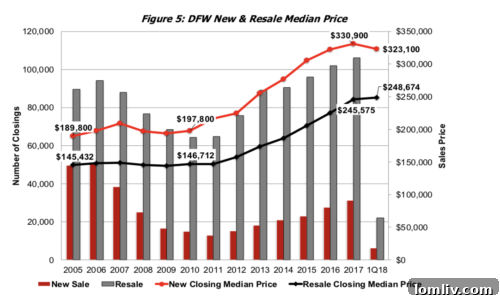
In the first quarter of 2018, the median new home price in DFW was recorded at $323,100. Interestingly, this represented a 2.4 percent decrease compared to the previous year, which had only seen a modest 2.6 percent increase itself. This downward trend in the median new home price, as highlighted by Metrostudy’s report, can be attributed to a strategic shift by builders. They are increasingly reintroducing more affordable product mixes into the market, focusing on smaller, more efficiently designed, and less expensive homes. Furthermore, a slowdown in sales within the higher price points has also contributed to the overall moderation of the median price, demonstrating a responsive market where builders adjust offerings to meet prevailing buyer budgets.
Starts and Closings: A Closer Look at Market Activity
The first quarter of 2018 saw a mixed performance in new home construction activity. New home starts experienced an 11.3 percent decline compared to the preceding quarter, with builders initiating 7,537 homes during this period, contributing to a total of 33,518 starts over the past 12 months. This dip in quarterly starts suggests a cautious approach from developers, potentially in response to inventory adjustments or market re-evaluation.
Conversely, annual closings showed resilience, increasing to 31,923 in the first quarter, slightly up from 31,755 in 2017. This indicates a consistent flow of completed homes transitioning to ownership over the longer term. However, first-quarter closings specifically dropped by 14.3 percent quarter-over-quarter, reflecting the earlier slowdown in starts. Despite this, year-over-year quarterly closings still managed to rise by 2.4 percent, illustrating a steady, albeit modulated, pace of market transactions over a broader period.
The Resale Market: An Alternative for DFW Homebuyers
While the new home market recalibrates, the resale market in DFW presents a different set of dynamics. Metrostudy’s analysis found that the median resale price increased by 1.3 percent in the first quarter of the year compared to 2017. This modest but consistent growth underscores the ongoing demand for existing homes, often perceived as offering more established neighborhoods, larger lots, or potentially better value compared to brand-new constructions in similar price ranges.
A significant observation from the report is the narrowing gap between the median resale price and the median new home price. This difference now stands at just shy of 30 percent, which Shipp notes is the lowest it has been since 2005. This shrinking disparity makes the resale market an increasingly attractive option for buyers, offering more competitive pricing relative to new builds than in previous years. It creates an interesting dynamic where buyers must weigh the benefits of a new, customizable home against the potentially lower price point and immediate availability of an existing property.
Existing Home Sales Volume
In the first three months of 2018, the DFW area witnessed a robust level of existing home sales, with 22,037 properties changing hands. The median price for these sales was $249,500, marking a healthy six percent increase over the fourth quarter of 2017. This strong performance in the resale segment highlights its continued vitality and desirability among a broad spectrum of buyers, further contributing to the overall strength and complexity of the DFW housing market.
Lot Inventory: A Snapshot of Future Development
The availability of developed lots is a critical indicator of future housing supply and builder confidence. In Dallas-Fort Worth, there are currently 38,944 lots under construction, representing an increase of over 1,150. This surge in lot development suggests that builders and developers are actively preparing for sustained demand, particularly within the more affordable price segments. Understanding where these lots are concentrated provides insights into future growth corridors and potential shifts in housing density.
Regional variations in lot supply are significant. North Fort Worth leads the pack with 4,386 lots under construction, translating to an almost 19-month supply. This substantial inventory suggests robust future development in this submarket, likely catering to a diverse range of buyers. Southwest Fort Worth also shows considerable activity, with 2,196 lots, but this area boasts a much larger near 32-month supply. Such a high supply indicates a longer pipeline for development or potentially a slower absorption rate compared to North Fort Worth.
Overall, the vacant developed lot inventory across DFW rose by 1.1 months, bringing the area’s total supply to 19.2 months. While this increase might signal ample future supply, it also requires careful management from developers to avoid oversupply, particularly in specific submarkets or price points.
Starts Outpacing Closings in Key Price Points
A notable trend highlighted by Shipp is that in Q1 2018, annual starts outpaced closings by almost 11 percent within the crucial $200,000 to $300,000 price bracket. This difference is considerably higher than the market average, where starts typically outpace closings by 5 percent. This aggressive building in the “new affordable” segment underscores builders’ commitment to meeting the strong demand in this evolving price range.
Strategic Imperatives for DFW Builders and Developers
The evolving DFW housing market necessitates strategic adjustments from builders and developers. As the region transitions into a sub-$300,000 focused market, builders are expected to continue their efforts to construct and inventory spec homes. This strategy is particularly vital in lower price points, where profitability often relies more on volume and the speed of construction rather than higher individual margins. By building homes on speculation, developers can shorten delivery times and capture buyers who need immediate housing solutions.
However, prudence is advised for communities priced above $400,000. Builders operating in this higher-end segment must remain vigilant about managing their inventory levels, especially as the market enters historically slower selling seasons. Over-exposure to inventory in luxury or premium price points can lead to increased carrying costs and potential price reductions if demand wanes. A balanced approach, closely monitoring market absorption rates and buyer trends, will be key to sustainable success across all price segments.
The Outlook for DFW Housing: Stability and Economic Resilience
The increased efforts of developers and builders to provide more new inventory in the $300,000 and below market segment are poised to yield positive outcomes for the Dallas-Fort Worth housing landscape. According to Metrostudy’s report, this strategic focus will translate into greater stability for the area’s housing market. By meeting the demand for more attainable price points, the market naturally achieves a better equilibrium between supply and demand, mitigating the risks associated with housing shortages or significant price volatility.
This stability is crucial not only for individual homebuyers but also for the broader economic health of the DFW metroplex. Providing a diverse range of housing options, especially within the “new affordable” brackets, creates “a buffer from future economic distress.” A stable housing market supports continued population growth, attracts businesses, and fosters a healthy economic environment where residents can afford to live and work. The proactive measures taken by the DFW real estate sector in adapting to affordability challenges underscore its resilience and forward-thinking approach, ensuring that North Texas remains a vibrant and attractive place to call home for years to come.