Navigating the Gridlock: A Comprehensive Look at Preston Center’s Traffic and Parking Woes
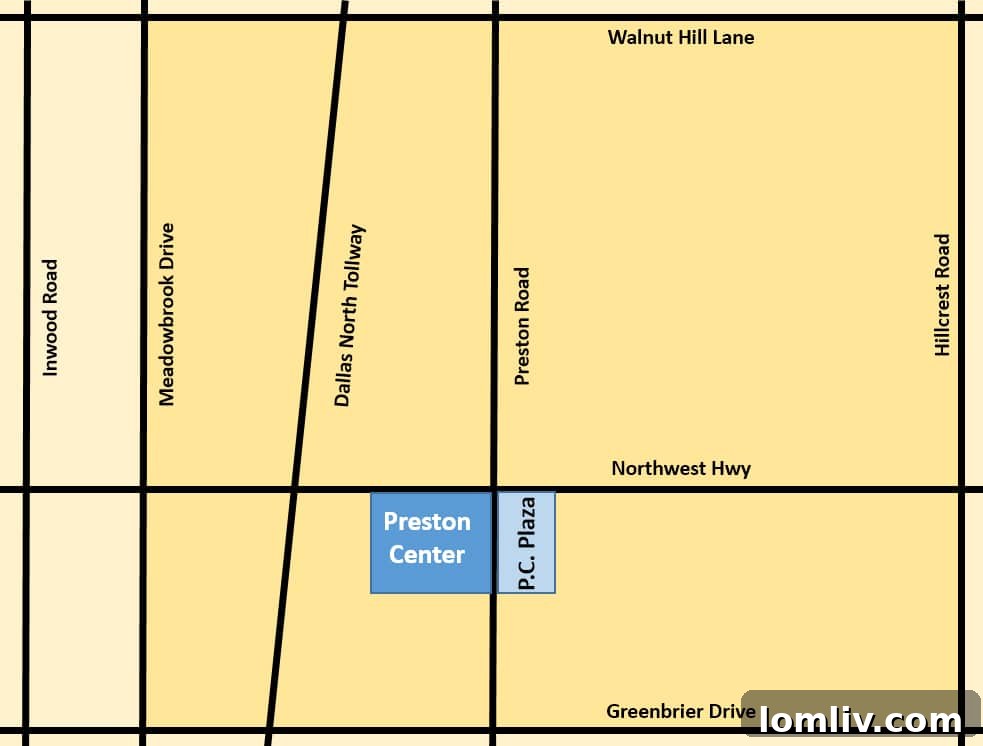
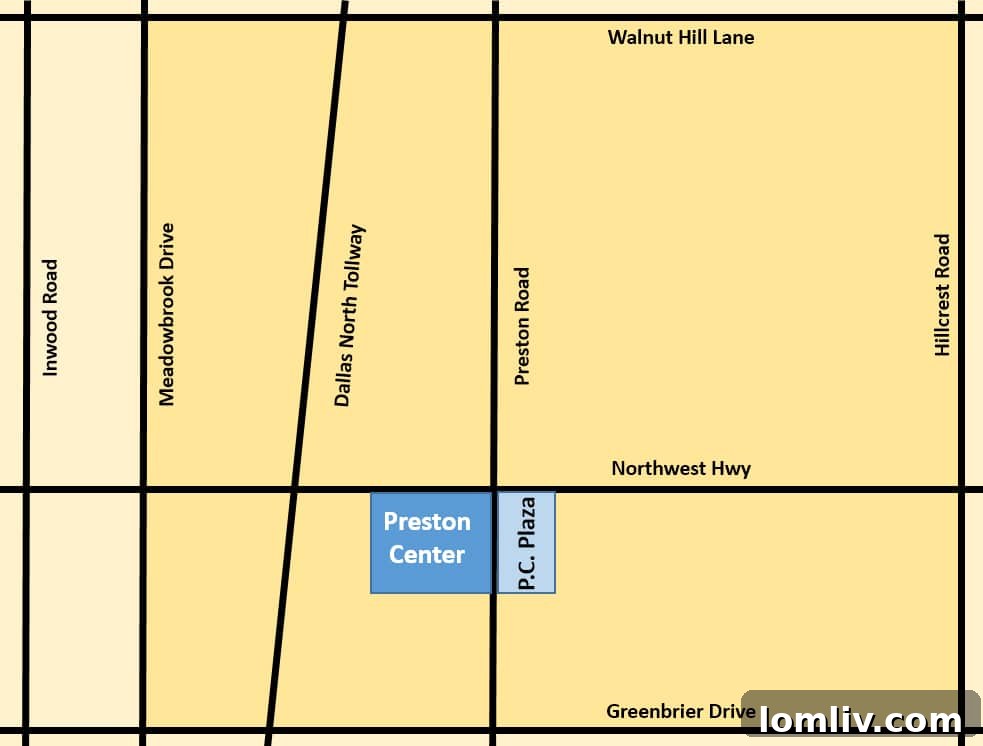
For residents, commuters, and businesses alike, the intersection of Preston Road and Northwest Highway in Dallas is a daily battleground against traffic congestion and inadequate parking. Recognizing the urgency of this persistent issue, Councilwoman Jennifer Gates initiated a task force, aiming to tackle the complex challenges plaguing the vital Preston Center area. While the project’s scope extends across a significant 1,630-acre expanse, as clearly illustrated on the accompanying map, all eyes remain fixed on this central intersection where the pulse of the problem beats strongest. Just recently, a consultant was officially selected to develop and propose solutions, commanding a substantial fee of $350,000 for their expertise.
The journey to finding a solution, however, has not been without its own hurdles. During the task force’s meeting on April 27th, it was disclosed that approximately $100,000 was still needed to fully fund the consultant’s engagement. This shortfall prompted an outreach to concerned area citizens and businesses, inviting them to contribute to the cause. The bulk of the funding, a significant $250,000, is being fronted by the North Central Texas Council of Governments (NCTCOG), highlighting the regional importance attributed to resolving Preston Center’s infrastructure challenges.
The North Central Texas Council of Governments (NCTCOG) is a voluntary association comprising local government representatives from the 16 counties surrounding the bustling Dallas and Fort Worth metropolitan areas, boasting a membership of 235 entities. Established in 1966 by the State of Texas as a political subdivision, NCTCOG’s overarching mission is to serve as a shared resource, facilitating effective municipal planning across the region. A closer look at their current job vacancies reveals that traffic management constitutes a major pillar of their operational focus. Despite their considerable expertise and valuable recommendations, NCTCOG’s influence is advisory; their reports carry no binding authority. This fundamental limitation means that, regardless of how insightful or accurate their proposals may be, individual local governments ultimately retain the autonomy to implement (or disregard) these recommendations as they see fit. The organization’s funding is drawn from a combination of member dues and contributions from local, state, and federal government agencies.
The path from problem identification to actual implementation is notoriously long. The initial phase, dedicated to gathering and meticulously presenting data to the task force, is projected to span 12 to 18 months. Following this, one can easily anticipate another 6 to 12 months spent in intensive digestion and robust deliberation over various proposed scenarios, culminating in the crafting of a definitive final document for presentation to the City Council. In essence, this process alone will consume approximately two years. Only then will the real work begin: the arduous task of securing political will, resources, and public support to transform these recommendations into tangible improvements. A realistic best estimate for the first groundbreaking ceremony? At least four years from now, and even that comes with a significant caveat: if at all.
The Elusive Promise of Change: Why “If at All” Lingers
The phrase “if at all” echoes with a deep-seated skepticism, reflecting the long and often frustrating history of attempts to address Preston Center’s chronic issues. Several critical factors contribute to this pervasive doubt:
- Funding Apathy: If the Dallas and University Park City Councils are hesitant to provide sufficient funding even for the initial study, it’s a stark indicator that they are unlikely to be eagerly awaiting, wallets open, to unleash the millions of dollars required to genuinely improve the area’s infrastructure. The initial funding struggle sets a concerning precedent for future, more substantial investments.
- A Relentless Echo of History: As astutely highlighted by Morning News blogger Robert Wilonsky, the current uproar is an unsettlingly familiar replay of events from 1976. That earlier effort sought, unsuccessfully, to rezone properties to a maximum of three stories in a bid to curb escalating development and traffic. The fact that the same arguments and challenges are resurfacing decades later underscores the cyclical nature of this problem and the difficulty in achieving lasting change.
- Unheeded Past Studies: The 1976 attempt was not an isolated incident. Two subsequent studies, conducted in 1986 and 1989, also yielded little to no substantive action or funding from the city. This pattern of analysis without implementation reinforces the concern that the current task force’s efforts may similarly languish in bureaucratic inertia.
- Prioritizing Tax Cuts Over Infrastructure: Faced with overflowing property tax coffers, former Mayor Mike Rawlins notoriously opted to cut taxes rather than allocate funds to fix crumbling infrastructure. This decision is particularly poignant given that the Texas Transportation Commission admits to an annual infrastructure funding deficit of $2 billion in the NCTCOG area. While tax relief is often popular, the neglect of critical infrastructure, especially roads, exacts a heavy toll on quality of life and economic efficiency. The current political climate often favors short-term fiscal gains over long-term infrastructural health.
Considering these formidable obstacles, it seems more probable that the City Council will commend the task force for their diligent work before politely ushering them out with symbolic gestures, rather than committing to meaningful action. For the vocal anti-development factions, this protracted process is often viewed as a strategic maneuver: to stall and ultimately starve developers of the opportunities they seek. It’s a classic case of the “death of 1,000 City Council postponements,” where inaction itself becomes a powerful form of policy.
Initiated in 2014, this endeavor has now extended over four years, characterized by a narrative that frames the project as inherently complex and time-consuming. However, I contend that this is not necessarily the case. In fact, I dedicated a mere few hours over a weekend to meticulously craft a “poor-man’s” Preston Center Traffic and Parking Plan. A copy of this plan has been personally mailed to each member of the city council, ensuring that, in the years to come, I will indeed have my moment to declare, with ample justification, “I told you so.”
Admittedly, my plan is notably more concise and lacks the elaborate, aesthetically pleasing sketches depicting idyllic, car-free streets populated by happy, dog-walking models beneath tree-lined canopies. My proficiency with Adobe Illustrator, Photoshop, or AutoCAD is, frankly, limited. However, one should not be swayed by such superficial presentations; these kinds of glossy images often serve as little more than a marketing “show,” designed to impress rather than to inform or solve core problems.
Despite the lack of visual polish, the fundamental recommendations for resolving traffic and parking issues will undoubtedly align. Why am I so confident in this assertion? Because the geographical area surrounding Northwest Highway and Preston Road is finite, and consequently, the array of viable solutions is also finite. It’s a matter of applying basic mathematical principles combined with a solid understanding of established traffic management theory. After all, we are dealing with physical roadways and predictable traffic flows, not a TARDIS that defies the laws of space and time.
Jon Anderson’s Traffic Plan for Preston Center
Untangling the Roots: How History Fuels Preston Center’s Traffic Problems
To truly grasp the intricacies of Preston Center’s traffic challenges, one must delve into its historical development. A significant portion of the current gridlock can be traced back to 1968, when the Dallas North Tollway emerged from the former St. Louis Railway Corridor. What was once a simple railroad crossing at Northwest Highway was abruptly transformed into a major automotive intersection, fundamentally altering the area’s traffic dynamics. While the Tollway undeniably excels at efficiently moving vehicles into and out of the broader region, its close proximity to Preston Center itself creates a detrimental impact on local traffic flow. The physical closeness of numerous traffic signals encircling the Tollway, particularly at Douglas Avenue, effectively creates a persistent bottleneck on Northwest Highway. This issue has been steadily exacerbated over the years as the Preston Center area experienced significant growth, and the surrounding communities, both north and south along the Tollway corridor, became increasingly populated, funnelling more traffic into an already constrained system.
Another lingering remnant of the railway-to-Tollway transformation is the glaring absence of a single Tollway crossing within the entire mile-long stretch between Northwest Highway and Lovers Lane. This design flaw critically funnels all east-west traffic through either Northwest Highway or Lovers Lane, creating immense pressure on these two arterial roads. In contrast, other major crossings across the city, such as Park, Beverly, and University avenues, typically feature intermediate crossings that help distribute traffic. For reasons lost to history, this crucial mid-point crossing was omitted for the Northwest Highway and Lovers Lane pair, intensifying congestion.
The problem of east-west traffic is further compounded by several cross-streets that frustratingly do not extend seamlessly across major thoroughfares. For instance, Park Lane successfully crosses the Tollway but abruptly jogs south at Preston Road. This ‘jog’ is further complicated by the presence of traffic signals at both of the resulting, staggered Preston Road intersections, creating additional points of friction and slowdowns for drivers attempting to navigate the area.
The Illusion of Expansion: Why More Lanes Don’t Solve Traffic
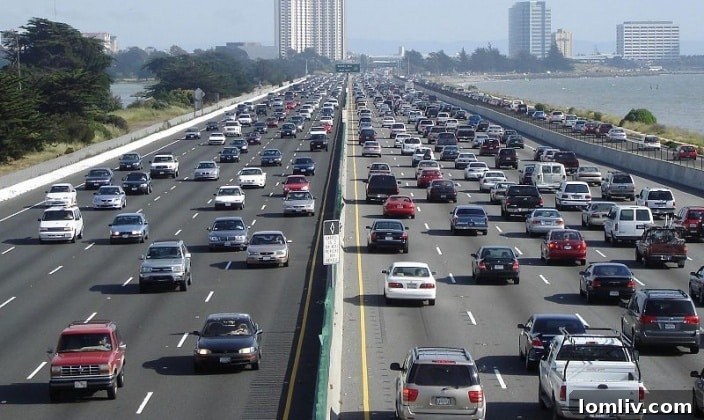
Some might instinctively believe that if only all major roads in the Preston Center area were expanded to, say, a sprawling 10 lanes, traffic would miraculously flow freely, even during the height of rush hour. This common perception, however, is fundamentally flawed. The reality of traffic management is much more akin to a one-gallon water bottle being filled by a hose. If the bottle is overfilled, the water inevitably spills out. If it’s half-empty, it quickly refills to capacity and, once again, overflows. The Preston Center area, particularly during peak hours, is precisely this overflowing gallon bottle, with excess traffic spilling onto side streets as drivers seek alternative routes.
If the roadways in the area were to be radically expanded, they would simply refill. This phenomenon is known as “induced demand.” Drivers, perceiving the newly expanded roads as less congested, would reroute their journeys, or new drivers (from population growth or previously avoided trips) would enter the system, quickly bringing the expanded capacity back to its previous state of congestion, or even worse. The ultimate, paradoxical result of drastically expanding roadways is often a drastic expansion of traffic itself.
Dallas, as one of the ten most populated cities in the United States, is experiencing rapid growth, mirroring trends seen in large urban centers worldwide. In any major city, some level of traffic congestion during peak hours is an unavoidable reality. Therefore, the strategy of endlessly expanding roadways is a losing proposition, a Sisyphean task that never truly solves the problem. We must accept that congestion is an inherent part of urban life in a thriving metropolitan area. Preston Center will always experience congestion because, ever since the area reached a critical mass of development and population, it always has. This enduring congestion is not a new phenomenon; it is vividly evidenced by numerous proposals and studies dating back to at least 1976—a mere decade after much of the area was initially developed. This is an immutable fact, a “bell you can’t un-ring.” Accepting this reality is the first step towards moving on and focusing on what truly can be done to manage it effectively.
Exploring Alternatives: The Case for Congestion Charges and Smart Urban Planning
While wholesale road expansion proves ineffective, history has shown that one of the most proven methods to actually decrease urban congestion is to charge drivers for the privilege of using certain roadways or entering specific zones. Dallas’s own Tollways, for instance, often experience less crowding, or congestion for shorter durations, precisely because of the fees associated with their use. Globally, cities like Singapore and London have successfully implemented robust congestion charging schemes, significantly easing traffic flow in their urban cores. London, for example, charges a daily fee of £11.50 (approximately US$18) for vehicles entering its central congestion zone. Since its inception in 2003, this scheme has generated over £1.2 billion (US$1.9 billion), which has been strategically reinvested into improving public transportation, roadways, and bridges. Given Dallas’s comparatively sparse public transportation system and a culture historically resistant to direct user fees for road access, can anyone realistically envision a similar congestion charge being implemented in their lifetime? The political and logistical hurdles remain immense.
Further pushing the boundaries of urban planning, Paris (the actual city, not a fictionalized version) has taken an even bolder step. The city is actively narrowing roadways and repurposing car lanes for pedestrians and cyclists, deliberately discouraging inner-city driving. This aggressive strategy has successfully eased traffic, effectively encouraging a significant shift towards public transit and active modes of transportation. These international examples underscore a crucial point: there is no single, miraculous “panacea” for urban congestion. To the “moaners and dreamers” hoping for a magical fix, the reality is that only a series of carefully considered, minor adjustments and strategic interventions can yield the best possible results. And here are some of those critical interventions.
Preston Center as a Destination: A New Philosophy for Traffic Management
A fundamental shift in how Preston Center is perceived is crucial for effective traffic management. Surgical changes to traffic flows must categorically account for the Preston Center area being treated primarily as a “destination” or an end point for travel, rather than merely an area to traverse. Designing traffic plans that prioritize and facilitate movement through Preston Center would, counterintuitively, only encourage more traffic to use it as a shortcut, thereby exacerbating the existing congestion problems. Instead, by conceptualizing Preston Center as an ultimate destination—whether for living, working, or leisure—traffic management efforts can squarely focus on optimizing the flow of vehicles into and out of the area, rather than across it. In practical terms, this means that solutions aimed at easing Preston Center’s congestion must explicitly avoid making it easier for drivers to cut through the area to reach other points like NorthPark Center or Central Expressway, as such improvements would simply invite more transient traffic and worsen local gridlock. Once this philosophical framework is adopted – that of optimizing ingress and egress rather than through-traffic – the available levers for intervention become fewer but more focused.
Strategic Traffic Signal Reconfiguration and Roadway Enhancements
Targeting Key Traffic Signals for Improved Flow
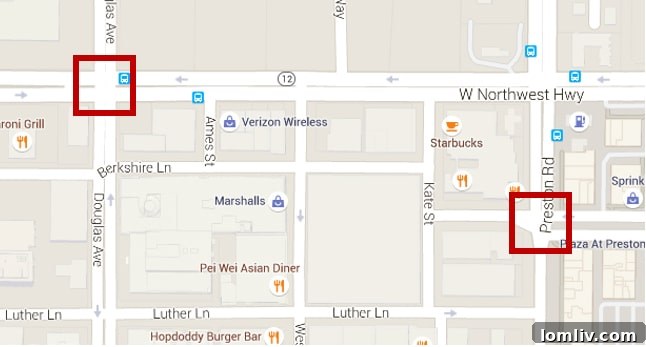
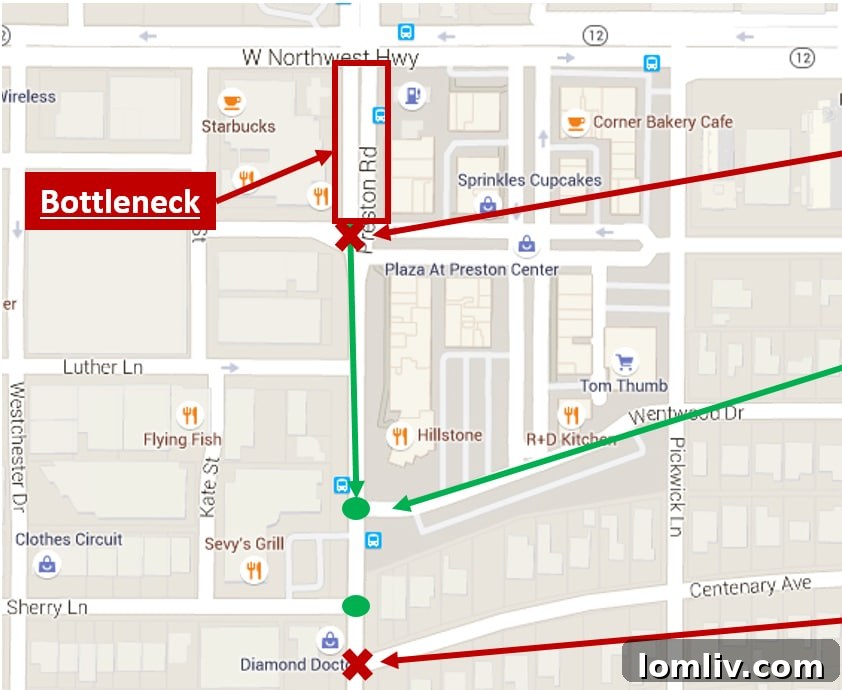
Two of the most significant impediments to smooth traffic flow in the Preston Center area are the poorly placed traffic signals at Douglas Avenue and Northwest Highway, and at Preston Road and Berkshire/Villanova. Both are situated far too close to major intersections, creating inefficient “damming” of traffic that results in significant backups and delays. For the Douglas intersection, the only pragmatic solution is the installation of a state-of-the-art “smart” traffic signal. Such a system would be capable of dynamically adapting to real-time congestion levels, making the best of an inherently difficult situation. The primary challenge, however, is Dallas’s antiquated traffic control system, which currently lacks the infrastructure to support such intelligent signals. Furthermore, the feasibility of installing advanced technology at a single, isolated intersection requires specialized knowledge. (Give me $350,000, and I’ll make the necessary inquiries to determine if this is possible!)
The traffic signal at Preston and Berkshire – one of four signals crammed into the approximately 1,000 feet between Northwest Highway and Centenary – is a major bottleneck and must be removed entirely. Its mere 295-foot proximity to Northwest Highway creates severe congestion during rush hours. To rectify this, the main entrance/exit points for Preston Center East and West need to be relocated further south: to the existing signal at Sherry Lane for Preston Center West, and to a new signal at Wentwood Drive for Preston Center East. This strategic relocation would provide over 1,000 feet of crucial “runway” for vehicles to clear the Northwest Highway intersection much more efficiently. To maximize flow, smart signals should also be installed at both Sherry and Wentwood. On a positive note, University Park, which controls these signals, is already familiar with the concept and benefits of smart traffic signals. In a recent conversation with University Park officials, I learned that the relocation of the Berkshire signal to Wentwood has indeed been suggested, though it has met with unspecified opposition.
Upon its removal, the Preston and Berkshire intersection would be transformed into a right-turn only, “stop” sign controlled intersection, simplifying movements and reducing conflict points. Concurrently, Sherry Lane should be expanded to four lanes, as it will become the primary entrance/exit for Preston Center West onto Preston Road, and there is ample physical space available for this expansion.
Strategic Roadway Widening for Targeted Relief
Beyond the proposed expansion of Sherry Lane, Preston Road itself requires strategic widening. It should be expanded to six lanes from Sherry Lane all the way north to Northwest Highway. Currently, Preston Road inconveniently zippers from six lanes down to four precisely at Northwest Highway. By extending the six-lane capacity further south, a greater volume of cars in both directions will be able to clear the critical Northwest Highway intersection during each signal cycle, dramatically improving throughput.
Similarly, widening Northwest Highway from Pickwick Lane to the Dallas North Tollway would offer a short but impactful improvement in roadway capacity. Crucially, this expansion would enable the creation of longer and larger dedicated turn lanes to and from the Tollway, Preston Road, and Preston Center. This is vital for reducing lane blockages caused by turning traffic backing up into through lanes, which currently snarls movement for straight-ahead drivers.
Finally, improving the capacity of Lomo Alto Drive, specifically from Lovers Lane to Northwest Highway, holds significant potential for diverting traffic. By making this route more efficient, more Tollway drivers approaching from the south would be encouraged to exit at Lovers Lane instead of continuing to the already congested Northwest Highway exit, thus distributing the traffic burden more evenly.
Innovative Solutions for Tollway Access and Local Connectivity
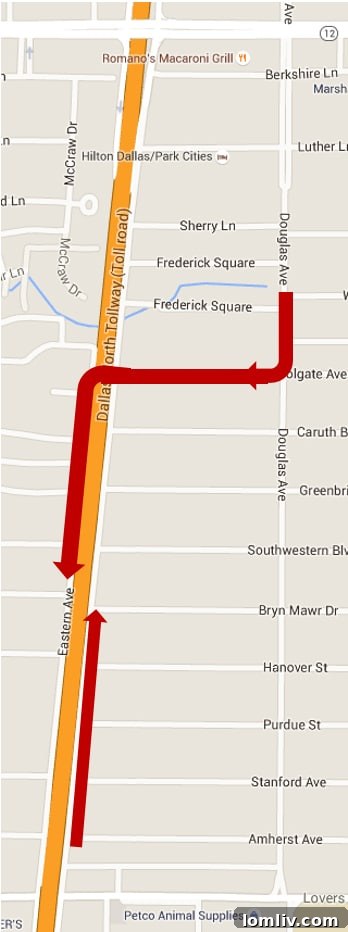
To maximize the efficiency of southbound Dallas North Tollway access at Lovers Lane, a direct and streamlined route to Eastern Avenue must be engineered. This innovative approach involves extending Douglas Avenue’s existing four-lane width to Colgate Avenue and, critically, constructing a new Tollway overpass at Colgate to seamlessly connect with Eastern Avenue. This strategic alignment would provide southbound traffic with a straight, uninterrupted run to the Tollway on-ramp at Lovers Lane. This mirrors the effectiveness of the northbound Lovers Lane exit, which efficiently shuttles traffic straight up Lomo Alto to enable entry into Preston Center from the south, completely bypassing the congested Northwest Highway intersection.
While this proposal would undoubtedly increase traffic on Colgate Avenue, it’s important to note that Colgate is a single block with residential properties on only one side, with St. Michael’s School occupying the other. I believe this represents a necessary and acceptable trade-off, as it significantly limits the overall neighborhood impact while providing substantial regional benefits. In an ideal world, I might also suggest making the small northern portion of Eastern Avenue a two-way street, enabling traffic to cut across Stonegate Road to Inwood Road. However, acknowledging the practicalities of urban planning, this particular suggestion faces a significant hurdle: while that half-mile stretch could easily be widened, its residents would, quite understandably, be vehemently opposed, making it a politically challenging proposal.
Rethinking One-Way Streets: Towards Enhanced Local Mobility
A critical change for Preston Center West involves widening all its existing one-way streets—specifically Westchase Drive, Luther Lane, Berkshire Lane, and Kate Street—to accommodate two-way traffic. To achieve the necessary width, street parking would be eliminated where required. The conversion to two-way roads would significantly reduce the wasted time and fuel currently spent by drivers circling block after block, attempting to navigate circuitous one-way entrance and exit routes to and from the parking garage. This change would not only streamline local circulation but also encourage more efficient use of the parking facilities.
Straightening Kate Street: A Minor Yet Impactful Adjustment
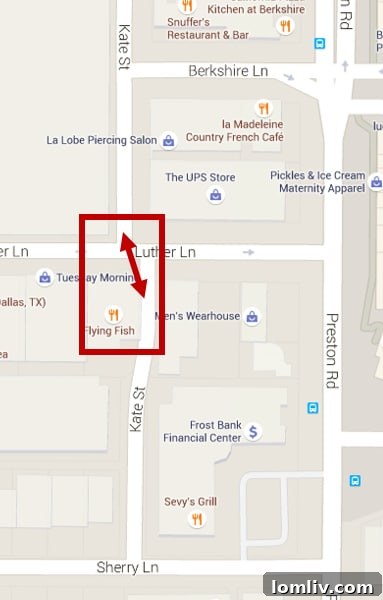
Beyond being a one-way thoroughfare, Kate Street currently suffers from an inconvenient “hiccup” or jog at Luther Lane. This anomaly significantly impedes its ability to efficiently shuttle traffic towards Sherry Lane. A relatively minor but impactful intervention would involve acquiring the commercial lot situated on the southwest corner of Luther and Kate, notably the site of Flying Fish restaurant. This acquisition would enable Kate Street to be straightened, thereby greatly improving the flow of traffic to and from Sherry Lane, enhancing overall local circulation within Preston Center West.
Revolutionizing Parking in Preston Center West
Unlike the pervasive problem of roadway congestion, the fundamental availability of parking in Preston Center West is not, at its core, a severe issue. However, the existing street parking is often perceived as inconvenient, leading drivers to endlessly circle blocks in an understandable attempt to avoid the dilapidated and largely underutilized existing parking garage (except, notably, during peak weekday lunch hours). The proposed conversion of one-way streets to two-way, coupled with the strategic elimination of some street parking, will naturally compel more parkers to utilize the garage, thus improving its efficiency.
The current parking garage is severely hampered by its convoluted ownership and control structure, which stifles any meaningful development or improvement. However, the City of Dallas possesses the legal authority to demolish the existing structure and rebuild a double-capacity, subterranean parking facility—critically, without requiring the explicit blessing of surrounding landowners. Indeed, any parking-related structure could be built under this prerogative. My recommendation is to double the garage’s capacity to four underground stories. This expansion would primarily account for anticipated future use, as the current structure is, even now, largely underutilized.
A common lament among opponents of potential skybridge projects is that Preston Center workers would be left without adequate parking. However, outside of weekday lunch hours, the second level of the existing garage is consistently largely vacant. This observation suggests that workers already have ample parking options, provided their shifts do not strictly commence between 11:30 am and 2:00 pm during the work week, when lunch traffic peaks.
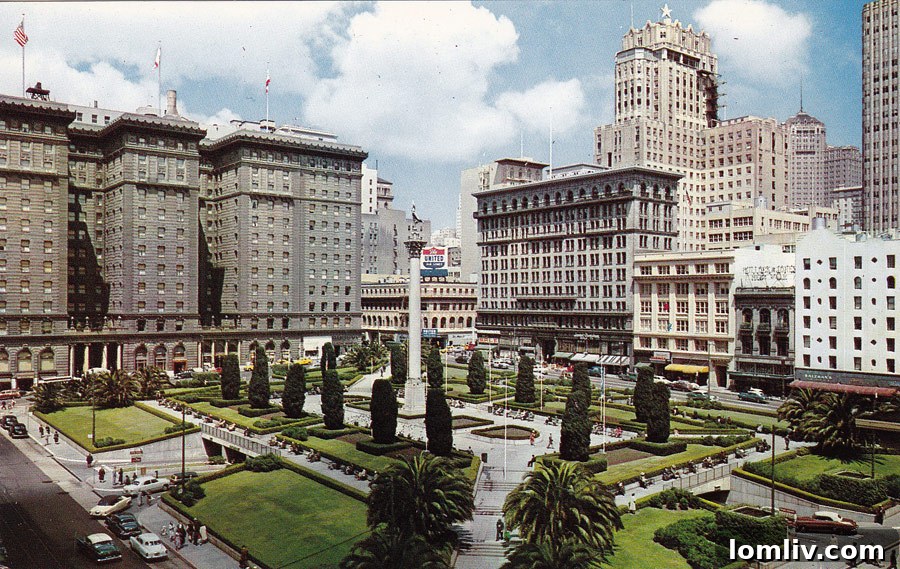
Furthermore, I advocate for an underground design primarily because, as one perceptive daltxrealestate.com reader noted, the resulting creation of a vibrant town square green space above the garage would be an enormous boon for both local businesses and area residents. Imagine San Francisco’s iconic Union Square – a verdant urban oasis enveloped by bustling retail, all gracefully positioned above a subterranean parking garage. This new structure would also inherently incorporate handicap accessibility, a feature conspicuously lacking in the current dilapidated garage. To enhance security and manage usage, a nominal $1 fee could be charged to non-workers unless their parking is validated by a local business, which would then assume the $1 cost. For quick errands or convenient to-go pickups, street parking spaces should be equipped with parking meters enforcing strict 30-minute limits on weekdays until 6:00 pm, mirroring successful models seen in downtown areas.
The Nuance of Development: Impact on Congestion
Any future development slated for the Preston Center area must involve close collaboration with developers, urging them to contribute financially towards these proposed infrastructure changes, given that the City of Dallas is unlikely to fully fund them. Traffic mechanics experts will confirm that merely increasing urban density, in itself, does not necessarily increase the sheer volume of congestion. Rather, it is more likely to extend the duration of peak congestion periods. In other words, you cannot physically cram more cars into a defined road space, but rush hours may begin earlier and last longer.
The specific type of development will also exert a minor but discernible impact on the timing and patterns of rush hour traffic. Residential and commercial developments, by their very nature, generate slightly different traffic flows. For instance, if a typical workday runs from 8:30 am to 5:00 pm, a commuting worker will generally leave home between 7:30-8:00 am and return between 5:30-6:00 pm.
Residential development, in this context, will typically generate its largest wave of area exits in the morning, often before the majority of area workers arrive for their shifts. In the evening, residents will arrive home after most commercial workers have already departed the area. Crucially, residential development tends to have no significant impact on local weekday lunch hour traffic, which is predominantly driven by commercial activity. Therefore, achieving a balanced mix of residential and commercial use within the area is generally the most optimal approach. There’s a slight advantage to businesses that inherently minimize traditional commuting—such as senior care facilities, retirement living communities, units targeting part-time residents, and integrated live/work spaces. When residential and commercial components are harmoniously synchronized, the residential sector can provide desirable and affordable housing options specifically tailored for the workforce employed in the newly developed commercial projects, fostering a more self-contained and efficient local economy.
The REAL Obstacles to Progress: Why Solutions Languish
You’ve seen the detailed solutions, meticulously outlined and grounded in sound urban planning principles. However, a stark reality dictates why many of these common-sense improvements may never come to fruition:
- Absence of City Budget: There is simply no dedicated or sufficient city budget earmarked for the implementation of any significant changes or improvements to the Preston Center area. Without financial commitment, even the most brilliant plans remain theoretical.
- Lack of Political Will: A critical deficit of political will exists within the City Council to robustly champion and implement necessary changes. The history of shelved studies and deferred decisions speaks volumes.
- Demonized Developers: While developers represent the most likely source of significant private funding, they have been unfairly demonized by anti-development factions. This hostile environment discourages potential investment and collaboration.
- Unrealistic Resident Expectations: Many area residents appear to harbor an unrealistic belief that there exists a “magic potion” capable of turning back time to 1962, miraculously clearing Preston Center’s congested roadways without any disruption or meaningful change. This resistance to modern solutions hampers progress.
- University Park’s Ambivalence: Although University Park is geographically on the periphery of the core problem area, its cooperation is absolutely essential for the successful implementation of key portions of this plan. Their current stance, however, appears to be one of ambivalence, hindering comprehensive regional solutions.
When we convene a few years from now, be prepared for a resounding “I told you so.” The patterns of inaction and the systemic challenges remain deeply entrenched.
Remember: Do you have a compelling HOA story to share? Perhaps a fascinating piece of high-rise history? Realtors, are you looking to feature a listing that’s ripe for renovation or one that has achieved spectacular success? How about hosting a Candy’s Dirt Staff Meeting? Don’t hesitate to shoot Jon an email. Marriage proposals are also gladly accepted (especially now that THEY ARE legal in Texas)! Contact Jon at [email protected].