In the bustling heart of Dallas, the debate surrounding the future of the Pink Wall’s PD-15 zoning district has become a microcosm of broader urban development challenges. This decades-old zoning plan, vital for the orderly growth and character of a significant community, is long overdue for an update. Yet, the path to a modern, equitable solution has been fraught with political maneuvering, community stalemates, and conflicting visions from various stakeholders, including local residents, developers, and city departments.
The central question remains: Can Dallas officials set aside political infighting and bureaucratic inertia to enact the necessary changes that will truly benefit the Pink Wall community and set a positive precedent for urban planning? This article delves into the intricate history, key controversies, and crucial decisions shaping the PD-15 update, highlighting the urgent need for a cohesive and future-forward approach.
The Long Road to Reform: Tracing the PD-15 Saga
The journey to update PD-15, a critical zoning designation for the Pink Wall area, commenced in April 2018. City staff initiated an “Authorized Hearing” process, a mechanism designed to facilitate community input on proposed zoning alterations. This structured approach was adopted following the complete breakdown of an earlier neighborhood committee in 2017, which had found itself deadlocked over proposed changes.
The primary culprit behind this initial stalemate was the entrenched Not In My Backyard (NIMBY) sentiment, particularly from residents of the Athena and Preston Tower condominiums. These influential voices vociferously opposed significant development or changes that might alter their immediate environment, effectively paralyzing the committee’s progress (a deeper look into these early meetings can be found here). Unfortunately, the Authorized Hearing process, despite its formal structure, succumbed to a similar fate, ending in another gridlock. Recognizing the urgent need to move forward, Council Member Jennifer Gates stepped in during November 2018, tasking city staff with drafting their own proposals to update the antiquated PD-15 regulations.
The “N” in NIMBY perfectly encapsulated the towers’ unwavering resistance. While their stance undeniably stalled progress, the fact that city staff finally put forth a concrete plan was a significant step. After two years, two committees had failed to produce anything substantial. Though the author held specific reservations regarding certain spacing and setback adjustments, the existence of a tangible proposal provided a much-needed foundation for discussion. This marked a stark contrast to the aspirational, often unrealistic, demands from the towers, a sentiment that reached its peak during a contentious city council election where incumbent Jennifer Staubach Gates faced off against former Mayor Laura Miller, who had strong backing from activists residing in Preston Tower and The Athena.
The City Plan Commission’s Momentous Role
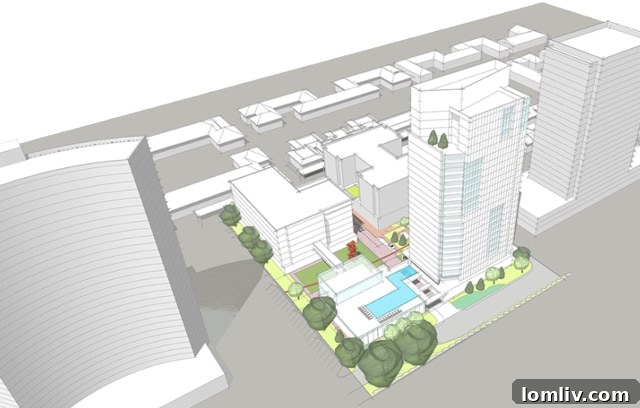
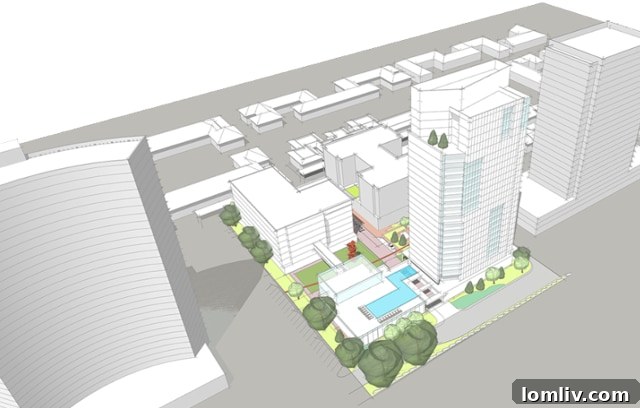
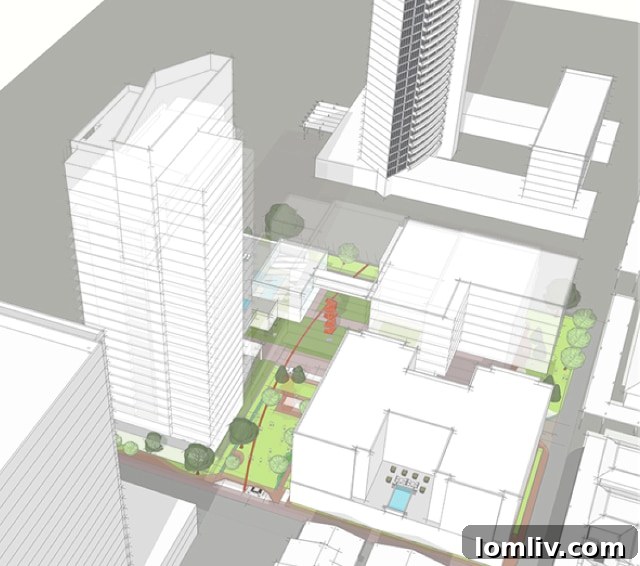
City staff’s recommendations were subsequently presented to the City Plan Commission in a two-part session held in April and June. While both city staff and commissioners had been extensively pre-briefed, the public was caught off guard during the June meeting by a last-minute proposal from Provident Residential. This ambitious plan for the Preston Place and Royal Orleans lots suggested exceeding the existing 240-foot height limit on Northwest Highway, pushing for a 310-foot third tower. In exchange, Provident promised reduced lot coverage and significantly more green space, aiming to transform the neighborhood’s landscape.
Provident’s proposal, while controversial and sparking debate on both sides, successfully garnered support from nearly all commissioners, with only Commissioner Michael Jung dissenting. This support, however, came with stringent conditions, specifically increased mixed-income housing requirements. The final, chaotic half-hour of the hearing was dedicated to outlining the additional obligations a developer would incur to reach the 310-foot height. The City Plan Commission shrewdly recognized that simply allowing a taller structure with proportional add-ons was insufficient; the community needed to gain significantly more in return.
This critical session left the 310-foot development burdened with substantial affordable housing requirements. These mandates were reportedly so demanding that they pushed the project’s financial viability to a razor-thin margin. Speculation quickly spread through the community: would the building ultimately convert to condominiums, or would Provident abandon their hard-won development envelope and withdraw from the project?
In addition to the revised height, commissioners also introduced a novel points-based system. This innovative framework allowed developers to earn density bonuses and setback relief by incorporating features such as fully underground parking, thereby contributing to a superior ground-level experience. While public attendees found this new system somewhat confusing, plan commissioners had been thoroughly briefed on both the points system and the 310-foot height proposal—an option that city staff had initially declined, a decision that may shed light on their subsequent modifications.
Critical Oversights: Unaddressed Tower Spacing and Setbacks
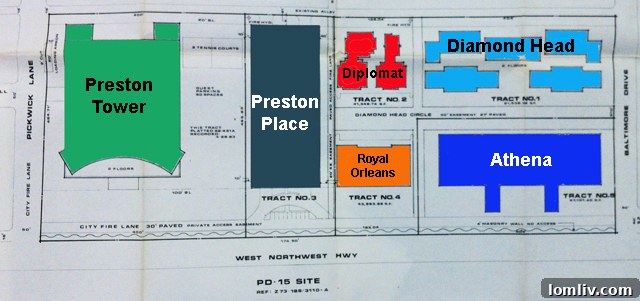
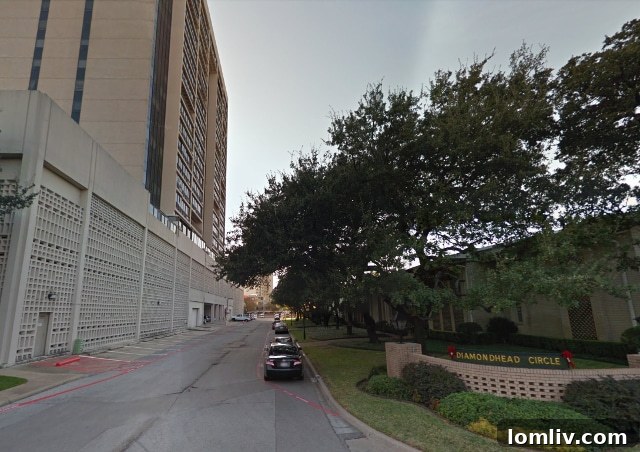
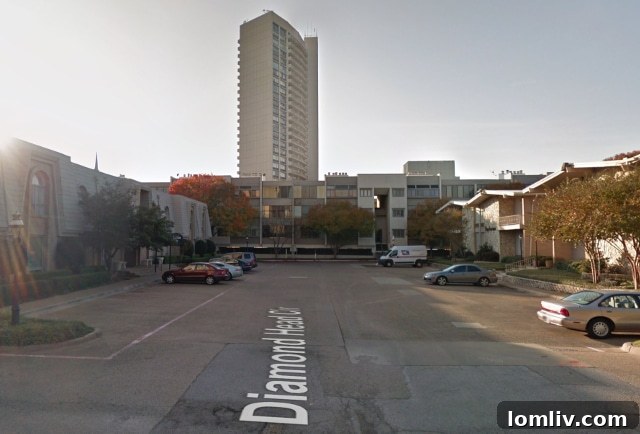
Despite significant progress, a major omission in the proposed plan relates to tower spacing—the mandated additional setbacks between tall buildings. A singular focus on the three primary parcels in play seems to have overshadowed the potential redevelopment of the Diamond Head Condos, which sit directly across Diamond Head Circle from The Athena. The new points system allows developers to circumvent tower spacing requirements on north/south facades. However, Diamond Head and Athena share an east/west property line, raising a critical question: Does this mean they are exempt? Not necessarily, and this oversight is deeply concerning.
Even prior to the implementation of the “points” system, the proposed ordinance outlined specific tower spacing requirements:
Tower spacing. Along Pickwick Lane, Baltimore Drive, and the interior property lines that run north/south an additional setback of one foot for each two feet in height above 45 feet is required for that portion of a structure over 45 feet in height, up to a total setback of 30 feet.
Conspicuously absent from this clause is any mention of the east/west Diamond Head Circle. This implies that the only location where new construction would directly abut the main facade of an existing tower—the Diamond Head and Athena intersection—lacks any explicit tower spacing guidelines. This represents a significant gap in the planning, potentially leading to undesirable proximity and overshadowing.
Furthermore, this isn’t the sole setback concern overlooking The Athena. Within the intricate points system, a developer could potentially “spend” two points to reduce east/west setbacks by an additional 10 feet. This provision would allow a redeveloped Diamond Head to be positioned even closer to The Athena, exacerbating existing concerns about density and privacy. If the intent of the document is solely to address spacing between Diplomat and Royal Orleans, it must be explicitly stated to avoid ambiguity and unintended consequences.
The Shifting Sands of Mixed-Income Housing Priorities
Following the City Plan Commission’s approval, city staff introduced several post-facto changes, two of which profoundly impact the feasibility of redevelopment. The first concerns mixed-income housing. Both city staff’s initial recommendations and the ordinance passed by the City Plan Commission offered developers flexibility in selecting incentives to increase density beyond the baseline of 90 units per acre. However, city staff’s subsequent rewrite, undertaken *after* the City Plan Commission’s approval, dramatically shifted priorities, placing mixed-income housing at the forefront of development incentives.
One might assume that maximizing density bonuses to reach the upper limit of 125 units per acre renders the specific prioritization irrelevant. However, this is far from the truth; it impacts projects significantly. Assuming a consistent maximum of 125 units per acre, staff’s revised prioritization of mixed-income housing for units between 91 and 115 per acre mandates that projects include a substantial 20 percent mixed-income units. This stands in stark contrast to the Plan Commission’s original requirement of only 8 percent mixed-income units, which was applied only to units between 115 and 125 per acre.
This 20 percent figure is staggering, particularly when considering that Dallas council members were reportedly “flabbergasted” by Lincoln Katy Trail’s unprecedented offer of 15 percent mixed-income housing. A 20 percent mandate surpasses that level of surprise by a significant 5 percent. City staff’s aggressive push for such high mixed-income requirements is tied to other incentives like underground parking and reduced building footprints, and potentially even height. Given the prevalent concrete coverage within PD-15, superior buildings and enhanced streetscapes would benefit the entire community, but the economic implications of such demands are considerable.
The Paradox of Excessive Green Space
The second significant challenge introduced by the staff’s revisions is the potential for excessive green space requirements. While advocating for more green areas in an urban setting might seem universally positive, the numbers proposed could jeopardize redevelopment efforts. The existing plans require a bare minimum of 5 percent green space, with both the original and commission-approved proposals incentivizing an additional 5 percent for developers who achieve five extra units per acre.
The Plan Commission wisely added provisions for an additional 7.5 percent green space beyond the 5 percent minimum if the Residential Proximity Slope (RPS) was breached, leading to a potential total of 12.5 percent connected open space. However, city staff subsequently combined these two figures, arriving at a daunting 17.5 percent total open space requirement. To visualize this, consider a one-acre lot. After accounting for essential infrastructure like private roads, sidewalks, and necessary setbacks, reducing the remaining buildable area by another 17.5 percent leaves very little land for actual construction.
This author contends that city staff’s insistence on such high numbers for both open space and mixed-income housing removes a substantial amount of potential profit from development projects, thereby placing the entire redevelopment in serious jeopardy. While the existing towers might cheer these restrictions, believing they hinder new construction, they should reconsider. This approach is counterproductive. A mutual agreement is always the best path to an optimal outcome. Every instance where the towers have aggressively promoted their NIMBYism, they have ultimately incurred greater losses.
Two years ago, the economic landscape was different: no Trump tariffs, more readily available and cheaper labor, and a Dallas less focused on mixed-income housing. Today, these factors significantly impact developer profits. The towers’ persistent objections have only escalated the stakes. If the current proposals fail to materialize, future development agreements will inevitably require even greater concessions, pushing the limits of viability further.
Beyond the Core: Other Concerning Staff Revisions
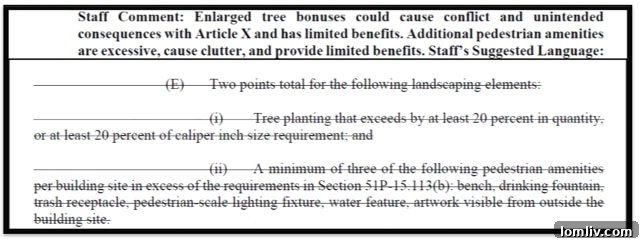
Several other problematic insertions by city staff warrant concern. For instance, they advocate for less landscaping, arguing that the City Plan Commission’s approved plan would “cause clutter, and provide limited benefits.” This assertion is baffling, suggesting that the predominantly concrete environment of PD-15 is somehow at risk of being “cluttered” by trees and green elements. In an urban area craving greenery, this stance seems deeply misaligned with contemporary urban planning principles.
Furthermore, city staff appears to favor what can only be described as typical, uninspired Dallas architecture. The City Plan Commission had sought to mandate more engaging designs, including ground-floor units with fences and stoops, the use of multiple façade materials, and building articulation to create more visually interesting structures, moving away from monotonous, flat stucco walls. City staff, however, summarily removed these requirements, claiming they were adequately covered elsewhere. Yet, the level of detail and specificity present in the Plan Commission’s original proposals is notably absent from the staff’s revised document, potentially leading to a less vibrant and pedestrian-friendly streetscape.

The Bureaucratic Overreach: Usurping the Plan Commission’s Authority
The most alarming aspect of the latest revisions is the apparent attempt by city staff to fundamentally alter the intent of the City Plan Commission’s approved plan. In many professional capacities, understanding complex information and repackaging it for broader comprehension is a common task. However, the staff’s latest version of the PD-15 update goes far beyond mere simplification; it actively changes the core intent and spirit of what the commission endorsed.
This situation has devolved into a political “we said, they said” dynamic, where the underlying goal seems to be to diminish the authority of both the City Plan Commission and the Dallas City Council, effectively granting the Planning and Zoning department the final say. This represents a dangerous precedent: unelected bureaucrats attempting to supersede the will of elected and appointed officials on a high-profile case. This move is particularly ill-timed, as the Dallas City Council is set to welcome seven new members who may not yet have established their trust in various city departments.
Such actions are precedent-setting and will undoubtedly have long-lasting implications for governance in Dallas. As council members deliberate on the final outcome for PD-15, they must recall the established process: city staff recommends, and plan commissioners approve. There are generally no “do-overs” or retroactive changes once a commission has made its decision.
A pertinent historical example is the Lincoln Katy Trail case, where a developer unsuccessfully lobbied a City Plan Commissioner to reopen their case after an initial failure. The City Plan Commission’s decisive response was, “what’s done is done,” emphasizing that reopening a case once would set a precedent for every future decision they made.
The Dallas City Council must heed this vital lesson. They should acknowledge city staff’s concerns but ultimately move forward with the PD-15 version officially approved by the City Plan Commission. For the seven new faces joining the council, who must now work with commissioners appointed by their predecessors, it is crucial to remember: “Just because you didn’t pick them, doesn’t mean they didn’t do their job.” To believe otherwise undermines the very institution of the Dallas City Plan Commission, including the integrity of the new members they will soon appoint.

About the Author: My professional focus spans high-rises, homeowners’ associations (HOAs), and renovation projects. I hold a deep appreciation for both modern and historical architecture, always balancing these aesthetic considerations against the dynamic principles of the YIMBY (Yes In My Backyard) movement, which advocates for greater urban density and accessible housing. My writing has been recognized by the National Association of Real Estate Editors, earning me three Bronze awards in 2016, 2017, and 2018, as well as two Silver awards in 2016 and 2017. If you have a compelling story or even a marriage proposal you’d like to share, please feel free to reach out via email at [email protected]. You’re welcome to search for me on Facebook and Twitter, though you may find my online presence elusive.