Preston Center’s Future: Development Takes Center Stage While Core Issues Linger
The recent meeting of the Preston Center Task Force starkly illuminated its primary objective: aggressive development. This newfound focus is particularly striking, given the Task Force’s original inception to meticulously study and resolve critical traffic and parking issues within the Preston Center area. Ironically, it now appears these fundamental concerns, which deeply affect the quality of life for residents and the operational efficiency for businesses, have been sidelined, pushed into the background by a dominant development agenda.
It’s essential to revisit historical recommendations, such as the call for a “Zone Zero” approach outlined as early as February 2015. This concept proposed a foundational strategy: first, meticulously calculate the maximum potential development permissible under existing infrastructure. This would involve optimizing current road networks and understanding prevailing traffic patterns to their fullest extent. Only after this initial optimization of raw traffic flows could the true impact of any new development – and the resulting need for capacity increases – be accurately measured against a robust, pre-established baseline. The principle is clear: comprehensive roadway optimization must logically precede any assessment or implementation of new development impacts. This crucial sequencing seems to be missing from the Task Force’s current strategy, leading to potentially flawed outcomes.
The Overlooked Imperative: Roadway Optimization
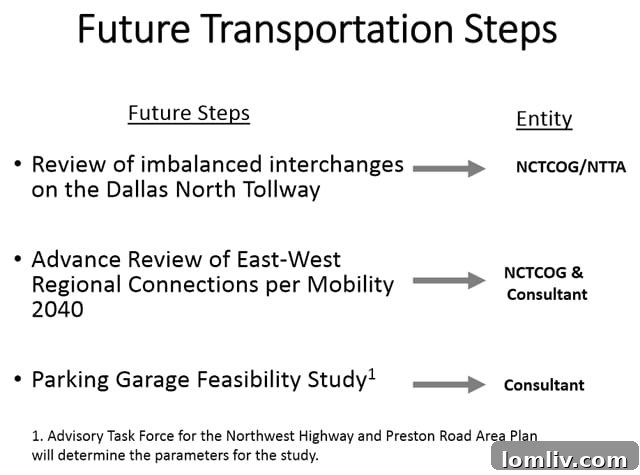
A notable moment occurred towards the end of the recent Task Force meeting, with the brief presentation of a single slide. This slide unveiled a future, three-stage project to be initiated by TXDoT and NCTCOG, aiming to address critical traffic flow optimization – a concept many, including myself (see my plan from July 2015), have advocated for years – alongside plans for a central parking garage. The timing is particularly perplexing: this vital work is slated to commence just as the Preston Center Task Force is concluding its mandate in June. Despite an invitation to participate in this new, crucial project, several Task Force members reportedly deemed it “beyond their scope of work.” This response highlights a significant disconnect, raising questions about the Task Force’s comprehensive vision for the area’s long-term sustainability.
The current work of the consultants advising the Task Force has predominantly centered on identifying the ideal mix of development and assessing its impact on “journeys” within the area. However, a glaring logical flaw persists: how can any “accurate” journey assessment be completed without a prior, fundamental understanding of the impact of systematic roadway optimization? The answer is unequivocally that it cannot. Without optimizing the existing transportation network first, any development plan risks exacerbating current traffic woes, creating new points of congestion, and ultimately failing to achieve its intended benefits for urban mobility.
This raises a crucial question for the city of Dallas: how can it credibly embrace recommendations from a task force whose foundational methodology appears inherently flawed? Regrettably, precedents for such oversights exist within major urban projects, reminiscent of the complexities surrounding the Trinity River development. For Preston Center to achieve truly sustainable and effective urban development, its plan must be built upon a transparent, logical, and thoroughly comprehensive foundation – a cornerstone that seems notably absent from the current Task Force proceedings.
The Imperative for Modeling Transparency
A significant point of contention revolves around the consultants’ modeling, which has, to a certain degree, been less than transparent. From an informed perspective, the first and most crucial data point in any credible planning process should be the raw amount of additional square footage that can be accommodated under current zoning and parking requirements. This figure must serve as the absolute starting point, largely because most zoning regulations in Preston Center primarily define allowable development by square footage, rather than specific usage. For example, various Planned Development (PD) districts within Preston Center set clear height limits, plot densities, and setbacks. Beyond specific restrictions like dancehalls and liquor establishments, property owners generally have considerable latitude to construct what they desire – be it residential, commercial, or retail – within these defined parameters.
Consider a hypothetical scenario: suppose there is an untapped pool of “X” square feet in Preston Center that could potentially expand to “2X” if comprehensive parking solutions were effectively implemented. The subsequent, pivotal planning question then becomes: how should this newly available “X” amount of extra space be judiciously apportioned? Furthermore, if the aspiration is to achieve the “2X” square feet development mark, what specific actions and investments are required to resolve existing parking deficiencies and other infrastructure bottlenecks? These are not minor details; they are the fundamental building blocks of responsible urban planning.
Establishing such a robust baseline would then allow for the strategic allocation of different development types – whether focused on mixed-use neighborhoods, advanced traffic control systems, or innovative parking infrastructure – based on community needs and desires. These allocations could then be meticulously mapped against individual parcel expandability and the anticipated traffic consequences, ensuring a holistic and sustainable approach.
Instead, what has often been presented feels akin to viewing only the “roof” of a complex structure, without a clear, detailed explanation of its “foundation.” This lack of foundational understanding inevitably leads to confusion, as evidenced by the high level of bewilderment expressed by Task Force members during their second meeting, where the underlying assumptions and methodologies of the proposals remained largely obscure.
In the aftermath of the meeting, several individuals were observed consulting maps, specifically pointing to the St. Michael’s parcel. They were vocally advocating for its upzoning, a move presumably aimed at facilitating the church’s much-discussed and long-desired 20-plus-story office tower – a proposition that stands in stark contrast to the area’s current zoning for three-story residential buildings. (For more details on this specific issue, please refer to previous articles here and here.) Such specific, high-impact development proposals underscore the urgent necessity for a clear, transparent, and infrastructure-first planning framework.
Navigating the Persistent Parking Predicament
While the Task Force’s proposals regarding parking might appear slightly more advanced than other areas, they still contain significant complexities that demand deeper scrutiny. The consultants’ modeling software is designed to incorporate the parking requirements driven by new development. And while the Task Force has been asked to conceptualize the general footprint of a potential central parking structure, the ultimate number of levels – whether it’s two, five, or hypothetically “a million” – is presented as a parameter easily adjustable in the final recommendations. However, this seemingly straightforward flexibility may obscure crucial behavioral and urban design considerations.
Preston Center’s parking issues are far more intricate than simply building or demolishing a central garage. A central parking facility generates a “ripple effect” of usefulness, much like a stone dropped in water. Its practical utility diminishes significantly with increasing distance from businesses. Consider the shopping habits of current customers on Sherry Lane: are they realistically utilizing a distant central garage, or are they, more likely, seeking the closest possible parking to their destination? Even if a central garage were “gold-plated” with every convenience, it is highly improbable that established consumer parking behaviors would fundamentally change. The intrinsic preference for convenient, proximate parking remains a powerful, often underestimated, factor in urban mobility.
Adding another layer of complexity are the differing parking requirements for commercial versus residential developments. This disparity is a strong candidate for explaining why areas like Sherry Lane and the vicinity of the central garage predominantly feature single-story structures. During the recent meeting, there was discussion about “tinkering” with the parking ratios mandated for new developments. This prospect, while offering some flexibility, raises significant concerns. Parking availability is arguably one of the two most sensitive “hot buttons” for neighborhood residents. The idea that consultants might be exploring options that could potentially worsen development-adjacent parking seems counterproductive and could ignite considerable community opposition. Any adjustments to parking ratios must be meticulously evaluated for their potential negative impacts on neighborhood livability and accessibility.
Fostering Residential Development and Affordability
The proposed loosening of parking requirements for new development is not primarily intended for high-rise buildings, which typically incorporate their own extensive parking facilities. Instead, this adjustment aims to encourage an influx of mixed-use, mid-rise developments – structures combining ground-floor commercial spaces with multiple levels of residential units above. This model represents a strategic shift in the urban character of Preston Center.
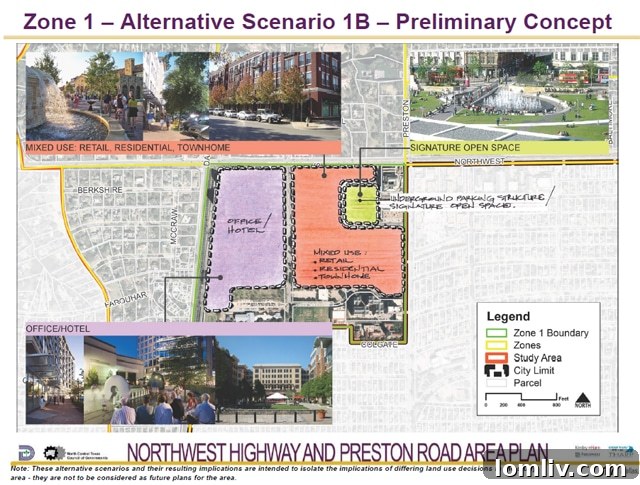
Consultants identified Sherry Lane as a particularly attractive location for this type of transformation. The vision entails demolishing existing single-story structures, constructing buildings of a reasonable height, and integrating residential components on upper floors. However, a deeper examination reveals several underlying historical and practical reasons why this kind of development has not materialized organically in the past:
- Prohibitive Parking Requirements and Costs: Strict parking mandates, coupled with the significant financial and engineering challenges of developing costly underground parking on small, individual lots, have often rendered such projects economically unfeasible.
- Fragmented Property Ownership: Many individual lot owners in the area may be reluctant to sell, whether to a single large developer seeking to consolidate parcels or to multiple condo owners. This fragmentation makes large-scale, cohesive redevelopment extremely challenging.
- Lack of Capital for Redevelopment: Existing property owners may lack the substantial financial resources required to undertake comprehensive redevelopment projects themselves.
- “If It Ain’t Broke, Don’t Fix It” Mentality: For some owners, the current operational model, even if not maximizing density or profit, might be sufficiently stable and lucrative, leading to a natural reluctance to engage in risky or costly redevelopment ventures.
In an ideal world, Sherry Lane could indeed evolve into a highly attractive and vibrant mixed-use corridor. However, this vision can only realistically come to fruition if property owners actively collaborate, either by voluntarily uniting for a cohesive development plan or by selling their properties to a single developer capable of orchestrating such a comprehensive project. The overarching goal should be the creation of a meticulously crafted and aesthetically unified development that avoids the architectural dissonance of disparate styles and building eras within the span of a single city block.
The Critical Element of Affordability
For Preston Center to truly thrive as a vibrant, sustainable community, a pragmatic approach to affordability is indispensable. One only needs to observe the numerous half-empty, luxury high-rises in areas like Uptown and Victory Park – often built on speculative demand with a “fingers-crossed” hope – to understand that a strategy focused exclusively on high-end luxury properties is fundamentally flawed and prone to failure. Such developments, while visually appealing, frequently create exclusive enclaves that fail to fully integrate into the broader urban fabric.
Moreover, if the stated objective is to foster a genuinely walkable Preston Center village – one that effectively reduces vehicular traffic by encouraging local pedestrian activity – then development must cater to a diverse spectrum of income levels. To be clear, this does not imply the introduction of Section 8 housing. Instead, the focus should be on creating housing options that are accessible to the crucial sub-$600,000 market, and significantly, not just for cramped studio apartments. We are referring to housing suitable for a range of buyers and tenants – individuals and families who would genuinely desire and be able to walk to work, shop, and engage socially within Preston Center itself. Without this diverse demographic, the concept of a walkable village remains largely theoretical, as residents would still primarily rely on cars to access the area.
It’s not to suggest that the Task Force is explicitly targeting only multi-million dollar condominiums. Rather, the critical observation is the notable absence of any explicit calculations or modeling dedicated to achieving a healthy economic mix within the proposed developments. This omission represents a significant oversight, as a balanced economic demographic is a cornerstone for the long-term vitality, diversity, and sustained success of any truly integrated urban environment.
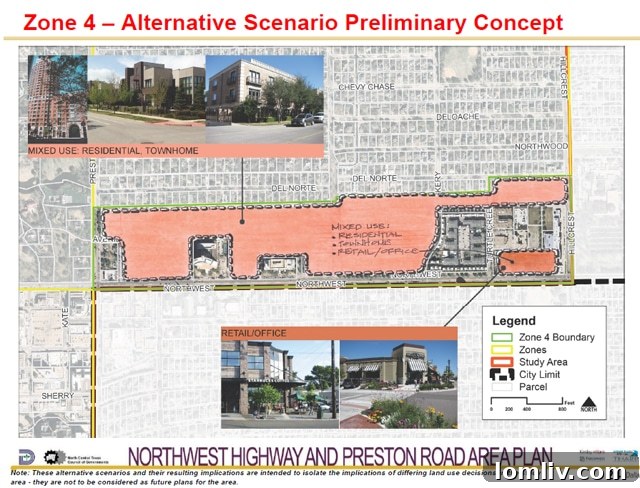
Zone 4: The Pink Wall and its Redevelopment Potential
Beyond the immediate core of Preston Center, Zone 4, commonly referred to as the “Pink Wall,” presents another significant area for redevelopment consideration. This zone, however, offers a bifurcated reality in terms of its development feasibility. The eastern stretch, extending from Edgemere to Hillcrest, holds considerable promise for substantial development. Critically, any new construction in this specific area is likely to have minimal impact on existing neighborhoods or contribute negligibly to increases in side-street traffic, making it a more amenable candidate for revitalization efforts.
In contrast, the western portion of Zone 4, which spans from Edgemere westward towards Preston Road, represents a much more intricate “tangle of Christmas lights” for potential developers. As previously highlighted in March, this particular section of the Pink Wall is encumbered by a dense network of deed restrictions. These legal covenants, often decades old, effectively quash any attempts to significantly increase density. Their removal or modification is a prerequisite for any meaningful redevelopment, adding a substantial layer of legal complexity and cost that significantly deters potential projects, irrespective of the underlying zoning potential.
A Note on Property Valuation Discrepancies: It is important to note that Dallas Central Appraisal District (DCAD) land valuations typically include a component for site potential based on prevailing city zoning regulations. However, these valuations often fail to account for the restrictive nature of civil deed limitations. If I were an owner of one of the two-story buildings in the western Pink Wall area, I would promptly submit my deed restrictions to DCAD. This action would logically support an argument for reducing the assessed land value of my property, given that these restrictions demonstrably stifle any property improvements or redevelopment opportunities not solely focused on internal unit renovations. This disparity underscores a crucial disconnect between theoretical zoning capacity and practical buildable potential.
According to the consultants’ analysis, PD-15 (the area encompassing Preston Tower to Athena, extending two lots deep to the alley) still possesses some excess development capacity. While not vast, this capacity is estimated to accommodate approximately 70-ish additional units, suggesting discrete opportunities for limited, strategic infill development.
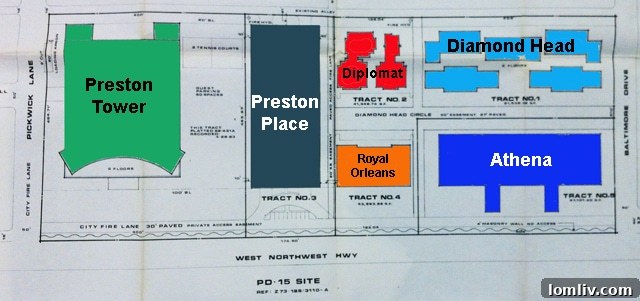
Considering these factors, a more innovative and potentially impactful approach could involve combining properties such as Preston Place, Royal Orleans, and Diplomat into a single, cohesive development. This consolidated site could then feature a strategically positioned tower on the Northwest Highway side, designed to align harmoniously with the two existing towers. The rear portion of this larger property could house a low-to-midrise structure, potentially comprising townhomes or flats, capped by an amenity deck. Such an integrated design could also potentially create valuable space for a much-needed community park.
This type of consolidated development offers several key advantages. It would minimize the visual impact on existing towers by avoiding a perpendicular building orientation, while simultaneously preserving a human-scale feel on the property’s backside. Crucially, this comprehensive development would also efficiently absorb all the identified excess capacity in one strategic sweep, thereby exhausting the potential for future, piecemeal, and potentially disruptive development. This “one and done” approach offers a clear, consolidated vision that could benefit both developers and the community by providing certainty and preventing fragmented growth.
Conclusion: Realigning Preston Center’s Development Trajectory
In summary, it has become abundantly clear that the Preston Center Task Force has significantly deviated from its foundational mission. Rather than meticulously addressing its original mandate of traffic and parking, it has seemingly embraced an aggressive development agenda without undertaking the prerequisite comprehensive “homework” essential for an accurate, sustainable, and well-received assessment and plan. The unsettling fact that the crucial process of road optimization is conspicuously divorced from the Task Force’s planning efforts – scheduled to occur only after its recommendations are presented to the city council – inherently introduces inaccuracy and critical deficiencies into the entire proposed framework. This sequencing fundamentally puts the cart before the horse, risking the perpetuation and exacerbation of existing urban challenges.
It must be unequivocally stated that this critique is not rooted in an anti-development stance. On the contrary, thoughtful, well-executed development is undeniably vital for urban vitality and progress. However, the pressing question remains: how can the most informed, beneficial, and sustainable decisions possibly be made for the Preston Center area without access to the most complete, accurate, and meticulously analyzed data set available? A truly effective plan for Preston Center demands an integrated approach that prioritizes foundational infrastructure improvements, champions transparency in its modeling, genuinely addresses real community concerns such as parking and affordability, and respects the unique characteristics and limitations of each development zone. Only through such a holistic and responsible approach can Preston Center truly thrive, successfully balancing growth with sustained livability for all its stakeholders.
Remember: Do you have an HOA story to tell? A little high-rise history? Realtors, want to feature a listing in need of renovation or one that’s complete with flying colors? How about hosting a Candy’s Dirt Staff Meeting? Shoot Jon an email. Marriage proposals accepted (they’re legal)! [email protected]