
The Fine Line Between Yard Art Love and Grand Obsession: A Tour of a Truly Unique Michigan Home

In the vast realm of home decoration and personal expression, few things bring as much vibrant character to a property as outdoor art. For many, including myself, adorning one’s yard with charming sculptures, whimsical figures, or even a statement piece, is a delightful way to inject personality and a touch of joy into everyday life. It’s a true confession, folks: I absolutely adore yard art, especially the animal variety. My own front yard is a testament to this affection, currently hosting a lively menagerie that greets me every time I pull into the driveway.
My collection, ever-evolving, includes a magnificent four-foot-tall, multi-colored rooster affectionately named Rodriguez, whose vibrant hues stand out against the greenery. Then there’s Jerry the giraffe, a whimsical character depicted riding a tricycle, complete with a charming flower basket perched on the back. Not to be outdone, Rainbow, our proud peacock, adds an exotic flair, while BS the bull daringly hangs off my deck, offering a touch of rustic charm. Even a humble little llama, acquired from a dollar store and mounted on a spike, finds its place among the more elaborate figures. And, of course, the grand flamingo patiently awaits its debut – a piece I haven’t quite placed yet, but whose time will surely come. The festive season brings another layer of fun, as I can easily transform BS into a holiday spectacle by attaching candy cane horns. It’s truly sensational!
Each of these pieces, a blend of metal and paint, contributes to a unique landscape, making my home feel distinctly mine. They are conversation starters, mood lifters, and a constant source of amusement. This personal connection to home aesthetics is a common thread that weaves through many households, manifesting in countless forms, from subtle planters to elaborate outdoor installations. However, while the joy of personalizing one’s space is undeniable, there exists a delicate equilibrium between genuine enjoyment and the slippery slope into what might be described as an overwhelming obsession.
Navigating the Thin Line Between Passion and Ponderous Collections
Now, before you conjure images of neighbors pointing and whispering about my burgeoning collection, let me assure you, there’s a vital lesson I’ve learned. My own experiences with yard art have given me a unique perspective, allowing me to appreciate the beauty of such decorations while also recognizing the potential for excess. Like Ebenezer Scrooge, who was granted a sobering glimpse into his future, I, too, have seen a vision that acts as a cautionary tale. It’s a stark reminder that even the most beloved hobby, when taken to extremes, can transform a home from a haven of personal expression into something entirely different.
The subject of this week’s column serves as precisely that warning. It’s a property that, at first glance, causes a slight twitch of the head, a lingering gaze that lasts just a smidge longer than customary. You try to move on, but it sticks with you, much like the compelling draw of a bizarre car wreck – you simply have to look more closely. This house challenges the conventional notions of home decor, pushing the boundaries of personal taste and inviting a deeper contemplation of what truly makes a living space feel comfortable and welcoming.
Introducing the Distinctive Dwelling of Highland Park, Michigan
This truly remarkable home, a focal point of our exploration, is nestled at 450 W Grixdale in Highland Park, Michigan. A suburb adjacent to Detroit, Highland Park boasts its own rich history and distinct character, making this property an even more intriguing find. The residence itself offers three comfortable bedrooms, two-and-a-half bathrooms, and rests on a generous plot of almost a quarter acre. The owners are currently seeking $345,000 for this unique estate, a price point that suggests not just the value of the structure, but also the extraordinary nature of its interior styling.
The listing agent, in a masterful stroke of understatement, perfectly encapsulates the essence of this property with the very first word of her description: “Unique barely begins to describe this one of a kind Grixdale Farms estate.” This immediately signals that what lies within transcends typical home aesthetics. It hints at an experience, an encounter with a vision so singular that words struggle to do it justice. And in a charming, almost enigmatic detail, prospective buyers are informed that the house is “only shown on sunny days.” This curious caveat only adds to the mystique, sparking imagination and anticipation. Perhaps the sunlight is necessary to fully appreciate its multifaceted wonders, or perhaps, as we’ll humorously speculate later, there are other, more peculiar reasons. But enough preamble – it’s tour time, my people. Let’s step inside and unravel the layers of this fascinating dwelling.
A Journey Through Statuary and Surrealism: Room by Room
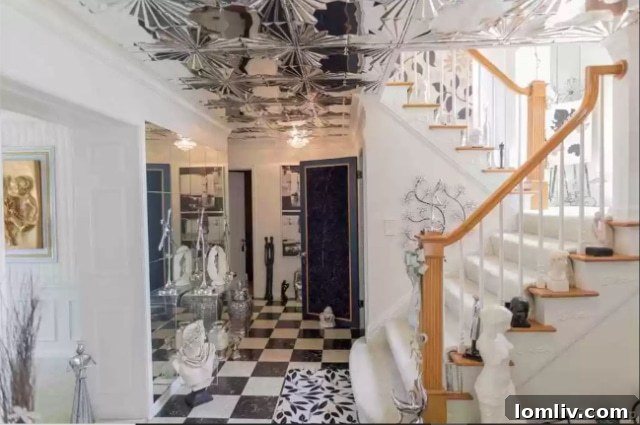
The Foyer: A Grand Overture of Eclecticism
Upon entering the foyer, one is immediately enveloped in an atmosphere that defies easy categorization. It is more than just a lot of decor; it is, quite literally, a lot, a lot. The space is densely populated with an astounding array of statues and busts, each vying for attention. Marble figures, classical forms, and perhaps even some more contemporary pieces stand shoulder to shoulder, creating a crowded artistic landscape. Adding to this visual feast is a striking mirror strategically placed on the ceiling, reflecting the bold black and white checkerboard floor below. The overall effect is disorienting yet undeniably captivating, reminiscent of the whimsical yet slightly unsettling fun houses found at grand events like the State Fair of Texas. It’s a sensory overload, a curated chaos that leaves an indelible first impression, challenging the visitor to absorb every intricate detail while navigating the sheer volume of artistic expression.
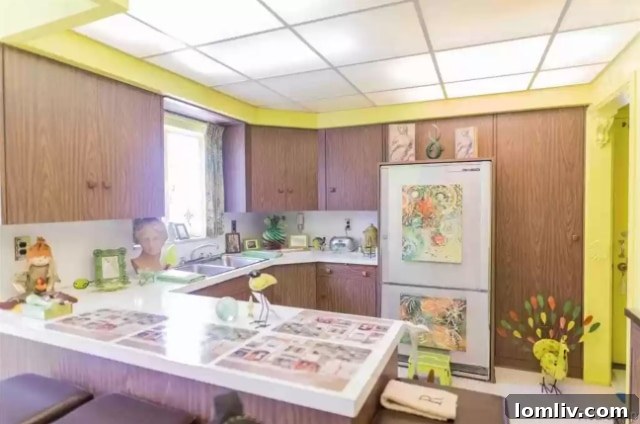
The Kitchen: Where Culinary Space Meets Curated Collections
Moving beyond the foyer, the kitchen presents another intriguing facet of this home’s unique interior design. While the image primarily showcases the dense collection of statuary, one can only imagine the practicalities of a space intended for cooking and dining, now shared with so many silent observers. It brings to mind my own peacock, Rainbow, who, thankfully, resides *outside*. My vibrant Rainbow is not a tripping hazard in my kitchen, allowing for safe and free movement, which is essential in such a functional space. Furthermore, my Rainbow is considerably larger and more colorful, a truly majestic outdoor ornament that enhances the garden without impeding daily life. But I digress.
The juxtaposition of such a profound collection of indoor statues with the highly functional demands of a kitchen raises questions about usability and flow. Is it possible to chop vegetables, prepare meals, or simply enjoy a morning coffee without feeling a sense of crowdedness? While artistic expression is valuable, a kitchen, by its very nature, demands clear pathways, accessible countertops, and an environment conducive to culinary tasks. Here, the boundaries between display and practicality seem blurred, creating a space that is undeniably unique but perhaps less than ideal for its primary purpose.
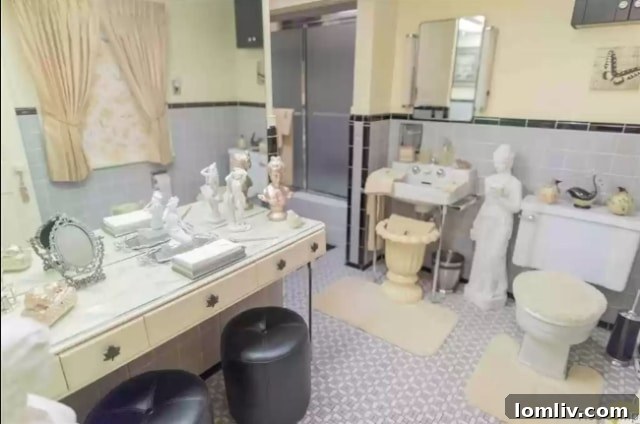
The Bathroom: A Sanctuary Transformed
The bathroom, traditionally a sanctuary of privacy and tranquility, receives the same treatment as the rest of the house. Here, too, numerous small statues populate every available surface, turning what should be a serene space into another gallery of watchful eyes. One can’t help but wonder how anyone could focus on the task at hand – whether it’s brushing teeth, showering, or simply taking a moment of quiet reflection – with so many inanimate figures staring back. The very essence of a bathroom, its role as a personal retreat, seems to be challenged by this pervasive decorative scheme. While a few well-placed decorative items can enhance a bathroom’s ambiance, an extensive collection such as this risks transforming a private functional area into an almost public exhibition, disrupting the sense of calm and intimacy essential for personal rejuvenation.
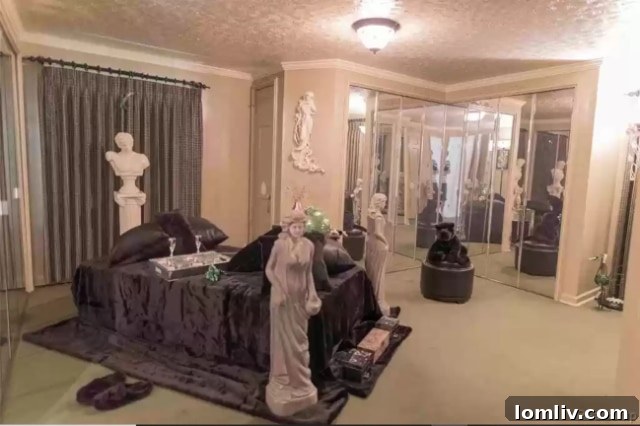
The Bedroom: A Restless Retreat
Perhaps the most poignant illustration of the fine line between collection and clutter is found within the bedroom. This is a space universally understood as a haven for rest, relaxation, and intimate peace. Yet, in this home, between the numerous mirrors and the relentless statuary, the concept of a restful night’s sleep seems almost impossible. Imagine trying to navigate this room in the dim light of night or the haze of a sleepy morning. Do you know why true rest might be elusive here? Because you’re constantly on high alert, perhaps writhing in pain after stubbing your toe on any one of the myriad statues strategically placed at the corners of your bed, or perhaps even in the pathways around it.
Beyond the physical hazards, there’s a psychological dimension. Mirrors, reflecting endlessly, can create a sense of being perpetually observed, while a multitude of silent figures can contribute to an unsettling, claustrophobic atmosphere rather than one of comfort and security. A bedroom should be a sanctuary, a place where the mind can unwind and the body can find repose. This particular bedroom, however, with its overwhelming visual density, seems to resist that fundamental purpose, suggesting a space designed more for exhibition than for true tranquility.
This next photo, for me, was the equivalent of Ebenezer Scrooge seeing his own tombstone – a powerful, almost symbolic moment that solidified the overwhelming nature of this home’s decor.
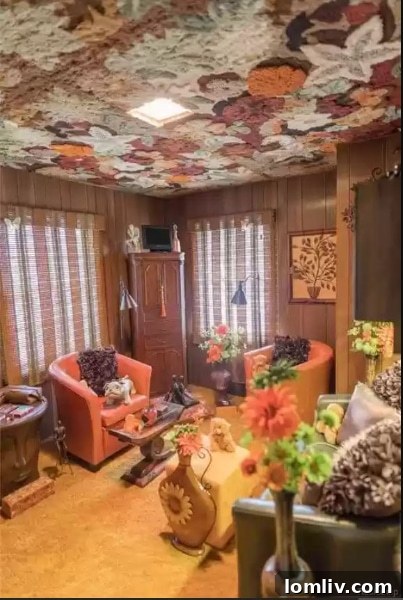
The Weary Companions: Even the Statues Feel It
In a particularly striking image from the tour, a dog statue sits slumped in a chair, its posture conveying an almost human sense of exhaustion or resignation. Even this inanimate canine companion appears distressed, seemingly overwhelmed by the sheer volume of its fellow figures. All I can say is, “I feel ya, bro.” It’s a humorous yet telling detail, hinting that perhaps even the statues themselves are feeling the weight of their collective presence. As I absorb these images, a profound weariness settles in. The visual density, the constant demand for attention from every corner, leaves one feeling drained. It’s an exhausting experience, even from a distance, reinforcing the idea that too much of a good thing can indeed become overwhelming.
The “Sunny Days Only” Theory: A Humorous Speculation
Considering the exhaustive nature of this interior, I think I’ve finally understood the realtor’s peculiar instruction: that the house is “only shown on sunny days.” I have a sneaky suspicion that these statues, imbued with an almost palpable energy, might just come to life on dark or overcast days. Imagine the creaking and stirring as the sun dips below the horizon, or when thick clouds obscure its light. Perhaps on those gloomy days, the statues begin to wander, rearrange themselves, or simply stand a little too eerily still. It’s a whimsical, slightly macabre thought that adds another layer of intrigue to this already extraordinary property. While purely a humorous speculation, it underscores the fantastical, almost cinematic quality of a home so densely packed with figures that they seem to possess a life of their own.

The Enduring Lesson: Balance in Beauty
So, needless to say, while my affection for my own collection of yard art remains strong and unwavering, this unique tour has served as a powerful reminder. It may be quite a while before I consider buying another piece. This extraordinary home in Highland Park is a vivid illustration of the delicate balance between passion and excess, between personalized decor and overwhelming clutter. It reminds us that while expressing oneself through art and decoration is a joyous pursuit, it’s always wise to exercise a degree of moderation. Allowing a passion to morph into an unbridled obsession can transform a beautiful intention into something that detracts from comfort, functionality, and even peace of mind.
Ultimately, this home offers a fascinating case study in interior design, personal taste, and the psychology of collecting. It prompts us to reflect on our own living spaces: Do our decorations enhance our lives, or do they begin to complicate them? Are we creating sanctuaries, or inadvertently building museums within our own homes? The lesson is clear: it is always good to be reminded not to allow yourself to get so obsessed that your cherished collections become a burden, or worse, cause you to end up on your keister. Find beauty, find expression, but always seek balance.
To delve further into the unique character of this listing and view more photos, simply click here.