Texas Rising: A Deep Dive into the Lone Star State’s Unprecedented Growth and Real Estate Boom
For years, the narrative has been building, but now it’s undeniable: Texas stands as a beacon for individuals and families seeking new horizons. Propelled by its robust and business-friendly environment, the Great State of Texas consistently boasts a fantastic job market and a comparatively lower cost of living, attracting a ceaseless stream of newcomers from states grappling with fewer economic opportunities and exorbitant housing prices. The allure of moving to Texas has never been stronger, making it an increasingly popular destination for those in pursuit of enhanced career prospects, a higher quality of life, and greater financial stability.
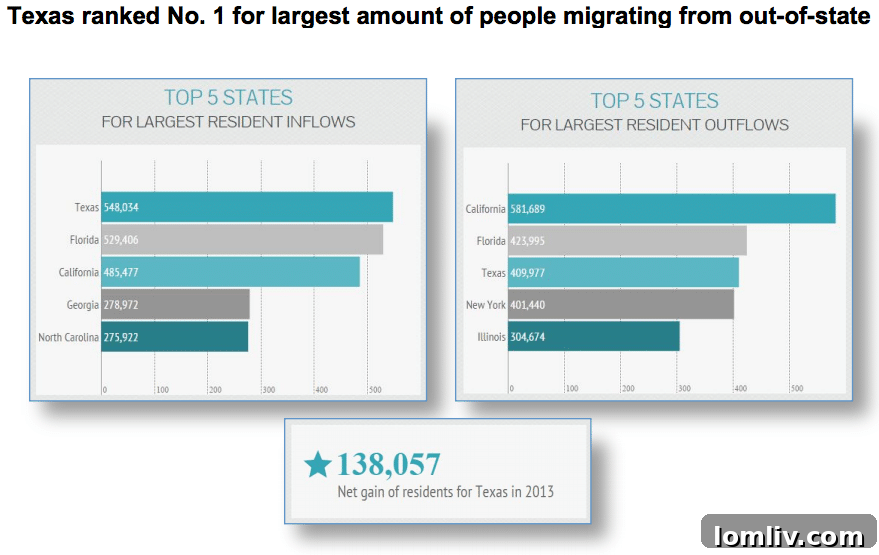
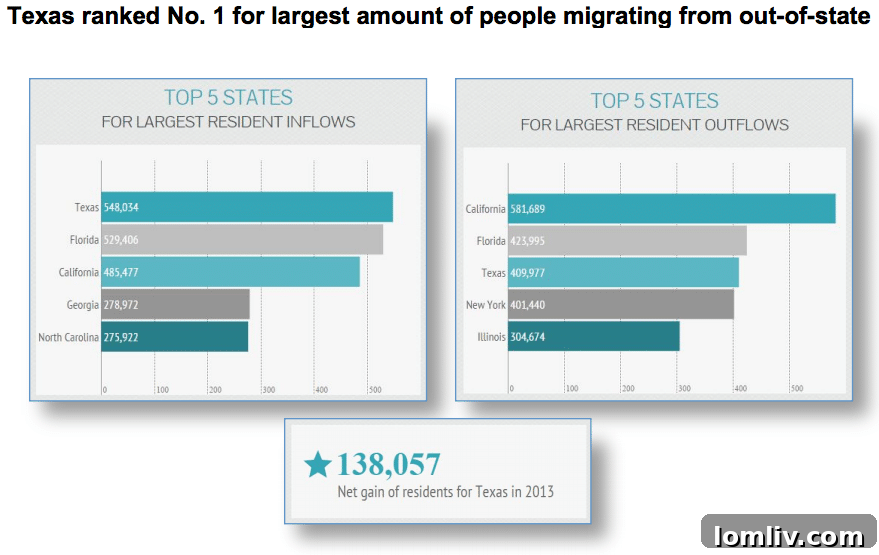
This vibrant migration trend naturally translates into a thriving landscape for the real estate sector across the state. According to compelling statistics from the Texas Association of Realtors’ comprehensive “Texas Relocation Report,” the state welcomed an astonishing total of 138,057 new clients to its real estate market, underscoring the immense demand and dynamic shifts within the housing industry. This influx isn’t just a number; it represents thousands of dreams realized, families settled, and communities enriched.
The Irresistible Pull: Why Texas Outshines Other States
Texas isn’t just growing; it’s leading the charge. The insightful report, meticulously compiled using data from the 2013 American Community Survey, the 2008-2012 American Community Survey 5-Year Estimates by the U.S. Census Bureau, and the U-Haul 2013 National Migration Trend Reports, vividly illustrates Texas’s dominance. The state is consistently outpacing other traditionally popular relocation destinations such as Florida, California, Georgia, and North Carolina in the sheer volume of people relocating from out of state. This superior growth trajectory is a testament to Texas’s unique blend of economic opportunity, diverse culture, and welcoming atmosphere.
The state’s economic engine is multifaceted, driven by flourishing sectors including technology, energy, healthcare, manufacturing, and aerospace. This diversification ensures a resilient job market that can absorb talent from various industries, making it an attractive hub for professionals at all career stages. Furthermore, the absence of state income tax, coupled with a generally lower cost of living compared to coastal urban centers, significantly boosts residents’ disposable income and overall financial well-being. From sprawling metropolitan areas like Dallas-Fort Worth and Houston to the innovative hub of Austin and the rapidly developing suburbs, Texas offers a spectrum of lifestyles and housing options that cater to a wide range of preferences and budgets, solidifying its reputation as a premier destination for relocation.
Decoding the Migration Map: Intra-State Shifts and Surprising Trends
Harris and Dallas counties remain the top two most mobile counties in the Lone Star State, ranking No. 1 and No. 2 in
Texas, respectively, for both the largest inflow and the largest outflow of people. However, both of these counties posted
the highest net losses of residents moving out of county, with Dallas County posting the highest net loss of people
(25,461) followed by Harris County (20,222).
The top 10 Texas counties with the highest net gains of people from out of county were spread all over the state, with
three of the top 10 counties located in Central Texas (Williamson, Hays, and Travis) but with the DFW-area’s Denton
County leading by far with a net gain of 13,754 out-of-county residents.
While Texas as a whole experiences tremendous population growth, a closer look at intra-state migration reveals fascinating dynamics. The report highlights that Harris County (home to Houston) and Dallas County remain the most mobile regions, seeing both significant inflows and outflows of residents. This constant churn indicates dynamic urban centers with high rates of internal movement, driven by job changes, lifestyle shifts, and evolving housing needs. However, the most intriguing detail from these statistics is that despite their bustling activity, both counties registered net losses of residents moving out of the county. Dallas County, in particular, posted the highest net loss of 25,461 people, closely followed by Harris County with a net loss of 20,222 residents. This suggests a pattern of people moving from dense urban cores to surrounding suburban or exurban areas, likely in search of more affordable housing, larger properties, or a different pace of life within the greater metropolitan areas.
The Suburban Surge: Central Texas and Denton County Lead the Way
In stark contrast to the net losses observed in core urban counties, other regions across the state are experiencing substantial net gains. The top 10 Texas counties with the highest net gains of people from out of county are distributed geographically, showcasing a diverse spread of growth hotspots. Central Texas, in particular, stands out as a magnet for new residents, with three counties — Williamson, Hays, and Travis (home to Austin) — making it into the top 10. These areas offer a compelling combination of access to major employment centers, burgeoning tech industries, vibrant cultural scenes, and still relatively attainable housing options, making them highly desirable for both young professionals and families.
However, the undisputed leader in net gains is Denton County, located within the expansive Dallas-Fort Worth metroplex. Denton County posted an exceptional net gain of 13,754 out-of-county residents, significantly outperforming its peers. This remarkable growth for what is often considered a “college town” (home to the University of North Texas and Texas Woman’s University) is truly outstanding. Denton’s appeal extends beyond its academic institutions; it boasts a thriving local economy, a vibrant arts scene, excellent schools, and a blend of urban amenities with a welcoming, community-oriented atmosphere. Its strategic location, providing easy access to the job markets of Dallas and Fort Worth while offering a distinct identity, has cemented its status as a premier growth hub in North Texas.
The Curious Case of Midland/Odessa: An Oil Hub’s Modest Influx
Perhaps one of the most surprising findings in the report, at least for those familiar with Texas’s economic landscape, concerns the Midland/Odessa metropolitan area. These two cities, historically recognized as the hotbed of oil and gas development in West Texas, presented a rather modest net gain of only 337 new residents. Given the booming energy sector and the high-paying jobs it generates, one might expect a much larger influx of people flocking to this region.
This intriguing statistic invites further analysis. While employment opportunities in the oil and gas industry are undoubtedly abundant and lucrative, factors such as housing availability and affordability in a high-demand, specialized market, coupled with quality of life considerations (e.g., limited cultural amenities compared to larger metros, specific environmental conditions), might play a role. Furthermore, the cyclical nature of the energy industry can sometimes lead to transient populations, or it may indicate that a significant portion of the workforce commutes from surrounding areas rather than fully relocating. This data point underscores that while jobs are a primary driver for migration, they are not the sole determinant, and a holistic view of living conditions, infrastructure, and community offerings significantly influences long-term residential patterns.
Empowering Real Estate Professionals with Data-Driven Insights
For any real estate professional, a deep understanding of market research and demographic trends is not just beneficial; it’s absolutely essential for success. The insights gleaned from reports like the “Texas Relocation Report” provide an invaluable compass for navigating the dynamic Texas real estate market. Knowing where people are moving from, where they are settling within the state, and the underlying reasons for these shifts empowers realtors to:
- **Anticipate Market Demand:** Identify emerging hot spots and prepare for increased housing demand in specific counties or neighborhoods.
- **Target Marketing Efforts:** Tailor marketing strategies to appeal to different demographic groups and relocation profiles.
- **Advise Clients Strategically:** Provide informed guidance to buyers and sellers, helping them make data-backed decisions about where to invest or how to position their properties.
- **Understand Client Needs:** Gain a clearer picture of what new residents are seeking in terms of housing types, community amenities, and proximity to work or schools.
- **Identify Investment Opportunities:** Spot potential areas for growth and development before they become mainstream.
In a competitive and rapidly evolving market, staying ahead means staying informed. For those keen to delve deeper into these critical market indicators and strengthen their strategic approach, it is highly recommended to check out the very easy-to-digest report yourself. It offers a wealth of actionable information presented clearly and concisely.
The Future is Lone Star Bright: Concluding Thoughts on Texas Real Estate
The story of Texas’s growth is far from over; it’s an ongoing saga of prosperity, opportunity, and transformation. The sustained influx of residents, driven by a compelling combination of economic vitality, diverse job opportunities, and a desirable cost of living, continues to reshape the state’s urban and suburban landscapes. The intricate patterns of migration, from the bustling heart of its major cities to the burgeoning suburbs and regional centers, paint a vivid picture of a state in constant evolution. For real estate professionals, policymakers, and indeed, anyone interested in the future of American demographics, Texas offers a compelling case study. Understanding these trends is not merely about tracking numbers; it’s about comprehending the forces that drive community development, economic expansion, and the very fabric of our society. The Lone Star State remains a land of immense potential, and its real estate market, fueled by this relentless growth, promises to be one of the most exciting and dynamic in the nation for years to come.