

Navigating the US Economy: Wage Growth, Employment Trends, and the Evolving Housing Market
The United States economy, now well into its post-Great Recession recovery phase, presents a fascinating and often complex picture of growth, challenges, and opportunities. For many Americans, the state of the labor market and its impact on personal finances directly influences major life decisions, particularly the aspiration of homeownership. While job numbers have shown promising trends, the pace of wage growth and the escalating cost of housing, especially in competitive regions like North Texas, continue to create a nuanced economic landscape.
For prospective homebuyers, particularly in booming markets, the most significant hurdles often extend beyond mere inventory shortages. Income stagnation remains a critical concern. The burden of substantial student loan debt for recent graduates, coupled with the challenging decision many families face when choosing to sacrifice a second income for stay-at-home parenting, highlights the immense pressure on household budgets. These factors collectively contribute to a persistent gap between earning potential and the financial demands of today’s housing market.
Key Labor Market Indicators: A Mixed Bag of Progress
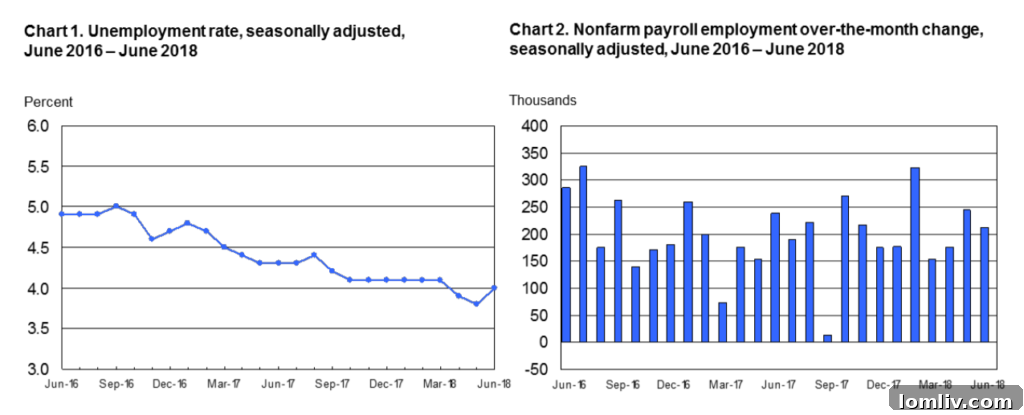
Against this backdrop, recent reports from the Bureau of Labor Statistics (BLS) have offered a glimmer of hope. After an extended period of slow-to-negligible wage growth across the nation, nine years removed from the depths of the Great Recession, the non-farm payroll sector experienced a notable increase. This surge in employment figures, however, was accompanied by a contraction in the retail industry, contributing to an overall unemployment rate of 4 percent – a figure often considered near “full employment” levels, yet one that warrants deeper analysis.
Understanding the “Full Employment” Debate and Labor Force Re-entry
The concept of a 4% unemployment rate has sparked considerable debate among economists regarding whether the U.S. economy has truly reached its full employment potential. As economist Evan Kraft explains, the recent increase in the labor force suggests that there is still untapped potential:
“… the increase in the labor force confirms suspicions that we have not reached full employment yet. It has been difficult to gauge whether many of those not seeking work would be willing to look again or to accept jobs.
Long-term demographic trends have been lowering the employment-population ratio since 2000, but the Great Recession accelerated the downward movement. It now seems clear that a good chunk of the decrease actually represents people who can return to work.
This is good for these individuals’ financial position, for the total output of the economy and for the government (fewer people relying on government transfer payments).
Additionally, the increase in the labor force suggests an answer to a key puzzle of the recovery: the slow growth of wages. If there still are people out there who answer help wanted ads, employers do not feel so much pressure to raise wages just to keep their businesses producing at the desired level.”
Kraft’s insights highlight a crucial dynamic: the availability of a significant pool of workers willing to re-enter the workforce. For years, economists grappled with understanding the true extent of labor market slack, wondering if those who had exited during the recession were permanently out or merely discouraged. Recent data suggests a substantial portion were indeed waiting for the right opportunities. This return to the labor force is a boon for individuals, improving their financial stability; for the broader economy, by increasing productivity and output; and for the government, by reducing reliance on social safety nets.
However, this expanded labor pool also directly addresses one of the most perplexing aspects of the economic recovery: the persistently slow growth of wages. With more job seekers available, employers face less pressure to significantly increase salaries to attract and retain talent. They can often fill open positions without engaging in competitive bidding wars for skilled labor, thereby keeping wage increases modest.
Real-World Impact: Stories of Re-entry and Sectoral Shifts
The implications of this dynamic are profound. Slow wage growth, combined with employers’ ability to fill positions at lower pay rates rather than actively competing for a diverse pool of candidates with higher compensation, is a primary driver of the income stagnation many households experience. Yet, as reported by The Wall Street Journal, the surge in educated parents and other previously sidelined individuals re-entering the workforce has substantially expanded the labor pool, indicating a healthy, albeit cautious, re-engagement with the job market.
Katie Garrison, 36 years old, is among those finding opportunities. She was out of the labor force for six years while caring for her young children. Last month, two weeks after she started searching, she was hired as a part-time government attorney.
“I was expecting it to be months and months,” Ms. Garrison said. “It was actually easier this time to get a job than any of us expected.”
New entrants to the labor force—be they parents, recent graduates or those previously frustrated by their prospects—have caused the civilian labor force to grow by an average of about 250,000 workers each month this year. That is the best six-month stretch of Americans entering the labor market in more than two years. In June, the share of American adults working or looking for a job rose by 0.2 percentage point to 62.9%. The gain runs counter to the longer-running trend of an aging population that is less likely to work.
Ms. Garrison’s experience is indicative of a broader trend: a robust job market that is drawing individuals back in, sometimes with surprising ease. This influx has led to the civilian labor force expanding by an average of approximately 250,000 workers each month, marking the strongest six-month period for labor market re-entry in over two years. This positive trend defies the demographic challenges of an aging population, demonstrating the resilience and adaptability of the American workforce.
Beyond the overall numbers, significant shifts are occurring across various industries. While the retail sector faced setbacks, largely due to the ongoing digital transformation and e-commerce growth, other sectors are experiencing substantial expansion. The healthcare sector, for instance, added over 25,000 jobs, driven by an aging population and advancements in medical services. Professional and business services also saw a strong increase of 50,000 jobs, reflecting growing demand for specialized expertise. Furthermore, manufacturing jobs grew by a healthy 36,000, pointing to a revitalization in certain segments of American industry. These sectoral growths are critical for regional economies, creating localized job hubs and contributing to the overall strength of the economy.
The Homeownership Challenge: Wages vs. Home Prices
So, what do these fluctuating labor market dynamics and varying wage increases mean for the average aspiring homeowner? The connection is direct and often disheartening, particularly in high-demand markets. Realtor.com chief economist Danielle Hale offers crucial insight into this disparity:
“Even though the unemployment rate ticked up for the first time since August 2017, today’s job report shows wages were up 2.7 percent. Meanwhile median home listing prices were up 9 percent in June from a year ago. Although wage growth is not too far off its highest point in the recovery, home prices continue to woefully outpace wage increases.
If the unemployment rate continues to remain low, companies may continue to push salary increases which could offer some relief for home buyers. There are more than 15 percent fewer entry-level homes under $200,000 on the market this year than last year. In contrast, there are slightly more $350,000 plus homes on the market than last year. If raises help buyers reach beyond entry-level homes, it could lead to a better match up of home shoppers and available homes.”
Hale’s analysis underscores the fundamental imbalance: despite a low unemployment rate and modest wage gains (2.7% at the time of the report), median home listing prices surged by a staggering 9% year-over-year. This significant divergence means that even with a stronger job market, the purchasing power of many potential homebuyers is eroding. The dream of homeownership, particularly for first-time buyers, remains elusive as affordability continues to be a major hurdle.
The situation is further complicated by the dwindling supply of entry-level homes. There are over 15% fewer homes priced under $200,000 on the market compared to the previous year. Conversely, the availability of homes priced at $350,000 and above has seen a slight increase. This market segmentation means that while there might be more options for affluent buyers, those relying on more modest incomes are increasingly priced out of the market. Hot markets like North Texas exemplify this challenge, where strong job growth fuels demand but limited supply and speculative investment drive prices beyond the reach of many local wage earners.
Looking ahead, there is a glimmer of hope. Should the unemployment rate remain consistently low, the sustained competition for labor might eventually compel companies to offer more substantial salary increases. Such a shift in wage growth could provide much-needed relief for homebuyers, potentially enabling them to save more for down payments and qualify for higher mortgages. If raises empower buyers to consider properties beyond the increasingly scarce entry-level segment, it could lead to a more balanced housing market, better matching available homes with the aspirations and financial capabilities of a wider range of prospective purchasers. The interplay between a dynamic labor market and an evolving housing landscape continues to define the economic experience for millions of Americans.