The atmosphere was palpable even before stepping into the recent Oak Lawn Committee (OLC) meeting. Arriving alongside an off-duty Dallas policewoman, whose presence was a clear indicator of anticipated tension, it was evident this gathering would be anything but routine. Indeed, it marked a unique first for me – an armed escort into a community meeting, a memorable experience to check off the list.
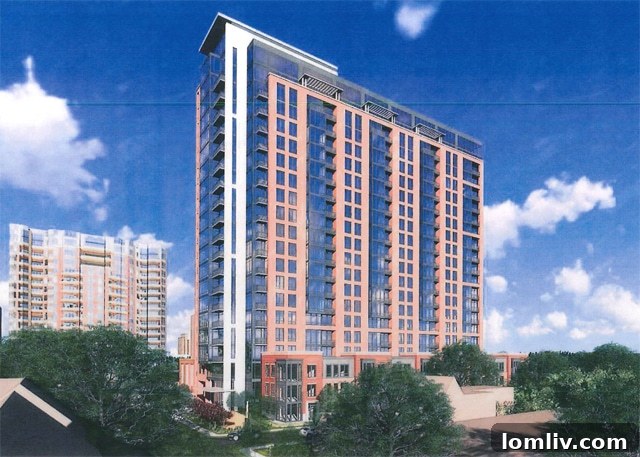
While the agenda usually boasts a variety of topics, this particular evening centered almost entirely on one pivotal issue: Toll Brothers’ ambitious plans for the property at 2728 Welborn. Although a brief two minutes were dedicated to celebrating Reverchon Park’s baseball field turning a century old, the main event was undoubtedly the contentious development. Located strategically southwest of Welborn and Congress, just north of the established Plaza high-rise condos, this site is earmarked for a significant rental unit complex, set to redefine a prominent section of the Oak Lawn neighborhood in Dallas.
The Revived Vision: Toll Brothers’ 21-Story Plan for 2728 Welborn
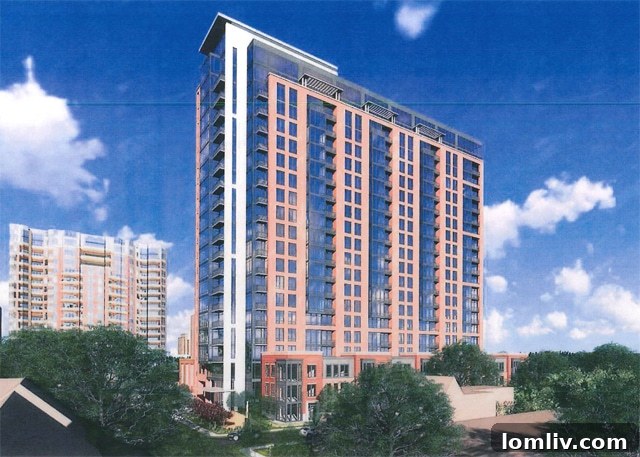
Approximately a year prior, this very project, initially conceived as a towering high-rise, faced considerable neighborhood resistance. Community pushback, often characterized by “pearl-clutching” concerns over density and scale, had seemingly forced a design downgrade to a more “squatty, lump of a building.” However, as urban development often dictates, destiny, or perhaps market forces, has prevailed. Toll Brothers has now re-submitted plans for a striking 21-story high-rise, a testament to evolving urban demands and persistent developer vision. This new iteration promises 271 sophisticated units, each averaging a spacious 938 square feet—a notable 63 square feet larger than typically required by zoning, underscoring a commitment to generous living spaces.
Designing Modern Urban Living: Units, Penthouses, and Townhomes
The development at 2728 Welborn is designed to cater to a diverse range of urban dwellers, offering a thoughtful mix of one and two-bedroom units. Complementing these are a select number of exclusive penthouses, poised to offer unparalleled luxury and views. A distinctive feature, enhancing the street-level engagement, will be nine walk-up townhomes, integrating residential charm directly into the urban fabric. Significantly, nearly a third of the total units will be two-bedroom configurations, addressing the growing demand for larger, more flexible living spaces within high-rise environments. While four penthouses are currently planned, this number remains fluid, subject to further interior floor plate refinements and market analysis, allowing for potential expansion should demand for larger, premium units be robust.
Thoughtful Infrastructure: Parking Solutions and Street-Level Integration
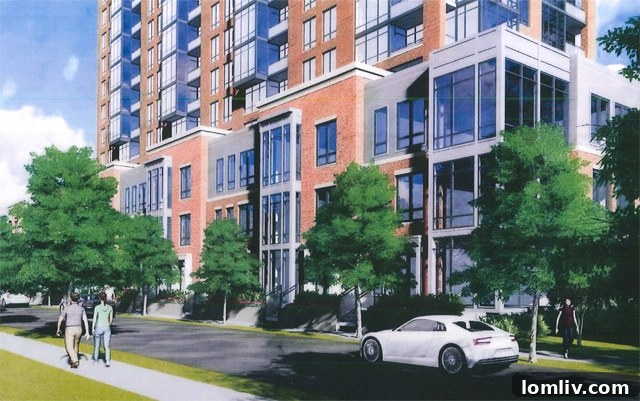
Addressing one of the perennial concerns in urban developments, parking, Toll Brothers’ plan for 2728 Welborn is notably generous. The project will feature 410 parking spaces for its 271 units, exceeding zoning requirements by a small margin. This ample provision aims to significantly alleviate street congestion, minimizing the reliance on public street parking by guests, delivery services, and moving vans. The parking structure itself will be a hybrid design, with three levels above ground and two below, skillfully integrated to optimize space while maintaining aesthetic harmony. Furthermore, the developer has ingeniously revived a concept from previous designs: incorporating three-story walk-up units along the front facade. This architectural choice not only serves to camouflage the parking garage from street view but also thoughtfully aligns with and enhances the existing residential streetscape, fostering a more pedestrian-friendly and cohesive urban environment.
Beyond the Blueprint: Setbacks and Community Considerations
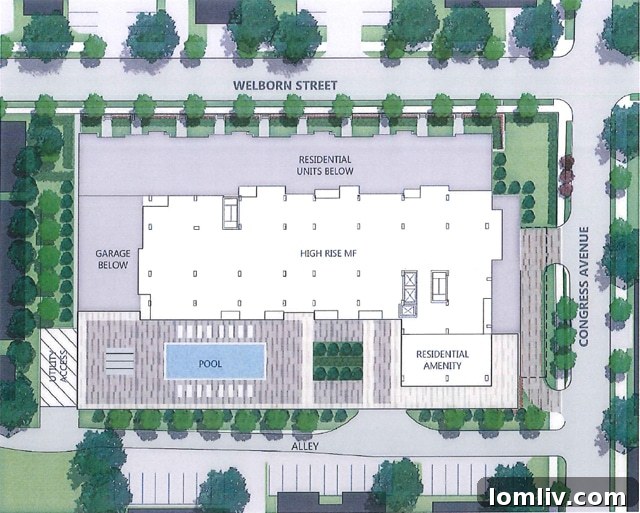
In a proactive move to foster neighborhood harmony, the Oak Lawn Committee had established a dedicated sub-committee. This group diligently collaborated with Toll Brothers and Masterplan, the project’s urban planning consultants, to meticulously devise a plan that directly addressed the primary concerns and “big-bucket problems” articulated by the surrounding community. Their joint efforts appear to have been largely successful in mitigating potential impacts. Key elements of this revised plan include dedicated space for future street widening, a forward-thinking measure to improve traffic flow. Additionally, the development features increased setbacks on all sides, strategically positioning the building further away from neighboring properties. This thoughtful design choice, coupled with the decision to shuffle the building closer to the center of the lot, ensures its substantial bulk is equally distanced from adjacent residences, minimizing visual and spatial intrusion. Furthermore, in a significant enhancement to urban infrastructure and aesthetics, the project commits to burying the power lines, a detail that often goes overlooked but vastly improves the street-level experience and long-term property appeal. When juxtaposed with the neighboring Plaza high-rise, the proposed building stands remarkably close in height, suggesting a careful balance in the urban skyline, where only a carpenter’s level might discern the winner in a height comparison.
Navigating Neighborhood Concerns: Traffic, Zoning, and Community Dialogue
Addressing Traffic Impacts in a Vibrant Corridor
Predictably, the issue of traffic congestion was a central point of discussion and concern. It is an undeniable fact that 271 new apartment units will generate a greater volume of traffic than the handful of condos currently occupying the site. However, the proposed building benefits from its strategic location, nestled between major thoroughfares such as Maple Avenue, Oak Lawn Avenue, Cedar Springs Road, and Turtle Creek Boulevard. This advantageous positioning is expected to facilitate the efficient dispersal of rush hour traffic, bleeding off congestion quickly into the wider road network. While the traffic landscape will undoubtedly change, the difference between the “as-zoned” capacity (216 units) and the “as-proposed” plan (271 units) is relatively minor in the grand scheme of urban growth. The core of the traffic debate often stems from a fundamental misunderstanding: that a new building will eventually occupy this land, rather than remaining as it is today. The real quibble lies between traffic generated by what is legally permissible under current zoning and what the community ideally desires, not between today’s traffic and future developed traffic. That ship, as the saying goes, has already sailed.
The “As-Zoned” vs. “As-Desired” Conundrum
At the conclusion of Masterplan’s comprehensive presentation, the floor was opened for questions from the Oak Lawn Committee members. For the most part, queries sought clarification on specific technical points, none of which represented insurmountable obstacles or major objections. The tenor was largely one of information gathering and fine-tuning, suggesting a collaborative process was, to that point, unfolding as intended. However, this period of relative calm proved to be merely the quiet before the storm. The true flashpoint of the meeting, revealing deep-seated frustrations and philosophical divides, was yet to come, erupting after the formal presentation concluded, transforming a deliberative meeting into a passionate debate.
The Storm Erupts: Opposition and Accusations at the OLC Meeting
The lid, as anticipated, blew off shortly after Masterplan’s representatives departed and Mr. Reverchon concluded his remarks about the historic baseball fields. A dramatic turn of events unfolded as two members of the Oak Lawn Committee, both residing within 200 feet of the proposed Toll Brothers development, launched into a vociferous attack. Their ire was directed not only at the development plan itself but also, pointedly, at the OLC, the very committee of which they were members. They expressed a profound sense of betrayal, articulating deep disappointment that the project, which had previously been scaled back to a “blob building,” had now resurfaced as a towering high-rise.
A Sense of Betrayal: Members Challenge the Committee
One of the dissenting members vehemently questioned why he had been excluded from the sub-committee formed to collaborate with Toll Brothers. His concerns were met with a direct reminder that the sub-committee already included two members living equally close to the site and, critically, that his membership in good standing was contingent upon him paying his outstanding dues, which he settled that very night. This exchange highlighted internal frictions within the committee, revealing personal grievances intertwined with broader development debates. The core issue, for these members, was a perceived lack of transparency and inclusive decision-making, fueling their sense of being sidelined in a process that directly impacted their immediate living environment.
The Down-Zoning Debate: A Waiting Game?
The frustrated members then pivoted their attack, demanding to know why Toll Brothers couldn’t simply delay the project. Their argument hinged on the ongoing efforts to “down-zone” the area, a process that would reduce the permissible building density and height, but which was not expected to receive a ruling from the Plan Commission and City Council for at least another year. This demand, however, revealed a fundamental misunderstanding of the OLC’s role and the realities of property development. The OLC’s mandate is advisory; it reviews proposals based on current regulations and provides recommendations (thumbs-up or thumbs-down) that balance neighborhood best interests with existing zoning laws. The committee has no direct authority over zoning changes. Furthermore, development decisions are inherently made based on the regulatory landscape “today,” not on speculative future legislative changes. Developers cannot, and indeed will not, halt multi-million-dollar projects awaiting hypothetical future government rulings, especially when such processes can be protracted and uncertain. One protester indignantly declared that opponents now possessed the financial resources to actively fight Toll Brothers, a clear indication that the battle was far from over. The re-emergence of the high-rise plan had certainly galvanized opposition, with reports of a flurry of emails circulating between a chief protester and the OLC, signaling that upcoming Plan Commission and City Council meetings for this project are likely to be contentious and “rowdy.”
Upholding Current Regulations: OLC’s Stance
Another point of contention arose when opponents of the proposal sought to have Angela Hunt address the OLC. Hunt, a prominent figure, had been instrumental in a group that successfully petitioned the Plan Commission to study the potential for down-zoning the area. The OLC, however, declined this request, asserting a policy of equal access: if Hunt were permitted to speak, all other interested parties would likewise have to be granted the opportunity, a logistical and procedural challenge the committee was unwilling to undertake during their meeting. This decision, while perhaps frustrating to the opposition, underscored the OLC’s attempt to maintain a structured and fair process, adhering to its established rules of engagement.
Anticipating Future Battles: Plan Commission and City Council
Ultimately, once the heated tirades subsided and order was restored, the Oak Lawn Committee proceeded with a vote. The outcome was clear and decisive: the majority of OLC members present voted to officially support the current, revised iteration of the Toll Brothers’ plan for 2728 Welborn. This vote, while significant, is merely one step in a multi-faceted approval process. The project will now advance to the Dallas Plan Commission and eventually the Dallas City Council, where it is highly anticipated that the fierce opposition witnessed at the OLC meeting will be reignited, leading to further intense public hearings and debates. The OLC’s support, however, provides a crucial endorsement from a key neighborhood stakeholder group, lending considerable weight to Toll Brothers’ proposal as it navigates the final stages of the municipal approval process.
Architectural Critique and Future Outlook: A Personal Perspective
The Aesthetic Appeal: A Preference for Tall Over “Squatty”
From my vantage point, tall buildings are not an anomaly in this urban landscape; they are, in fact, a defining characteristic. In my opinion, a well-designed tall structure is often preferable to a “short, hulking mass-type apartment block.” Aesthetics and urban design are critical, and elements such as generous setbacks and thoughtful street frontage significantly influence how a building integrates into its environment, affecting neighbors and passersby alike. While increased traffic is an unavoidable consequence of urban development, it’s also important to acknowledge that any single building’s capacity to effect widespread neighborhood traffic improvements is inherently limited. The current design of 2728 Welborn, with its emphasis on glass and modern lines, is, in my view, aesthetically superior to the neighboring Plaza. It exudes a more contemporary elegance and offers a brighter, more transparent facade, contributing positively to the architectural dialogue of the area.
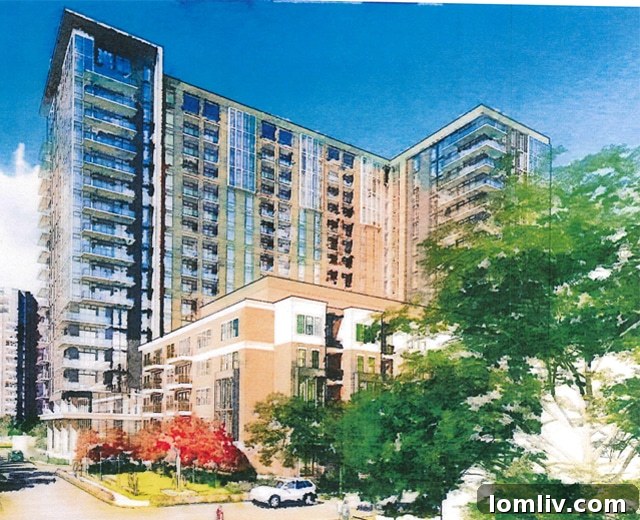
The latest design represents a marked improvement over both the original “chair” design and the previously discussed “squatty, dense, blob” concept. This evolution signifies a responsiveness to feedback and an ongoing refinement process. However, without access to the individual unit plans, my primary critique centers on the balconies. I confess to being a lone crusader for expansive outdoor spaces in high-rises, believing they significantly enhance urban living. In the current design, the balconies appear relatively small. Worse, their integration into the building’s footprint, rather than being boldly cantilevered off the side, feels somewhat constrained. Observing the earlier “chair” design, it seems the current approach might represent a backtrack from that design’s more generous end-unit balconies, which offered a greater sense of openness and connection to the outside.
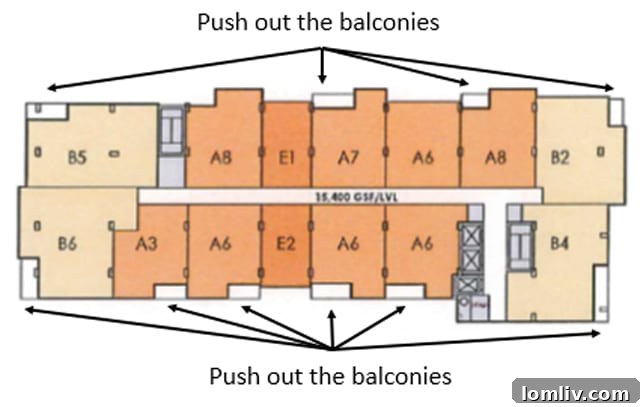
Balconies and Outdoor Space: A Persistent Quibble
Indeed, were I to inhabit one of these non-penthouse units, which, by their very nature, are not designed to be voluminously spacious, I would constantly contemplate the missed opportunity. My thought would be, “If only the room immediately behind the balcony could be extended outwards to ‘square off’ the unit, the interior living space would feel vastly more expansive and functional.” My personal preference leans strongly towards elegant high-rises that feature balconies running the entire length of the unit, providing a continuous, generous outdoor retreat. The balconies in the current design, unfortunately, conjure images of a basic white plastic Dollar Store chair and a struggling frozen basil plant, inevitably adorned with visitors’ discarded cigarette butts – a far cry from the luxurious, integrated outdoor living spaces I envision for modern urban residences.
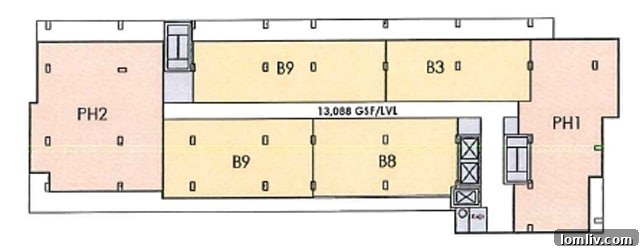
Intriguingly, the penthouse level of the building is slated to feature those highly desirable, full-length, generous balconies. This design choice prompts the unavoidable question: if such expansive outdoor spaces are feasible and desirable for the top-tier units, why not extend this architectural amenity, or at least a more substantial version of it, to the remainder of the building? The disparity highlights a potential missed opportunity to elevate the living experience for a broader range of residents, adding significant value and appeal across all unit types, not just the exclusive penthouses.
A Critical Look at Property Futures in PD-193
Critically, property owners within the PD-193 zoning district should be undertaking a thorough and dispassionate assessment of their future prospects. The implications of the ongoing “down-zoning” movement are profound: should the proponents of down-zoning succeed, the inherent value of existing property parcels would likely diminish. For any owners who have ever contemplated selling their land to a developer, the present moment – right this second – represents a critical window of opportunity. Delaying this decision, even by a week or a month, could prove financially detrimental. Assembling a successful development deal is a complex, time-consuming process, and any potential sale would almost certainly be contingent upon an approved plan that aligns with current, more liberal zoning regulations. Furthermore, if an individual parcel is deemed too small for standalone development, now is the opportune time to actively engage with immediate neighbors to collaboratively assemble a build-able package, thereby maximizing collective land value. The clock is ticking, and the potential value inherent in these properties is truly yours to lose if inaction prevails.
Engaging with Dallas Real Estate: My Expertise and Invitation
My professional focus and passion lie deeply within the dynamic realms of high-rise developments, Homeowners Associations (HOAs), and property renovation. Beyond these core areas, I possess a profound appreciation for the delicate balance between innovative modern architecture and the preservation of historical structures, all viewed through the evolving lens of the YIMBY (Yes In My Backyard) movement. This perspective allows for a comprehensive understanding of urban growth and community integration. Should your organization be interested in hosting a daltxrealestate.com Staff Meeting event, leveraging my insights and expertise, I am readily available and eager to connect. My commitment to insightful real estate commentary has been recognized through industry accolades; in 2016, my writing was honored with both Bronze and Silver awards from the esteemed National Association of Real Estate Editors. Whether you have a compelling story to share, a crucial question about Dallas real estate, or perhaps even a unique marriage proposal to make, please do not hesitate to reach out. You can connect with me directly via email at [email protected]. I look forward to hearing from you and engaging in meaningful dialogue about the vibrant real estate landscape of Dallas.