Texas Housing Market Defies Seasonal Slowdown: A Deep Dive into Q3 2014 Trends
Typically, the rhythm of the real estate market follows a predictable pattern: spring and summer witness a flurry of activity, culminating in robust home sales, while the onset of fall and the new school year traditionally usher in a slower pace of closings. However, the third quarter of 2014 presented a notable deviation from this expected trend across Texas. According to the recently released Texas Association of Realtors Quarterly Housing Report, the Lone Star State’s housing market demonstrated remarkable resilience, defying the usual seasonal deceleration. This period was further characterized by a consistent monthly increase in housing inventory, a crucial development that continued to fuel brisk sales in many localized areas.
This surprising stability and even growth in certain segments underscore the unique dynamics at play within the Texas economy during this time. While the statewide picture painted a story of robust activity, local markets experienced varied conditions, emphasizing the age-old adage that all real estate is inherently local. This report offers invaluable insights into the forces shaping supply, demand, and pricing across one of the nation’s most dynamic housing landscapes.
Statewide Texas Housing Market: Defying Expectations
The third quarter of the year, spanning July, August, and September, typically signals a winding down from the peak buying seasons. However, as Dan Hatfield, then chairman of the Texas Association of Realtors (TAR), observed, “The third quarter of the year is typically a much slower sales period – summer is over, school has started and families are staying put for the upcoming holiday season. That was not the case this year.” He further elaborated on the unexpected strength, noting that “Texas home sales continue to slightly exceed last year’s levels. If this trend continues, 2014 will surpass 2013 to become the second-best year ever for Texas real estate.” This statement highlighted a strong trajectory, indicating that the overall health and momentum of the Texas housing market were robust, potentially setting new benchmarks for the state.
The report detailed significant figures that substantiated Hatfield’s observations, painting a clear picture of an active and competitive market. The volume of sales across Texas remained remarkably consistent, reinforcing the underlying strength of demand despite seasonal pressures. This steadiness in sales, coupled with an essential replenishment of housing inventory, positioned the market for sustained activity rather than a slump.
According to the report, 80,851 Texas homes were sold in 2014-Q3. This figure represents only a marginal 0.63 percent decrease compared to the sales volume of the preceding second quarter, and, more notably, a slight but significant 0.61 percent increase over the home sales volume recorded in Q3 2013. While some local Texas markets experienced minor dips in home sales during 2014, the statewide figures remained impressively steady. This stability was primarily attributed to much-needed gains in housing inventory and the unrelenting, strong housing demand characterizing the state’s vibrant economy.
A pivotal factor contributing to this stability was the consistent growth in monthly housing inventory across Texas. For the second consecutive quarter, inventory levels rose, increasing by 2.77 percent from Q2 2014 to reach 3.7 months of supply. While this figure still indicated a 7.5 percent decline compared to Q3 2013, it marked a significant easing of the severe year-over-year decreases in inventory that had plagued the market, with sharp 20- to 30-percent drops observed over the preceding two years. This moderation in inventory decline signaled a healthier, albeit still tight, market environment.
The Quest for a Balanced Market: Inventory Challenges Persist
While the easing of inventory declines was indeed a positive sign for continued growth and sales, the Texas market remained far from what economists consider a balanced state. Jim Gaines, an economist with the Real Estate Center at Texas A&M University, defines a comfortable, balanced housing market as one with approximately 6.5 months of inventory. At 3.7 months, the Q3 2014 figures clearly indicated that supply was still significantly lagging behind demand, fostering an environment where sellers often had the upper hand.
Gaines further elaborated on the persistent challenges facing the construction industry, which plays a critical role in alleviating inventory shortages. “Developers are building homes about as fast as they can, but continued shortages in labor and vacant developed lots are keeping homebuilders from increasing production even further,” he explained. This bottleneck in new construction, stemming from both a scarcity of skilled workers and a lack of ready-to-build land, prevented a quicker replenishment of available homes. When combined with other market pressures such as incrementally higher home prices and more stringent lending standards for buyers, the prognosis was clear: “the Texas housing market will remain very competitive for homebuyers into 2015.” This outlook signaled a continued challenging environment for those looking to purchase, where swift decisions and strong offers would often be necessary to secure a property.
Dallas Real Estate: A Local Deep Dive into Mixed Signals
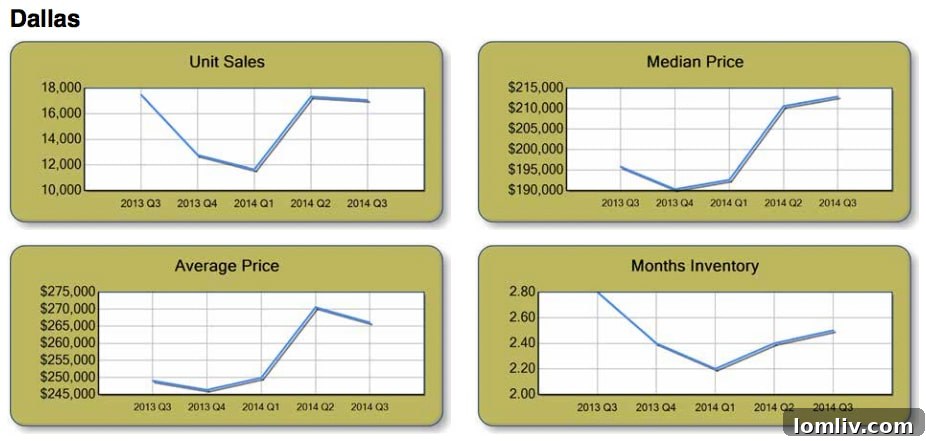
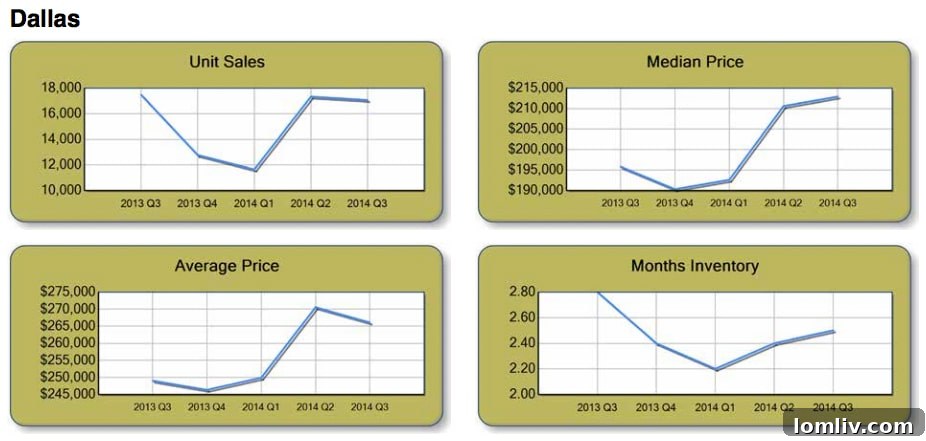
While the statewide narrative of robust performance and steady sales offered a generally optimistic view, the Dallas real estate market presented a more nuanced picture. In a testament to the “all real estate is local” mantra, Dallas experienced trends that diverged from the broader Texas pattern in key aspects. Specifically, the third quarter of 2014 saw home sales in Dallas decrease by 2.36 percent year-over-year. This modest decline in sales activity occurred concurrently with a significant rise in median home prices, which climbed by 8.73 percent, reaching new highs for the region. Perhaps the most critical factor influencing both these trends was the precipitous drop in inventory, which was down a striking 10.71 percent from Q3 2013 levels.
The interplay of these factors in Dallas illustrates a classic economic principle: when supply is constrained, demand, even if slightly tempered, can drive prices upward. The sharp reduction in available homes meant that fewer transactions were taking place, yet the intense competition for the limited properties pushed values higher. This dynamic suggests that until housing inventory in Dallas sees a substantial increase, home prices will likely continue their ascent, while sales volumes could remain on a slow, downward trajectory as buyers face fewer options and higher barriers to entry. This creates a challenging environment for prospective homebuyers, who must navigate a market with limited choices and escalating costs.
However, even within Dallas, conditions varied considerably from neighborhood to neighborhood, highlighting the granular nature of the real estate market. Certain areas demonstrated exceptional vitality, experiencing notable increases in activity and value. Districts such as Midway Hollow, Lakewood, Lake Highlands, and West Kessler stood out as pockets of strong performance, likely driven by specific amenities, school districts, or development initiatives. Conversely, other areas and particular price ranges within the city continued to experience sluggish activity, struggling to attract buyers despite the overall upward trend in prices. This regional disparity underscores the importance of hyper-local analysis when evaluating real estate opportunities and challenges within a large metropolitan area like Dallas.
Price Trends, Economic Drivers, and Infrastructure Challenges
Across the state, the tight inventory conditions naturally led to continued upward pressure on home prices. The report indicated that median home prices increased at a “steady, but slower pace” during the last quarter. The statewide median home price surged by 6.84 percent from the same period last year, reaching $188,900. While this represented robust growth, the double-digit gains witnessed in 2012 were largely a thing of the past, with only a few select markets still experiencing such accelerated appreciation. Texas’s major metropolitan areas generally saw more moderate price gains, typically ranging between 5 to 9 percent year over year, reflecting a more sustainable, albeit still competitive, growth rate.
The underlying engine driving Texas’s robust housing market and rising prices was its booming economy and unparalleled job growth. Texas continued to be a magnet for individuals and families seeking new opportunities, leading to significant population growth. This influx of new residents created sustained demand for housing, consistently outstripping supply. However, this rapid expansion also brought with it a critical challenge: the strain on existing infrastructure. The state’s ability to maintain its growth trajectory and quality of life depends heavily on its capacity to support a continually expanding population.
Infrastructure: The Unseen Challenge for Sustained Growth
The scale of population growth in Texas is truly remarkable, with profound implications for all sectors, including real estate. As TAR Chairman Dan Hatfield highlighted, “Approximately 1,600 Americans per day relocate to Texas to take part in our state’s booming job market and economic growth.” This staggering daily influx places immense pressure on everything from roads and bridges to public utilities and schools. Hatfield stressed the urgency of addressing these foundational needs: “The future sustainability of the Texas housing market is dependent upon having the right infrastructure in place to support our state’s rapid growth.” Without adequate infrastructure, the very growth that fuels the housing market could eventually be hampered, leading to decreased quality of life and potentially slowing economic momentum.
To proactively address these critical needs, the Texas Association of Realtors actively encouraged Texans to participate in the democratic process by voting for Proposition 1 on November 4th. This proposition was presented as a crucial step forward in tackling the approximately $5 billion in statewide transportation needs that historically went unmet each year. The passage of such initiatives is vital, as improved infrastructure not only supports the existing population but also facilitates continued economic development and makes Texas an even more attractive destination for businesses and individuals, thereby indirectly sustaining the health and growth of the real estate sector.
Looking Ahead: Navigating a Competitive Texas Real Estate Market
The Q3 2014 Texas Housing Report paints a picture of a resilient and competitive real estate market that defied traditional seasonal slowdowns. While robust job growth and population influx continued to fuel demand, persistent inventory shortages remained a defining characteristic, driving up prices and creating challenges for homebuyers. The moderation in the rate of inventory decline statewide offered a glimmer of hope for a more balanced market in the future, but experts indicated that a true equilibrium was still some time away, with significant hurdles in construction and land development yet to be overcome. For buyers, sellers, and real estate professionals alike, understanding these nuanced trends, from statewide statistics to hyper-local market dynamics, remains crucial for making informed decisions in a dynamic and ever-evolving landscape.
The discussion around infrastructure also underscores a broader, long-term challenge that transcends immediate market cycles, emphasizing that sustainable growth requires comprehensive planning and investment. As Texas continues to attract new residents and businesses, its ability to adapt and expand its foundational services will directly impact the long-term health and desirability of its communities and, by extension, its housing market. Looking forward from 2014, the trajectory of Texas real estate would undoubtedly be shaped by how effectively these interconnected challenges were addressed.
We invite our readers to share their perspectives on the ballot propositions and local developments. What are your observations in your neighborhood? How do these statewide trends resonate with your personal experiences in the Texas housing market?