The Battle for Fair Park: Unpacking Dallas’s Controversial Revitalization Plan
Dallas’s iconic Fair Park, a treasured historical site and host to the renowned State Fair of Texas, stands at a pivotal crossroads. A contentious plan, vigorously championed by Mayor Mike Rawlings, aims to redefine its future. However, this ambitious proposal, designed to revitalize the historic grounds, faces fierce opposition and raises serious questions about public accountability, financial transparency, and the very spirit of democratic governance. Despite concerns from numerous city council members and the public, Mayor Rawlings is determined to push through a plan that could cost taxpayers a staggering $7 to $9 million annually, yet notably excludes the creation of a much-needed public park.
Critics argue that the plan, far from being a genuine revitalization effort, might merely be a disguised jobs program slated to be transferred to a private foundation. Such a move, they contend, could create a convenient veil behind which further mismanagement of taxpayer funds could be concealed, away from public scrutiny. Moreover, serious questions have been raised regarding the legality of the proposed process, hinting at potential violations of established competitive bidding laws and best practices in public procurement.
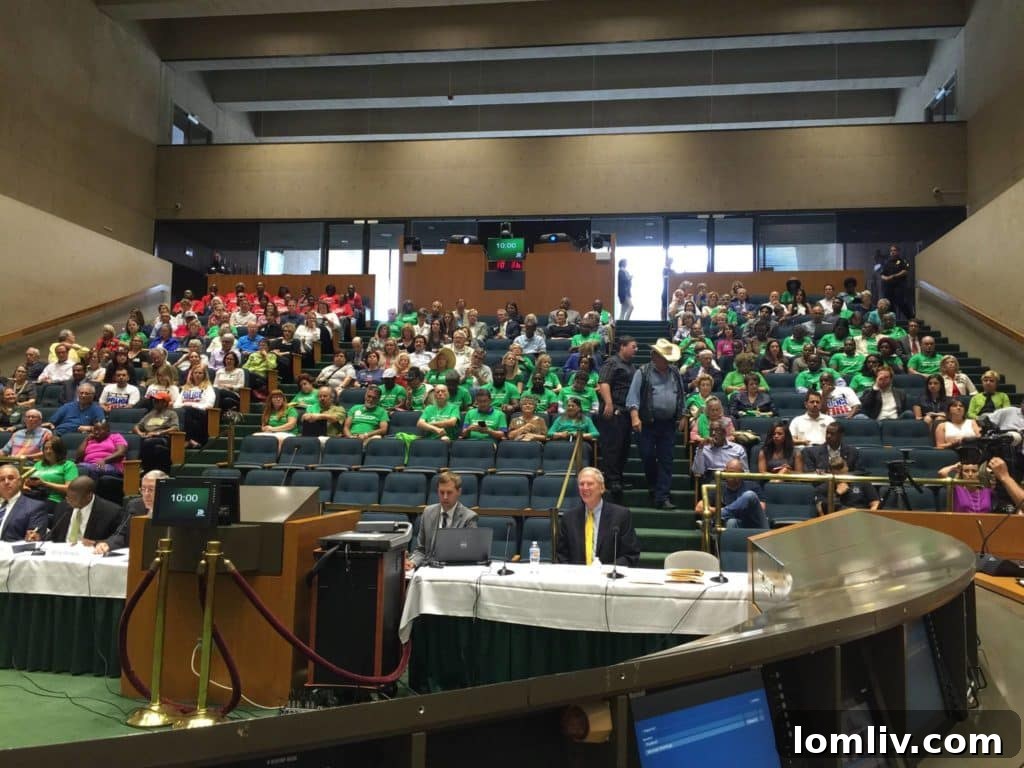
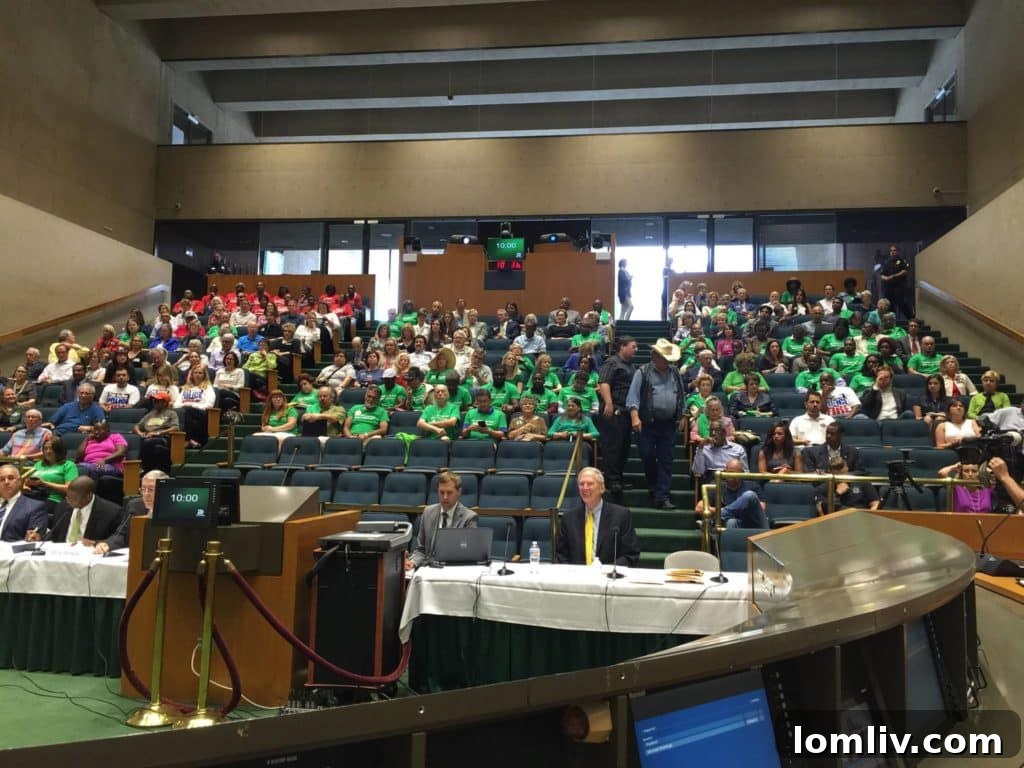
Attending Monday’s four-hour city council briefing offered profound insights into the intricacies and tensions surrounding this issue. It was a marathon session that, arguably, should have been scheduled during a more taxpayer-convenient time, such as an evening or a weekend, to allow broader public participation and engagement. The sparse empty seats at City Hall, visible in images from the day, underscore the community’s keen interest in the future of Fair Park.
The Mayor’s Urgent Agenda: A Question of Democratic Process?
One of the most striking observations from the lengthy debate was the Mayor’s undeniable urgency to finalize this deal. At the session’s conclusion, Mayor Rawlings declared, “If we don’t pass this, it doesn’t happen in the next twenty years. This is a democracy. Let’s talk, let’s get it done.” This statement, however, starkly contrasts with his actions throughout the process. Following four hours of robust debate, during which several council members meticulously dissected and criticized the plan, the Mayor bypassed the broader democratic process by handing the proposal over to a select committee of three allies: Tiffany Young, Adam McGough, and Monica Alonzo. Notably, Councilman Adam Medrano, whose district encompasses much of Fair Park, was deliberately excluded from this committee after expressing his opposition to the plan.
“It is near impossible to negotiate a deal with 30 people,” Rawlings stated, attempting to justify his decision to narrow the negotiation team. Yet, as many observers pointed out, isn’t complex negotiation with multiple stakeholders precisely what defines a functional democracy and effective governance? Even Adam McGough, a former chief of staff to the Mayor and initially one of the plan’s tougher questioners, voiced his reluctance to vote for the plan as it stood. This sentiment, indicating a desire for more deliberation and refinement, appeared to be dismissed by the Mayor, signaling a clear intent to fast-track the project.
For a comprehensive summary of the afternoon’s proceedings, Watchdog.org provided an excellent recap, underscoring the political dynamics at play.
It’s clear now that Mayor Mike Rawlings doesn’t have the votes to ram through a version of the plan that would commit the city of Dallas to $600 million-plus in repairs, salaries, and fees, while leaving the actual park contingent on the success of some future fundraising drive. The issue is likely to come down to the votes of three African-American council members: Casey Thomas, II, Carolyn King Arnold and Erik Wilson.
The original text counted Jennifer Gates as a “half” vote, indicating her critical stance despite potential eventual alignment. She asked crucial questions, particularly about the proposed offer of jobs to all current Fair Park employees without any prior performance reviews. The response—”Park and Recreation to evaluate performance”—struck many as an evasion, fueling public anger over what appeared to be a continuation of inefficient practices and political patronage within the Dallas municipal system. This situation, observers suggest, might be a lingering symptom of Dallas clinging to its “old small town ways.” Despite these reservations, there was an underlying expectation that Councilwoman Gates and Lee Kleinman, known for his fiscal vigilance, would ultimately side with the Mayor, highlighting the political pressures at play.
Fair Park Revitalization: Unpacking the Plan’s Flaws and Fiscal Realities
The core issue is not a lack of desire to revitalize Fair Park. There is universal agreement on the importance of restoring and preserving its historic buildings and finally giving the landmark the attention it deserves as a national treasure. The true contention lies in the fundamental flaws of the specific plan Mayor Rawlings is aggressively promoting—a plan many perceive as rapidly and undemocratically pushed. It is riddled with inconsistencies and gaps; council members even noted missing pages in the proposal documents, underscoring a lack of thoroughness.
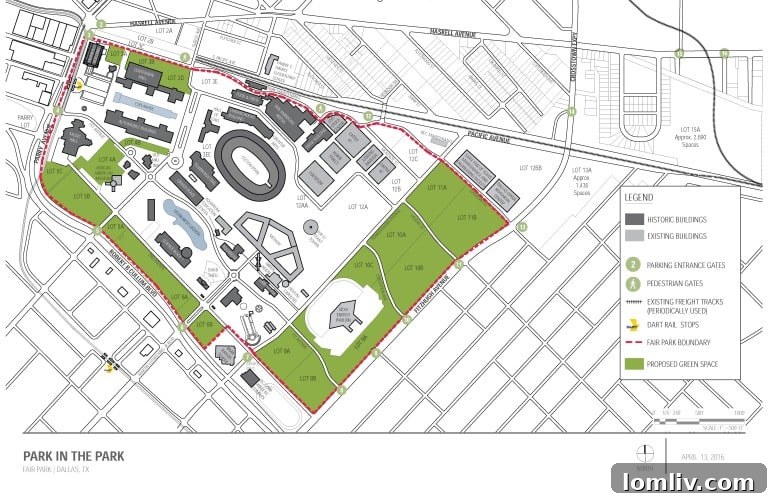
This plan was primarily developed in collaboration with Walt Humann, a former Hunt Oil executive and philanthropist. While Mr. Humann undoubtedly put forth his best effort, critics suggest his approach was overly cautious, careful not to disrupt the established operations and financial interests of the State Fair of Texas, a major tenant and long-term stakeholder at Fair Park.
Councilman Scott Griggs, however, was unafraid to challenge this delicate balance. He pointedly questioned whether the State Fair would finally begin contributing to the maintenance of the buildings they occupy, many of which have fallen into disrepair over years of deferred maintenance. Griggs asserted that all excess revenue generated by the State Fair should be reinvested directly into these historic structures, rather than solely relying on public funds. He also advocated for greater community representation on the deciding board, insisting that at least four local residents, rather than just one or two, should hold positions of power on the governing body to ensure equitable development. “It can’t be people coming down, crossing the river and coming home,” Griggs emphasized, highlighting the critical need for genuine local engagement and sustained investment from the surrounding neighborhoods.
Griggs went further, suggesting that if Humann wished to lead the foundation dedicated to Fair Park’s future, he should relocate to Dallas from University Park within a year, demonstrating a deeper, more personal commitment to the city and its residents. He also highlighted the untapped potential for Fair Park’s buildings to become profitable through strategic tenant placements and commercial leasing. While Humann frequently underscored Fair Park’s free entry, contrasting it with paid attractions like the Dallas Zoo or the Dallas Arboretum, Griggs shrewdly countered: “You can’t put someone in the gorilla cage at the Zoo and lease it, but you can lease Fair Park’s real estate.” His insightful arguments garnered significant applause from the public, prompting a pause in the clock to allow him more time to speak. Yet, concerning the State Fair’s concrete involvement, the only vague assurance offered was that “they are working with us.” The specifics of this collaboration and their financial contributions remain conspicuously absent, raising flags about their true commitment.
Financial Discrepancies and the State Fair’s Obligations
In his 30-plus minute address to the council, Walt Humann, presenting himself as a humanitarian, emphasized that a “great park” would be the plan’s paramount priority. Yet, a glaring contradiction emerged from the financial details: the plan proposes 100% city funding for the repair of all Fair Park buildings, from the Hall of State to the Swine Building—structures predominantly utilized by the State Fair of Texas for its annual event. Councilman Mark Clayton meticulously highlighted this point, revealing a budget allocation of $250,000—a mere quarter of a million dollars—specifically earmarked for the park itself, to be funded directly by Dallas taxpayers. To put this in perspective, $250,000 is comparable to the landscaping budget for a modest $5 million home, underscoring the limited investment in actual green space compared to the vast sums allocated for building repairs benefiting a private entity.

This financial disparity is the crux of the frustration for many, including theDallas Morning News, who struggle to reconcile the proposal. While there is universal consensus on the critical need to preserve, restore, and maintain Fair Park’s historic architecture, the question remains: why should Dallas taxpayers bear the full burden when the State Fair has allegedly deferred maintenance for such an extended period? With a contract extending until 2028, as confirmed by Rick Callahan, many question why the city cannot re-evaluate and potentially alter this agreement, especially given the alleged failure of one party to meet its obligations—a common practice in contract law. Modifying such a lease or contract happens all the time when one party is not holding up their end of the bargain.
Under the council’s intense questioning, Walt Humann visibly showed signs of discomfort and frustration. The public gallery reflected the deep divisions, with “green shirts” advocating for a larger, park-first approach outnumbering the “red shirts” supporting Humann’s plan. Yet, numerous “pro Fair Park” stickers were also evident, highlighting a nuanced public sentiment focused primarily on the buildings themselves. A woman observed muttering, “it’s about the buildings,” while a South Dallas councilman spoke about economic development for his neighborhood. This tension was further amplified by fourteen pastors who took out a full-page advertisement in Sunday’s Dallas Morning News, citing the area’s “history of division and injustice” and imploring the council to prioritize community and green space before rushing into a decision. Despite these powerful pleas, Mayor Rawlings remained steadfast in his determination to “get ‘her done,” signaling a disregard for community-led initiatives.
The grim faces of police and firemen in the audience underscored another painful trade-off and a glaring disparity in public funding. Dallas had recently been forced to scale back its plans to hire 549 new police officers, a $20.3 million investment, phasing them in over three years to save money. The official explanation cited difficulties in finding qualified candidates quickly. This directly led to the stark question: how many police officers could be hired with the $7 million per year proposed for Fair Park—a sum that would largely benefit buildings used by a private entity?
When Councilwoman Carolyn King Arnold pressed for a clear, concise cost figure she could present to her constituents, City Manager A.C. Gonzales, under Mayor Rawlings’s prompting, quoted “$7 million.” This figure represents the increase in cost over the current annual expenditure, which stands at approximately $11.1 million, less about $2 million in trickling Fair Park revenues. Crucially, this “$7 million” is not the future cost, as the plan’s expenses are projected to escalate annually over a 20-year period. This escalating cost, even accounting for inflation and cost-of-living indexes, left many council members, including those who questioned Humann, scratching their heads. Humann himself had previously emphasized the current “terribly inefficient” upkeep of Fair Park, citing examples like separate contractors for exterior and interior door repairs. The council’s pertinent question then became: why would the city’s cost *increase* if the plan promises snowballing efficiencies, such as streamlined door repairs? The inescapable conclusion, for many, was that the Humann Plan, despite its grand promises, appears to be a costly continuation of the “same old status,” rather than a revolutionary improvement.
The Legal Labyrinth: Bypassing Competitive Bidding and the Threat of Litigation
A crucial legal challenge emerged during Councilman Philip Kingston’s pointed interrogation. He directly asked whether a Request for Proposal (RFP) process had been followed. This was precisely the question that had been raised at an earlier panel discussion, highlighting a significant procedural oversight that could undermine the entire deal. An RFP is a standard solicitation for business proposals designed to ensure fairness, transparency, inclusivity, and competitive bidding, ultimately securing the best value and deal for a municipality. Kingston’s question triggered a brief, visibly flustered exchange among city attorneys, who consulted multiple legal pads before offering a response.
Their answer cited a potential exemption within Texas state law, specifically Section 252.022(a)(7)(F). This section states that if a proposed contract is for “management services provided by a nonprofit organization to a municipal museum, park, zoo, or other facility to which the organization has provided significant financial or other benefits,” then “that organization is exempt” from the usual competitive bidding requirements. The interpretation of this exemption became the central legal battleground.
Kingston, however, pressed for specifics, demanding, “Where’s the beef?” He drew a clear parallel with Klyde Warren Park, a successful Dallas urban park that was established with substantial upfront financial contributions from Kelcy Warren and other private donors *before* public funds were committed. In stark contrast, Humann’s non-profit was not approaching the city with pre-raised funds for Fair Park. This raised the critical question: what were the “other benefits” the foundation was *currently* offering the city that would justify this significant exemption from competitive bidding, as the law specifies “provided” (past tense) significant benefits?
City attorneys then attempted to argue that the management services Mr. Humann was *offering* (future tense) constituted the benefit. However, Philip Kingston swiftly countered this interpretation: “They are saying it is the money they intend to raise in the future, but the law says it must previously have been contributed to the park.” This distinction between past contributions and future intentions is paramount and, if Kingston’s interpretation of the statute is correct, renders the entire process potentially illegal. “I think the whole thing is illegal,” he later stated, warning that “if the Mayor wins this even by a slim victory, we run the risk of being sued.” When asked who could initiate such a lawsuit, Kingston confirmed that any interested taxpayer would have standing, as would any entity that might have wished to bid on the project through a proper, transparent RFP process, thus being unfairly excluded.
A Glimmer of Hope: The Rise of a Watchdog City Council
Beyond the immediate controversy surrounding Fair Park, the prolonged and intense council session revealed another significant development for Dallas: the nascent formation of a highly promising City Council, possibly one of the best in recent memory. While acknowledging that a few council members still need to adjust their approach and fully embrace independent scrutiny, there was a palpable sense of fresh air circulating through City Hall. This new generation of council members displayed a clear commitment to acting as genuine watchdogs for the entire city, not merely their individual districts or political allegiances. They demonstrated an unwavering unwillingness to succumb to the status quo or permit “the good old ways” of backroom deals and opaque processes to dictate public policy. Councilwoman Sandy Greyson encapsulated this sentiment perfectly with her memorable quip about not “paying $100 for a hammer,” symbolizing a refreshing demand for fiscal responsibility, transparency, and meticulous scrutiny of public expenditures. Indeed, those four hours spent witnessing the impassioned and informed debate felt like some of the most valuable time invested in civic engagement in a long while, offering a hopeful outlook for Dallas’s governance.
APPENDIX: Relevant Excerpts from Texas Local Government Code Chapter 252
Below are pertinent sections of the Texas Local Government Code that inform the discussion around municipal purchasing and contracting authority, particularly concerning competitive bidding and exemptions. This code governs how municipalities in Texas conduct their procurement processes.
TITLE 8. ACQUISITION, SALE, OR LEASE OF PROPERTY
SUBTITLE A. MUNICIPAL ACQUISITION, SALE, OR LEASE OF PROPERTY
CHAPTER 252. PURCHASING AND CONTRACTING AUTHORITY OF MUNICIPALITIES
SUBCHAPTER A. GENERAL PROVISIONS
Sec. 252.001. DEFINITIONS. In this chapter:
(1) “Bond funds” includes money in the treasury received from the sale of bonds and includes the proceeds of bonds that have been voted but have not been issued and delivered.
(2) “Component purchases” means purchases of the component parts of an item that in normal purchasing practices would be purchased in one purchase.
(3) “Current funds” includes money in the treasury, taxes in the process of being collected in the current tax year, and all other revenue that may be anticipated with reasonable certainty in the current tax year.
(4) “High technology procurement” means the procurement of equipment, goods, or services of a highly technical nature, including:
(A) data processing equipment and software and firmware used in conjunction with data processing equipment;
(B) telecommunications equipment and radio and microwave systems;
(C) electronic distributed control systems, including building energy management systems; and
(D) technical services related to those items.
(5) “Planning services” means services primarily intended to guide governmental policy to ensure the orderly and coordinated development of the state or of municipal, county, metropolitan, or regional land areas.
(6) “Separate purchases” means purchases, made separately, of items that in normal purchasing practices would be purchased in one purchase.
(7) “Sequential purchases” means purchases, made over a period, of items that in normal purchasing practices would be purchased in one purchase.
(8) “Time warrant” includes any warrant issued by a municipality that is not payable from current funds.
Acts 1987, 70th Leg., ch. 149, Sec. 1, eff. Sept. 1, 1987. Amended by Acts 1989, 71st Leg., ch. 1250, Sec. 2, eff. Sept. 1, 1989; Acts 1995, 74th Leg., ch. 207, Sec. 1, eff. May 23, 1995.
Sec. 252.002. MUNICIPAL CHARTER CONTROLS IN CASE OF CONFLICT. Any provision in the charter of a home-rule municipality that relates to the notice of contracts, advertisement of the notice, requirements for the taking of sealed bids based on specifications for public improvements or purchases, the manner of publicly opening bids or reading them aloud, or the manner of letting contracts and that is in conflict with this chapter controls over this chapter unless the governing body of the municipality elects to have this chapter supersede the charter.
Acts 1987, 70th Leg., ch. 149, Sec. 1, eff. Sept. 1, 1987. Amended by Acts 1993, 73rd Leg., ch. 749, Sec. 5, eff. Sept. 1, 1993; Acts 1993, 73rd Leg., ch. 757, Sec. 7, eff. Sept. 1, 1993.
Sec. 252.003. APPLICATION OF OTHER LAW. The purchasing requirements of Section 361.426, Health and Safety Code, apply to municipal purchases made under this chapter.
Added by Acts 1991, 72nd Leg., ch. 303, Sec. 17, eff. Sept. 1, 1991.
SUBCHAPTER B. COMPETITIVE BIDDING OR COMPETITIVE PROPOSALS REQUIRED
Sec. 252.021. COMPETITIVE REQUIREMENTS FOR PURCHASES. (a) Before a municipality may enter into a contract that requires an expenditure of more than $50,000 from one or more municipal funds, the municipality must:
(1) comply with the procedure prescribed by this subchapter and Subchapter C for competitive sealed bidding or competitive sealed proposals;
(2) use the reverse auction procedure, as defined by Section 2155.062(d), Government Code, for purchasing; or
(3) comply with a method described by Chapter 2269, Government Code.
(b) A municipality may use the competitive sealed proposal procedure for the purchase of goods or services, including high technology items and insurance.
(c) The governing body of a municipality that is considering using a method other than competitive sealed bidding must determine before notice is given the method of purchase that provides the best value for the municipality. The governing body may delegate, as appropriate, its authority under this subsection to a designated representative. If the competitive sealed proposals requirement applies to the contract, the municipality shall consider the criteria described by Section 252.043(b) and the discussions conducted under Section 252.042 to determine the best value for the municipality.
(d) This chapter does not apply to the expenditure of municipal funds that are derived from an appropriation, loan, or grant received by a municipality from the federal or state government for conducting a community development program established under Chapter 373 if under the program items are purchased under the request-for-proposal process described by Section 252.042. A municipality using a request-for-proposal process under this subsection shall also comply with the requirements of Section 252.0215.
Acts 1987, 70th Leg., ch. 149, Sec. 1, eff. Sept. 1, 1987. Amended by Acts 1989, 71st Leg., ch. 1, Sec. 56(b), eff. Aug. 28, 1989; Acts 1993, 73rd Leg., ch. 749, Sec. 1, eff. Sept. 1, 1993; Acts 1993, 73rd Leg., ch. 757, Sec. 11, eff. Sept. 1, 1993; Acts 1995, 74th Leg., ch. 45, Sec. 1, eff. May 5, 1995; Acts 1997, 75th Leg., ch. 790, Sec. 1, eff. June 17, 1997; Acts 1999, 76th Leg., ch. 571, Sec. 1, eff. June 18, 1999; Acts 2001, 77th Leg., ch. 115, Sec. 1, eff. Sept. 1, 2001; Acts 2001, 77th Leg., ch. 436, Sec. 2, eff. May 28, 2001; Acts 2001, 77th Leg., ch. 436, Sec. 3, eff. May 28, 2001; Acts 2001, 77th Leg., ch. 1409, Sec. 1, eff. Sept. 1, 2001; Acts 2003, 78th Leg., ch. 217, Sec. 1, eff. June 18, 2003; Acts 2003, 78th Leg., ch. 1276, Sec. 12.003, eff. Sept. 1, 2003.
Amended by:
Acts 2007, 80th Leg., R.S., Ch. 434 (S.B. 1765), Sec. 1, eff. September 1, 2007.
Acts 2007, 80th Leg., R.S., Ch. 1213 (H.B. 1886), Sec. 1, eff. September 1, 2007.
Acts 2007, 80th Leg., R.S., Ch. 1272 (H.B. 3517), Sec. 1, eff. September 1, 2007.
Acts 2007, 80th Leg., R.S., Ch. 1272 (H.B. 3517), Sec. 2, eff. September 1, 2007.
Acts 2011, 82nd Leg., R.S., Ch. 1129 (H.B. 628), Sec. 4.01, eff. September 1, 2011.
Acts 2013, 83rd Leg., R.S., Ch. 161 (S.B. 1093), Sec. 22.002(20), eff. September 1, 2013.
Sec. 252.0215. COMPETITIVE BIDDING IN RELATION TO HISTORICALLY UNDERUTILIZED BUSINESS. A municipality, in making an expenditure of more than $3,000 but less than $50,000, shall contact at least two historically underutilized businesses on a rotating basis, based on information provided by the comptroller pursuant to Chapter 2161, Government Code. If the list fails to identify a historically underutilized business in the county in which the municipality is situated, the municipality is exempt from this section.
Added by Acts 1993, 73rd Leg., ch. 749, Sec. 3, eff. Sept. 1, 1993. Amended by Acts 1997, 75th Leg., ch. 165, Sec. 17.18, eff. Sept. 1, 1997; Acts 2001, 77th Leg., ch. 115, Sec. 2, eff. Sept. 1, 2001.
Amended by:
Acts 2007, 80th Leg., R.S., Ch. 434 (S.B. 1765), Sec. 2, eff. September 1, 2007.
Acts 2007, 80th Leg., R.S., Ch. 937 (H.B. 3560), Sec. 1.100, eff. September 1, 2007.
Sec. 252.022. GENERAL EXEMPTIONS. (a) This chapter does not apply to an expenditure for:
(1) a procurement made because of a public calamity that requires the immediate appropriation of money to relieve the necessity of the municipality’s residents or to preserve the property of the municipality;
(2) a procurement necessary to preserve or protect the public health or safety of the municipality’s residents;
(3) a procurement necessary because of unforeseen damage to public machinery, equipment, or other property;
(4) a procurement for personal, professional, or planning services;
(5) a procurement for work that is performed and paid for by the day as the work progresses;
(6) a purchase of land or a right-of-way;
(7) a procurement of items that are available from only one source, including:
(A) items that are available from only one source because of patents, copyrights, secret processes, or natural monopolies;
(B) films, manuscripts, or books;
(C) gas, water, and other utility services;
(D) captive replacement parts or components for equipment;
(E) books, papers, and other library materials for a public library that are available only from the persons holding exclusive distribution rights to the materials; and
(F) management services provided by a nonprofit organization to a municipal museum, park, zoo, or other facility to which the organization has provided significant financial or other benefits;
(8) a purchase of rare books, papers, and other library materials for a public library;
(9) paving drainage, street widening, and other public improvements, or related matters, if at least one-third of the cost is to be paid by or through special assessments levied on property that will benefit from the improvements;
(10) a public improvement project, already in progress, authorized by the voters of the municipality, for which there is a deficiency of funds for completing the project in accordance with the plans and purposes authorized by the voters;
(11) a payment under a contract by which a developer participates in the construction of a public improvement as provided by Subchapter C, Chapter 212;
(12) personal property sold:
(A) at an auction by a state licensed auctioneer;
(B) at a going out of business sale held in compliance with Subchapter F, Chapter 17, Business & Commerce Code;
(C) by a political subdivision of this state, a state agency of this state, or an entity of the federal government; or
(D) under an interlocal contract for cooperative purchasing administered by a regional planning commission established under Chapter 391;
(13) services performed by blind or severely disabled persons;
(14) goods purchased by a municipality for subsequent retail sale by the municipality;
(15) electricity; or
(16) advertising, other than legal notices.
(b) This chapter does not apply to bonds or warrants issued under Subchapter A, Chapter 571.
(c) This chapter does not apply to expenditures by a municipally owned electric or gas utility or unbundled divisions of a municipally owned electric or gas utility in connection with any purchases by the municipally owned utility or divisions of a municipally owned utility made in accordance with procurement procedures adopted by a resolution of the body vested with authority for management and operation of the municipally owned utility or its divisions that sets out the public purpose to be achieved by those procedures. This subsection may not be deemed to exempt a municipally owned utility from any other applicable statute, charter provision, or ordinance.
(d) This chapter does not apply to an expenditure described by Section 252.021(a) if the governing body of a municipality determines that a method described by Chapter 2269, Government Code, provides a better value for the municipality with respect to that expenditure than the procedures described in this chapter and the municipality adopts and uses a method described in that chapter with respect to that expenditure.
Acts 1987, 70th Leg., ch. 149, Sec. 1, eff. Sept. 1, 1987. Amended by Acts 1989, 71st Leg., ch. 1, Sec. 47(c), eff. Aug. 28, 1989; Acts 1989, 71st Leg., ch. 1001, Sec. 1, eff. Aug. 28, 1989; Acts 1991, 72nd Leg., ch. 42, Sec. 1, eff. April 25, 1991; Acts 1993, 73rd Leg., ch. 749, Sec. 7, eff. Sept. 1, 1993; Acts 1993, 73rd Leg., ch. 757, Sec. 9, eff. Sept. 1, 1993; Acts 1995, 74th Leg., ch. 207, Sec. 2, eff. May 23, 1995; Acts 1995, 74th Leg., ch. 746, Sec. 1, eff. Aug. 28, 1995; Acts 1997, 75th Leg., ch. 125, Sec. 1, eff. May 19, 1997; Acts 1997, 75th Leg., ch. 1370, Sec. 3, eff. Sept. 1, 1997; Acts 1999, 76th Leg., ch. 405, Sec. 41, eff. Sept. 1, 1999; Acts 2001, 77th Leg., ch. 1409, Sec. 2, eff. Sept. 1, 2001; Acts 2001, 77th Leg., ch. 1420, Sec. 8.290, eff. Sept. 1, 2001.
Amended by:
Acts 2007, 80th Leg., R.S., Ch. 434 (S.B. 1765), Sec. 3, eff. September 1, 2007.
Acts 2007, 80th Leg., R.S., Ch. 885 (H.B. 2278), Sec. 3.77(3), eff. April 1, 2009.
Acts 2011, 82nd Leg., R.S., Ch. 1129 (H.B. 628), Sec. 4.02, eff. September 1, 2011.
Acts 2013, 83rd Leg., R.S., Ch. 161 (S.B. 1093), Sec. 22.002(21), eff. September 1, 2013.
Sec. 252.023. EXEMPTIONS FROM REFERENDUM PROVISIONS. The referendum provisions prescribed by Section 252.045 do not apply to expenditures that are payable:
(1) from current funds;
(2) from bond funds; or
(3) by time warrants unless the amount of the time warrants issued by the municipality for all purposes during the current calendar year exceeds:
(A) $7,500 if the municipality’s population is 5,000 or less;
(B) $10,000 if the municipality’s population is 5,001 to 24,999;
(C) $25,000 if the municipality’s population is 25,001 to 49,999; or
(D) $100,000 if the municipality’s population is more than 50,000.
Acts 1987, 70th Leg., ch. 149, Sec. 1, eff. Sept. 1, 1987. Amended by Acts 1991, 72nd Leg., ch. 109, Sec. 1, eff. Aug. 26, 1991.
Sec. 252.024. SELECTION OF INSURANCE BROKER. This chapter does not prevent a municipality from selecting a licensed insurance broker as the sole broker of record to obtain proposals and coverages for excess or surplus insurance that provides necessary coverage and adequate limits of coverage in structuring layered excess coverages in all areas of risk requiring special consideration, including public official liability, police professional liability, and airport liability. The broker may be retained only on a fee basis and may not receive any other remuneration from any other source.
Acts 1987, 70th Leg., ch. 149, Sec. 1, eff. Sept. 1, 1987.
SUBCHAPTER C. PROCEDURES
Sec. 252.041. NOTICE REQUIREMENT. (a) If the competitive sealed bidding requirement applies to the contract, notice of the time and place at which the bids will be publicly opened and read aloud must be published at least once a week for two consecutive weeks in a newspaper published in the municipality. The date of the first publication must be before the 14th day before the date set to publicly open the bids and read them aloud. If no newspaper is published in the municipality, the notice must be posted at the city hall for 14 days before the date set to publicly open the bids and read them aloud.
(b) If the competitive sealed proposals requirement applies to the contract, notice of the request for proposals must be given in the same manner as that prescribed by Subsection (a) for the notice for competitive sealed bids.
(c) If the contract is for the purchase of machinery for the construction or maintenance of roads or streets, the notice for bids and the order for purchase must include a general specification of the machinery desired.
(d) If the governing body of the municipality intends to issue time warrants for the payment of any part of the contract, the notice must include a statement of:
(1) the governing body’s intention;
(2) the maximum amount of the proposed time warrant indebtedness;
(3) the rate of interest the time warrants will bear; and
(4) the maximum maturity date of the time warrants.
Acts 1987, 70th Leg., ch. 149, Sec. 1, eff. Sept. 1, 1987. Amended by Acts 1991, 72nd Leg., ch. 109, Sec. 2, eff. Aug. 26, 1991; Acts 1993, 73rd Leg., ch. 749, Sec. 4, eff. Sept. 1, 1993; Acts 1993, 73rd Leg., ch. 757, Sec. 6, eff. Sept. 1, 1993.
Sec. 252.0415. PROCEDURES FOR ELECTRONIC BIDS OR PROPOSALS. (a) A municipality may receive bids or proposals under this chapter through electronic transmission if the governing body of the municipality adopts rules to ensure the identification, security, and confidentiality of electronic bids or proposals and to ensure that the electronic bids or proposals remain effectively unopened until the proper time.
(b) Notwithstanding any other provision of this chapter, an electronic bid or proposal is not required to be sealed. A provision of this chapter that applies to a sealed bid or proposal applies to a bid or proposal received through electronic transmission in accordance with the rules adopted under Subsection (a).
Added by Acts 2001, 77th Leg., ch. 1063, Sec. 6, eff. Sept. 1, 2001.
Sec. 252.042. REQUESTS FOR PROPOSALS FOR CERTAIN PROCUREMENTS. (a) Requests for proposals made under Section 252.021 must solicit quotations and must specify the relative importance of price and other evaluation factors.
(b) Discussions in accordance with the terms of a request for proposals and with regulations adopted by the governing body of the municipality may be conducted with offerors who submit proposals and who are determined to be reasonably qualified for the award of the contract. Offerors shall be treated fairly and equally with respect to any opportunity for discussion and revision of proposals. To obtain the best final offers, revisions may be permitted after submissions and before the award of the contract.
Acts 1987, 70th Leg., ch. 149, Sec. 1, eff. Sept. 1, 1987. Amended by Acts 1989, 71st Leg., ch. 1, Sec. 56(c), eff. Aug. 28, 1989; Acts 1995, 74th Leg., ch. 45, Sec. 2, eff. May 5, 1995.
Sec. 252.043. AWARD OF CONTRACT. (a) If the competitive sealed bidding requirement applies to the contract for goods or services, the contract must be awarded to the lowest responsible bidder or to the bidder who provides goods or services at the best value for the municipality.
(b) In determining the best value for the municipality, the municipality may consider:
(1) the purchase price;
(2) the reputation of the bidder and of the bidder’s goods or services;
(3) the quality of the bidder’s goods or services;
(4) the extent to which the goods or services meet the municipality’s needs;
(5) the bidder’s past relationship with the municipality;
(6) the impact on the ability of the municipality to comply with laws and rules relating to contracting with historically underutilized businesses and nonprofit organizations employing persons with disabilities;
(7) the total long-term cost to the municipality to acquire the bidder’s goods or services; and
(8) any relevant criteria specifically listed in the request for bids or proposals.
(b-1) In addition to the considerations provided by Subsection (b), a joint board described by Section 22.074(d), Transportation Code, that awards contracts in the manner provided by this chapter may consider, in determining the best value for the board, the impact on the ability of the board to comply with laws, rules, and programs relating to contracting with small businesses, as defined by 13 C.F.R. Section 121.201.
(c) Before awarding a contract under this section, a municipality must indicate in the bid specifications and requirements that the contract may be awarded either to the lowest responsible bidder or to the bidder who provides goods or services at the best value for the municipality.
(d) Except as provided by Subsection (d-1), the contract must be awarded to the lowest responsible bidder if the competitive sealed bidding requirement applies to the contract for construction of:
(1) highways, roads, streets, bridges, utilities, water supply projects, water plants, wastewater plants, water and wastewater distribution or conveyance facilities, wharves, docks, airport runways and taxiways, drainage projects, or related types of projects associated with civil engineering construction; or
(2) buildings or structures that are incidental to projects that are primarily civil engineering construction projects.
(d-1) A contract for construction of a project described by Subsection (d) that requires an expenditure of $1.5 million or less may be awarded using the competitive sealed proposal procedure prescribed by Subchapter D, Chapter 2269, Government Code.
(e) If the competitive sealed bidding requirement applies to the contract for construction of a facility, as that term is defined by Section 2269.001, Government Code, the contract must be awarded to the lowest responsible bidder or awarded under the method described by Chapter 2269, Government Code.
(f) The governing body may reject any and all bids.
(g) A bid that has been opened may not be changed for the purpose of correcting an error in the bid price. This chapter does not change the common law right of a bidder to withdraw a bid due to a material mistake in the bid.
(h) If the competitive sealed proposals requirement applies to the contract, the contract must be awarded to the responsible offeror whose proposal is determined to be the most advantageous to the municipality considering the relative importance of price and the other evaluation factors included in the request for proposals.
(i) This section does not apply to a contract for professional services, as that term is defined by Section 2254.002, Government Code.
Acts 1987, 70th Leg., ch. 149, Sec. 1, eff. Sept. 1, 1987. Amended by Acts 1997, 75th Leg., ch. 1370, Sec. 4, eff. Sept. 1, 1997; Acts 2001, 77th Leg., ch. 1409, Sec. 3, eff. Sept. 1, 2001.
Amended by:
Acts 2005, 79th Leg., Ch. 739 (H.B. 2661), Sec. 1, eff. September 1, 2005.
Acts 2007, 80th Leg., R.S., Ch. 428 (S.B. 1618), Sec. 1, eff. June 15, 2007.
Acts 2011, 82nd Leg., R.S., Ch. 1129 (H.B. 628), Sec. 4.03, eff. September 1, 2011.
Acts 2013, 83rd Leg., R.S., Ch. 161 (S.B. 1093), Sec. 22.002(22), eff. September 1, 2013.
Sec. 252.0435. SAFETY RECORD OF BIDDER CONSIDERED. In determining who is a responsible bidder, the governing body may take into account the safety record of the bidder, of the firm, corporation, partnership, or institution represented by the bidder, or of anyone acting for such a firm, corporation, partnership, or institution if:
(1) the governing body has adopted a written definition and criteria for accurately determining the safety record of a bidder;
(2) the governing body has given notice to prospective bidders in the bid specifications that the safety record of a bidder may be considered in determining the responsibility of the bidder; and
(3) the determinations are not arbitrary and capricious.
Added by Acts 1989, 71st Leg., ch. 1, Sec. 58(b), eff. Aug. 28, 1989.
Sec. 252.0436. CONTRACT WITH PERSON INDEBTED TO MUNICIPALITY. (a) A municipality by ordinance may establish regulations permitting the municipality to refuse to enter into a contract or other transaction with a person indebted to the municipality.
(b) It is not a violation of this chapter for a municipality, under regulations adopted under Subsection (a), to refuse to award a contract to or enter into a transaction with an apparent low bidder or successful proposer that is indebted to the municipality.
(c) In this section, “person” includes an individual, sole proprietorship, corporation, nonprofit corporation, partnership, joint venture, limited liability company, and any other entity that proposes or otherwise seeks to enter into a contract or other transaction with the municipality requiring approval by the governing body of the municipality.
Added by Acts 2003, 78th Leg., ch. 156, Sec. 1, eff. Sept. 1, 2003.
Sec. 252.044. CONTRACTOR’S BOND. (a) If the contract is for the construction of public works, the bidder to whom the contract is awarded must execute a good and sufficient bond. The bond must be:
(1) in the full amount of the contract price;
(2) conditioned that the contractor will faithfully perform the contract; and
(3) executed, in accordance with Chapter 2253, Government Code, by a surety company authorized to do business in the state.
(b) Repealed by Acts 1993, 73rd Leg., ch. 865, Sec. 2, eff. Sept. 1, 1993.
(c) The governing body of a home-rule municipality by ordinance may adopt the provisions of this section and Chapter 2253, Government Code, relating to contractors’ surety bonds, regardless of a conflicting provision in the municipality’s charter.
Acts 1987, 70th Leg., ch. 149, Sec. 1, eff. Sept. 1, 1987. Amended by Acts 1993, 73rd Leg., ch. 865, Sec. 2, eff. Sept. 1, 1993; Acts 1995, 74th Leg., ch. 76, Sec. 5.95(17), eff. Sept. 1, 1995.
Sec. 252.045. REFERENDUM ON ISSUANCE OF TIME WARRANTS. (a) If, by the time set for letting a contract under this chapter, a written petition with the required signatures is filed with the municipal secretary or clerk requesting the governing body of the municipality to order a referendum on the question of whether time warrants should be issued for an expenditure under the contract, the governing body may not authorize the expenditure or finally award the contract unless the question is approved by a majority of the votes received in the referendum. The petition must be signed by at least 10 percent of the qualified voters of the municipality whose names appear as property taxpayers on the municipality’s most recently approved tax rolls.
(b) If a petition is not filed, the governing body may finally award the contract and issue the time warrants. In the absence of a petition, the governing body may, at its discretion, order the referendum.
(c) The provisions of Subtitles A and C, Title 9, Government Code, relating to elections for the issuance of municipal bonds and to the issuance, approval, registration, and sale of bonds govern the referendum and the time warrants to the extent those provisions are consistent with this chapter. However, the time warrants may mature over a term exceeding 40 years only if the governing body finds that the financial condition of the municipality will not permit payment of warrants issued for a term of 40 years or less from taxes that are imposed substantially uniformly during the term of the warrants.
(d) This section does not supersede any additional rights provided by the charter of a special-law municipality and relating to a referendum.
Acts 1987, 70th Leg., ch. 149, Sec. 1, eff. Sept. 1, 1987. Amended by Acts 1999, 76th Leg., ch. 1064, Sec. 38, eff. Sept. 1, 1999.
Sec. 252.046. CIRCUMSTANCES IN WHICH CURRENT FUNDS TO BE SET ASIDE. If an expenditure under the contract is payable by warrants on current funds, the governing body of the municipality by order shall set aside an amount of current funds that will discharge the principal and interest of the warrants. Those funds may not be used for any other purpose, and the warrants must be discharged from those funds and may not be refunded.
Acts 1987, 70th Leg., ch. 149, Sec. 1, eff. Sept. 1, 1987.
Sec. 252.047. PAYMENT METHOD FOR CERTAIN CONTRACTS. If the contract is for the construction of public works or for the purchase of materials, equipment, and supplies, the municipality may let the contract on a lump-sum basis or unit price basis as the governing body of the municipality determines. If the contract is let on a unit price basis, the information furnished to bidders must specify the approximate quantity needed, based on the best available information, but payment to the contractor must be based on the actual quantity constructed or supplied.
Acts 1987, 70th Leg., ch. 149, Sec. 1, eff. Sept. 1, 1987.
Sec. 252.048. CHANGE ORDERS. (a) If changes in plans or specifications are necessary after the performance of the contract is begun or if it is necessary to decrease or increase the quantity of work to be performed or of materials, equipment, or supplies to be furnished, the governing body of the municipality may approve change orders making the changes.
(b) The total contract price may not be increased because of the changes unless additional money for increased costs is appropriated for that purpose from available funds or is provided for by the authorization of the issuance of time warrants.
(c) If a change order involves a decrease or an increase of $50,000 or less, the governing body may grant general authority to an administrative official of the municipality to approve the change orders.
(c-1) If a change order for a public works contract in a municipality with a population of 300,000 or more involves a decrease or an increase of $100,000 or less, or a lesser amount as provided by ordinance, the governing body of the municipality may grant general authority to an administrative official of the municipality to approve the change order.
(d) The original contract price may not be increased under this section by more than 25 percent. The original contract price may not be decreased under this section by more than 25 percent without the consent of the contractor.
Acts 1987, 70th Leg., ch. 149, Sec. 1, eff. Sept. 1, 1987. Amended by Acts 1995, 74th Leg., ch. 706, Sec. 1, eff. Sept. 1, 1995; Acts 1995, 74th Leg., ch. 746, Sec. 2, eff. Aug. 28, 1995.
Amended by:
Acts 2011, 82nd Leg., R.S., Ch. 479 (H.B. 679), Sec. 1, eff. June 17, 2011.
Acts 2011, 82nd Leg., R.S., Ch. 1129 (H.B. 628), Sec. 2.09, eff. September 1, 2011.
Acts 2013, 83rd Leg., R.S., Ch. 1127 (H.B. 1050), Sec. 7, eff. September 1, 2013.
Acts 2013, 83rd Leg., R.S., Ch. 1356 (S.B. 1430), Sec. 2, eff. June 14, 2013.
Sec. 252.049. CONFIDENTIALITY OF INFORMATION IN BIDS OR PROPOSALS. (a) Trade secrets and confidential information in competitive sealed bids are not open for public inspection.
(b) If provided in a request for proposals, proposals shall be opened in a manner that avoids disclosure of the contents to competing offerors and keeps the proposals secret during negotiations. All proposals are open for public inspection after the contract is awarded, but trade secrets and confidential information in the proposals are not open for public inspection.
Acts 1987, 70th Leg., ch. 149, Sec. 1, eff. Sept. 1, 1987.
Sec. 252.050. LEASE-PURCHASE OR INSTALLMENT PURCHASE OF REAL PROPERTY. (a) This section applies only to a lease-purchase or installment purchase of real property financed by the issuance of certificates of participation.
(b) The governing body of a municipality may not make an agreement under which the municipality is a lessee in a lease-purchase of real property or is a purchaser in an installment purchase of real property unless the governing body first obtains an appraisal by a qualified appraiser who is not an employee of the municipality. The purchase price may not exceed the fair market value of the real property, as shown by the appraisal.
Added by Acts 1989, 71st Leg., 1st C.S., ch. 10, Sec. 2, eff. Oct. 18, 1989.
Sec. 252.051. APPRAISAL REQUIRED BEFORE PURCHASE OF PROPERTY WITH BOND PROCEEDS. A municipality may not purchase property wholly or partly with bond proceeds until the municipality obtains an independent appraisal of the property’s market value.
Added by Acts 2011, 82nd Leg., R.S., Ch. 719 (H.B. 782), Sec. 1, eff. September 1, 2011.
SUBCHAPTER D. ENFORCEMENT
Sec. 252.061. INJUNCTION. If the contract is made without compliance with this chapter, it is void and the performance of the contract, including the payment of any money under the contract, may be enjoined by:
(1) any property tax paying resident of the municipality; or
(2) a person who submitted a bid for a contract for which the competitive sealed bidding requirement applies, regardless of residency, if the contract is for the construction of public works.
Acts 1987, 70th Leg., ch. 149, Sec. 1, eff. Sept. 1, 1987.
Amended by:
Acts 2009, 81st Leg., R.S., Ch. 979 (H.B. 3668), Sec. 1, eff. September 1, 2009.
Sec. 252.062. CRIMINAL PENALTIES. (a) A municipal officer or employee commits an offense if the officer or employee intentionally or knowingly makes or authorizes separate, sequential, or component purchases to avoid the competitive bidding requirements of Section 252.021. An offense under this subsection is a Class B misdemeanor.
(b) A municipal officer or employee commits an offense if the officer or employee intentionally or knowingly violates Section 252.021, other than by conduct described by Subsection (a). An offense under this subsection is a Class B misdemeanor.
(c) A municipal officer or employee commits an offense if the officer or employee intentionally or knowingly violates this chapter, other than by conduct described by Subsection (a) or (b). An offense under this subsection is a Class C misdemeanor.
Acts 1987, 70th Leg., ch. 149, Sec. 1, eff. Sept. 1, 1987. Amended by Acts 1989, 71st Leg., ch. 1250, Sec. 3, eff. Sept. 1, 1989.
Sec. 252.063. REMOVAL; INELIGIBILITY. (a) The final conviction of a municipal officer or employee for an offense under Section 252.062(a) or (b) results in the immediate removal from office or employment of that person.
(b) For four years after the date of the final conviction, the removed officer or employee is ineligible:
(1) to be a candidate for or to be appointed or elected to a public office in this state;
(2) to be employed by the municipality with which the person served when the offense occurred; and
(3) to receive any compensation through a contract with that municipality.
(c) This section does not prohibit the payment of retirement or workers’ compensation benefits to the removed officer or employee.
Added by Acts 1989, 71st Leg., ch. 1250, Sec. 4, eff. Sept. 1, 1989.