
Property taxes are a significant financial burden for homeowners, often representing one of the largest annual expenses associated with homeownership. In times of economic uncertainty, like the period impacted by the COVID-19 pandemic, the accuracy of property appraisals becomes an even more critical concern. During such turbulent times, local officials, like Dallas County Judge Clay Jenkins, took proactive steps to advise residents on how to mitigate potential financial strain.
Following the widespread economic disruption caused by the COVID-19 pandemic, many homeowners faced unprecedented challenges. Businesses closed, jobs were lost, and the overall economic landscape shifted dramatically. Despite these hardships, property tax appraisals often continued to rise, leading to what many homeowners experienced as “sticker shock.” In response, Judge Jenkins publicly encouraged Dallas County residents to protest their property tax appraisals, especially in the absence of broader state-level initiatives, such as a statewide appraisal freeze from Governor Greg Abbott. This advice underscored a crucial principle for homeowners: actively challenging property valuations can be a powerful tool to ensure fairness and potentially reduce tax liabilities.
At that time, the deadline for filing property tax protests in Dallas County was fast approaching. For those unfamiliar with the process, the Dallas County Appraisal District (DCAD) website served as the primary portal for homeowners to initiate their protests. The system was designed to be user-friendly, allowing individuals to navigate the process online. To begin, property owners would typically visit the Dallas County Appraisal District website, locate the “Search Appraisals” option on the homepage menu, and then search for their property using an address or the owner’s name. Once on the specific property page, a convenient link, often labeled “uFile Online Protest,” would guide them through the submission process.
Successfully protesting a property tax appraisal requires more than just submitting a form; it necessitates robust documentation and compelling evidence to support a reduced appraised value. Homeowners were advised to gather various pieces of information to strengthen their case. This typically included recent property sales amounts for comparable homes in their area, detailed estimates for any necessary repairs or renovations that might diminish the property’s value, and a collection of clear photographs illustrating any issues or conditions impacting the property. Furthermore, an independent appraisal report from a certified professional could serve as highly persuasive evidence, offering an unbiased assessment of the property’s true market value. Understanding the specific requirements and guidelines for evidence submission, available on the DCAD website, was paramount for any homeowner seeking a favorable outcome.
The COVID-19 pandemic also introduced significant changes to traditional protest procedures. Due to public health concerns, DCAD, like many public institutions, adjusted its operational protocols. Specifically, it ceased offering in-person informal hearings, a common step in the protest process where homeowners could discuss their appraisal with a DCAD representative. This shift meant that virtual or mailed communications became the primary channels for resolving appraisal disputes. Homeowners had to adapt to these new methods, highlighting the need for clear, concise, and well-organized documentation in their online or mailed submissions. The pivot to remote interactions emphasized the importance of digital literacy and preparedness for property owners navigating these critical financial processes.

Navigating Real Estate Careers: Insights from Champions School of Real Estate’s Virtual Fairs
The real estate industry, dynamic and ever-evolving, constantly attracts new talent. For aspiring professionals or those looking to pivot their careers, understanding the landscape of brokerages and the diverse opportunities they offer is crucial. In response to the changing professional environment and the challenges of in-person gatherings, institutions like the Champions School of Real Estate successfully transitioned their highly anticipated career fairs to a virtual format. These events, such as the ones held from June 18-20, became invaluable platforms for individuals seeking to launch or advance their careers in real estate, particularly during a period of significant economic flux.
Virtual career fairs, especially those hosted by reputable institutions like Champions School of Real Estate, offered unique advantages. They provided an accessible and convenient way for prospective real estate professionals to connect with various brokerages across key Texas regions, including Austin, Dallas/Fort Worth, San Antonio, and Houston. Attendees could explore different business models, learn about the specific offerings of various firms, and gain insights into what it truly takes to succeed in the competitive real estate market. These online events allowed participants to field questions directly to experienced brokers, gaining firsthand knowledge and clarifying any uncertainties about the industry.
Beyond direct interactions with brokerages, these virtual fairs also provided attendees with direct access to Champions School of Real Estate career counselors. These counselors played a vital role, offering personalized advice, guidance on educational pathways, and insights into licensing requirements. Their expertise helped many navigate the complexities of entering the real estate profession, from understanding the different specializations available (e.g., residential, commercial, property management) to developing a strategic plan for career growth. The ability to engage with both industry leaders and career guidance experts in one virtual setting made these events exceptionally comprehensive and beneficial for anyone considering a real estate career.
For those interested in exploring future opportunities or understanding the scope of such events, additional information about these virtual career fairs, including tips on preparing questions for potential brokers and details on regional focuses, could be found on the Champions School of Real Estate website. These platforms served as essential resources, not just for event details but also for general career development tools and insights into the evolving real estate market, underscoring the school’s commitment to supporting its students and the broader real estate community.
Housing Market Under Strain: Persistent Missed Payments and Service Worker Vulnerability
The early months of the COVID-19 pandemic presented a paradox: while some sectors of the economy showed signs of recovery and social distancing restrictions began to ease, the financial struggles of American households, particularly concerning housing payments, remained stubbornly persistent. Despite hopeful signals of layoffs reversing and people returning to work, the underlying economic fragility for many families continued to manifest in their ability to meet essential housing obligations. This period highlighted a critical disconnect between broader economic indicators and the lived financial realities of millions of Americans.
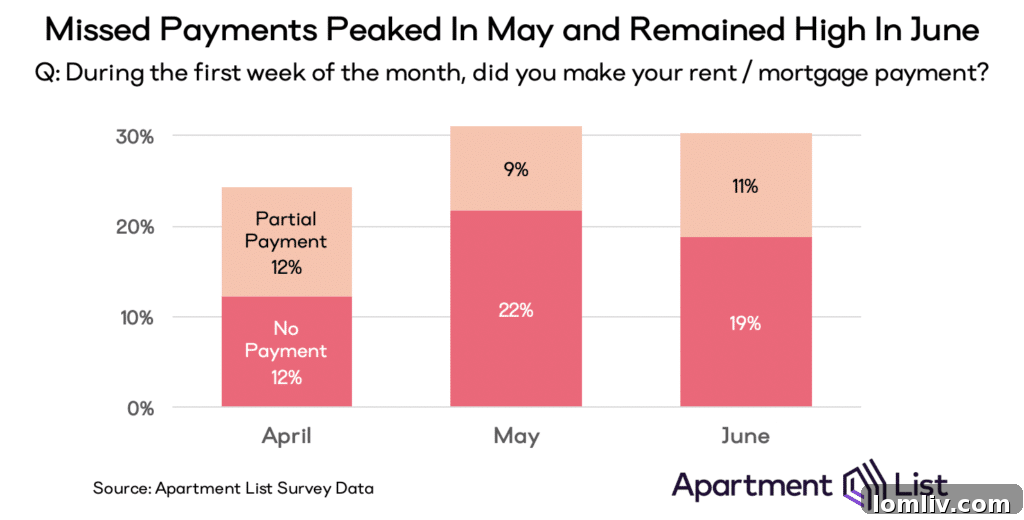
Comprehensive data collected during this time underscored the depth of the crisis. According to Apartment List’s latest report, which surveyed over 4,000 Americans, a staggering 30 percent of respondents failed to make their full housing payments on time in June. This figure represented only a marginal improvement from the 31 percent rate observed in May, indicating that the economic relief and reopening efforts had not yet translated into widespread financial stability for many households. The persistent high rate of missed payments signaled a continued state of severe financial distress for a significant portion of the population.
The prolonged inability to make housing payments fueled widespread anxiety among both renters and homeowners. The report revealed that 37 percent of renters expressed at least some concern about facing eviction in the subsequent six months. For homeowners, the threat of foreclosure loomed large, with 26 percent voicing similar worries. These statistics painted a stark picture of the housing market’s vulnerability, where millions faced the potential loss of their homes, highlighting the critical need for sustained economic support and housing stability measures.
A particularly vulnerable segment of the population during this period was service-sector workers. These individuals, employed in industries such as food service, arts, entertainment, recreation, and retail, bore the brunt of pandemic-induced shutdowns and operational reductions. Consequently, many found themselves reliant on unemployment benefits. Analysis from this period estimated that service-sector workers receiving unemployment benefits accumulated over $1.7 billion in rent and mortgage payments each month. This colossal sum represented a ticking time bomb, as the sustainability of these payments hinged precariously on the continuation of expanded local and federal unemployment assistance programs. If such aid were to fade or if workers remained without stable incomes longer than anticipated, these payments—and the housing stability of millions—were in serious jeopardy.
Further detailed by a new Zillow® analysis, the financial strain on service-sector workers was profound. These workers, who comprised a significant portion—more than a third—of those who lost their jobs due to the pandemic, faced immense pressure to cover their housing costs. The Zillow study corroborated the estimated $1.7 billion monthly deficit in rent and mortgage payments owed by these individuals, particularly those receiving unemployment benefits in April. The analysis highlighted that approximately 70 percent of this total, amounting to $1.2 billion, was attributable to renters. This disproportionate impact on the rental market underscored an unprecedented scale of risk, threatening widespread instability for a large segment of the housing population.
The gravity of the situation was articulated by Zillow Senior Principal Economist Skylar Olsen, who noted the critical role of government intervention. She observed, “As we’re watching resilient buyers return to the for-sale market and more renters able to pay on time in May than in April, it’s important to remember that much of the confidence that led to that improvement rests on massive government aid.” Olsen emphasized that the comprehensive aid packages, designed to support the millions of Americans who filed for unemployment benefits, were not merely easing immediate financial hardships but were also acting as a crucial safeguard for the entire housing market. Without this safety net, the country faced the potential for widespread evictions and foreclosures, which could have had devastating long-term economic and social consequences. The economist warned that if employment did not rebound as hoped during the summer months, the nascent housing recovery could be severely impeded, with renters, who lack the equity homeowners possess, being particularly vulnerable to these adverse economic shifts.