

The landscape of urban living is rapidly evolving, significantly impacted by the rise of short-term rentals (STRs). Across major cities like Plano, Dallas, and Arlington, these temporary lodging options, often facilitated by platforms such as Airbnb and Vrbo, have ignited a fervent debate. Balancing the economic benefits for property owners and the tourism sector against concerns from long-term residents regarding neighborhood character, safety, and regulatory compliance has become a critical challenge for municipal governments.
In Plano, this contentious issue recently led to a pivotal moment. The Plano City Council, during its recent session, opted to delay decisive action on new short-term rental regulations. However, the meeting served as a crucial forum for residents and city officials, including the Director of Neighborhood Services, to discuss potential regulatory frameworks. A significant part of this discussion focused on developing an ordinance modeled after the comprehensive approach successfully adopted by the City of Arlington, indicating a clear direction for Plano’s future policy.
The controversy surrounding short-term rentals is not unique to Plano. Throughout the summer months, the debate surrounding STRs garnered significant media attention in Dallas. While the intensity of the discussion briefly subsided as the city shifted its focus to the annual budget process, the underlying issues remained unresolved. The Dallas City Plan Commission reignited the discussion by revisiting the matter, culminating in the scheduling of a special day-long public hearing for December 8. This indicates the depth and complexity of finding an equitable solution that addresses the varied interests of all stakeholders.
Advocates for short-term rentals, often referred to as STR operators, assert that they conduct their businesses responsibly, offering well-maintained homes on platforms like Airbnb and Vrbo. They emphasize that these rentals provide a vital supplementary income source for homeowners, helping them manage property costs or achieve financial goals. Many responsible operators voluntarily implement their own rules, such as strict curfews and guest limits, to minimize disruption to neighbors. Furthermore, they highlight their commitment to compliance by registering their properties and paying applicable fees to the city, portraying themselves as contributors to the local economy rather than sources of conflict.
Conversely, opponents of STRs view these units as a persistent nuisance, fundamentally altering the residential fabric of neighborhoods. Their primary argument centers on the assertion that STRs function essentially as hotels, providing commercial lodging services. Consequently, they contend that these operations should be confined to areas explicitly zoned for commercial or hotel use, rather than permeating quiet, single-family residential zones. Concerns frequently raised include increased noise, parking congestion, safety issues due to transient populations, and a general erosion of community character. For these residents, the debate is less about economic opportunity and more about preserving the sanctity and intended purpose of residential areas.
Plano’s Deliberation: Charting a Course for Short-Term Rental Regulation
The Nov. 14 Plano City Council meeting provided a revealing glimpse into the city’s approach to the complex issue of short-term rentals. Commencing around the 1:20 mark of the meeting’s recording, elected officials announced their decision to table any immediate action on STR legislation. This postponement, based on legal counsel, highlighted the intricate legal considerations involved in crafting an effective and defensible ordinance. Despite tabling the item for action, the council proceeded with a robust public hearing, underscoring their commitment to gathering extensive community feedback.
The public hearing proved to be a powerful platform for resident voices. Thirteen speakers addressed the city council, and their collective message was clear and unanimous: they overwhelmingly supported zoning changes that would either stringently regulate or outright prohibit short-term rentals in residential areas. Many of these speakers also strongly advocated for the implementation of a third-party data collection service. This service, they argued, is crucial for the city to accurately identify the locations of all operating STRs, thereby enabling more effective enforcement of regulations and the systematic collection of appropriate fees. Without precise data, residents contended, any regulatory framework would be significantly hampered.

Residents presented compelling evidence of the scale of the issue, reporting that Plano currently hosts approximately 900 short-term rentals. A significant point of concern raised was that a portion of these STRs are allegedly engaged in activities that violate existing ordinances or contribute to public disturbances. This statistic alone underscores the urgent need for a robust and enforceable regulatory framework.
Lori Schwarz, Plano’s Director of Neighborhood Services, provided an update on the city staff’s progress. She confirmed that in October, staff received directives to develop an STR program closely mirroring the successful model implemented in Arlington. This directive encompasses several key components: establishing a comprehensive registration program for all STRs, and initiating a thorough zoning review to determine appropriate locations and restrictions for these properties within the city.
Under Plano’s proposed plan, all short-term rentals would face a mandatory registration requirement with the city, with implementation slated to begin in January. The application process for this registration is designed to be comprehensive, ensuring transparency and accountability. Key requirements would include providing local emergency contacts who can respond quickly to issues, submitting detailed floor plans indicating the location of safety equipment such as smoke detectors and fire extinguishers, proof of adequate insurance coverage, completion of a self-inspection checklist by the owner, and sworn statements from both the owners and operators affirming compliance with city regulations. These measures aim to enhance safety and mitigate potential neighborhood nuisances.
Beyond registration, the city intends to actively conduct inspections of registered properties to ensure ongoing compliance. In cases of non-compliance, the city would be authorized to file citations in Municipal Court, holding operators accountable. Director Schwarz strongly recommended that the city explore entering into a contract with a specialized STR monitoring service. Elaborating on this necessity, she stated, “We’ve done a lot of investigation about what’s possible with the government regulation of these types of housing. Most of them require some sort of monitoring contract.” This suggests that effective oversight of a large number of distributed STRs necessitates sophisticated technological solutions.
Mayor John Muns clarified that the council had received additional, pertinent information regarding STRs during an executive session, which ultimately contributed to the delay in council action. This new information requires careful consideration and integration into the proposed framework. As a result of this extended review, Director Schwarz indicated that a final recommendation for an implementation plan might be pushed back to spring 2023. This revised timeline suggests a more cautious and thorough approach, allowing for additional legal review, community engagement, and refinement of the proposed ordinance.
Arlington’s Blueprint: A Comprehensive Ordinance for Short-Term Rental Regulation
As Plano seeks an effective regulatory framework, the City of Arlington’s established ordinance stands as a significant point of reference and a blueprint for action. Plano resident Catherine Parker, a vocal advocate for responsible STR management, outlined four crucial tenets of the Arlington model, emphasizing their potential applicability and effectiveness for Plano:
- Third-Party Data Collection: Arlington’s success began with hiring a specialized third-party data collection firm. This crucial step allowed the city to accurately identify and track all short-term rentals operating within its municipal boundaries. This comprehensive data is indispensable for understanding the true scope of the STR landscape and for targeted enforcement.
- Community Engagement: A cornerstone of Arlington’s process involved conducting extensive town hall meetings. These forums provided invaluable opportunities to gather direct input from citizens, particularly those residing in single-family neighborhoods most affected by STRs. Such engagement ensures that the ordinance reflects community needs and concerns.
- Zoning Ordinance Updates: Arlington undertook a critical update to its City Zoning Ordinance. This update specifically clarified and demarcated where short-term rentals are explicitly permitted and where they are unequivocally prohibited. This legal clarity is vital for preventing ambiguity and ensuring consistent application of rules.
- Registration and Monitoring Program: Arlington established a robust registration program designed to monitor STRs in areas where they are permitted. Concurrently, the ordinance clearly prohibits STRs in districts where they are deemed incompatible, particularly within many single-family residential zones. This two-pronged approach allows for controlled operation in appropriate areas while protecting residential sanctity elsewhere.

Attorney David Schwarte of the TX Neighborhood Coalition provided a critical legal perspective on Plano’s initial proposal. He cautioned that the current wording of the Plano City Council’s plan, as it stands, could inadvertently be interpreted as implicitly authorizing short-term rentals within single-family residential neighborhoods. This interpretation, Schwarte argued, carries significant legal ramifications.
“If that was the intent or the effect of this proposal, then this is a proposed regulation that would amend de facto the zoning ordinance,” Schwarte explained. He underscored the severe implications of such an action: “Such an action, even though it’s not labeled as a zoning change, would violate the provisions of the Texas Local Government Code. I think an objective reading of your current code shows that single-family residential neighborhoods are not places where short-term rentals are allowed. Short-term rentals are currently forbidden in all residential districts in Plano.” This legal analysis highlights a crucial distinction: simply regulating STRs does not automatically grant them legality in zones where they are otherwise prohibited by existing zoning codes. Any effective regulation must first address the fundamental question of where STRs are permitted through proper zoning procedures.
Schwarte further emphasized that any substantive changes to the city’s zoning code, which would include the authorization of STRs in previously prohibited areas, must first undergo a review and recommendation process by the Planning and Zoning Commission. This step ensures proper legal procedure and public oversight. Drawing on his extensive experience, Schwarte concluded, “I was involved from start to finish in the Arlington ordinance. There’s a lot of work to be done if you really want to follow in our footsteps.” This statement serves as a clear warning to Plano that adopting a robust and legally sound STR ordinance is a complex and time-consuming undertaking, requiring meticulous attention to legal details and community input.
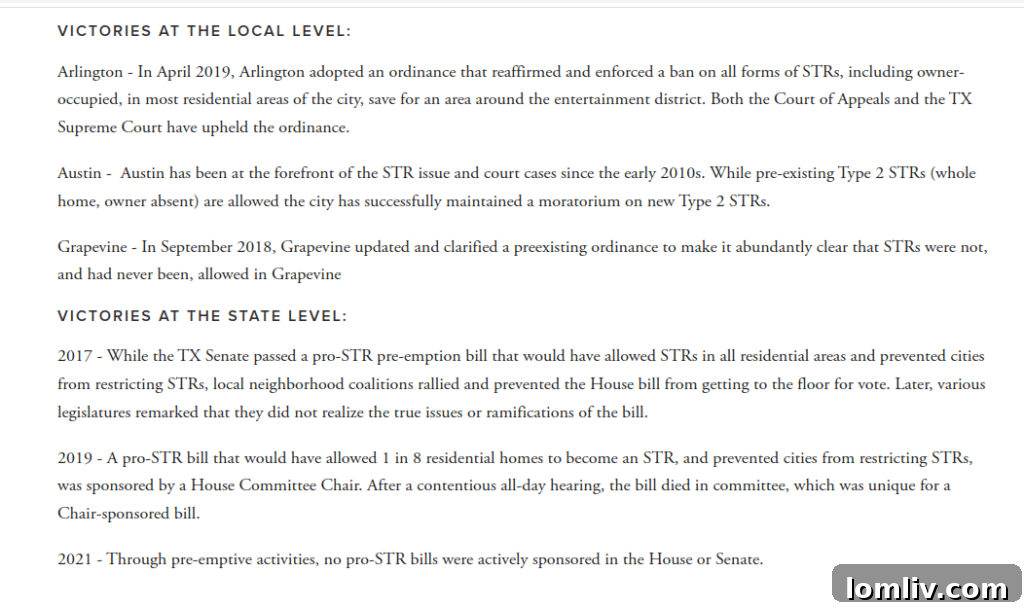
Resident Steven Kiriakos reiterated the community’s desire for collaborative action. He passionately encouraged the city council to prioritize gathering comprehensive neighbor feedback before making any final decisions regarding STR regulations. His plea resonated with many, underscoring the importance of community involvement in shaping policies that directly impact their living environments. “Please work with us, not against us,” Kiriakos urged, extending an olive branch for cooperation. “We would love to work with you outside this forum if possible. We would love to follow the Arlington model and expedite the zoning, which would be a great use of taxpayer dollars. Subscribing to the host compliance data collection would be great.” His comments highlight the community’s proactive stance and their willingness to contribute constructively to finding a solution, advocating for a path that is both fiscally responsible and community-centric.
The ongoing discussions in Plano, Dallas, and Arlington underscore a broader national reckoning with the short-term rental phenomenon. As cities grapple with how to integrate these popular services into existing urban landscapes, the focus remains on crafting regulations that are fair, enforceable, and ultimately serve the best interests of both residents and responsible property owners. The path forward for Plano, likely influenced by Arlington’s tested model and guided by community input and legal counsel, will be crucial in defining the future of its neighborhoods and housing market in the coming years.